Way back in the mists of time, 12-18 April to be exact, Kaggsy and Simon ran the 1936 Club. Although my reading has recovered somewhat, my blogging is still non-existent. So although I’d read two novels from the year, I failed miserably to write on them at all. This is my much belated attempt to recover lost ground…
I picked the two novels simply because they were the right year and in the TBR pile, but as it turned out they were thematically linked, both dealing with extramarital affairs. Spoiler alert: don’t do it kids, it causes misery. Yet although both novels show the pain caused by the affairs, they are not moralising or didactic. Rather, they are well-observed character studies of people looking for happiness in the wrong places.
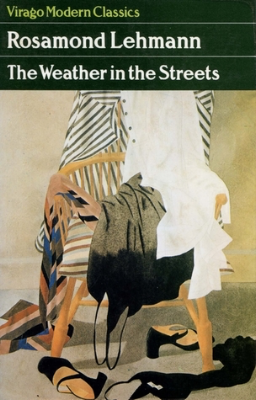
The Weather in the Streets is Rosamond Lehmann’s sequel to Invitation to the Waltz (1932), which in an entirely unhelpful way I hope to blog on in a few weeks. I read the novels in order, but you don’t need to have read the first to enjoy the second.
The Weather in the Streets continues the story of Olivia Curtis, now in her late twenties and divorced, living an impoverished bohemian existence with her cousin Etty in London. When her father is taken ill, she catches the train back to the family home and finds herself sitting opposite Rollo Spencer, who was kind to her at the titular dance in the first novel.
“He burst out laughing; and she was struck afresh by what she remembered about him years ago: the physical ease and richness flowing out through voice and gestures, a bountifulness of nature that drew one, irrespective of what he had to offer.”
I thought that was so clever, the capturing of a realisation of physical attraction alongside a foreshadowing of what will follow: “irrespective of what he had to offer”. What Rollo can offer is very little at all, given that he’s married and has entire life away from Olivia, separated by class and circumstance, that she can never be part of.
“She looked away. A bubble of tension seemed to develop and explode between them.”
This tension is acted on and the two begin to see each other. I was particularly struck by the passage describing Olivia’s feelings after they first sleep together. Throughout the novel Lehmann switches between first and third person and here we are entirely with Olivia:
‘Then it was afterwards. He said, whispering:
‘I’m your lover…’
I thought about it. I had a lover. But nothing seemed changed. It wasn’t disappointing exactly…The word is: unmomentous…Not wonderful – yet…I couldn’t quite look at him, but it was friendly and smiling. His cheek looked coarse-grained in the light of the lamp. I saw the hairs in his nostrils…I was afraid I’d been disappointing for him….Thinking: Aren’t I in love with him after all then? …We hadn’t said love once, either of us…Thinking: It’s happened too quickly, this’ll be the end…”
Depicting the ordinariness of it all is a brave move but I thought it was the strength of this novel. It’s not romantic, it’s not two people being swept away, it’s also not sordid or bitter. Its individuals who feel a connection trying to build happiness within their unsatisfactory lives, in a deeply misguided way.
The Weather in the Streets is also excellent in its depiction of the loneliness of an affair. The title is from a scene where Olivia is sat inside Rollo’s car, looking out from behind the window. This separation exists in all her relationships to an extent: she lives in a society where emotions occur out of sight and you certainly don’t impose your feelings on others by daring to discuss them or letting social mores slip for a minute. For example, when your husband might be dying:
“The lurking threats of change, of disaster, retreated before Mother’s impregnable normality. Rather pale, rather drawn and dark about the eyes, but neat, but fresh, erect, composed as ever, preoccupied with the supervision – in retrospect – of the arrival, checking up on detail with nearly all her customary minuteness and relish…Mother was being wonderful.”
The affair exacerbates the loneliness it is attempting to relieve. This is in especially sharp relief when Olivia has to experience an (illegal) abortion entirely on her own – finding the money, visiting the doctor, dealing with the aftermath.
Apparently some contemporary critics thought Rollo was a total bounder. I didn’t read it that way; I thought he was a weak man who has always done entirely what is expected of him and then wonders one day why on earth he isn’t happy. Rather than reflect on his life and try and work out who he is, he carries on doing entirely what would be expected by having an affair.
“He said more than once, ‘Darling, don’t care too much about me, will you?’
‘Don’t you want me to love you then?’ I said.
‘Yes, yes I do terribly. Only you mustn’t sort of think too much of me, will you? I’m not much good, and mind you remember it. Don’t expect a lot of me will you? I’ve never been any use to anyone…’”
It is desperately sad but Lehmann never suggests the story is a tragic one. People endure, but unfortunately so do their unmet needs for intimacy, acceptance and love.
“’Don’t be frightened.’ I did love him, then. It was what one had always longed for, never expected to have – someone appearing quietly at need, saying that – someone for oneself…”
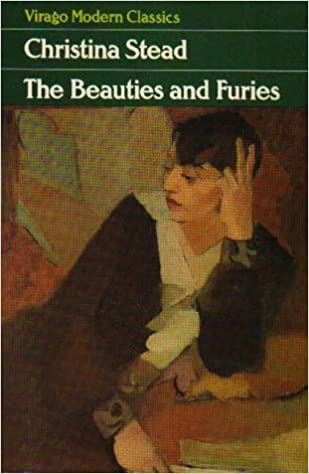
I had less tolerance for the protagonists of Christina Stead’s The Beauties and Furies. They were vacuous and self-obsessed and I was pleased to leave them behind. It was Stead’s excellent writing that both made them so believably unbearable and kept me going to the end of the novel.
The novel opens with Elvira Western on a train to Paris, having left her husband Paul for her young student lover Oliver (the lover’s names are similar and I did wonder if for two such vain people the attraction was how they saw themselves reflected in one another…)
She sits with a lace buyer called Marpurgo, little knowing that he will manipulate how her affair plays out. He will exploit the very obvious faultlines in the relationship, but it never feels like much of a loss, as from the start Stead casts an ironic eye over the romance:
“ ‘You won’t have any more trouble – in your life! Think of that: here’s someone who loves you dearer than all the world. Put your head on my shoulder…’
It gave her a crick in the neck.”
Oliver sees himself as a Marxist intellectual, although nothing he does really demonstrates either of these aspirations. Elvira’s indolence is repeatedly emphasised and she cannot join Oliver in his pursuit of ideas if she is not warm, rested and fed, such as when he takes her to see Faust:
“she had not liked it although they had a box to themselves, because she was hungry.”
Neither seem particularly invested in the affair, more the idea of the affair. Oliver sleeps with lace-maker Coromandel and actress Blanche, both a contrast to Elvira as they display a degree of self-determinism, not that he’s interested. Elvira meanwhile, seems to just potter about. It’s mentioned that she gave up a promising education, but she seems disinclined to do anything, as Elvira’s husband observes:
“he works in the archives and reads her the political news, and she does nothing at all. She sits in cafes.”
When Elvira becomes pregnant, they both know they are not able to care for a baby, but they also vacillate between keeping it or taking the same decision as Olivia in The Weather in the Streets:
“This second marriage would be even worse than the first, because she had to cope with a brilliant young man’s impatience and disappointment. She said to herself babyishly:
‘I want a baby and a comfortable home: I don’t want to be part of the intelligentsia.’”
Meanwhile Oliver ponders:
“I am sending my seed from generation unto generation, a man full of humility.”
Spare me.
In many ways The Beauties and Furies is a novel of ideas. The sitting around in cafes arguing about politics, psychology and society gives plenty of scope for Stead to explore issues through her characters and it really captures some of the early twentieth century concerns.
“ ‘The real thought of the middle-class woman,’ complained Elvira, ‘is the problem of economic freedom and sexual freedom: they can’t be attained at the same time. We are not free. The slave of the kitchen and bedroom.’”
What stops it being overly weighty is the high degree of scepticism shown towards Elvira and Oliver, and ultimately I read The Beauties and Furies as a satire on bohemian pretentiousness and self-delusion. I’m not sure that’s correct but certainly Stead turns a sharp eye on conceit and hubris. She can be absolutely scathing towards her characters, such as this instance of Elvira becoming distressed:
“her prolific ego, masked in pathos, had them in its tendrils.”
Ouch! Although I couldn’t love The Beauties and Furies I still found much to enjoy. The incisive, well-observed writing did whet my appetite for more Stead – I have Cotter’s England in the TBR and I’m hoping for slightly less intellectual exposition and a bit more character-driven story.
Next I’m hoping to take part in Ali’s Daphne du Maurier reading week, which is running 10-16 May. Will I manage a post for it before the end of July? Watch this space… 😀
To end, I adore Greta Garbo, which is why I picked a quote from Camille to head the post, and why I’ll end the same way:
 madame bibi lophile recommends