As I mentioned in my last post, I’m disappointed not to be doing my novella a day in May project this year, but for my sanity something had to give! Simon is undertaking a book a day for the month which I’m sure will give me many ideas for next year 😊
I still plan to focus on novellas this month though, and last year when I read Small Things Like These by Claire Keegan, a few people mentioned that I read needed to read Foster. How right they were, it’s an extraordinary novella.
Apparently it started life as a New Yorker short story (it has two copyright dates) and although I haven’t read that version, as a novella I would say it is completely realised in just 88 pages.
A young girl is taken to the west of Ireland to live with the Kinsellas, her aunt and uncle, as her mother is heavily pregnant and struggling with the number of children she has to care for. Her father gambles away the family heifer and there isn’t enough food to go round, or time for adequate physical or emotional care.
At the place where she is to spend the summer, chores are achieved daily on the farm and within the home. There is enough food and enough care.
“Her hands are like my mother’s hands but there is something else in them too, something I had never felt before and have no name for. I feel at such a loss for words but this is a new place, and new words are needed.”
Although the time is never specified, it seems to be around the 1970s/early 1980s as there is a discussion of hunger strikers. The narrator is nameless and we’re not sure of her age, but I would say somewhere around nine to eleven years old.
“I am in a spot where I can neither be what I always am nor turn into what I could be.”
Keegan trusts the reader not to need everything spelled out. We get a sense of the wider family dynamics and the feelings of various family members without them being explicitly stated. The slowly building bonds of trust and affection between the young narrator and the Kinsellas are so delicately evoked and tenderly realised.
A stunning scene sees the narrator and Mr Kinsella walking along the beach. When they turn around to walk back, he can only see her footprints
“’You must have carried me there.’
[..]
We stand then, to pause and look back out at the water.
‘See, there’s three lights now where there was only two before.’
I look out across the sea. There, the two lights are blinking as before, but with another, steady light, shining in between.
‘Can you see it?’ he says.
‘I can,’ I say. ‘It’s there.’
And that is when he puts his arms around me and gathers me into them as though I were his own.”
There is also the gradual understanding by the narrator that a life is possible, and exists, beyond that which she has always known.
“But this is a different type of house. Here there is room, and time to think. There may even be money to spare.”
Throughout, there is an awareness that this is a temporary time, with a defined end date. The situation cannot endure and the narrator and the Kinsellas will have to part.
Foster is a stunning novella. A deeply moving and perfectly crafted gem, complete in itself, down to the final devastating line.
I’ve not seen the film adaptation of Foster, but it looks faithful, and beautifully shot:
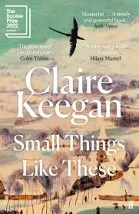
Small Things Like These – Claire Keegan (2021) 110 pages
Claire Keegan’s short story collection Antarctica was the only work of hers I had read, but I remembered being really impressed by it. When Small Things Like These got so much love in blogosphere I knew I needed to pick her up again. Thankfully the planets aligned and I found a copy of it in a charity shop the very month I was focussing on novellas 😊
Bill Furlong is a coal merchant who lives a quiet life with his wife and young daughters in a 1980s Irish town. However, there is something in his past that means Bill has a sense of being an outsider. Perhaps it is this that means his compassion for people who are finding life harder and are homeless or struggling to make ends meet, or may be self-medicating with alcohol, is in contrast to those around him.
“Some nights, Furlong lay there with Eileen going over small things like these. Other times, after a day of heavy lifting or being delayed by a puncture and getting soaked out on the road, he’d come home and eat his fill and fall into bed early, then wake in the night sensing Eileen, heavy in sleep, at his side – and there he’d lie with his mind going round in circles, agitating, before finally he’d have to go down and put the kettle on, for tea.”
There is a Magdalene laundry in the town, and events conspire so that Bill becomes aware of the horrors that are taking place, sanctioned by state and church. His wife voices the general attitude when she says:
“‘If you want to get on in life, there’s things you have to ignore, so you can keep on.’”
However for Bill it is not so easy. The revelation comes at a time when he is questioning the purpose of his life, the daily toils and the wider meaning. So it is understandable that he is the one to break out from the conspiracy of wilful ignorance and silence that allows the abuse to continue.
“What would life be like, he wondered, if they were given time to think and reflect over things? Might their lives be different or much the same – or would they just lose the run of themselves?”
There is no way that the physical and psychological torture of the laundries can be captured in a 110 page novella, if ever, although there a couple of very distressing scenes. But I don’t think this is Keegan’s point. Instead she uses our pre-existing knowledge of the laundries to focus on putting us in the position of an ordinary person at that time. She demonstrates why he might take action, and what he could lose by doing so. The ambiguous ending, not without hope but not suggesting that Bill will avoid devastation, doesn’t allow for easy resolution.
Keegan is asking the reader to consider: what would you do? How much will you stand for, and how much are you prepared to lose? Knowing that throughout history atrocities have taken place while societies looked away, it is a powerful and enduring challenge.
“It would be the easiest thing in the world to lose everything, Furlong knew.”
Happy New Year! My 2018 is rubbish so far but I’m hopeful of improvement – I’ve caught the horrible virus everyone is down with at the moment. According to fellow sufferer Rev. Richard Coles on twitter, it’s God’s way of telling you to watch a boxset. My virus-addled brain can’t focus on the plot of a single episode of something at the moment, never mind a whole boxset (so this post may be even less coherent than usual). I’m fed up and bored and so I thought I’d look at people pushing themselves to physical extremes when I can’t even get off my sofa at the moment without a 5-point plan. It will also be another stop on my Around the World in 80 Books Reading challenge, hosted by Hard Book Habit. Off to Antarctica!
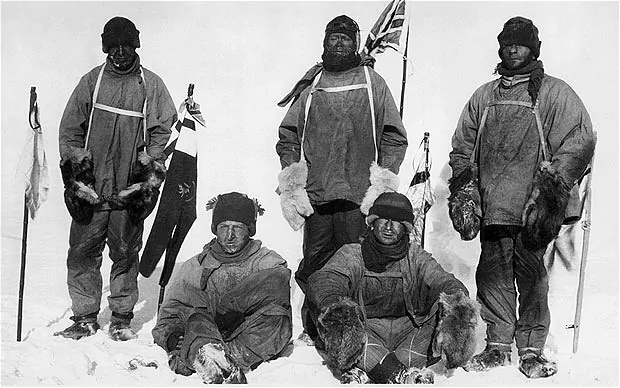
Firstly, The Birthday Boys by Beryl Bainbridge (1991) which tells the story of Scott’s disastrous attempt to reach the South Pole. Five sections are narrated by different members of the party with Scott in the middle. It’s an effective approach, building a picture of the different personalities involved and the disintegration of their hopes.
Petty Officer Evans begins the tale, full of military loyalty to their leader.
“Being down a crevasse together is no excuse for stepping out of line. All I know is I’d die with the man, and for him, God help me, if the necessity arose.”
However, through Dr Wilson, Bainbridge articulates the changes taking place in society at the time of the expedition, just into the second decade of the twentieth century.
“All the things we were taught to believe in, love of country, of Empire, of devotion to duty, are being held up to ridicule. The validity of the class system, the motives of respectable, educated men are now as much under scrutiny of the magnifying glass as the parasites feeding off the Scottish grouse.”
The men are clinging onto ideas in the face of unstoppable forces, both societally at home, and environmentally in the Antarctic. They are doomed to failure.
Scott takes up the middle portion of the book and Bainbridge brilliantly captures all his contradictions. He is arrogant yet doubtful, single-minded yet insightful.
“justifying my actions would have been simply no good for morale. Like it or not, and God knows, half the time I don’t, someone has to take the decisions – along with the consequences.”
His motivations are mixed. He claims it as a scientific expedition for Empire, yet is furious when he is beaten to the Pole.
“I came to sanity under Bill’s tuition. He wisely said I must continue as if nothing happened, as if Amundsen didn’t exist. It was unthinkable that our scientific projects should be sacrificed in a vulgar scramble to reach the Pole.”
Yet Bainbridge never allows us to despise his hubris. To do so would mean we lose our empathy with the men who he led to their deaths, and the novel would lose its enormous emotional power. As Lieutenant Bowers observes:
“I think I know what ails the Owner. He’s absolutely sound as regards what’s right, but he lacks conviction. He simply isn’t stupid enough to be convinced his is the only way. In the circumstances, it’s a dangerous trait.”
That’s not say that by the time we get to sceptical, reticent Oates, I wasn’t pleased to hear someone expressing their anger and frustration at their leader.
“I’ve never known such a man for making mistakes and shifting the blame onto others.”
However, as the nearness of death, their body parts rotting, the tedium of days desperately clinging to life in an inhospitable landscape starts to send them all insane with desperation, even Oates admits:
“Truth to tell, I think he was the only one among us capable of making any decisions.”
Bainbridge is a wonderful writer and even though we know what happened, she still manages to create tension and drama from the men’s horrific situation. She is also able to capture the landscape as beautifully and evocatively as she does the men’s psychology.
“Those who envisage this place as nothing more than a godforsaken plateau of ice and snow are mistaken. For one there are outcrops of jet-black rock about which the wind blows so fiercely the snow can never settle; and for another, the ice, being subject to reflections of sun and sea, is never purely white but tinged with rose and cobalt-blue and every shade of violet, the whole set against skies, days or night, that run through all the colours of the spectrum.”
The Birthday Boys is a short novel (181 pages) but none the less for it. It is Bainbridge at the height of her powers and as such, it is immense.
Secondly, a quick foray into Antarctica by Claire Keegan (1999) because I’ve got quite carried away with Beryl. This is Keegan’s first collection of short stories and it’s remarkably assured with a strong narrative voice. I actually found the titular story the weakest, but I suspect maybe it’s dated a wee bit. My favourite stories in the collection were those set in rural Ireland. The Ginger Rogers Sermon was devastating. The narrator is a young girl on the cusp of adulthood, living on her parents farm in a place where there’s not much to do.
“Don’t ask me why we called him Slapper Jim. My mother stamped his image in my head, and I was at an age when pictures of a man precede the man himself. The posters verify: Thin Lizzie with a V of chest exposed, Pat Spillane’s legs racing across my bedroom wall…I was the girl with the sweet tooth and a taste for men.”
The taste for men is problematic when you have feelings and knowledge, but not a great deal of understanding. Adulthood is approaching rapidly but childhood also lingers:
“Now that I am thirteen I am sectioned off from men. It happens in school too, in gym class. I play basketball and jump over hurdles and come back all red-faced and sweaty and talk non-stop in class. Nobody sits beside me because I smell like an afterbirth. I wear the pads and Lily of the Valley and go dancing down the pub. Slapper Jim is always there with the bantam. I waltz around in the cigarette smoke with old men my father knows.”
This is the tone of The Ginger Rogers Sermon exactly: matter-of-fact, unsentimental, funny and sad. A tragedy occurs, arising from disturbing circumstances, yet the ending contains some hope. As in many of Keegan’s stories, things are unresolved and the story is stronger for it.
Keegan has spent time in the States and some of her stories are set there. The final one, Passport Soup, is one of these, a sad tale of the parents of a missing child. Keegan is brilliant at capturing deep feeling without melodrama, in beautiful but sparse prose:
“Frank Corso has lost his appetite. He pushes his plate aside and gets up and puts the milk carton with his daughter’s photograph back in the refrigerator and goes to bed. The sheets are cold. He hears a wedge of snow fall from the eaves of the roof onto the drift beneath the window. Snow falling, compounding cold. Daylight bleaches the walls before he finally sleeps.”
This is a powerful collection of stories, and if you’re not keen on short stories but want to give them a go, it’s a good place to start. Keegan absolutely understands the form, she doesn’t waste a word. Unfortunately, she seems to publish rarely: her second collection came 8 years later, followed after another 3 years by a stand-alone ‘long short story’. That’s not a criticism though – quality like this is worth waiting for.
To end, a tasteful video for once (clearly I really am ill), narrated by the unsurpassable Sir David & full of arresting images (normal cheesy service will resume next week):




 madame bibi lophile recommends