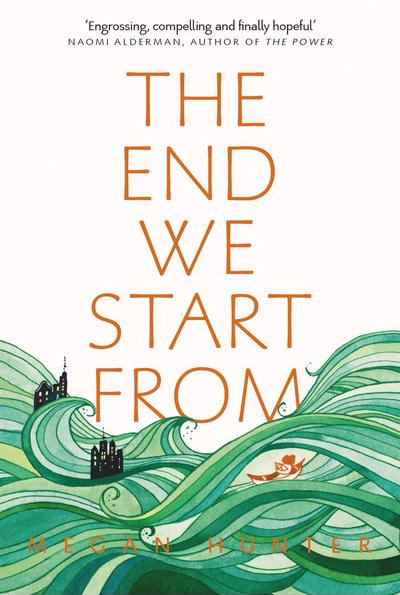
The End We Start From – Megan Hunter (2017) 127 pages
The End We Start From is poet Megan Hunter’s first novel, and she brings a poet’s precision to her longer-form writing. The words on the page are sparse and she knows how to use them to convey maximum meaning and build atmosphere.
The narrator is a young woman who has just given birth. The day her son arrives in the world is the day London disappears in floods, and so the newly-expanded family head north to her in-laws.
“R’s father N will not turn the television off. I stay in the kitchen, the only screenless room, with my smarting pulp on a cushion and the baby mushed against my breast.
R’s mother G will not stop talking. This not-stopping seems to be the first side-effect.
Everything has been unstopped, is rising to the surface.”
Referring to characters just by their initials adds to the general sense of disorientation as the woman adapts to her wholly new life. She views the horrors of what is happening to society at a step removed, aware but also wrapped up in her new baby. This means that while the novella is dystopian, it doesn’t have the relentless quality of some dystopian fiction. Instead it feels quietly unsettling and unnerving.
“It is bad, the news. Bad news as it always was, forever, but worse. More relevant. This is what you don’t want, we realise. What no-one ever wanted: for the news to be relevant.”
There is also a dark humour at moments, in the contrast between their old and new lives.
“He has not researched the best camp. He has not spent hours poring over comparative reviews of refugee camps. He wants none of them.”
The stark style of Hunter’s writing captures the fractured experience in the aftermath of a natural disaster. The reading experience is a series of startling images and arrested sentences that build to effective portrayal of new motherhood in extreme circumstances.
“Whatever I imagine, it is something else.
Where I expect desolation there is the atmosphere of a jumble sale.
Where I envisage welcomes and tea, smiles and Blitz spirit, there is grey concrete, wailing people dragging themselves across the road, photo-boards of the missing.
Our city is here, somewhere, but we are not.
We are all untied, is the thing.
Untethered, floating, drifting, all these things.
And the end. The tether, the re-leash, is not in sight.”
 madame bibi lophile recommends