“I have a great deal of difficulty in beginning to write my portion of these pages, for I know I am not clever.” (Esther Summerson in Bleak House)

I’m not a fan of Dickens. I don’t like his caricatured villains, I don’t like his insipid virgin heroines, I don’t like his sentimentality. This may explain why it’s taken me thirty years to open the copy of Bleak House given to me as a teenager by my mother, as it’s one of her favourite novels. It begins:

“London. Michaelmas term lately over, and the Lord Chancellor sitting in Lincoln’s Inn Hall. Implacable November weather. As much mud in the streets as if the waters had but newly retired from the face of the earth, and it would not be wonderful to meet a Megalosaurus, forty feet long or so, waddling like an elephantine lizard up Holborn Hill. Smoke lowering down from chimney-pots, making a soft black drizzle, with flakes of soot in it as big as full-grown snowflakes—gone into mourning, one might imagine, for the death of the sun. Dogs, undistinguishable in mire. Horses, scarcely better; splashed to their very blinkers. Foot passengers, jostling one another’s umbrellas in a general infection of ill temper, and losing their foot-hold at street-corners, where tens of thousands of other foot passengers have been slipping and sliding since the day broke (if this day ever broke), adding new deposits to the crust upon crust of mud, sticking at those points tenaciously to the pavement, and accumulating at compound interest.”

And that’s how long it took me to absolutely love Bleak House. Which just goes to show that as always, my mother knows best 😀 (as do the bloggers who recommended I choose this as my tome reading after a month of novellas – many thanks!)
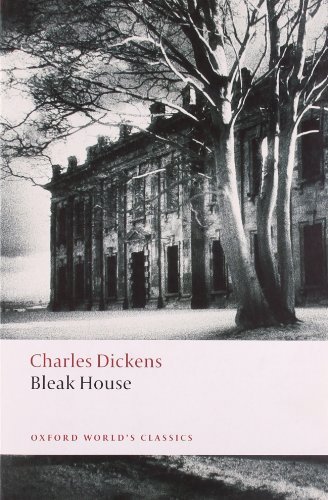
Bleak House follows the fortunes of three young people caught up in a long-running legal wrangle:

“Jarndyce and Jarndyce drones on. This scarecrow of a suit has, in course of time, become so complicated that no man alive knows what it means. The parties to it understand it least, but it has been observed that no two Chancery lawyers can talk about it for five minutes without coming to a total disagreement as to all the premises. Innumerable children have been born into the cause; innumerable young people have married into it; innumerable old people have died out of it.”

Esther Summerson, Ada Clare and Richard Carstone find themselves under the guardianship of John Jarndyce, a benevolent older distant relation of the latter two. Ada and Richard fall in love, but it is Esther rather than the young lovers who is the focus, her first-person narration alternating with that of an omniscient narrator.

She is from a mysterious background, not knowing who her parents are and raised by an abusive godmother. “Your mother, Esther, is your disgrace, and you were hers”. Esther is a Victorian heroine though, so rather than becoming defensive or angry, she decides she will:

“strive as I grew up to be industrious, contented, and kind-hearted and to do some good to some one, and win some love to myself if I could. I hope it is not self-indulgent to shed these tears as I think of it. I am very thankful, I am very cheerful, but I cannot quite help their coming to my eyes.”

Although tediously self-deprecating at times, generally I found Esther really likable. Her narrative is can be witty and some of her portraits of others almost sharp, so I did wonder if the reader wasn’t supposed to take her modest protestations entirely at face value, at least not consistently.

The omniscient narrator widens the tale to explain the various legal dealings of Chancery Lane and all its hangers-on, alongside the situation of the Dedlock family:

“there is no end to the Dedlocks, whose family greatness seems to consist in their never having done anything to distinguish themselves for seven hundred years.”

The current incumbent Sir Leicester Dedlock does little to change this history of his family as he “is generally in a complacent state, and rarely bored. When he has nothing else to do, he can always contemplate his own greatness. It is a considerable advantage to a man to have so inexhaustible a subject. After reading his letters, he leans back in his corner of the carriage and generally reviews his importance to society.”

He is devoted to his beautiful, fashionable, remote wife Honoria, who the reader quickly realises has A Big Secret in Her Past. Hmm, based on what we know of the other characters so far, what on earth could it be…?  

It’s not hard to guess what it is as the clues are laid on pretty thickly, and I thought the imagery when Esther first sees Lady Dedlock was so striking:

“It was easy to know that the ceremonious, gouty, grey-haired gentleman, the only other occupant of the great pew, was Sir Leicester Dedlock, and that the lady was Lady Dedlock. But why her face should be, in a confused way, like a broken glass to me, in which I saw scraps of old remembrances, and why I should be so fluttered and troubled (for I was still) by having casually met her eyes, I could not think.”

Dickens weaves together the various strands of the story, the main plots and all the subplots with brilliant dexterity. Sometimes with these big Victorian baggy monsters (to steal a phrase from Henry James) the stories can flag a bit, as the authors are trying to keep them going for a number of episodes in the serial. I really didn’t feel this with Bleak House. The story kept driving forward and all the various plots came together so cleverly, contriving to make a well-paced page-turner.

What really struck me about Bleak House though, is that it is a story of great compassion. Of course I knew Dickens had a strong social conscience and his work has a social message to it. But Bleak House demonstrated a degree of understanding and sympathy that I wasn’t expecting. Unmarried mothers, those struggling with addictions, human weakness and vulnerability – none are judged. Those who are judged are the ones who seek to profit from such.

Which brings me on to Mr Tulkinghorn… I said at the beginning I’m not usually keen on Dickens’ villains, finding them too caricatured. The lawyer Tulkinghorn was medacious, conniving, cold as ice, completely believable and completely terrifying. Truly villainous.

Although there are romantic elements to Bleak House, it is not an overly romantic tale. It is a novel much more concerned with the fall-out on the vulnerable members of society from immovable and self-serving institutions. Perhaps the main way in which the novel has dated is an engagement that seemed highly questionable to me, but as it remains chaste and ultimately everyone comes to their senses, it didn’t overly offend my modern sensibilities 😀

If I’ve made Bleak House sound a heavy read though, I’ve done it a disservice. I found it very often funny, whether satirically critiquing the legal system or broader nonsense like Mrs Guppy trying to throw John Jarndyce out of his own home and resisting all attempts to explain the illogicality of such a move. It has its sad moments too, and is genuinely moving in places.

And just in case a Victorian novel may seem to have no relevance to our modern world, I leave you with this exchange between Esther and Miss Flite:

“I said it was not the custom in England to confer titles on men distinguished by peaceful services, however good and great, unless occasionally when they consisted of the accumulation of some very large amount of money.

“Why, good gracious,” said Miss Flite, “how can you say that? Surely you know, my dear, that all the greatest ornaments of England in knowledge, imagination, active humanity, and improvement of every sort are added to its nobility! Look round you, my dear, and consider. YOU must be rambling a little now, I think, if you don’t know that this is the great reason why titles will always last in the land!”

I am afraid she believed what she said, for there were moments when she was very mad indeed.”

This is an excessively long post and I’ve barely scratched the surface of Bleak House. But in summary: funny, sad, socially engaged, well-paced, emotionally affecting, entertaining, original. An absolute masterpiece.

To end, I remember watching the BBC adaptation of Bleak House when it came out and thinking it very well done. Now I’ve read the book I might go for a rewatch, as I don’t remember it that well and it does look entertaining (especially Charles Dance as Tulkinghorn):

“I wanna be anarchy” (The Sex Pistols)

Do you ever get the feeling you want to kick over the traces and run away?  I’m really fed up with my job and while I daydream about jacking it all in through some dramatic gesture before setting off to backpack round the Greek islands, it’s not going to happen. Not if I want a home to return to – the pesky mortgage will insist on being paid.

7f5d661625t-work.gif

Fundamentally I’m not an anarchist, however much I might like to think I’m a free-wheeling, free-thinking rebel.

tumblr_n3gpy7nhan1rvzbdgo1_500

So I’ll just have to compensate by watching Marlon Brando films (any excuse) and reading about anarchy.  The novel and play I’ve chosen suggest anarchy may not be the best way to go anyway.

Firstly, The Secret Agent by Joseph Conrad (1907). I studied this for ‘A’ level and it’s no exaggeration to say it was the bane of my life.  I hated it.  I found it so unbearable I never actually finished reading it and wrote my exam essay based on the chapter summary at the back of the edition we used (not an exam technique I recommend, kids).  Events conspired against me and about ten years later I had to read it again for a course I was doing.  Much to my surprise, I didn’t mind it so much this time and found it quite readable.  A lesson there that I should return things I’ve previously written off – at the very least I can confirm my prejudices, which is always fun.

The Secret Agent was inspired by an actual event in 1894, where a French anarchist, Martial Bourdin, accidently blew himself up in Greenwich Park.  Conrad sets his story two years later, and the opening of the novels sets everything up expertly:

Mr Verloc, going out in the morning, left his shop nominally in charge of his brother-in-law.  It could be done, because there was very little business at any time, and practically none at all before the evening.  Mr Verloc cared but little about his ostensible business.  And, moreover, his wife was in charge of his brother-in-law.

The shop was small, and so was the house.  It was one of those grimy brick houses which existed in large quantities before the era of reconstruction dawned upon London.  The shop was a square box of a place, with the front glazed in small panes.  In the daytime the door remained closed; in the evening it stood discreetly but suspiciously ajar.

The window contained photographs of more or less undressed dancing girls; nondescript packages in wrappers like patent medicines; closed yellow paper envelopes, very flimsy, and marked two-and-six in heavy black figures; a few numbers of ancient French comic publications hung across a string as if to dry; a dingy blue china bowl, a casket of black wood, bottles of marking ink, and rubber stamps; a few books, with titles hinting at impropriety; a few apparently old copies of obscure newspapers, badly printed, with titles like The TorchThe Gong—rousing titles.  And the two gas jets inside the panes were always turned low, either for economy’s sake or for the sake of the customers.

This basically tells you all you need to know: the grimy sordidness of Verloc’s existence, the fact that he is involved in some sort of subterfuge, and the involvement of his family at the edges, with his wife, Winnie, devoted to her brother Stevie.

Verloc is utterly unlikeable – lazy and self-serving, he is not an anarchist dedicated to a higher cause.  His ‘comrades’ are equally despicable and pathetic, except for The Professor, who is altogether more sinister:

The Professor’s indignation found in itself a final cause that absolved him from the sin of turning to destruction as the agent of his ambition.  To destroy public faith in legality was the imperfect formula of his pedantic fanaticism; but the subconscious conviction that the framework of an established social order cannot be effectually shattered except by some form of collective or individual violence was precise and correct.  He was a moral agent—that was settled in his mind.  By exercising his agency with ruthless defiance he procured for himself the appearances of power and personal prestige.  That was undeniable to his vengeful bitterness.”

Conrad is highly sceptical of the motivation of those proclaiming themselves agents of societal change.  The group of would-be anarchists plot a violent act, and unfortunately, skirting around them is Verloc’s brother-in-law:

“There was no young man of his age in London more willing and docile than Stephen, she affirmed; none more affectionate and ready to please, and even useful, as long as people did not upset his poor head.”

Stevie is an obvious choice, for those who would not want to risk their own lives in carrying out terrorist acts, to manipulate and control.  The Secret Agent is fairly predictable, but the flash-forward/flash-back structure works well at sustaining plot tension, and its utter bleakness, while unrelenting, is effectively ironic in evoking politics where the principle is self-preservation above all else.

The Secret Agent was made into a film in 1996 starring Bob Hoskins as Verloc ,Patricia Arquette as Winnie, and Batman Christian Bale as Stevie:

Secondly, Accidental Death of an Anarchist by Italian theatre legend Dario Fo (1970), which you can read here. Like The Secret Agent,  it is based on actual events. Giuseppe Pinelli was an anarchist accused of bombing a bank who fell (?) to his death from a police station window in Milan in 1969. In Fo’s play version, events become farcical, beginning with the Maniac being interrogated at the police station by Inspector Bertozzo. The Maniac denies being a con artist and impersonator, insisting he is mentally ill:

“I have a thing about dreaming up characters and then acting them out. It’s called ‘histrionomania’ – comes from the Latin histriones, meaning ‘actor’. I’m a sort of amateur performance artist. With the difference that I go for ‘Théatre Verité’ – my fellow performers need to be real people, but people who don’t realise that they’re in my plays. Which is just as well, ‘cos I’ve got no money and couldn’t pay them anyway…”

 This metatheatrical theme runs throughout the play, with Fo using the dramatic form to demonstrate how public life can often involve playing a role.  The Maniac poses as a judge to interrogate the officials on the fourth floor and explore the events that led to the fall of the anarchist:

“MANIAC: We’ll stick with the ‘right at the start’ for the moment… One step at a time. So, at about midnight, the anarchist was ‘seized by a raptus’ – these are still your words – he was seized by a ‘raptus’ and went and threw himself to his death from the window. Now, what is a ‘raptus’? Bandieu says that a ‘raptus’ is a heightened form of suicidal anxiety which can seize even people who are psychologically perfectly normal, if something provokes them to extremes of angst, in other words, to utter desperation. Correct?

 SUPERINTENDENT AND SPORTS JACKET: Correct.

 MANIAC: So we need to find out who or what it was provoked this anxiety, this desperation. I suspect that the best way would be if we do a reconstruction. Superintendent, the stage is yours.

 SUPERINTENDENT: Me?

 MANIAC: Yes, go ahead: would you mind re-enacting your famous entrance?

 SUPERINTENDENT: I’m sorry, what famous…?

 MANIAC: The one that brought about the ‘raptus’.

 SUPERINTENDENT: Your honour, there must be a misunderstanding here. It wasn’t me who did the entrance, it was one of my officers…”

 As the role playing intensifies, so does the satire:

MANIAC: It’s true, I’m afraid: your careers are in tatters! Blame it on politics, friends! At the start you served a useful function: something had to be done to stop all the strikes… So they decided to start a witch-hunt against the Left. But now things have gone a bit too far… People have got very upset about the death of our defenestrated anarchist… they want someone’s head on the block, and the government’s going to give them – yours!

 […]

  SUPERINTENDENT: Your Honour, you’re going to have to advise us. What do we do now?

 MANIAC: How should I know?

 SPORTS JACKET: Yes – what would you advise?

 MANIAC: If I were in your shoes…

 SUPERINTENDENT: Yes?

 MANIAC: I’d throw myself out of the window!

In the second act a journalist turns up, the physical comedy intensifies and it all degenerates into total…well, you know.  Accidental Death of an Anarchist is very silly, but don’t let that fool you. The satire is sharp and the theatricality informed and accomplished. It’s a play with plenty to say and it does it with great energy and verve.

There’s really only one way to finish this post:

Feminist Sundays: Beatrice in Much Ado About Nothing

Feminist Sundays is a meme created by Elena over at Books and Reviews. Here’s what she says about it: “Feminist Sundays is a weekly meme created at Books and Reviews. The aim is simply to have a place and a time to talk about feminism and women’s issues. This is a place of tolerance, creativity, discussion, criticism and praise. Remember to keep in mind that everyone is entitled to their own opinion, although healthy discussion is encouraged.” Do head over to Books and Reviews to read the excellent posts for this meme so far.

So, this isn’t my usual sort of post, with a theme and two book choices.  Instead, as part of Feminist Sundays I was thinking about any times that a feminist discussion has come up around something I’m reading.  And I remembered a tutor of mine saying that she thought she’d been such a doormat in her first marriage because she’d unconsciously integrated the misogynistic attitudes towards women from her specialism, Renaissance literature (inappropriate disclosure to her students about her personal life was another speciality of hers).

Now, I love Early Modern literature, but I’m not going to try and claim that sixteenth-century England was a progressive, proto-feminist society.  However, at the same time I think my tutor was talking nonsense.  When we look back at Early Modern texts, there are strong females for us to identify with, and I’m going to take a look at one of my favourites, the brilliant Beatrice in Much Ado About Nothing by William Shakespeare. Here’s Emma Thompson in the role:

Beatrice

Image from: (http://www.monologuedb.com/comedic-female-monologues/much-ado-about-nothing-beatrice/)

This is one of Shakespeare’s most popular plays; the city I live in (London) has seen 3 productions I can think of in recent years (one at the Globe in 2011, the other with Catherine Tate and David Tennant at Wyndams the same year, one this year with Vanessa Redgrave and James Earl Jones at the Old Vic); Joss Whedon also released a film version earlier this year.  I think this is a good indication that Beatrice is a character who still has something relevant to say to us.

For those of you who don’t know the story: a group of soldiers arrive in Messina.  One of the officers, Benedick, has some romantic history with Beatrice (niece of Messina’s governor), and they spend a lot of their time bickering and proclaiming they’re not interested in each other at all – lies, all lies.  Their friends conspire against them, convincing each of the other one’s feelings.  Meanwhile one of the younger soldiers, Claudio, wants to marry the governor’s daughter, Hero, but the evil Don John works to tear this all apart…

This being a comedy, it all works out OK in the end.  Along the way we have some brilliant sparky dialogue from Beatrice.  On hearing Benedick will arrive:

“In our last conflict four of his five wits went halting off, and now is the whole man governed with one: so that if he have wit enough to keep himself warm, let him bear it for a difference between himself and his horse;”

Ouch.  Their first meeting:

Benedick. Then is courtesy a turncoat. But it is certain I am loved of all ladies, only you excepted: and I would I could find in my heart that I had not a hard heart; for, truly, I love none.

Beatrice. A dear happiness to women: they would else have been troubled with a pernicious suitor. I thank God and my cold blood, I am of your humour for that: I had rather hear my dog bark at a crow than a man swear he loves me.

Benedick. God keep your ladyship still in that mind! so some gentleman or other shall ‘scape a predestinate scratched face.

Beatrice. Scratching could not make it worse, an ’twere such a face as yours were.

Beatrice strives to establish and maintain her own personality amongst a society that deems women should be seen and not heard – something she resolutely refuses to do.  She’s witty, she holds her own against Benedick’s jibes, and she’s caring and honest.  She’s also feisty until the end:

Benedick. Do not you love me?

Beatrice. Why, no; no more than reason.

Benedick. Why, then your uncle and the prince and Claudio
Have been deceived; they swore you did.

Beatrice. Do not you love me?

Benedick. Troth, no; no more than reason.

Beatrice.Why, then my cousin Margaret and Ursula
Are much deceived; for they did swear you did.

Benedick. They swore that you were almost sick for me.

Beatrice.They swore that you were well-nigh dead for me.

Benedick. ‘Tis no such matter. Then you do not love me?

Beatrice.No, truly, but in friendly recompense.

[…]

Beatrice. I would not deny you; but, by this good day, I yield upon great persuasion; and partly to save your life,for I was told you were in a consumption.

Benedick. Peace! I will stop your mouth. (Most productions have him kiss her at this point)

Aww, true love conquers all.  And although my feminist side balks at her mouth being stopped once she’s in a relationship, I also think you could never keep Beatrice down, and marriage will not silence her. She and Benedick form a relationship of equals. Compared to the insipid rent-a-virginal-romantic-lead Hero, Beatrice is a fully realised, complex and intriguing female character.  She’s definitely one of my feminist icons.

Here’s a clip from the very enjoyable Globe production mentioned earlier.  Eve Best plays Beatrice, bantering with Charles Edward’s Benedick: