Hello you gorgeous creature. Yes, you. I’m talking to you. You’re lovely. Thank you for visiting my blog, I really appreciate it. And I’m confident in my assertion that you’re lovely, because in the short time I’ve been blogging, I’ve been struck by what a great community the blogosphere (as I’ve encountered it) is. Recently there’s been a lot of attention in the media given to trolls, and the very real havoc they can wreak. While this atrocious, it’s also true that “Two Bloggers Disagree – Lively & Respectful Debate Ensues” is not a headline you’ll see anytime soon. People behaving well is just not newsworthy. So this week I thought I’d make the theme of my post comfort reading. A cosy corner to celebrate the niceties of life, with you, my fellow bibliophiles and general all round good-eggs. Pull up an overstuffed chair, wrap yourself in a quilt, keep the hot chocolate and cake within arm’s reach – let’s get cosy and settle down to some books!
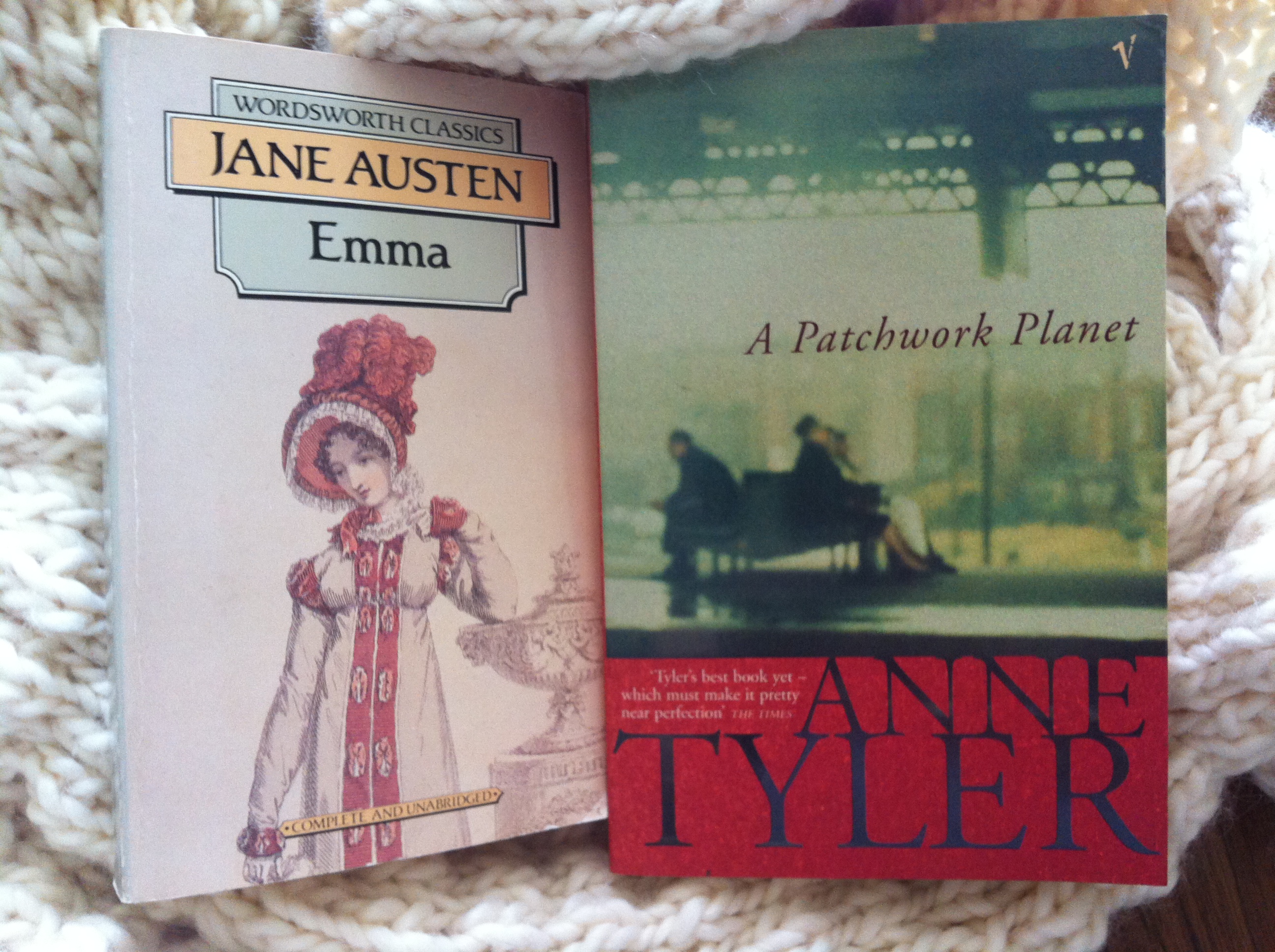
Firstly, Emma by Jane Austen (1815, my edition Wordsworth, 1992). I chose this novel because I remember the first time I read it, once all the characters were introduced, thinking “well, I can see exactly how this is going to play out”. And I don’t think I’m particularly clever or insightful, I think most readers would experience the same. It’s not that it’s a badly written book, far from it, but just that nowadays we’re used to these sorts of plotlines (romantic story arc, some misunderstanding and confusion, resolution leading to reunited lovers) and I think there’s comfort to be gleaned from that predictability. I’m not a big reader of crime fiction, but I imagine it’s a similar sort of deal – you get to walk away from the novel with the ends nicely tied up and equilibrium restored. And that can be very comforting. So let me introduce you to:
“Emma Woodhouse, handsome, clever, and rich, with a comfortable home and happy disposition, seemed to unite some of the best blessings of existence; and had lived nearly twenty-one years in the world with very little to distress or vex her.”
Emma is not necessarily all that likeable – she’s a spolit snob who thinks she knows what is best for people. But Emma grows and matures throughout the novel and becomes more humble, and fundamentally has her heart in the right place, so it’s difficult not to warm to her. The novel is resolutely domestic, as Emma concerns herself with her neighbours and plots to arrange romantic attachments. The plot is slight, but Emma sees Jane Austen writing as a confident and accomplished author, and the story is delivered with great verve. There are plenty of Austen’s aphorisms to enjoy:
“It was a delightful visit;-perfect, in being much too short.”
“I always deserve the best treatment because I never put up with any other.”
“One half of the world cannot understand the pleasures of the other.”
I had a tutor who specialised in Austen, and told me she enjoyed her because she was such an absolute bitch, at odds with her rather twee image. Certainly the portrayals of the vain, boorish characters pull no punches:
“Emma was not required, by any subsequent discovery, to retract her ill opinion of Mrs. Elton. Her observation had been pretty correct. Such as Mrs. Elton appeared to her on this second interview, such she appeared whenever they met again,—self-important, presuming, familiar, ignorant, and ill-bred. She had a little beauty and a little accomplishment, but so little judgment that she thought herself coming with superior knowledge of the world, to enliven and improve a country neighbourhood”
Ouch. So if you fancy losing yourself in the domestic and romantic concerns of Regency England, just beware that all is not as cosy as it appears. But Emma is still a comforting read, and one that is huge fun.
Secondly, A Patchwork Planet by Anne Tyler (Vintage, 1999). I haven’t read much by this prolific and much-loved author, only this novel and Breathing Lessons, so forgive me if I seem to be saying very obvious things to established Anne Tyler fans out there. I chose it because I found it comforting read, suggesting there is hope for all of us and people are capable of giving a great deal to one another as we all muddle through life. Anne Tyler has observed in an interview that “very small things are often really larger than the large things” and this is what she concerns herself with, the small things that hold great meaning in our lives. A Patchwork Planet tells the story of Barnaby Gaitlin, a man whose life is not where he wants it to be, but he’s not sure what he does want. His family struggle to forgive him after he was caught in high school breaking into peoples’ homes to go through their things and read their mail. His ex-wife has moved away and taken their rabbit-faced daughter with her. He works for Rent-a-Back, providing odd jobs for the elderly in the neighbourhood. He feels he is not the good person others think he is:
“Oh, what makes some people more virtuous than others? Is it something they know form birth? Don’t they ever feel that zingy , thrilling urge to smash the world to bits? Isn’t it possible, maybe, that good people are just luckier people? Couldn’t that be the explanation?”
A Patchwork Planet is peopled with eccentric characters, Barnaby’s co-workers, clients and family. Tyler writes with warmth and acceptance for people in all their guises:
“Then Mrs Alford started sorting her belongings. That’s always a worrisome sign. For a solid week she had three of us come in daily – me, Ray Oakley, and Martine. (“Two men for the real lifting,” was how she put it, “and a girl so as to encourage the hiring of women.”) […] Half the time she called Martine “Celeste” which was the name of our other female employee, and I was “Terry”.
“It’s Barnaby, Mrs Alford,” I said as gently as possible.
“Oh! I’m sorry! I thought your name was Terry and you played in that musical group.””
The humour in A Patchwork Planet is gentle, and never at the expense of the characters. As Barnaby muddles his way through another year of his life, you’re left with the feeling that nothing’s perfect but it’s OK. Sometimes it’s better than OK. And we may all be alone, but we’re all in this together. What’s more comforting than that?
Here are the books getting cosy, wrapped in a chunky woollen scarf I knitted (and got completely carried away with, it’s about 8 feet long, good job I’m tall):
 madame bibi lophile recommends