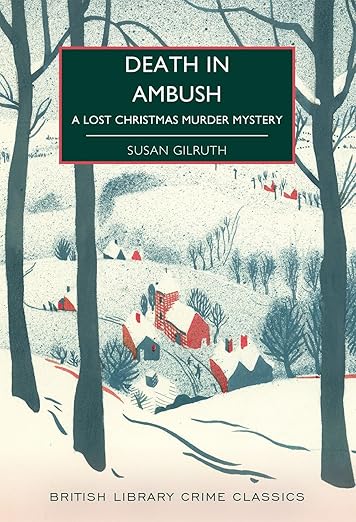
Continuing my cosy mystery reads for Christmas, it was Kaggsy’s tempting review at the start of the month which alerted me to Death in Ambush by Susan Gilruth (1952), republished by the British Library Crime Classics imprint.
It opens with Liane – Lee – Crauford reflecting on what happened when she accepted her friend Betty’s invitation to stay at Christmas:
“As far as the murder went, we all disliked the victim so heartily that nobody could screw up much actual grief on that score; but all the same it was an upsetting thing to happen and caused a good deal of distress one way and another in the village.”
Betty is the doctor’s wife and has two small children. Lee is married but her husband will be joining her later, so she heads to the small village of Staple Green alone. It’s the sort of place where everyone knows everyone else’s business, and Lee soon meets several of the neighbours when Betty throws a drinks party.
Sir Henry Metcalfe is the local retired hanging judge and landowner who is given to pronouncements like:
“No wonder the Empire’s going to the dogs when people of our standing—the very ones who should know better and set an example to the working classes—behave like a set of hedonistic escapists.”
As well as smaller scale observations:
“Once a week, not to mention Sundays, we are left stranded and servantless while they frivol away their time and my money in the vulgar and overheated precincts of some neighbouring picture palace.”
In other words, his staff go to the cinema at Tunbridge Wells.
His wife Diana is universally acknowledged to be entirely lovely, not least by the land agent John Wickham – rumours abound but no-one can quite believe it of the irreproachable lady of the manor.
His tenants are the Qualnoughs, Lewis and his bright young daughter Ann, a slightly affected actress who calls everyone Darling. Sir Henry is threatening to turn them out of their home, and Ann is deemed an unsuitable match for Sir Henry’s son Michael, who also wants to pursue a career on the stage, against his father’s wishes. So it’s hardly surprising that when Sir Henry is found dead at home, Ann speaks for many when she pronounces it:
“The best bit of news we’ve had in Staple Green since they put in the main electricity cable”
While her father refuses to be hypocrite and freely admits, most entertainingly, that he found the deceased to be “a fraudulent nincompoop” and “a pedantic popinjay”.
It soon emerges that Sir Henry was poisoned, and given that Betty’s husband Howard leaves his surgery unlocked with all manner of medications freely available, any of the neighbours could have wandered in and helped themselves, including the mysterious and glamorous newcomer Sonia Phillips…
Scotland Yard arrive in the form of Detective Inspector Hugh Gordon and Sergeant Spragg. Hugh and Lee know each other and there are clear references to a previous mystery, although I didn’t feel I needed to have read that one to enjoy this. Hugh stays at the Blue Boar in the village with its “depressing air of frowst and aspidistras” and he and Lee are soon charging about in his flashy new Lancia to find the murderer.
I thought it was entirely obvious from some heavy clues at the start who the murderer was, and mostly how they’d done it too, apart from some logistics a twenty-first century reader is unlikely to pick up. But this didn’t detract from my enjoyment at all. These types of stories are comfort reads for me, and the detectives working everything out and tying it all up neatly is soothing escapism.
Lee is an entertaining narrator, clear sighted and witty. She is grumpy at not being a full confidante of Scotland Yard which seemed a bit presumptuous to me, while she lets being called “a good girl” by men who want her to be convenient slide by (no doubt a sign of the times). She and Hugh have a flirtatious relationship which provides an additional frisson to proceedings while never becoming anything more.
The story is well paced, believable and entertaining. There are also some lovely details to convey the Christmas setting:
“It was only a short distance to the village green, and we strolled up the lane admiring the wonderful patterns of filigree lace made by the spiders webs which hung festooned all over the high hedges, sparkling in the chilly sunshine, and the way each blade of grass on the verge stood out stiff and encrusted with thick frost.”
I hope this is the start of more Gilruth issues from BLCC – fingers crossed!
To end, mine is a secular Christmas, but I still have a favourite carol:
I do enjoy a cosy crime novel, and one with a 1960s Berlin setting ticked so many boxes I jumped at the chance to take part in this blog tour from the ever-wonderful Corylus Books. I hope they carry on asking me to take part in these tours even though I feel like my posts for their books are getting very formulaic: “I loved it! I want more translations!” Take a guess as to whether this one will be any different… 😉
Nightingale & Co. is the first in a series written by Charlotte Printz and translated by a blogger many of you know, Marina Sofia. Here is the blurb from Corylus Books:
“Berlin, August 1961.
Since the death of her beloved father, Carla has been running the Nightingale & Co detective agency by herself. It’s a far from easy job for a female investigator.
When the chaotic, fun-loving Wallie shows up at the door, claiming to be her half-sister, Carla’s world is turned upside down. Wallie needs Carla – the Berlin Wall has been built overnight, leaving her unable to return to her flat in East Berlin.
Carla certainly doesn’t need Wallie, with her secret double life and unorthodox methods for getting results. Yet the mismatched pair must find a way to work together when one of their clients is accused of murdering her husband.
Nightingale & Co is the first in a cosy historical crime series featuring the sisters of the Nightingale & Co detective agency in 1960s Berlin.”
The story gets off to a fun, engaging start. Carla receives a call from her aunt Lulu telling her she’s waving an airgun on the set of the Billy Wilder film One, Two, Three, seemingly in a deeply flawed attempt to secure a role. As Carla sets off across Berlin at pace, the 1960s city is evoked organically, without seeming like an info-dump.
This trailer for the film includes some external shots:
Yet despite the joy of these opening scenes, we are quickly shown the psychological impact of living in Berlin as the Wall goes up:
“‘They’re building a wall,’ said Lulu. The words were like a punch to her stomach. Carla felt faint. Ulbricht had lied to them. That was why there were so many guards at the Brandenburg Gate yesterday. How naïve of them to believe it was merely for the film set.”
Carla lives with her mother in the same building that houses the agency her father built. The domestic scenes with her bitter, passive-aggressive, baiting parent were so well-realised. Printz really captured the psychological warfare that people can tie themselves into, unable to see an escape route however desperately they want one. Carla is also grieving her father, who died in the crash which left her with enduring head injury symptoms.
When her half-sister Wallie arrives having been cut off from her home in the East by the rapid installation of the Wall, she couldn’t be more different. Physically Carla is compared to Audrey Hepburn, Wallie to Marilyn Monroe. Wallie gives free rein to all her appetites and doesn’t mind dubious means to achieve her ends, while Carla is controlled and keen to remain above reproach. Carla’s mother is entirely charmed by Wallie, although she believes her to be a cousin of her dead husband.
In less skilled hands the contrasting sisters could seem cliched and merely vehicles for dramatic tension. But both Carla and Wallie were entirely believable and well-rounded. The tensions between them arising from Carla not knowing about Wallie’s existence until she turns up on the doorstep, and what this means for her memories of her father, was lightened by their very different attitudes. Their growing but begrudging respect for one another as they find themselves an effective team made them an endearing pair.
The central strand of the story concerns Alma, a beautiful rich woman who asks the agency for help due to her husband’s domestic violence. Carla is sympathetic but realistic about Alma’s options:
“I’m afraid that’s no motive for divorce. A man who beats his wife is regarded by the courts as quick tempered and they usually advise the wife not to annoy him.”
The 1960s are a time of change but some changes aren’t occurring quickly enough. (I was reminded this week that it wasn’t until 1975 that women in Britain were allowed their own mortgage!)
When Alma’s husband is killed and her subsequent behaviour leads to her arrest, the sisters investigate. The plot is satisfyingly complex without being overly convoluted and frustrating.
The shadows of the war, less than twenty years previous, still loom large and Printz manages to capture how the fallout is interwoven with the modernising present.
“Hadn’t they learnt anything from the past? It wasn’t enough to just stand there and repeat slogans. Everyone had to contribute.”
It’s hard to judge a translation when you don’t speak both languages, but I was struck by how Marina Sofia managed a sensitive balance in providing an English translation that flowed so well, yet also kept sense of place and contributed to Berlin being evoked so clearly in my mind. The significances of formal/informal address were conveyed without any clunkiness.
What I really enjoyed in Nightingale & Co was the mix of compassion and cynicism displayed by both the sisters in their different ways. It made them, and the story, humane without being sentimental, hopeful in the face of horrors.
“In the end, that was all that anyone wanted: forgiveness. And to be loved. Which made everyone predictable.”
So in summary: I loved it! I want more translations!
Here are the rest of the stops on the tour, do check out how other bloggers found Nightingale & Co:
I enjoy a golden age mystery at Christmas. It’s my comfort reading at any time of year, but I always try and read one at Christmas, when the tropes of being snowed in (and what will the thaw reveal?!), country houses, groups of people with various tensions trapped together, jovial facades and traditions hiding mendacity and murderers, work especially well.
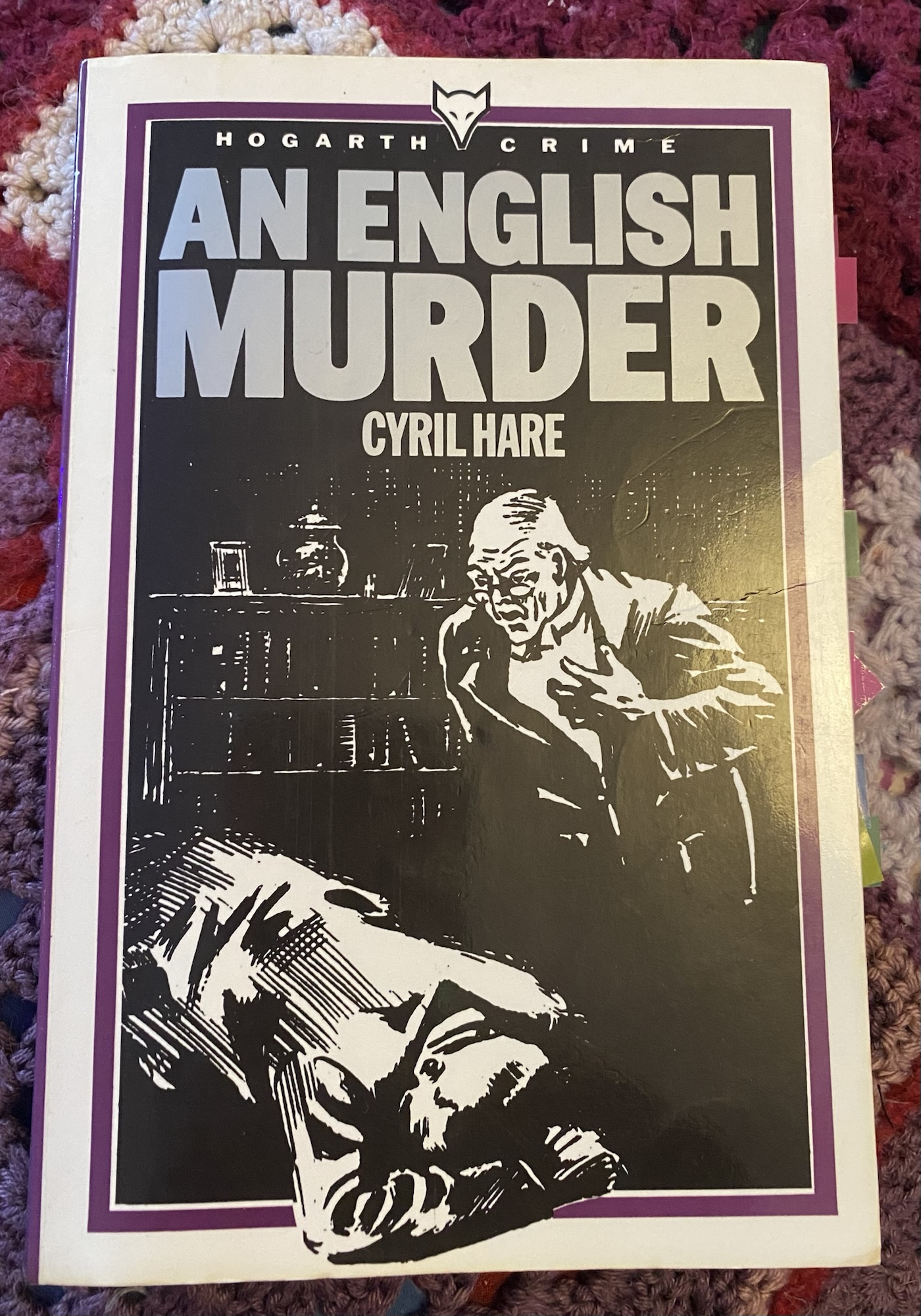
Unfortunately I had a couple of false starts. The first two I tried promised much of the above, but for various reasons didn’t quite work. Thankfully, a recent addition to the TBR, Cyril Hare’s An English Murder (1951), came to the rescue.
The title of the mystery is very apt: Hare takes a humorous but incisive view of postwar English society, making his points without rancour. Published only six years after the war, perhaps too harsh a criticism would not have been well-received by a generation who went through horrors in service of country, but at the same time things were changing and Hare captures this well.
The story opens:
“Warbeck Hall is reputed to be the oldest inhabited house in Markshire. The muniment room in the north-eastern angle is probably its oldest part; it is certainly the coldest. Dr. Wenceslaus Bottwink, Ph.D. of Heidelberg, Hon.D.Litt. of Oxford, sometime Professor of Modern History in the University of Prague, corresponding member of half a dozen learned societies from Leyden to Chicago, felt the cold sink into his bones as he sat bowed over the pages of a pile of faded manuscripts, […] The real obstacle that was worrying him at the moment was the atrocious handwriting in which the third Viscount Warbeck had annotated the confidential letters written to him by Lord Bute during the first three years of the reign of George III. Those marginalia! Those crabbed, truncated interlineations! Dr. Bottwink had begun to feel a personal grievance against this eighteenth-century patrician.”
Dr Bottwink is a concentration camp survivor. He is learned and wise, and really wants to be left alone with his papers “in response to an instinct that drove him to seek refuge from the horrors and perplexities of the present in the only world that was entirely real to him.”
Unfortunately for him, he will be drawn into the Warbeck family’s Christmas, including having to deal with the revolting Robert, heir apparent:
“I don’t think I shall greatly enjoy sitting down at table with Mr. Robert Warbeck.”
“Sir?“
“Oh, now I have shocked you, Briggs, and I should not have done that. But you know who Mr. Robert is?”
“Of course I do, sir. His lordship’s son and heir.”
“I am not thinking of him in that capacity. Do you not know that he is the president of this affair that calls itself the League of Liberty and Justice?”
“I understand that to be the fact, sir.”
“The League of Liberty and Justice, Briggs,” said Dr. Bottwink very clearly and deliberately, “is a Fascist organization.”
“Is that so, sir?”
“You are not interested, Briggs?”
“I have never been greatly interested in politics, sir.”
“Oh, Briggs, Briggs,” said the historian, shaking his head in regretful admiration, “if you only knew how fortunate you were to be able to say just that!”
One of the drawbacks of golden age crime is that you often come across anti-Semitism. It was a relief to see Dr Bottwink quickly established as the reluctant detective, and Robert and his organisation given short shrift.
Also present in the house are Sir Julius, cousin to Lord Warbeck and Chancellor of the Exchequer in the new socialist government, whose budget is likely to mean Warbeck Hall will be sold; his Scotland Yard bodyguard, Rogers; Lady Camilla Prendergast (who for unfathomable reasons is attracted to Robert); Mrs. Carstairs, politically ambitious for her husband; Briggs the ancient retainer steeped in duty to the class system and struggling with all changes; and his daughter Susan. I have a terrible memory with too many characters in mystery novels and this number was just right – enough for various suspects but not so many that I had trouble keeping them straight.
Hare lightens the story with gentle humour. Dr Bottwink’s outsider status means there are plenty of digs at English social mores, as well as direct from the authorial voice too, such as this sickbed reunion between Lord Warbeck and Robert:
“When they met they shook hands as English people should. But there is something rather absurd about shaking hands with a man who is lying down. Eventually he compromised by placing one hand lightly on his father’s shoulder.
“Sit down over there,” said Lord Warbeck gruffly, as though a little ashamed at his son’s display of emotion.”
I also enjoyed Rogers’ resolute imperturbability in the face of any heightened emotions from his political employer. Mrs Carstairs provides broader humour through unstintingly loquacious self-interest:
““She overran [Lord Warbeck’s library] like an occupying army, distributing her fire right and left and reducing the inhabitants to a stunned quiescence.”
If you’ve struggled with the social demands of Christmas dragging you away from your reading, you will certainly identify with Dr Bottwink. Far away from his beloved manuscripts, his considered, intelligent attempts at small talk fail miserably in the face of English ignorance:
Camilla laughed. “That was very simple of you, Dr. Bottwink,” she said. “Did you really expect a Cabinet Minister to know the first thing about constitutional history? He’s much too busy running his department to bother about a thing like that.”
“I fear that my knowledge of England is still imperfect,” said the historian mildly. “On the Continent it used not to be uncommon to find professors of history in Cabinet posts.””
On the first night Robert gets horribly drunk and offends even those more favourably disposed towards him. Dr Bottwink’s assessment of him remains unchanged:
“A disregarded spectator in the shadows, Dr. Bottwink gazed at him with cold and steady dislike, remembering other men who had professed principles not so very different from those of the League of Liberty and Justice, who had been noisy and genial in their cups, and had thereafter committed crimes beyond all reckoning.”
Unsurprisingly someone soon bumps Robert off with cyanide in his drink. But as it snows steadily, cutting everyone off, are the others safe? Will Dr Bottwink find the culprit in time, and if he does will anyone listen to him?
An English Murder was well-paced and a quick read. I hadn’t read Cyril Hare before but on the strength of this I’d be keen to read more. The Guardian included An English Murder in its Top Ten golden age detective novels and I can see why.
“When I am told that I cannot possibly think anything, my nature is so contradictory that I immediately begin to think about it.”
To end, Dr Bottwink’s knowledge of William Pitt helps him solve the mystery. He may take issue with the historical accuracy this portrayal:
‘Tis the season of gluttony and excess, but how about some amuse-bouche in the form of festive short stories, before settling down with a chunkster tome to while away the long winter evenings?
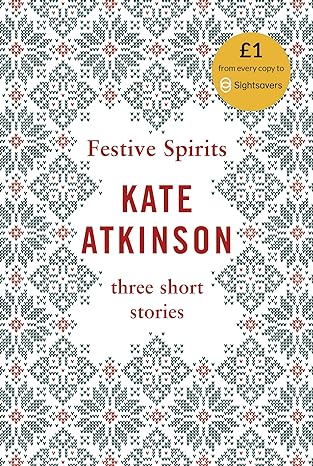
Festive Spirits by Kate Atkinson (2019) features three very short stories. It’s a small hardback which is sold in aid of Sightsavers.
Given their very concise length, I can’t say too much except they’re all as inventive and witty as you would expect from Atkinson.
In Lucy’s Day, a busy, exhausted mother attends her children’s nativity play.
“The Nativity was a dishevelled construct made mostly, as far as Lucy could tell, from lollipop sticks, cotton wool and hamster bedding. And lentils. The school used lentils a lot in its artwork, as well as pasta and beans. You could have made soup from some of the collages Beatrice and Maude brought home.”
In Festive Spirit, a woman reflects on her unhappy marriage to her successful husband and takes metaphysical steps in keeping with the time of year:
“When he was a boy he didn’t know anyone who got their hands dirty for a living. Now he was an MP everyone he knew had dirty hands.”
The final story, Small Mercies, returns to familiar domesticity and captures the sadness and loneliness experienced by so many at this time of year. But there is a glimmer of hope for middle-aged Gerald.
“It was difficult to make out his mother’s words, laced as they were with emotion and free alcohol.”
Festive Spirits is a quick but very worthwhile read. Kate Atkinson is great at short stories and these capture the time of year without sentimentality but also without any bitter irony. Highly enjoyable.
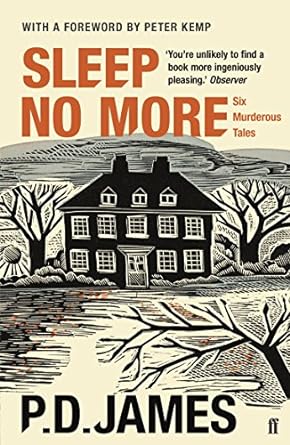
PD James’ collection Sleep No More: Six Murderous Tales (2017) features two stories set at this time of year. The Murder of Santa Claus is the longest in the collection and probably the weakest (the denouement is someone explaining to the murderer how they know they did it) but still so much to enjoy.
It begins with Charles Mickledore, an author of cosy crimes, (“I’m no HRF Keating, no Dick Francis, not even a PD James.”) looking back on Christmas 1939 when he was 16. He goes to stay with a distant relative, Victor Mickledore, in a country house, with other guests who don’t know each other that well.
There’s a faithful secretary, an aging starlet, the couple Victor booted out of their home, and a dashing pilot. There are long-held resentments regarding Victor possibly killing someone in his car and paying off his valet as an alibi.
“The paper tore apart without a bang and a small of object fell out and rolled over the carpet. I bent down and picked it up. Wrapped neatly in an oblong of paper was a small metal charm in the shape of a skull attached to a key ring; I had seen similar ones in gift shops. I opened the paper folded round it and saw a verse hand printed in capitals.”
The verse is a death threat of course, which Victor disregards and insists the Christmas traditions will go ahead as usual, including his routine of dressing up as Santa and delivering presents. The title tells us all will not end well…
It’s hard to write a satisfying whodunit in a short story form and as I mentioned, this was a bit clunky. But PD James is such a brilliant crime writer it was still highly readable, and she clearly had a lot of fun with the cosy crime tropes and characters. The Christmas setting made for a real treat too.
The first story in the collection, The Yo-Yo, also features an older man looking back on his youth and remembering a murder. The difference here being there is no mystery, as he witnessed the event directly.
“I found the yo-yo the day before Christmas Eve, in the way one does come across these long-forgotten relics of the past, while I was tidying up some of the unexamined papers which clutter my elderly life. It was my seventy-third birthday and I suppose I was overtaken by a fit of momento mori.”
It was Christmas years earlier in 1936 when he was being driven from his boarding school to spend the festive period with his indifferent grandmother, that the story takes place.
James expertly paces the story to the climax of the murder, and then demonstrates the fallout with equal precision. A recurring theme through all six stories is of people getting away with murder (no Commander Dalgliesh here to find the culprits!) and whether justice occurs only within the law, despite it, or not at all.
“We walked back to the car together, almost companionably, as if nothing had happened, as if that third person was walking by our side.”
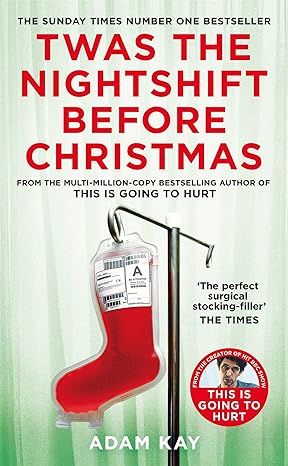
Finally, not short stories but an honourable mention to Adam Kay’s ‘Twas the Night Shift Before Christmas (2019) detailing his experiences working as a doctor over the Christmas period for several years. I haven’t read his hugely successful book This is Going to Hurt or watched the tv series with Ben Whishaw – having worked in the NHS for several years I find portrayals either inaccurate and infuriating or authentic and stress-inducing. I feared Kay’s would be the latter. But for some reason I was tempted by this little stocking filler, and he managed to take me right back, but entertain me rather than induce vicarious trauma. Highly recommended, as long as you don’t mind a lot of swearing 😀
“Sunday 26 December 2004
Full marks to the anaesthetist wearing a badge that says: ‘He sees you when you’re sleeping, he knows when you’re awake.’”
To end, I’m never ahead of the game on anything, but this year I snapped up on pre-order the Christmas album by these two titans of contemporary folk music:
You may remember, back in the mists of time (14-20 October), the 1930 Club, hosted by Karen at Kaggsy’s Bookish Ramblings and Simon at Stuck in a Book. Although I took part, I’d hoped to do two posts, but was far too disorganised with the second one. Karen kindly said I could sneak in a late entry, so here it is, very much overdue and very much overlong!
My excuse is I’m having renovations done in my tiny flat and the whole place is in disarray to say the least. It has made me clear out 19 sacks of books to the lovely charity bookshop, but the overall effect on my shelves has been negligible. Which makes me think I should just give in and accumulate books until they take over entirely and smother me. A good way to go in my opinion.
Back to 1930! Do have a look at all the wonderful posts from people who managed to post on time – it turned out to be a great year 😊
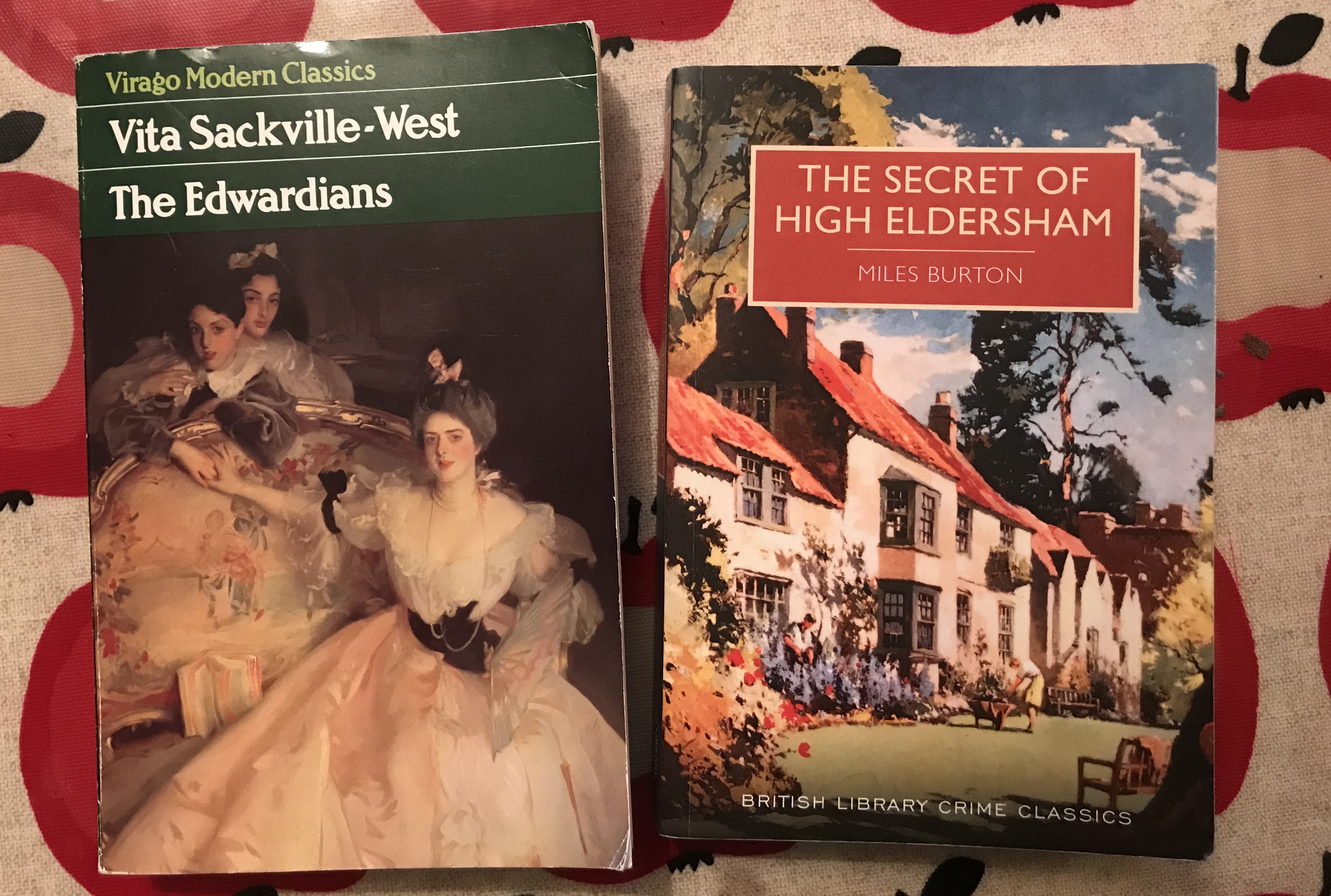
Firstly, some cosy crime courtesy of the British Library Crime Classics series, The Secret of High Eldersham by Miles Burton.
The titular village is a pretty place in East Anglia, but somewhat isolated and insular “with that curious half-mistrustful air not uncommon among the natives of East Anglia.” 😀
Strangers are not welcome in High Eldersham, and Samuel Whitehead, retired police officer and local publican, was one such stranger. Still, he seemed to have settled in relatively well right up until the point that someone stabbed him to death. Inspector Young is called in from Scotland Yard and immediately suspects one of the locals:
“He knew from experience that brutal murders, inspired by some entirely inadequate motive, were not uncommon. They were nearly always due to the workings of an unbalanced mind, brooding over some fancied grievance until the lust of blood was awakened. Then the hitherto harmless and peaceful individual became a criminal… He would await his opportunity and deliver the blow. And, the deed once perpetrated, he would return to normal sanity. It was not unlikely that the murder of Whitehead was due to such causes.”
It’s hardly a robust theory. Young is not an idiot though, and he quickly unearths the titular secret, although that doesn’t tell him who murdered the pub landlord, or why. He decides to call on his old friend Desmond Merrion “a living encyclopaedia upon all manner of obscure subjects which the ordinary person knew nothing about.”
And so the professional and amateur detective set about solving the mystery, which to modern readers won’t be much mystery at all – its very clear what’s going on. That’s not a criticism though. I suspect in 1930 it wasn’t quite so obvious, and it doesn’t matter now – the comfort of these plot-driven golden age stories is watching everything play out exactly as it’s supposed to, and I enjoyed following Young and Merrion as they discovered the extent of the dastardly deed.
While it’s not the most sophisticated in terms of plot or characterisation, The Secret of High Eldersham still has enough about it to pull you along. It also doesn’t fall foul of many of the prejudices of GA detective fiction either. Despite the bizarre opinion of East Anglians that I quoted at the beginning, in fact the residents aren’t made too yokely; there’s no racism/anti-Semitism that I can remember; and the loveliness of the female love interest isn’t dwelt upon and she’s actually allowed to have a personality.
Burton doesn’t hang about – there’s very little filler here. He gets on with telling the story and once that’s done, it ends. So, a quick, cosy crime read, perfect autumnal reading as the nights get longer for those of us in the northern hemisphere.
In my last post I looked at EM Delafield’s Diary of a Provincial Lady which included this entry:
“August 31st.—Read The Edwardians which everybody else has read months ago—and am delighted and amused. Remember that V. Sackville-West and I once attended dancing classes together at the Albert Hall, many years ago, but feel that if I do mention this, everybody will think I am boasting—which indeed I should be—so better forget about it again, and in any case, dancing never my strongest point, and performance at Albert Hall extremely mediocre and may well be left in oblivion.”
Although I don’t have much in common with the Provincial Lady’s life of ease, like her I enjoyed The Edwardians, which Sackville-West told Virginia Woolf she was writing to ‘make my fortune. Such a joke it will be, and I hope everybody will be seriously annoyed.’
Although she saw it as a joke, its not really a comic novel. It tells the story of Sebastian, heir to the country estate of Chevron, and his sister Violet. Chevron is VSW’s beloved Knole, which she couldn’t inherit due to having ovaries, and which Virginia Woolf also immortalised as the home of Orlando.
The chapters are told from the point of view of different characters, beginning with adventurer Leonard Anquetil, who is not of the same class as the rest but has been invited to Sunday dinner because they think he will be amusing.
“And now the rest of the day must be got through somehow, but the members of the house-party, though surely spoilt by the surfeits of entertainment that life had always offered them, showed no disposition to be bored by each other’s familiar company, and no inclination to vary the programme which they must have followed on innumerable Sunday afternoons since they first emerged from the narrowness of school or schoolroom, to take their place in a world where pleasure fell like a ripened peach for the outstretching of a hand. Leonard Anquetil, watching them from outside, marvelled to see them so easily pleased. Here are a score or more of people, he thought, who by virtue of their position are accustomed to the intimate society of princes, politicians, financiers, wits, beauties, and other makers of history, yet are apparently content with desultory chatter and make-believe occupation throughout the long hours of an idle day. Nor could he pretend to himself that on other days they diverted themselves differently, or that their week-end provided a deserved relaxation from a fuller and more ardent life.”
Through Anquetil, our introduction to the lives of the privileged class is a sceptical one at the least, scathing at most. Yet VSW adored Knole, and through Sebastian’s feelings for Chevron we learn how feelings of home run deep, even when that home is a vast estate populated by many.
“Everybody, from Sebastian downwards, obtained exactly what they wanted; they had only to ask, and the request was fulfilled as though by magic. The house was really as self-contained as a little town; the carpenter’s shop, the painter’s shop, the forge, the sawmill, the hot-houses, were there to provide whatever might be needed at a moment’s notice. So the steward’s room, like the dining-room and the schoolroom, was never without its fruit and delicacies.”
Meeting Anquetil has an enduring effect on both Sebastian and Violet. Sebastian’s conflicted feelings about his class, privilege and the society he operates within are brought more to the fore.
“One half of Sebastian detested his mother’s friends; the other half was allured by their glitter. Sometimes he wanted to gallop away by himself to the world’s ends, sometimes he wanted to give himself up wholly to the flattering charm of pretty women. Sometimes he wished to see his whole acquaintance cast into a furnace, so vehemently did he deprecate them, sometimes he thought that they had mastered the problem of civilisation more truly than the Greeks or Romans. “Since one cannot have truth,” cried Sebastian, struggling into his evening shirt, “let us at least have good manners.” The thought was not original: his father had put it into his head, years ago, before he died. But this brings us to Sebastian’s private trouble: he never could make up his mind on any subject. It was most distressing. He had, apparently, no opinions but only moods,—moods whose sweeping intensity was equalled only by the rapidity of their change.”
We follow Sebastian as he has affairs, becomes a fashionable man about town, and tries to figure out what he wants. In the background of this is his younger sister Violet, who seems a more determined and clear-sighted individual:
“She felt inclined to say, “Very well, if you want the truth, here it is. The society you live in is composed of people who are both dissolute and prudent. They want to have their fun, and they want to keep their position. They glitter on the surface, but underneath the surface they are stupid—too stupid to recognise their own motives. They know only a limited number of things about themselves: that they need plenty of money, and that they must be seen in the right places, associated with the right people. In spite of their efforts to turn themselves into painted images, they remain human somewhere, and must indulge in love-affairs, which sometimes are artificial, and sometimes inconveniently real. Whatever happens, the world must be served first. In spite of their brilliance, this creed necessarily makes them paltry and mean. Then they are envious, spiteful, and mercenary; arrogant and cold. As for us, their children, they leave us in complete ignorance of life, passing on to us only the ideas they think we should hold, and treat us with the utmost ruthlessness if we fail to conform.””
The plot is slight but I think it’s meant to be – one of VSW’s points is that nothing much happens to these people. I came away with a mixed picture of aristocratic life; on the one hand there is an unflinching portrayal of wasteful, privileged lives, but on the other hand, they are never entirely condemned. I suspect this mirrors VSW’s conflicted feelings on the issue, and it also stops the novel from being too judgemental and bitter.
I didn’t enjoy The Edwardians as much as the other Sackville-Wests I’ve read ( All Passion Spent and Family History) but maybe that’s because I didn’t find Sebastian particularly engaging. I felt Violet was off having a far more interesting time, living in her own flat, hanging out with Bohemians and falling in love. I would have liked to hear more about that, or even some more about their wonderfully bitchy mother. But that’s just personal preference and I do find VSW’s writing to be a great read.
To end, the classic musical Puttin’ on the Ritz was released in 1930. Imagine if you’d never heard that well known ‘reasonably straightforward syncopated 5/4 time signature’, you might struggle with it…
After last week’s moany post, I have survived both work dos and I am in the Christmas spirit – joyeux noel!
I even gifted to myself, in the shape of Karl Ove Knausgaard (if only) by going to see him interviewed for World Book Club, in the rather formal surrounds of the council chamber at the BBC (free wine! and crisps! so that’s where my licence fee goes – I approve). He was every bit as good-looking charming and erudite as I’d hoped so if you get a chance to listen to the show at some point (on in early January) I recommend it. And it warmed my post-Brexit heart to be part of such an international audience, so thank you BBC 🙂
Back to Christmas. At this time of seasonal over-indulgence, I’ve decided to exercise uncharacteristic restraint. Two Christmas stories, but both of them short stories, wee amuse-bouches that can easily be consumed by a brain threatening to slip into a vegetative state from the over-consumption of, well, everything really…
OK, I can probably manage one more Ferrero Rocher…
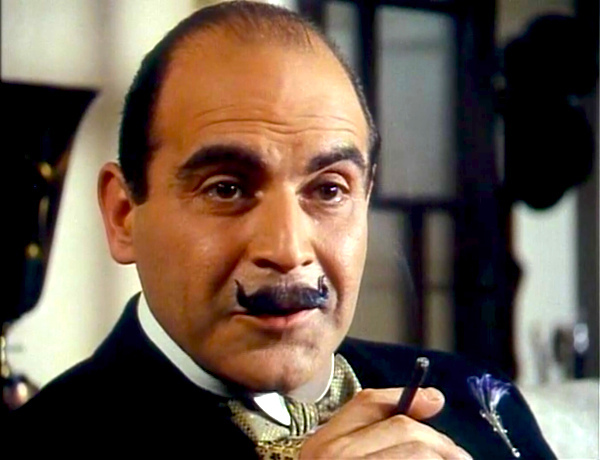
Firstly, the titular story from The Adventure of the Christmas Pudding and a selection of entrees by Agatha Christie (1960). Things begin in fine Golden Age form: Poirot is asked by a mysterious government-type to find a missing ruby that a foreign prince has mislaid on Blightly’s shores, in order to avoid an international incident. Poirot is hard to persuade and the government-type is close to losing his cool:
“Mr Jesmond made a peculiar noise rather like a hen who has decided to lay an egg and then thought better of it.”
Poirot decides to leave his lovely art deco flat (I want it! I want it!) once he knows his accommodation for Christmas has oil-fired central heating:
“Again Poirot shivered. The thought of a fourteenth-century English manor house filled him with apprehension. He had suffered too often in the historic country houses of England.”
I did enjoy that little swipe at the trope of country house mysteries. Christie’s clearly having a great time writing this, evoking a traditional country house Christmas and then throwing everything at it, from faked murders to mysterious strangers to anonymous notes left for Poirot:
“Don’t eat none of the plum pudding. One as wishes you well.”
I think I’ve eaten that plum pudding. Of course, Poirot is on top of everything and speedily resolves murder, mystery, missing jewels and that most pressing of seasonal considerations: is the plum pudding safe?
Secondly, again the titular story of a collection, this time Christmas at Cold Comfort Farm by Stella Gibbons (1940), set in the time before her famous comic novel, and so the Starkadder family are in full disarray.
“The Starkadders of Cold Comfort Farm had never got the hang of Christmas, somehow, and on Boxing Day there was always a run on Howling pharmacy for lint, bandages, and boracic powder.”
In this short story we are treated to a portrait of Christmas at the farm, a Christmas no-one in their right mind would want. Nothing particularly happens, it is more a series of events over the course of the day to display the Starkadders in all their colourful, brutal, hilarious glory. If you’re not familiar with the family from Cold Comfort Farm, well, firstly, away with you and read the comic treat! But if you decide to read the Christmas story first, all you need to know about the family can be gleaned from the idiosyncratic and truly disgusting charms which grace the Christmas pudding:
“Him as gets the sticking plaster’ll break a limb; the menthol cone means as you’ll be blind wi’ headache, the bad coins means as you’ll lose all yer mony, and him as gets the coffin-nail will die afore the New Year. The mirror’s seven years’ bad luck for someone, Aie! In ye go, curse ye!”
Gibbon’s driest humour is saved not for the family but for those around them, such as the vicar who has been guided to pay a Christmas Eve visit by the crate of British Port-type wine he saw being delivered to the farm (surely there’s not enough port wine in the world to get you through a festive visit with the Starkadders?) If you enjoyed Cold Comfort Farm there’s much to relish in this brief visit to the family. A treat.
Another treat – Rufus Sewell as Seth Starkadder in the 1996 BBC adaptation. Apparently Kate Beckinsale and a bull are in this photo too – I can’t see them anywhere…
To end, proof if proof were needed, that my ‘taste’ in Christmas tunes is very much of an era. The post began with the double-denim Welsh Elvis that is Shaky, and now ends with the greatest Christmas video ever (non-debateable). There will never come a day when I’ve seen this too many times, I love everything about it. The snow, the ski lodge, the mullets, the meaningful looks over the tinsel, the death stare down the dining table… enjoy 😀
UPDATE: It was announced on Christmas Day that George Michael had died. Rest in Peace George, and thank you for all the tunes xx
Last week I wrote about dystopian novels, and Kaggsy commented that when things are bad, comfort reading is the thing, particularly golden age crime. A sage suggestion – it offers the escape of another time, and the reassurance of puzzles being solved, things being put right. So this week’s post is all about comfort. The comfort of people being stabbed in the back with knives, and left to freeze to death in the snow.
Firstly, the golden age classic A Man Lay Dead by Ngaio Marsh (1934), the first of her novels featuring Chief Inspector Alleyn. I did enjoy this: a country house murder, a closed circle of suspects, class snobbery, unfounded paranoia about Bolsheviks; it was a perfect example of the genre 😀
Sir Hubert Handesley throws a party at his country house, to include a game of ‘Murder’ – you can probably guess what happens. During the time allotted to the game, a man who disappointingly, is never referred to as a cad or bounder though he is clearly both those things, is found stabbed in back, bleeding out next to the cocktail tray and the dinner gong (love the incidental details of golden age mysteries!) What’s more, the knife is Russian:
“‘Rum coincidence that the knife, your butler, and your guest should all be of the same nationality.’”
Enter Inspector Alleyn – dry of wit, Oxford of education, mysterious of background but suspiciously posh, not a man to be carried away by xenophobic paranoia, who sets about investigating the murder through an appealing mix of dogged attention to detail and flashes of flamboyance fuelled by his prodigious intelligence:
“‘As a rule,’ he observed, ‘there is much less to be gleaned from the clothes of a man with a valet than from those of the poorer classes. “Highly recommended by successful homicide” would be a telling reference for any man-servant.’”
Ngaio Marsh’s authorial voice is similarly witty, making this novel a funny, entertaining puzzle.
“Mr Benningden was one of those small, desiccated gentleman so like the accepted traditional figure of a lawyer that they lose their individuality in their perfect conformation to type.”
A Man Lay Dead is perfectly paced (only 176 pages in my edition) and of course Alleyn gets his murderer, with a few red herrings along the way. I bought this as part of the perennially tempting collected sets from Book People, and I’m looking forward to working my way through the rest…
Patrick Malahide as Inspector Alleyn in the BBC adaptation
Secondly, a novel I’m including as part of Women in Translation month – head over to Meytal’s blog to read all about WITmonth. Under the Snow by Kerstin Ekman (1961, trans. Joan Tate 1996) is not a golden age novel, but it offers much of the same appeal, being a straightforward, non-gory whodunit. Reading in the midst of a UK summer (such as it is) it also offered me an escape into a wintry Lapland landscape, far away from real life and the daily news which currently evokes this reaction in me:
One winter’s night in a remote northern village in Lapland, a mah jong party gets out of hand (as they so frequently do, those crazy mah jong players) and the art teacher of the local school, Matti, is found frozen to death in the snow. Police officer Torsson is called into this small community:
“just like Torsson, the chief of police of this mining town had originally come from the south. Having carried out his duties for thirty-five years among a taciturn breed in a country where the winter is five thousand and sixty-four hours long, he had lost some of the animation in his speech and the cheerfulness he associated with brightly lit shopping streets and apple blossom. He did not like to be disturbed.”
Torsson feels something is not right with Matti’s death, but can’t prove it. The story then jumps forward to the summer, when Matti’s friend David arrives in the area:
“Occasionally the road seemed to be leading up to heaven, the car climbing in growling second-gear up kilometre-long hills towards the empty sky…this July day was clear, the sky blue. The mountains seemed to him to be the most immobile and largest objects he had ever seen. Top marks to you, old chap, he thought, for David Malm travels round the world, painting, and he’s seen a thing or two”
David and Torsson form an unlikely partnership as they start exploring the events of the winter night in the midst of the relentless daylight of summer within the Arctic Circle. The overweight, steady, unemotional Torsson has been underestimated by the villagers but alongside the more flamboyant David progress is made. The mystery itself is straightforward (the novel is only just over 200 pages) but the atmosphere evoked by the extremes of light in the different seasons is fully utilised by Ekman to create an eerie, unsettling atmosphere.
“there is infinite patience up here. This is due to time, which thanks to the sun’s strange behaviour exists here in different proportions. A year is one long cycle of cold night and blistering light day. The celestial clock turns rather majestically when you live right underneath the pendulum.”
To end, a cornucopia of comfort 🙂
Bagpuss, Michael Palin and ponies images from here, here, here













 madame bibi lophile recommends