Novella a Day in May 2022 No.27

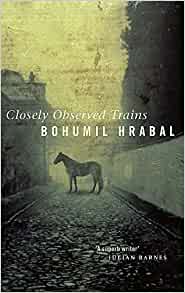
Closely Observed Trains – Bohumil Hrabal (1965, trans. Edith Pargeter 1968) 91 pages

I’m flagging a bit with my Novella a Day challenge, but I’m telling myself there’s only a few more days to go. I’m still really enjoying it, but my post-covid brain is struggling. This meant when I sat down to read Closely Observed Trains, I thought for ages that it wasn’t working for me due to my rubbish concentration levels. Then suddenly it clicked, and as a result it broke my heart.

The story is narrated by Miloš Hrma, young apprentice on the railways during 1945 in Bohemia (one more stop on my Around the World in 80 Books reading challenge.)

“The dive-bombers were disrupting communications to such an extent that the morning trains ran at noon, the noon trains in the evening, and the evening trains during the night, so that now and then it might happen that an afternoon train came in punctual to the minute, according to the timetable, but only because it was the morning passenger train running four hours late.”

This slightly surreal comedic tone continues throughout the novel as we learn about Miloš’ colleagues: lascivious dispatcher Hubička and pigeon-loving station master Lánksý. There is a lot of silliness – Hubička is caught up in a daft sex scandal, Lánksý can be pompous and ridiculous.

But there is a serious side too. Miloš is returning to work after cutting his wrists. There is a lot of animal suffering and at first I was baffled as to why, before realising it was a way of introducing violence and victimhood to a novel about war which doesn’t include warfare.

As Miloš and his colleagues continue their ordinary lives, the troop trains trundle past to the Eastern front.

“This year the Germans had lost control of the airspace over our little town. When I rode along the footpath to the fuselage of the aircraft the snow was glittering on the level fields, and in every crystal of snow there seemed to be an infinitely tiny second hand ticking, the snow crackled so in the brilliant sunlight, shimmering in many colours.”

Closely Observed Trains presents a narrator with a distinct young voice: vulnerable, inexperienced, sceptical and funny. It finely balances unreality and humour alongside humanity and pathos. It’s deeply serious but written lightly, showing how bravery and heroism can exist in the unlikeliest places.

It could be my aforementioned foggy covid brain, but as I was writing this post I started to feel a bit teary by the end. This really was the most affecting novella.
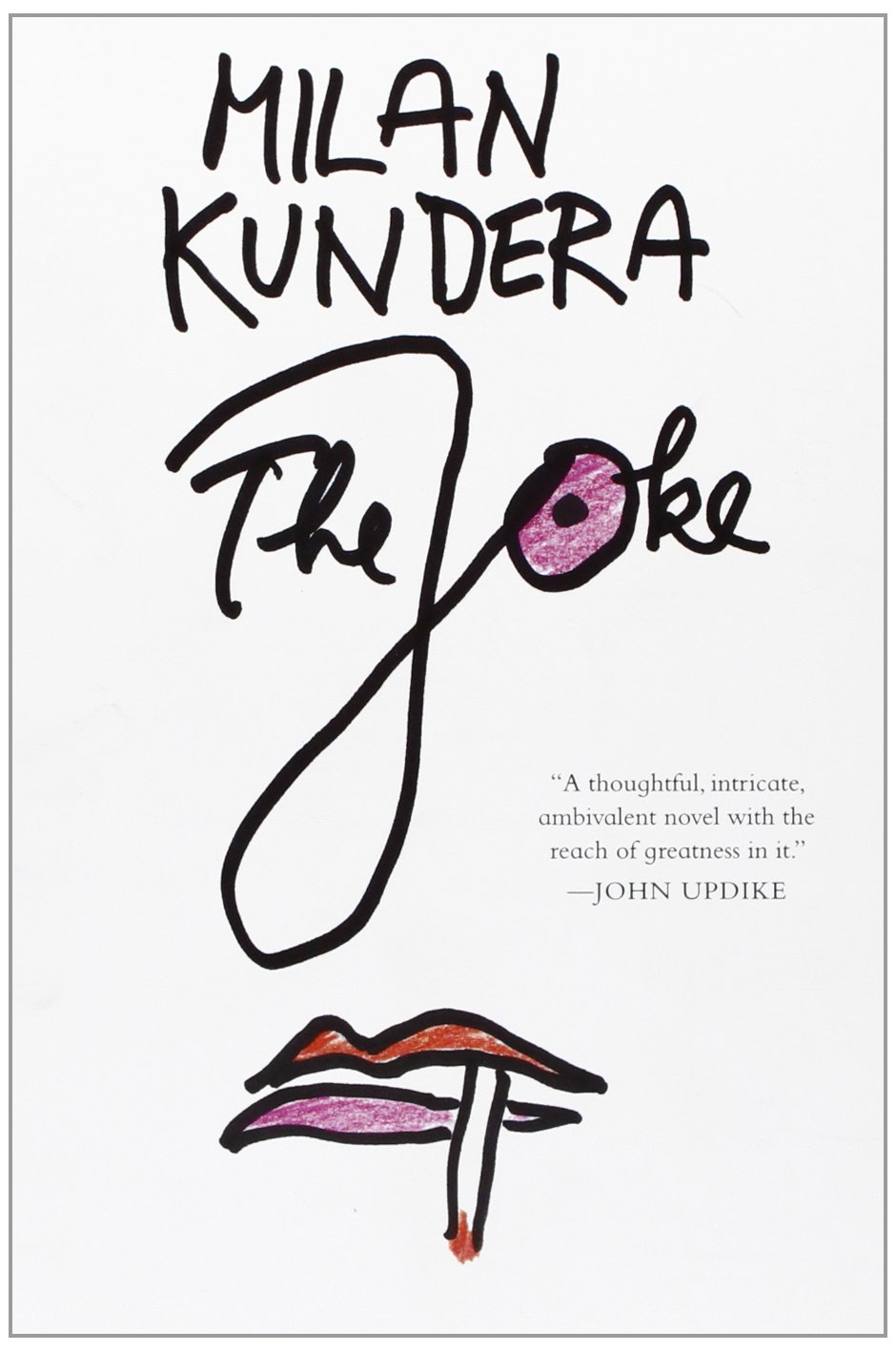
The Joke – Milan Kundera (Le Monde’s 100 Books of the Century #47)

This is part of a series of occasional posts where I look at works from Le Monde’s 100 Books of the Century.  Please see the separate page (link at the top) for the full list of books and an explanation of why I would do such a thing.

The Joke (1967; trans. Michael Henry Heim 1982*)  is the first Milan Kundera I’ve read, as I found his massive intellectual-philosopher reputation intimidating to my tiny brain.  However, I found this, his first novel, very readable so who knows, maybe I will tackle the cumbersomely-titled The Unbearable Lightness of Being at some point?

Ludvik lives in 1950s communist Czechoslovakia (as it then was) and is sulking when he sends his girlfriend, Marketa a facetious postcard:

“Optimism is the opium of the people! A healthy atmosphere stinks of stupidity! Long live Trotsky!”

Unfortunately, as we who live in the age of twitter know, irony is not always apparent in the written word and the authorities do not appreciate his sentiments. He is thrown out of the Party and sent to a labour camp with other political dissidents.  The story is told from the viewpoint of Ludvik, his friend Jaroslav who is interested in Moravian culture, lecturer Kostka who is Christian in the face of Ludvik’s atheism, and journalist Helena who is used cruelly to facilitate a revenge act.

As Ludvik looks back on his interrupted career and the injustice he has suffered, Kundera offers an incisive commentary on the effect of repressive regimes, but also questions how far all of us can lose sight of ourselves in the face of societal pressures:

“When the Comrades branded my conduct and my smile as intellectual (another notorious pejorative of the times) I actually believed them. I couldn’t imagine (I wasn’t bold enough to imagine) that everyone else might be wrong, and that the Revolution itself, the spirit of the times, might be wrong, and I, an individual, might be right. I began keeping tabs on my smiles, and soon I felt a tiny crack opening up between the person I’d been and the person I should be (according to the spirit of the times) and tried to be.”

Ludvik attempts to enact a revenge for his treatment, but it does not go as planned. He realises that the man who has become the focus of his anger is only a man, and that the issues are larger than a single person.

“How would I explain I used my hatred to balance out the weight of evil I bore as a youth? How would I explain I considered him the embodiment of all the evil I had ever known? How would I explain I needed to hate him?”

Overall, the sense is of an almost Beckettian absurdity. There isn’t the surrealism of Beckett, but certainly the sense of futility and powerlessness of the individual in the face of an indifferent world. Kundera evokes this lightly, so The Joke is not a heavy read, although it considers huge themes. While the politics are particularly relevant to Europe in the last century, the story moves beyond the specific to challenge the role of the individual within structures in which we live, how much agency we have, and what responsibility that brings with it.

“what if history plays jokes? And all at once I realise how powerless I was to revoke my own joke: I myself and my life as a whole had been involved in a joke much more vast (all-embracing) and absolutely irrevocable.”

Kundera has been exiled in France since 1975 after criticising the repressive nature of the then Czech government. The Joke is not self-righteous or overly polemical: it portrays, Kundera writes in the introduction, a man “condemned to triviality”.  While this ironical awareness distanced me from Ludvik somewhat and stopped me totally loving this novel, it also prevents The Joke being pompous, and instead funny, sad, tragic and wise.

To end, an apt song which I hope a book blogger who likes singers called Barry will enjoy even though it’snot Barry singing, and a video that is most definitely of a certain era (it wasn’t all repressive politics in the 1960s kids, there were psychotropic drugs too!):

*It’s worth seeking out a later translation of the novel, as Kundera was unhappy with the first English translations but has authorised the later ones