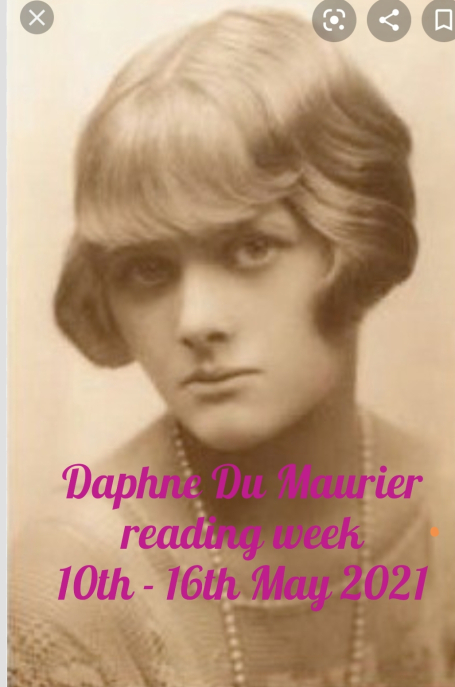
“Life has to be endured, and lived. But how to live it is the problem.” (Daphne du Maurier)

I was disappointed to miss posting for Ali’s annual Daphne du Maurier Reading Week this year, due to the demands of blogging on novellas every day for a month, so once that madness was over I thought I would enjoy a visit to this ever-readable author.

(Also, thank you to everyone who commented on which Big Massive Tome I should pick up after so many novellas. Bleak House was far and away the winner, so I’m embarking on Dickensian legal wrangling next 😊)

Apparently DDM said that Frenchman’s Creek (1941) was the only romantic novel she wrote. This meant I went into it expecting a similar experience to when I read Jamaica Inn, that is: enjoying it but wishing I had read it as a teenager. Now I’m older I’m more inclined towards the psychological darkness of My Cousin Rachel and her frankly terrifying short stories.

However, these expectations were confounded. Frenchman’s Creek can definitely be read as a romance: a young beautiful noblewoman leaves her stifling court life and starts running around the Cornish coast with a sexy French pirate. But I thought there were some much more interesting themes being explored in this novel too.

Dona St Columb is married to the ineffectual Harry, and is part of the indulgent court of Charles II. After a particular prank that she regrets, she leaves London and makes her way to Harry’s country pile in Cornwall.

“The sense of futility had been growing upon her for many months, nagging at her now and again like dormant toothache, but it had taken Friday night to arouse in her that full sense of self-loathing an exasperation, and because of Friday night she was jolting backwards and forwards now in this damnable coach, bound on a ridiculous journey to a house she had seen once in her life and knew nothing about, carrying with her, in anger and irritation, the two surprised children and their reluctant nurse.”

Once there, her pompous neighbour lets her know that dangers lurk amongst the beautiful countryside and coast, in the form of a successful pirate from Brittany.

“‘No lives have been lost as yet, and none of our women have been taken,’ said Godolphin stiffly, ‘but as this fellow is a Frenchman we all realise that it is only a question of time before something dastardly occurs.’”

Throughout the novel anyone expressing xenophobia is shown to be monumentally stupid, which is not always what I expect in novels of this period and it was certainly refreshing.

It isn’t long before Dona crosses paths with the captain of La Mouette, Jean Benoit Aubréy. Undoubtedly his portrait is romantic: he sketches birds, reads poetry, and of course is extremely handsome. Dona finds she has much in common with Jean Benoit, namely the search for an authentic life and personal freedom. As his loyal man William explains:

 “’Approve and disapprove are two words that are not in my vocabulary, my lady. Piracy suits my master, and that is all there is to it. His ship is his Kingdom, he comes and goes as he pleases, and no man can command him. He is a law unto himself.’”

Dona longs for something similar, but it is clearly demonstrated how limited she is due to being a woman. She has to meet the expectations of domestic roles, and also of her class. It is the insistence of her male neighbours that brings Harry to Cornwall, and his mendacious friend Rockingham, who poses a real threat to Dona.

Du Maurier expertly builds the tension as a trap is laid for the pirate, and he takes phenomenal risks to outmanoeuvre his enemies. Frenchman’s Creek is real page-turner, but it is also a believable exploration of a woman’s search for meaning and personal agency in her life. Her romantic partner is fully portrayed but not overly dwelt upon – this is Dona’s story and the romantic relationship is one that brings her back to herself:

“She felt, in a sense, like someone who had fallen under a spell, under some strange enchantment, because this sensation of quietude was foreign to her, who had lived hitherto in a turmoil of sound and movement. And yet at the same time the spell awoke echoes within her that she recognised, as though she had come to a place she had known always, and deeply desired, but had lost, through her own carelessness, or through circumstances, or the blunting of her own perception.”

Du Maurier really is so good at what she does. In Frenchman’s Creek she creates a compelling adventure alongside some lovely evocations of the natural world while highlighting the enduring challenges of the expectations placed on women. Dona’s quest for a life that will enable a fulfilling expression of self remains as relevant and compelling as ever.

“Much will be forgotten then, perhaps, the sound of the tide on the mud flats, the dark sky, the dark water, the shiver of the trees behind us and the shadows they cast before them, and the smell of the young bracken and the moss. Even the things we said will be forgotten, the touch of hands, the warmth, the loveliness, but never the peace that we have given to each other, never the stillness and the silence.”

I wanted to end with a trailer for the 1944 film adaptation with Joan Fontaine, but alas I couldn’t find it anywhere. So here is a clip from the 1998 BBC adaptation, which for reasons best known to itself has moved the story to the time of the Glorious Revolution and completely invented a scene. Has anyone seen this version? It doesn’t look very enticing but I do think Tara Fitzgerald is a good actor:

“What goes on in the twisted, tortuous minds of women would baffle anyone.” (Daphne du Maurier, Rebecca)

This week is Daphne du Maurier Reading Week, hosted by Ali who shares a birthday with the author today. It’s always a wonderful event so do check out the posts!

I’m a bit consumed with Novella a Day in May at the moment, but Ali said you can participate in DDMReadingWeek with a short story, which was very tempting. I was so impressed when I read the NYRB Classics short story collection Don’t Look Now for DDMReadingWeek back in 2019, and I have the Virago collection The Breaking Point in my TBR (luckily they only have one story in common, The Blue Lenses). The Alibi is the first story in the Virago collection.

The story opens with James Fenton and his wife Edna taking their usual Sunday stroll along Albert Embankment. A picture of middle-class contentment, but you know that this being du Maurier, anything remotely safe and familiar is about to be undermined.

And it is. Passing a nanny “pushing a pram containing identical twins with round faces like Dutch cheeses”, his wife mentions arranging dinner with their friends, and among all this domesticity Fenton suddenly feels entirely disassociated. He could kill someone.

“‘They don’t know,’ he thought, ‘those people inside, how one gesture of mine, now, at this minute, might alter their world. A knock on the door, and someone answers – a woman yawning, an old man in carpet slippers, a child sent by its parents in irritation; and according to what I will, what I decide, their whole future will be decided. Faces smashed in. Sudden murder. Theft. Fire.’ It was as simple as that.”

He decides he will murder someone entirely at random. In order to undertake his nefarious plan, he takes a room in a seedy flat, sublet by Madame Kaufman, a woman worn down by life, living with her small son Johnnie.

To justify his taking of the room he claims to be a painter, and goes as far as buying canvases and oils. At this point, his plan starts to go awry…

Everything that I love about du Maurier was in this story. The creepily destabilising of the familiar; the resolute ordinariness of evil; the sense that anything could happen and that whatever it is would be horribly believable. There was also some humour in the portrayal of the deeply unpleasant James Fenton:

“If there was one thing he could not stand it was a woman who argued, a woman who was self-assertive, a woman who nagged, a woman who stood upon her rights. Because of course they were not made for that. They were intended by their Creator to be pliable, and accommodating, and gentle, and meek. The trouble was that they were so seldom like that in reality.”

The end of the story completely reframed all that had gone before – du Maurier is certainly a writer that keeps her readers on their toes.

I’m really looking forward to finishing the collection once I’ve stopped consuming novellas at quite such a rapid rate. Many thanks Ali, for hosting this wonderful event, and a very happy birthday to you!

“I like simple things, books, being alone, or with somebody who understands.” (Daphne du Maurier)

This is my contribution to Ali’s Daphne du Maurier reading week, and much to my own amazement I’ve managed to post on time – hooray! I really enjoyed taking part in 2019 and reading du Maurier’s creepy, unsettling short stories. This time I’ve plumped for two of her most famous novels which I’ve never got round to reading, despite enjoying Rebecca as a teenager.

Firstly, Jamaica Inn (1936), a gothic period drama set in the 1820s. Mary Yellan is 23 when her mother dies, leaving her orphaned and having to live with her Aunt Patience, who is married to Joss Merlyn, landlord of the eponymous coaching inn. Mary would like to live alone and run her own farm, which is clearly a ridiculous notion:

“‘A girl can’t live alone, Mary, without she goes queer in the head, or comes to evil. It’s either one or the other. Have you forgotten poor Sue, who walked the churchyard at midnight with the full moon, and called upon the lover she had never had? And there was one maid, before you were born, left an orphan at sixteen. She ran away to Falmouth and went with the sailors.’”

So off she treks to a “wild and lonely spot” 12 miles outside Bodmin in Cornwall.  Du Maurier does a great job of creating gothic unease, both in the scenery and the relationships within Mary’s family.

“To the west of Jamaica high tors raised their heads ; some were smooth like downland, and the grass shone yellow under the fitful winter sun; but others were sinister and austere, their peaks crowned with granite and great slabs of stone.  Now and again the sun was obscured by cloud, and long shadows fled over the moors, like fingers. Colour came in patches; sometimes the hills were purple, ink-stained and mottled, and then a feeble ray of sun would come from a wisp of cloud, and one hill would be golden-brown while his neighbour still languished in the dark. The scene was never once the same, for it would be the glory of high noon to the east, with the moor as motionless as desert sand; and away to the westward arctic winter fell upon the hills, brought by a jagged cloud shaped like a highwayman’s cloak, that scattered hail and snow and a sharp spittle rain on to the granite tors.”

Joss is violent and binges on alcohol, and Mary’s Aunt Patience is completely destroyed by her marriage. She serves a useful dramatic purpose, providing the reason that morally upright Mary doesn’t report her uncle when it emerges that he makes his money through wrecking: luring ships onto rocks, murdering the sailors and stealing the loot.

“And, although there should be a world of difference between the smile of a man and the bared fangs of a wolf, with Joss Merlyn they were one and the same.”

The portrayals of the criminals in Jamaica Inn are dated, with more than a hint of ableism and classism. But Joss Merlyn is slightly more complex, and there is a sense of the pain he has experienced in his life that has led to him becoming the man he is. By enduring her life at Jamaica Inn, Mary meets her uncle’s brother Jem, and romance ensues:

“He was no more than a common horse-thief, a dishonest scoundrel, when all was said and done[…] Because he had a disarming smile and his voice was not unpleasing, she had been ready to believe in him”

What follows is a well-paced tale of Mary being drawn into her uncle’s life of crime far more than she would like, yet also feeling increasingly alienated from the good people of the town. It was this latter aspect that interested me most. What du Maurier seemed to be exploring was how a woman finds her own way in the world, and how the easiest path may not be the truest one.

“There would never be a gentle season here, thought Mary;”

Through the course of the novel Mary learns that a gentle season may not be what she wants; that her authentic life is one not led within the heart of society. Ultimately she’s quite a tough heroine, and she forges her own path.

At first I wasn’t sure Jamaica Inn was really for me: it seemed a bit formulaic and I’m not really one for gothic romance – usually the men are abhorrent, violence is indulged and somehow supposed to be attractive. Yet Jem could be gentle with Mary and they actually had a laugh together which is not very gothic at all. Sexual attraction is also dealt with frankly, and although it is a romantic tale (a young pretty girl wandering on the wild moors, a ruggedly handsome lover…) in some ways romance is given short shrift:

“There was precious little romance in nature, and she would not look for it in her own life. She had seen the girls at home walk with the village lads; and there would be a holding of hands, and blushing and confusion, and long-drawn sighs, and a gazing at the moonlight on the water […] They would look at the stars and the moon, or the darning sunset if it was summer weather, and Mary, coming out of the cow-shed, wiped the sweat from her face with dripping hands, and thought of the new-born calf she had left beside its mother. She looked after the departing couple, and smiled, and shrugged her shoulders, and, going into the kitchen, she told her mother there would be a wedding in Helford before the month was past.”

I wish I’d read Jamaica Inn after Rebecca in my teens, I probably would have loved it then. Reading it at 44 means it will probably not be amongst my favourite du Maurier – I didn’t find as much to admire as I did with her short stories –  but I thought she put an interesting heroine amongst the romantic tropes and her descriptions of the natural world are stunning. She also succeeded in writing a page-turning ripping yarn, and sometimes that is exactly what is needed when you pick up a novel.

The BBC adapted Jamaica Inn in 2014. I watched it, but the main thing I remember is everyone complaining about the mumbling:

Secondly, My Cousin Rachel (1951) which I thought was excellent. Du Maurier’s voice felt more individual in this and I wondered if in the intervening 15 years she had become more confident in her craft. The story and characterisation seemed more complex too.

It opens with a fairly graphic description of a hanged man that I could have done without, but it serves well in introducing the narrator Philip, orphaned and subsequently raised by his cousin Ambrose, a misogynist landowner, adored by Philip despite his uncompromising ways.

Du Maurier foreshadows the events of the story, and also it’s ambiguity:

“No one will ever guess the burden of blame I carry on my shoulders; nor will they know that every day, haunted still by doubt, I ask myself a question which I cannot answer. Was Rachel innocent or guilty?”

Ambrose in middle-age takes his winters abroad, for the sake of his chest. There he meets the titular distant relative, and they marry. Philip is perturbed by this, but not nearly as much as he is when Ambrose’s letters become infrequent, scribbled and paranoid:

“For God’s sake come to me quickly. She has done for me at last, Rachel my torment. If you delay, it may be too late. Ambrose.”

Philip hastens to Italy, only to find Ambrose died three weeks previously and his wife has disappeared. When he returns to England and finds Rachel is due to visit he is determined to expose her for the villain she is. This resolve lasts, ooh, about five minutes:

“I was glad I had the bowl of my pipe to hold, and the stem to bite upon; it made me feel more like myself and less like a sleep-walker, muddled by a dream. There were things I should be doing, things I should be saying, and here was I sitting like a fool before the fire, unable to collect my thoughts or my impressions. The day, so long-drawn-out and anxious, was now over, and I could not for the life of me decide whether it had turned to my advantage or gone against me.”

The local people are equally charmed by Rachel’s beauty and wit. Philip’s friend Louise, the daughter of his guardian, points out Rachel is beautiful – something Philip has not mentioned. The skirting around his attraction for Rachel exposes him as an unreliable narrator, insofar as we would all be unreliable narrators of our own lives:

““How simple it must be for a woman of the world, like Mrs Ashley, to twist a young man like yourself around her finger,” said Louise.

I turned on my heel and left the room. I could have struck her.”

What follows is what du Maurier seems so expert at: building an atmosphere of tense unease, where the truth of a situation remains determinedly obscure. Philip is naïve, but are the more sceptical viewpoints of his friends and advisors any more valid?

“Here I was, twenty-four, and apart from the conventional years at Harrow and Oxford I knew nothing of the world but my own five hundred acres. When a person like my cousin Rachel moved from one place to another, left one home for a second, and then a third; married once, then twice, how did it feel? Did she shut the past behind her like a door and never think of it again, or was she beset with memories from day to day?”

Whether Rachel is conniving and manipulative is difficult to ascertain and this works so well in sustaining tension throughout. It also enables du Maurier to demonstrate how a beautiful woman with very few rights in law is subject to the fantasies and whims of men who hold the power. Rachel remains unknown to the reader because she remains unknown to Philip, and yet he professes he loves her.

Philip is not likeable – he is callow, arrogant, and violent. But he is somewhat sympathetic as he knows so little of life, floundering around in situations he doesn’t understand and is painfully ill-equipped to manage. Ultimately it is this quality that provides the persistent mystery of My Cousin Rachel, a mystery we must all find our own answer to:

“The point is, life has to be endured, and lived. But how to live it is the problem.”

My Cousin Rachel was adapted most recently on film in 2017. I’ve not seen it but it’s certainly beautifully shot if this trailer is anything to go by:

PS Happy birthday Daphne, born on this day in 1907, and to #DDMreadingweek host Ali – have a wonderful day!

“Women want love to be a novel. Men, a short story.” (Daphne du Maurier)

This week is Daphne du Maurier reading week, hosted by Ali over at heavenali. It’s also Ali’s birthday today, so Happy Birthday Ali!

I read Rebecca as a teenager and thought it was great, but somehow never read anything else by du Maurier. I had the NYRB collection of her short stories in the TBR, and yet I always gravitate towards the novels I have, so I’m glad #DDMreadingweek gave me the kick I needed, as it’s a great read.

I’m rubbish at reviewing short story collections so please bear with me. This is an excellent selection of nine stories, five of which are 40+ pages, the shorter ones coming in between 10-20ish pages. For me the longer stories were the stronger in the collection – although all are compelling reads – so I’ll concentrate on a couple of those.

The first two were made into incredibly famous films, so I won’t dwell on those as many of you will know the stories. What I will say is Don’t Look Now is just as creepy as the film but with a really dark humour to it, and The Birds is miles better than the film (I’m not really a Hitchcock fan) and totally freaked me out to the extent that I’ve been looking askance at every pigeon which has crossed my path since.

In Blue Lenses,  Marda West has an operation to restore her sight. She is in hospital, intensely vulnerable, dependent on the nursing staff, her doctors and her husband. She has only what they say and the sound of their voices to go on. Already she feels unnerved, even around her husband:

“Now, for no known reason except that darkness, perhaps, had made her more sensitive, she was shy to discuss her eyes with him. The touch of his hand was the same as it had ever been, and his kiss, and the warmth of his voice; but always, during these days of waiting, she had the seed of fear that he, like the staff at the hospital, was being too kind. The kindness of those who knew towards the one who must not be told.”

She has the operation to fit the titular lenses as a temporary measure and is warned they will make everything monochrome. On using her eyes for the first time with the lenses, Marda is shocked to discover is that she now sees everyone with the head of an animal.

This could be funny, or ridiculous, but in du Maurier’s hands it is deeply upsetting. There is the suggestion that the animal Marda sees tells her something about the person. One nurse is a benign cow, the other a kitten. Her doctors are both terrier dogs, one a tenacious Jack Russell, the other a sweet natured Highland. Someone she trusted is a snake, possibly in cahoots with a vulture…

At first Marda believes it is an elaborate joke being played on her, but then she goes to the window:

 “An elderly cod, leaning on two sticks, was being helped into a waiting car by the boar headed porter. It could not be plot. They could not know she was watching them.”

She is completely isolated. No-one will believe her and they will think she is mad. Who can she trust? The cow? The Highland terrier? What will Marda do with this newfound insight into people and their motivations? What will happen when the permanent lenses are fitted?

“The utter hopelessness of her position was like damnation itself. This was her hell. She was quite alone, coldly conscious of the hatred and cruelty about her.”

Blue Lenses takes a bizarre premise to question what we choose to see, how much we really know people, and to dramatise how vulnerable we are when we trust. The denouement is devastating.

Split Second begins like many a domestic fiction, and uses this familiarity to lull us into a false sense of security:

“Mrs Ellis was methodical and tidy. Unanswered letters, unpaid bills, the litter and rummage of a slovenly writing-desk were things she abhorred. Today, more than usual, she was in what her late husband used to call her ‘clearing’ mood […] First, she checked the linen. The smooth white sheets lying in rows upon their shelves, pillow slips beside, and one set still in its pristine newness from the shop, tied with blue ribbon, waiting for a guest who never came.”

So far, so deeply ordinary. Then Mrs Ellis goes for a walk, a walk she has done many times before, and when she returns it is to find strangers living in her house and no-one with any idea who she is. The police are called, but to Mrs Ellis’ horror it is she who is taken to the station:

“Could this officer and his subordinate be genuine members of the police force? Or were they, after all, members of the gang? This would explain their strange faces, their obvious mishandling of the situation. In which case they were now going to take her away to some lair, drug her, kill her possibly.

‘I’m not going with you,’ she said swiftly.

‘Now Mrs Ellis,’ said the constable, ‘don’t give any trouble. You shall have a cup of tea down at the station, and no-one is going to hurt you.’

He seized her arm. She tried to shake it off. The young policeman moved closer.”

Split Second is incredibly clever in how it positions the reader. It shows us the epitome of middle-class calm, we think we know the story we are getting, then like the experience of Mrs Ellis, everything is thrown in complete disarray. Twice I thought I had the answer to what was happening, and twice I was wrong, having followed the false trails du Maurier had set up.

Split Second is a sad story, and one that suggests we can attempt to create all the calm and order we like in our own small setting, it will be no match for the chaos and disarray of other people in the wider world.

The common theme across many of the stories is people doubting their view of reality: feeling isolated and threatened with nowhere to turn. It is this that makes du Maurier’s stories so unsettling and upsetting. The horror comes not from the more outlandish situations but from the feeling of dread, of creeping insanity with no sanctuary in sight.

I’m sure someone told me once that there’s a lot of snobbery around Daphne du Maurier, that she was seen as a popular writer and therefore not a very good one. It really is ridiculous; du Maurier is such a good storyteller, she draws you in from the start, holds you there until she’s ready to let you go, and makes it look easy.

To end, there are many cinematic adaptations of du Maurier to choose from, but I’ve picked the title story of this collection, as it was an adaptation she approved of (unlike The Birds):