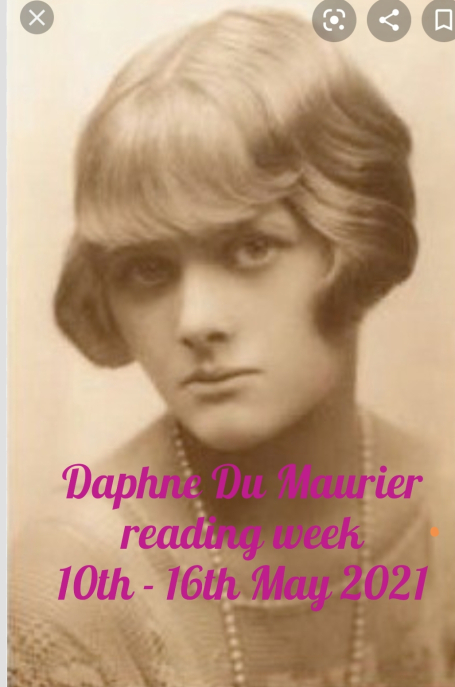
This is my contribution to Ali’s Daphne du Maurier reading week, and much to my own amazement I’ve managed to post on time – hooray! I really enjoyed taking part in 2019 and reading du Maurier’s creepy, unsettling short stories. This time I’ve plumped for two of her most famous novels which I’ve never got round to reading, despite enjoying Rebecca as a teenager.
Firstly, Jamaica Inn (1936), a gothic period drama set in the 1820s. Mary Yellan is 23 when her mother dies, leaving her orphaned and having to live with her Aunt Patience, who is married to Joss Merlyn, landlord of the eponymous coaching inn. Mary would like to live alone and run her own farm, which is clearly a ridiculous notion:
“‘A girl can’t live alone, Mary, without she goes queer in the head, or comes to evil. It’s either one or the other. Have you forgotten poor Sue, who walked the churchyard at midnight with the full moon, and called upon the lover she had never had? And there was one maid, before you were born, left an orphan at sixteen. She ran away to Falmouth and went with the sailors.’”
So off she treks to a “wild and lonely spot” 12 miles outside Bodmin in Cornwall. Du Maurier does a great job of creating gothic unease, both in the scenery and the relationships within Mary’s family.
“To the west of Jamaica high tors raised their heads ; some were smooth like downland, and the grass shone yellow under the fitful winter sun; but others were sinister and austere, their peaks crowned with granite and great slabs of stone. Now and again the sun was obscured by cloud, and long shadows fled over the moors, like fingers. Colour came in patches; sometimes the hills were purple, ink-stained and mottled, and then a feeble ray of sun would come from a wisp of cloud, and one hill would be golden-brown while his neighbour still languished in the dark. The scene was never once the same, for it would be the glory of high noon to the east, with the moor as motionless as desert sand; and away to the westward arctic winter fell upon the hills, brought by a jagged cloud shaped like a highwayman’s cloak, that scattered hail and snow and a sharp spittle rain on to the granite tors.”
Joss is violent and binges on alcohol, and Mary’s Aunt Patience is completely destroyed by her marriage. She serves a useful dramatic purpose, providing the reason that morally upright Mary doesn’t report her uncle when it emerges that he makes his money through wrecking: luring ships onto rocks, murdering the sailors and stealing the loot.
“And, although there should be a world of difference between the smile of a man and the bared fangs of a wolf, with Joss Merlyn they were one and the same.”
The portrayals of the criminals in Jamaica Inn are dated, with more than a hint of ableism and classism. But Joss Merlyn is slightly more complex, and there is a sense of the pain he has experienced in his life that has led to him becoming the man he is. By enduring her life at Jamaica Inn, Mary meets her uncle’s brother Jem, and romance ensues:
“He was no more than a common horse-thief, a dishonest scoundrel, when all was said and done[…] Because he had a disarming smile and his voice was not unpleasing, she had been ready to believe in him”
What follows is a well-paced tale of Mary being drawn into her uncle’s life of crime far more than she would like, yet also feeling increasingly alienated from the good people of the town. It was this latter aspect that interested me most. What du Maurier seemed to be exploring was how a woman finds her own way in the world, and how the easiest path may not be the truest one.
“There would never be a gentle season here, thought Mary;”
Through the course of the novel Mary learns that a gentle season may not be what she wants; that her authentic life is one not led within the heart of society. Ultimately she’s quite a tough heroine, and she forges her own path.
At first I wasn’t sure Jamaica Inn was really for me: it seemed a bit formulaic and I’m not really one for gothic romance – usually the men are abhorrent, violence is indulged and somehow supposed to be attractive. Yet Jem could be gentle with Mary and they actually had a laugh together which is not very gothic at all. Sexual attraction is also dealt with frankly, and although it is a romantic tale (a young pretty girl wandering on the wild moors, a ruggedly handsome lover…) in some ways romance is given short shrift:
“There was precious little romance in nature, and she would not look for it in her own life. She had seen the girls at home walk with the village lads; and there would be a holding of hands, and blushing and confusion, and long-drawn sighs, and a gazing at the moonlight on the water […] They would look at the stars and the moon, or the darning sunset if it was summer weather, and Mary, coming out of the cow-shed, wiped the sweat from her face with dripping hands, and thought of the new-born calf she had left beside its mother. She looked after the departing couple, and smiled, and shrugged her shoulders, and, going into the kitchen, she told her mother there would be a wedding in Helford before the month was past.”
I wish I’d read Jamaica Inn after Rebecca in my teens, I probably would have loved it then. Reading it at 44 means it will probably not be amongst my favourite du Maurier – I didn’t find as much to admire as I did with her short stories – but I thought she put an interesting heroine amongst the romantic tropes and her descriptions of the natural world are stunning. She also succeeded in writing a page-turning ripping yarn, and sometimes that is exactly what is needed when you pick up a novel.
The BBC adapted Jamaica Inn in 2014. I watched it, but the main thing I remember is everyone complaining about the mumbling:
Secondly, My Cousin Rachel (1951) which I thought was excellent. Du Maurier’s voice felt more individual in this and I wondered if in the intervening 15 years she had become more confident in her craft. The story and characterisation seemed more complex too.
It opens with a fairly graphic description of a hanged man that I could have done without, but it serves well in introducing the narrator Philip, orphaned and subsequently raised by his cousin Ambrose, a misogynist landowner, adored by Philip despite his uncompromising ways.
Du Maurier foreshadows the events of the story, and also it’s ambiguity:
“No one will ever guess the burden of blame I carry on my shoulders; nor will they know that every day, haunted still by doubt, I ask myself a question which I cannot answer. Was Rachel innocent or guilty?”
Ambrose in middle-age takes his winters abroad, for the sake of his chest. There he meets the titular distant relative, and they marry. Philip is perturbed by this, but not nearly as much as he is when Ambrose’s letters become infrequent, scribbled and paranoid:
“For God’s sake come to me quickly. She has done for me at last, Rachel my torment. If you delay, it may be too late. Ambrose.”
Philip hastens to Italy, only to find Ambrose died three weeks previously and his wife has disappeared. When he returns to England and finds Rachel is due to visit he is determined to expose her for the villain she is. This resolve lasts, ooh, about five minutes:
“I was glad I had the bowl of my pipe to hold, and the stem to bite upon; it made me feel more like myself and less like a sleep-walker, muddled by a dream. There were things I should be doing, things I should be saying, and here was I sitting like a fool before the fire, unable to collect my thoughts or my impressions. The day, so long-drawn-out and anxious, was now over, and I could not for the life of me decide whether it had turned to my advantage or gone against me.”
The local people are equally charmed by Rachel’s beauty and wit. Philip’s friend Louise, the daughter of his guardian, points out Rachel is beautiful – something Philip has not mentioned. The skirting around his attraction for Rachel exposes him as an unreliable narrator, insofar as we would all be unreliable narrators of our own lives:
““How simple it must be for a woman of the world, like Mrs Ashley, to twist a young man like yourself around her finger,” said Louise.
I turned on my heel and left the room. I could have struck her.”
What follows is what du Maurier seems so expert at: building an atmosphere of tense unease, where the truth of a situation remains determinedly obscure. Philip is naïve, but are the more sceptical viewpoints of his friends and advisors any more valid?
“Here I was, twenty-four, and apart from the conventional years at Harrow and Oxford I knew nothing of the world but my own five hundred acres. When a person like my cousin Rachel moved from one place to another, left one home for a second, and then a third; married once, then twice, how did it feel? Did she shut the past behind her like a door and never think of it again, or was she beset with memories from day to day?”
Whether Rachel is conniving and manipulative is difficult to ascertain and this works so well in sustaining tension throughout. It also enables du Maurier to demonstrate how a beautiful woman with very few rights in law is subject to the fantasies and whims of men who hold the power. Rachel remains unknown to the reader because she remains unknown to Philip, and yet he professes he loves her.
Philip is not likeable – he is callow, arrogant, and violent. But he is somewhat sympathetic as he knows so little of life, floundering around in situations he doesn’t understand and is painfully ill-equipped to manage. Ultimately it is this quality that provides the persistent mystery of My Cousin Rachel, a mystery we must all find our own answer to:
“The point is, life has to be endured, and lived. But how to live it is the problem.”
My Cousin Rachel was adapted most recently on film in 2017. I’ve not seen it but it’s certainly beautifully shot if this trailer is anything to go by:
PS Happy birthday Daphne, born on this day in 1907, and to #DDMreadingweek host Ali – have a wonderful day!


 madame bibi lophile recommends