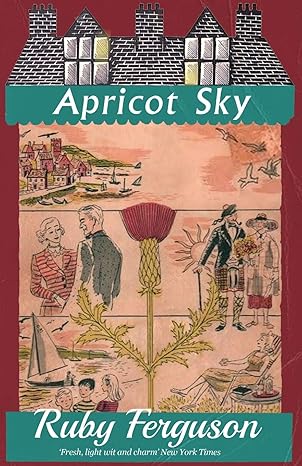
“She had adored her husband, and was very fond of her French pepper-mill.” (Margery Sharp, The Foolish Gentlewoman)

It’s been a busy month trying to get to grips with my new job, but I’m delighted to contribute to Dean Street December, hosted by Liz at Adventures in Reading, Running and Working from Home. This reading event provides a lovely end to the reading year, and it encouraged me to get The Foolish Gentlewoman by Margery Sharp (1948) off the TBR, which Dean Street Press publish as part of their Furrowed Middlebrow imprint.

I really enjoy Margery Sharp’s comic eye, and there’s a perfect example early in this novel in a description of the family’s Sealyham:

“His shaggy eyebrows and meditative gaze gave him an old-gentleman look; he sat there like a retired Colonel, newspaper laid aside, contemplating Socialism.”

The terrier’s family are hodgepodge: widowed fifty-five year old Isabel Brocken, “sentimental, affectionate, uncritical,” and her priggish brother-in-law Simon:

“Mr Brocken was not conceited enough to perceive in himself any compensating charms. To be loved without reason did not flatter him. He put up with Isabel’s affection, as he put up with Isabel, because he had to.”

As well as two younger people staying at the house: Isabel’s nephew Humphrey and her companion Jacqueline, both recovering from the recent war.

This unlikely group live a life of very little strife, ensconced in Isabel’s old family home of Chipping Lodge, sat in a suburb of London which escaped the bombs. (Unlike Simon’s house which is why he finds himself having to tolerate other people, while it is rebuilt.)

Keeping them in domestic order are the self-contained housekeeper Mrs Poole and her teenage daughter Greta.

Their domestic peace is shattered when Isabel invites her old school friend Tilly Cuff to stay indefinitely. The motivation stems from a perceived injustice she did to Tilly years ago, and a plan to make amends. For Tilly does not seem to have thrived:

“No-one ever fell in love with Tilly, not even curates.”

Simon, Humphrey and Jacqueline are horrified. Firstly by Isabel’s plan to leave Tilly all her money, and secondly by Tilly herself:

“Is she to be allowed to beggar herself for the sake of a peculiarly offensive incubus?”

Sharp is always good at villains without caricature, and Tilly is a perfect example. She is manipulative and mendacious, particularly towards Greta Poole. It is Greta and her mother that provide the greatest emotional engagement in the novel: Tilly’s treatment of them shows her to be a real threat, and Simon’s attitude towards them shows him not to be irredeemably hard-hearted.

Yet Tilly is also shown to be vulnerable, lonely and defensive. Although she is powerful in her ability to completely destabilise the entire household, really she has less resources, personal and financial, to draw on than anyone else.

I found The Foolish Gentlewoman to be a surprising page-turner, as I wanted to see how the household would escape Tilly! And yet, things didn’t quite pan out as I expected. Sharp has fun with confounding reader’s expectations:

“To set one’s foot on a tragic stage, and find that the part thrust into one’s hand belonged to a domestic comedy: to read on, and perceive in prospect a crisis after all potentially tragic: to turn the last page upon anticlimax. How inartistic, and yet how life like!”

Yes, anti-climatic in a sense, but wholly satisfying and enjoyable. I particularly liked the happy ending arranged for Simon:

“With no less than five persons had Mr Brocken narrowly escaped, if not intimacy, a degree of acquaintance that would have allowed any one of them to become a nuisance to him.”

A gentle joy made readily available thanks to the excellent Dean Street Press and Furrowed Middlebrow.

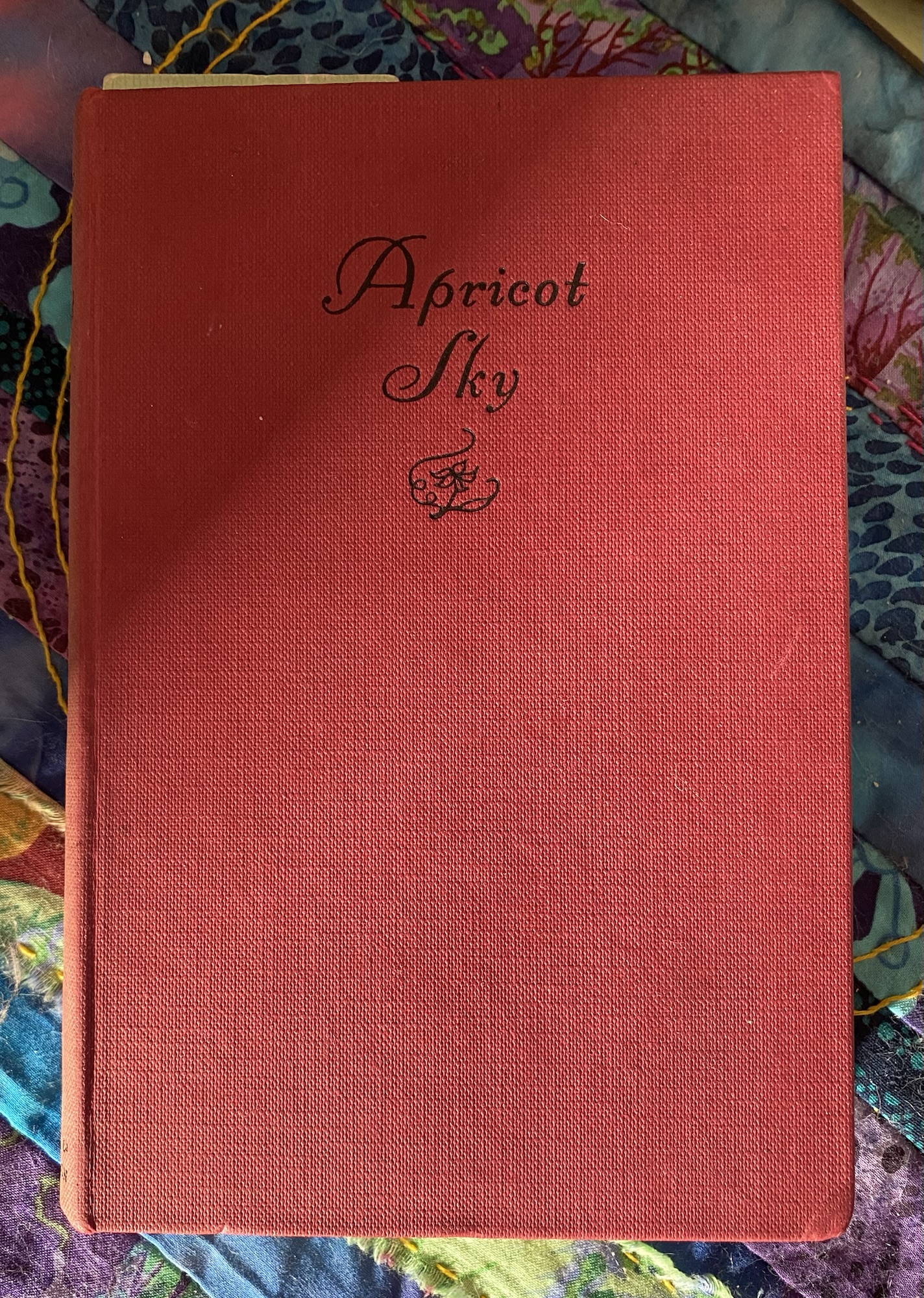
“Have you practised swooning?” (Ruby Ferguson, Apricot Sky)

This is my contribution to Dean Street December, a month-long celebration of this wonderful indie publisher, hosted by Liz at Adventures in Reading, Running and Working from Home.

Dean Street Press’ imprint Furrowed Middlebrow focuses on early and mid-twentieth century women writers, and it’s from this collection that I’ve chosen my read, Apricot Sky by Ruby Ferguson (1952 – please note for Simon and Kaggsy’s 1952 Club running next year!)

I must confess that rather than a DSP edition, my copy is a nice little hardback I found in my local charity shop, inscribed with the author’s love to Flossie and John 😊 I picked up her later novel The Leopard’s Coast at the same time, also given with the author’s love, so I wonder if Flossie and John lived near me and their books have been cleared out…?

Aside from the Jill pony books I read as a child, I only knew Ruby Ferguson from Lady Rose and Mrs Memmary  (1937) republished by Persephone Books. But I’d enjoyed that so much that I felt confident enough to swoop up the two books when I saw them; and what a total joy Apricot Sky turned out to be.

Set in 1948 in the Highlands of Scotland, the story follows the MacAlvey family through the events of one summer. A descriptive passage on the first page sets the tone:

“The charm of islands which changed their colour every few minutes, of lilac peaks smudged on the farthest horizon, of white-capped waves on windy days, of distant steamers chugging romantically on their ways, of little boats with faded brown sails scudding before the breeze, of sudden storms pouring fiercely across the terrific expanse of sky and water, of thousands of seabirds planing and diving, of floods of sunshine scattering millions of diamonds upon the rippling waves, all this made-up the view about which the MacAlvey’s visitors had so much to say while the MacAlvey’s themselves listened indulgently and with inward amusement.”

The MacAlvey’s are a nice family living a life not without trials but without any great drama, comfortably well-off and settled.

“Kilchro House was noted for its hospitality. It was a gay house where a gay family gave charming entertainment and never tried to descend into banality by prattling about themselves.”

The MacAlvey’s younger daughter Raine is due to marry Ian, brother of the Laird of Larrich. This is the thread which runs through the novel, as the wedding gathers apace for the September ceremony.

Raine’s older sister Cleo is back from three years in America, everyone expecting her much changed, but her heart stayed with her Highland home, and Neil, the Laird. Whenever she sees him she becomes utterly tongue-tied, and feels entirely inadequate alongside the charms of Inga Duthie, a sophisticated widow who is new to the area.

“Cleo MacAlvey could think of no worse desolation than that those she liked should not like her. She was a great deal more diffident than her sister Raine, who barged through life without caring whether people liked her or not, and was about as introverted as a fox-terrier puppy.”

Alongside these adult concerns are the younger children, left to their own devices. Primrose, Gavin, and Archie were orphaned by the war and live with their grandparents. The whole summer stretches before them:

“At Strogue there was no promenade and no cinema or skating-rink and only about three shops, and you couldn’t move without getting yourself in a mess with tar and fish and stuff left about, but everything you did there was full of exhilaration and had a way of turning out quite otherwise than you expected.”

They love boats and beaches and being out of doors. The only blight on their idyll is distant cousins Elinore and Cecil who come to stay for a few weeks. They are refined and self-contained, and in the case of Elinore, an unmitigated snob.

The children’s adventures are reminiscent of the Famous Five: there are islands, swimming and a big focus on picnics. There is post-war rationing to contend with, but it is seemingly straightforward to overcome – they frequently manage sweets, pies, jam, sandwiches and fizzy drinks.

For the adults, the trials are tedious houseguests in the shape of Dr and Mrs Leigh, and the appalling Trina, married to their son James. Mrs MacAlvey loves having guests though, and loves her family and her garden. Her part of the world gives her all she needs and she feels no desire to venture any further:

“She found herself unable to picture it, for she had never been to England, and always thought of it as being full of successful people living in Georgian houses.”

Despite being so rooted in her domestic life, she remains blissfully unaware of what her grandchildren get up to all day, and how tortured poor Cleo is by her unspoken love for Neil:

“Nobody talked about their feelings at Kilchro House, it was considered one stage worse than talking about your inside.”

I thoroughly enjoyed my summer with the MacAlvey family in a beautifully evoked part of the world, far away from chilly London. The stakes were soothingly low, and the humour was gentle. Any drama was short-lived, and things worked out exactly as they should.

If you are looking for a warm-hearted, escapist read, Apricot Sky will serve you well.

“‘All right,’ said Raine, holding out a ten-shilling note. ‘I’ll try anything once, even altering the course of history.’”

“Orange is red brought nearer to humanity by yellow.” (Wassily Kandinsky)

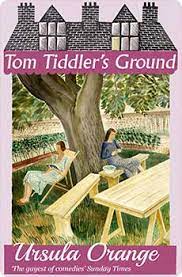
This is my contribution to Dean Street December hosted by Liz at Adventures in Reading, Running, and Working From Home. Tom Tiddler’s Ground by the delightfully named Ursula Orange (1941) is part of their Furrowed Middlebrow imprint and I thought it was an absolute joy.

It tells the story of Constance Smith and her childhood friend Caroline Cameron, who find themselves living together again in the early days of World War II. Caroline is urbane and worldly, leaving behind her life in London with her husband John. She is entirely self-focussed and amoral, but also quite caring regarding people. Despite her shortcomings, I really liked her.

Constance could not be more different. We are introduced to her early on through the thoughts of the billeting officer who is trying to persuade people in the quiet village of Chesterford to take evacuees:

“Mrs Latchford grimaced and lit a cigarette. A thoroughly unenviable job altogether, and she felt she deserved a few minutes respite with nice, schoolgirlish, foolish Constance Smith. Foolish? Well, of course, it always looked a little foolish to see a woman of over thirty behaving like an enthusiastic bride, even after two years of marriage. But apart from that and her volubility and her poppings out and her nippings in and all her silly mannerisms, was Constance at all foolish? Certainly she handled the relations-in-law-in-the-village situation well, or rather did not handle it at all, but accepted it so naturally and pleasantly that she might really be said to be on the best of terms with her sister-in-law, Mary Hodges, the local greengrocer’s wife.”

Her husband Alfred is an utterly self-centred snob, intent on social climbing and ashamed of his sister. He married well-to-do Constance for social advancement and he doesn’t love her. Caroline sees this clearly on arrival in the village with her daughter Margeurite.

The other evacuee is Mrs Gossage, who seems entirely disinterested in everyone, including her baby son Norman.  

We follow this unlikely group of housemates as they adjust to their much-changed living arrangements. The story moves between the characters but is told primarily from Caroline’s point of view, which I thought worked well. She has good insights into other people and is entirely clear-sighted about herself too:

“There was a certain note in her voice that led Caroline to suspect that Lavinia belonged to that large class of people who find children sweet, but rather prefer they should go and be sweet upstairs in the nursery. It was an attitude she entirely sympathised with and absolutely hated people for.”

Constance as narrator would be far too guileless to carry the reader along. And of course, Caroline’s arrival in the village offers an outsider’s view on the characters and various intrigues. But what is lovely too, is Caroline’s changing attitude towards the village. Initially she is greatly amused by everyone, but as time moves on she starts to see them as real people, her “strange lapses into sincerity” possibly becoming longer lasting. This isn’t a trite city-girl-learns-the-true-value-of-Things-when-forced-into-small-town-life tale however. Orange is not at all sentimental about people:

“Caroline, looking at the expression on Mary’s face, marvelled at the extraordinary cruelty of the thoroughly respectable woman.”

“There was no doubt Constance, in her misery, was very pathetic. There was no doubt she was also rather irritating.”

But there’s not a bitter tone either. I found the characters recognisable and portrayed with human understanding. Caroline would be rather a controversial figure for the time, but Orange doesn’t judge her.

“It’s my red finger-nails that put the idea of asking me into her head, I’m sure.”

I liked the fact that Caroline didn’t overly judge herself, which would seem somehow hypocritical, but she does recognise that her actions hurt people, which she regrets.

There are serious concerns in Tom Tiddler’s Ground; adultery, bigamy, child neglect and lack of choices for women. Somehow Orange balances that with a knowing humour without belittling the issues at all.

My favourite character was George, Constance’s gentle, drifting brother:

“What could you do with a man who loved women, who loved domestic life, but who (according to Constance) had never seemed to want to marry anyone in particular? A man who obviously adored other people’s children, but who had none of his own? A man who had plenty of personality and probably (under all that indolence) considerable abilities, but who had never settled any profession or career? The only answer was – nothing, you could do nothing with him. And […] that was, of course, what George preferred. Caroline liked him enormously.”

We learn more about George’s background, who to my twenty-first century eyes had PTSD from World War I. Orange builds to a satisfying denouement, tying up many characters pasts with the present in a way that promises a better future, despite the war.

I really loved Tom Tiddler’s Ground, and got very excited about the thought of exploring Ursula Orange further, thinking the humour and characterisation made her another Margery Sharp. However, Stacy Marking’s excellent introduction to this edition explains the publishers took exception to Caroline as a character, and so she adjusted her style for later books, which also contained more snobbery (somewhat in evidence here but not overly stressed – Mrs Gossage is definitely treated with condescension, but also compassion). If anyone has read any other novels by Ursula Orange I’d love to know how you found them, especially as DSP publish some other titles.

“‘I suppose we ought to be thinking about Christmas,’ said Constance, a few days later. Everybody became conscious of a very strong disinclination to think about anything of the sort.”

To end, it’s a time of year when Nat King Cole is on heavy rotation, and quite right too. Here he is singing about orange (sort of 😉 )