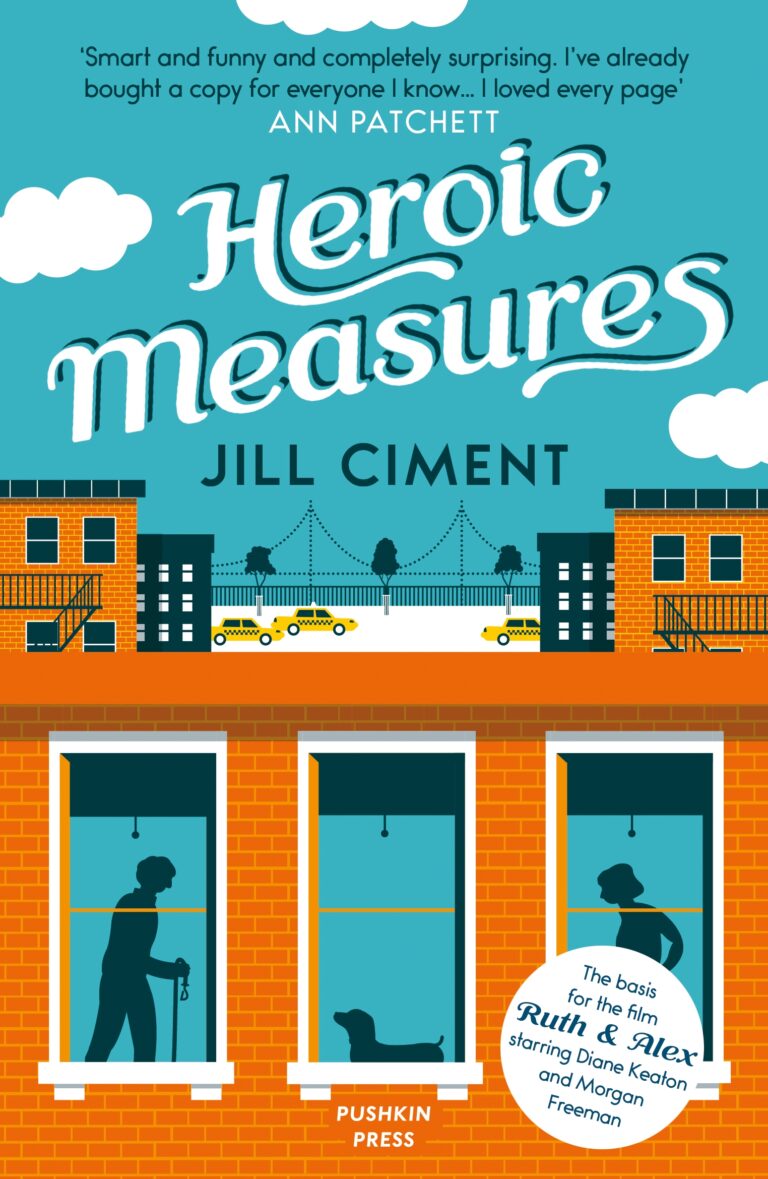
I might not have picked up Heroic Measures by Jill Ciment (2009) ordinarily, but it is published by the marvellous Pushkin Press and they’ve never done me wrong so far 😊 It turned out to be a nice book about nice people, gently humorous and engaging. It wasn’t overly sweet or sentimental, and I enjoyed it immensely. The right book at the right time.
Ruth and Alex Cohen are an older couple looking to sell their East Village apartment for a million dollars (I suspect the intervening fifteen years since publication have seen the relative price rocket even further). They can currently manage the five flights to their front door but they’re aware this is likely to change. Alex is an artist and Ruth a retired teacher; they live with their beloved dachshund Dorothy.
“Alex brought Dorothy home the day Ruth retired after three decades as a public school English teacher. Those first few nights tending to Dorothy’s mystifying needs and constant demands had reminded Ruth of a Victorian novel in which the husband acquires an orphan for his greying childless wife to raise.”
We follow their potential sale over a weekend where Dorothy is in the animal hospital. She is also advanced in years and she suddenly can’t move her back legs. We are privy to her thoughts as well as those of her humans.
The scenes where Alex and Ruth are managing a sick Dorothy were really moving. They weren’t over-the-top deliberately heartrending, but they were very affecting in portraying the deep upset when an animal is ill.
“Alex touches her sleeve: he’s found the source of the alarm, the metal buckle on Dorothy’s faux leopard collar. Ruth had bought the collar because she thought it gave Dorothy a risque, haughty look, an old dominatrix, say, whose specialty was biting. Ruth watches as Alex unclasps the buckle at the nape of Dorothy’s neck with an intimacy and caution, a husband removing his ill wife’s necklace.”
Over the weekend Ruth and Alex will have to deal with their ambivalence about the move – neither afraid of change, but unsure if this is a change they really want to push for:
“He’s been covering these walls with his imagery for almost half a century, as methodically as a clam secretes its essence to make its shell. When Lily had first peered into his studio during the appraisal, she proclaimed it would make a perfect nursery.”
“She can almost see the spines of her library arranged alphabetically, floor to ceiling. Finding a home for her books is no less important to Ruth than finding a museum for his paintings is to Alex.”
There is humour alongside these more melancholy aspects, making the novel seem very real. Lily the realtor and the various people who attend their open house provide some respite from their worries about Dorothy. In the background there is also the unease of a possible terrorist at large in the city, which Alex and Ruth are concerned will affect their apartment price. They also struggle with pushing buyers for more money. Neither of these considerations endear them to themselves.
They are deeply principled people, monitored during the McCarthy era, and their struggles with these materialist considerations lightens their characterisation and stops them seeming priggish.
“His wife – whose ethics has been his bedrock and his muse and his shackles, who wouldn’t lie about her beliefs to the house Un-American Activities Committee even when it cost them friends, passports, his first retrospective, almost her beloved teaching job”
I thought Ciment beautifully evoked the love between these two people in old age too. They have been together forever and they still like one another. Ruth compensates for Alex’s poor hearing, he compensates for her poor eyesight.
“He has loved her for so long that he can no longer distinguish between passion and familiarity. He slips off her glasses, puts away her book, douses the light, and returns to the living room.”
Heroic Measures is also about the love of a city, and New York is portrayed as fondly as the human and animal characters. A lovely read throughout.
To end, Heroic Measures was adapted as Five Flights Up in 2015. It looks a faithful adaptation, although the location of the apartment and Dorothy’s breed has changed. I guess EB White is right about dachshunds’ temperament and the filmmakers needed a more amenable doggy actor:
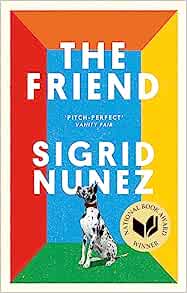
After a focus on cats last week, I thought this week I’d look at a book with dog, The Friend by Sigrid Nunez (2018).
The novel is addressed to ‘you’ throughout: a friend and mentor of the narrator who has died by suicide. They were friends for many years and her grief is deep.
“The dead dwell in the conditional, tense of the unreal. But there is also the extraordinary sense that you have become omniscient, that nothing we do or think or feel can be kept from you. The extraordinary sense that you are reading these words, that you know what they’ll say even before I write them.”
The person was a writer and teacher, as is the narrator. What I thought worked well was that the dead person didn’t sound particularly likeable – a vain, slightly arrogant man who used his moderate fame and academic position to sleep with lots of women, and became angry and bitter when his looks faded and the world moved on. The narrator doesn’t seek to excuse or validate this behaviour. She didn’t approve of it, but she valued her friend and the relationship they had for many years. She is grieving an imperfect person and she is wise enough not to try and make him anything other than who he was.
Wife Three visits her and pulls a guilt trip about the man’s Great Dane dog, who is pining.
“You can’t explain death.
And love deserves better than that.”
And so Apollo, the only named being in the story, moves into her tiny apartment, where her lease forbids dogs. And he is a lot of dog:
“Thirty-four inches from shoulder to paw. A hundred and eighty pounds. Attached was a photograph of the two of you, cheek to jowl, the massive head at first glance looking like a pony’s.”
The descriptions of the grieving dog, of his subdued, baffled silence are heartbreaking, and an effective display of grief alongside a human who is expected to get up, go to work, smile and be polite, do her shopping, clean her home. Apollo can behave more honestly:
“He walks with his head lowered, like a beast of burden.”
As the narrator talks to her friend, we get a sense of her emerging relationship with Apollo, his learning to trust her, and their deepening bond. There is no doubt the relationship is bound up in her deep grief and Apollo becomes a focus for her feelings.
Unlike the narrator’s friends though, I didn’t think it was particularly unhealthy or dysfunctional. There is a sense of the narrator as a writer trying to work through her feelings, sometimes intellectually by falling back on the writers and books she has spent her entire working life with, (including JR Ackerley’s My Dog Tulip, which I thought documented a much stranger relationship with a dog) and at other times by physically massaging the enormous canine.
“The friend who is most sympathetic about my situation calls to ask how I am. I tell him about trying music and massage to treat Apollo’s depression, and he asks if I’ve considered a therapist. I tell him I’m sceptical about pet shrinks, and he says, That’s not what I meant.”
This gentle humour runs throughout The Friend and stops it becoming mawkish. As the story is one writer talking to another, there are some spiky observations about the literary scene, such as at his funeral:
“It was not very different from other literary gatherings. People mingling at the reception were heard talking about money, literary prizes as reparations, and the latest die, author, die review.”
And also a repeated motif of the relief of writers who have found Something Else to do:
“Are you kidding? says a friend who raises goats on a farm upstate and makes award-winning chèvre. Writers block was the best thing that ever happened to me.”
I’ve seen The Friend described as stream of consciousness. It is a conversation with a silent interlocutor (apart from one section, the only part that felt a bit clunky to me) but it has a structure, if not a plot. To me this was an effective portrayal of grief, which isn’t linear or logical.
“Is this the madness at the heart of it? Do I believe that if I am good to him, if I act selflessly and make sacrifices for him, do I believe that if I love Apollo – beautiful, ageing, melancholy Apollo – I will wake one morning to find him gone and you in his place, back from the land of the dead?”
Nunez mentions more than once: “There’s a certain kind of person who, having read this far, is anxiously wondering: Does something bad happen to the dog?” I am definitely that kind of person. If you are too, I don’t want to give spoilers but what I will say is that The Friend is a book about grief, and so it is a sad read, but it’s not a traumatic one.
The Friend isn’t a book to read for plot, or even for story. It is a reflection on friendship, writing, reading, aging; and a meditation on grief and grieving, and joys and pains of sharing our lives with humans and with animals. There is sadness and there is humour, and there is never a sense that grief is a price not worth paying, however painful.
“Your whole house smells of dog, says someone who comes to visit. I say I’ll take care of it. Which I do by never inviting that person to visit again.”
I’m starting to write this post at 7pm on the final day of the1956 Club, hosted by Karen at Kaggsy’s Bookish Ramblings and Simon at Stuck in a Book. There used to be a time when I wrote my Club posts in advance of the week, so it’s fair to say my blogging still hasn’t quite got back on track yet😊
Unusually for this blog, my first read is a non-fiction work, My Dog Tulip by JR Ackerley, a book which took me by surprise. The blurb on the back of my NYRB Classics edition describes it thus:
“The distinguished British man of letters J. R. Ackerley hardly thought of himself as a dog lover when, well into middle age, he came into possession of a German shepherd […] she turned out to be the love of his life […] a bittersweet retrospective account of their sixteen-year companionship, as well as a profound and subtle meditation on the strangeness that lies at the heart of all relationships. In vivid and sometimes startling detail, Ackerley tells of Tulip’s often erratic behavior and very canine tastes, and of his own fumbling but determined efforts to ensure for her an existence of perfect happiness.”
So basically I was expecting a period piece Marley and Me. The trailer for the 2010 film did nothing to dissuade me of this:
Yet my experience of reading this was of a deeply eccentric and sometimes quite unnerving narrative. I didn’t dislike it, but it just wasn’t what I expected at all. I should have paid more attention to the use of ‘strangeness’ and ‘startling’ in the blurb. I think Ackerley was probably quite an independent thinker and so he writes about Tulip in really quite astonishing ways. He clearly adores his dog and captures her in almost poetic blazon style:
“these dark markings symmetrically divide up her face into zones of pale pastel colours, like a mosaic, or a stained glass window; her skull, bisected by the thread, is two primrose pools, the centre of her face light grey, the bridge of her nose above the long, black lips fawn, her cheeks white, and upon each a patte de mouche has been tastefully set.”
That’s lovely, but for much of the book Ackerley is quite determined to Tulip mated and pregnant, and I could have done without similar dwelling on the state of her vulva. I’m not a prude, and my job means I spend most of each day talking about human anatomy in very frank terms, but I was truly taken aback.
I guess if you have a pedigree dog you do have to concern yourself with such things? Every animal I’ve had has been resolutely mongrel and neutered/spayed and therefore unable to pass on their moggy/mutt genes 😊
Being an animal lover I am used to vet visits, but this book made me very glad I’m not taking my furry family members to the vets in the 1950s. The beginning of the book describes some truly distressing experiences and I am so grateful times have changed. Ackerley shares this view and can’t believe what is happening, until he and Tulip meet the lovely Miss Canvey. Tulip is untrained and appallingly behaved (according to the introduction Ackerley became something of a social pariah for the 16 years he spent with Tulip) and Miss Canvey tells it like it is: “ ‘Tulip’s a good girl. I saw that at once. You’re the trouble.’”
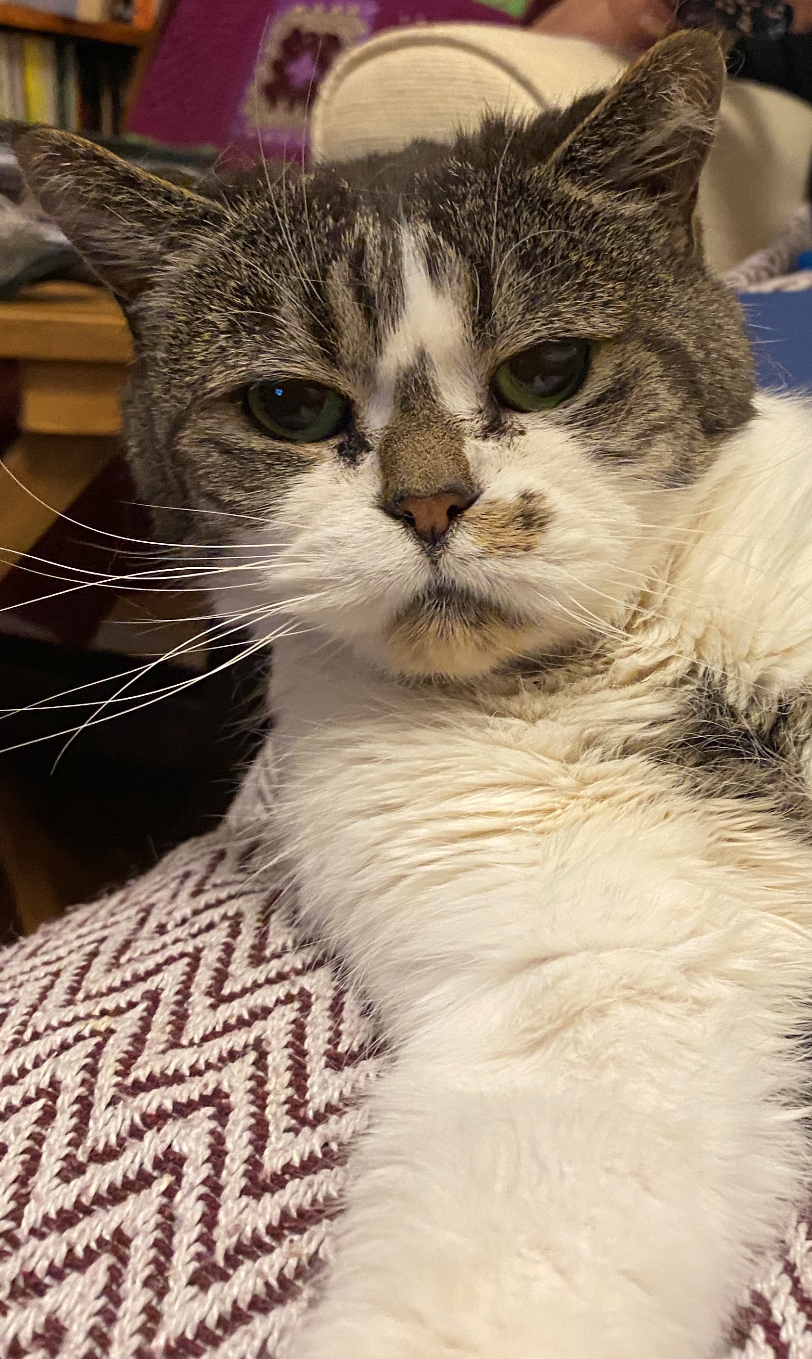
As an aside, I had to say goodbye to my sweet wee boy this June, and the vets could not have been kinder, or more respectful and caring. They even relaxed their own lockdown rules so I could be with him when he died (still all very careful and socially distanced). This was the last picture I took of him, just before he became unwell:
So I’m very glad Ackerley and Tulip find Miss Canvey, but unfortunately her insight doesn’t result in any changes and Ackerley observes: “people seem to resent being challenged whenever they approach their own sitting or dining rooms.”
He does feel some sympathy for the local shop owners though (somewhat surprisingly, as he does come across as a terrible snob), when Tulip fouls their frontage:
“True they were horrid people, but no doubt they had their burdens like the rest of us, and Tulip’s gift would not help to uplift their hearts to a sweeter view of life.”
Ultimately what Ackerley captures in My Dog Tulip is the close bond that is unique to every human and animal relationship; and what us animal lovers know for sure, that they behave infinitely better than humans:
“But if you look like a wild beast you are expected to behave like one; and human beings, who tend to disregard the savagery of their own conduct, shake their heads over the Alsatian dog. ‘What can you expect of the wolf?’ they say.”
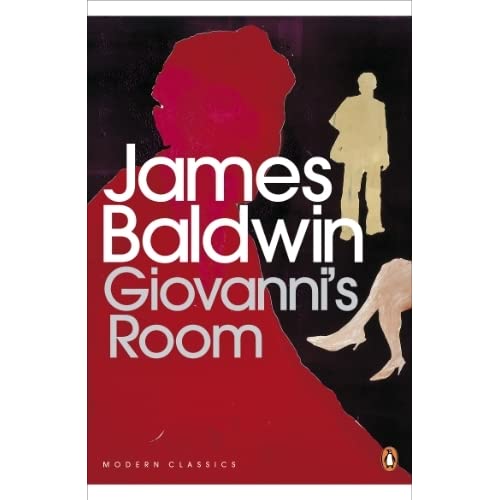
Secondly, Emma at Book Around the Corner suggested reading Giovanni’s Room by James Baldwin and I am so glad she did. You can read Emma’s review here. This was my first James Baldwin and on the strength of this novella I’ll definitely be seeking out more of his work. He is a stunning writer: precise, poetic, insightful and so deeply moving. I knew from the opening lines, told from the point of view of young blond American David, that I’d found a writer to love:
“I stand at the window of this great house in the south of France as night falls, the night which is leading me towards the most terrible morning of my life. I have a drink in my hand, there is a bottle at my elbow. I watch my reflection in the darkening gleam of window pane.”
It’s a terrible morning because Giovanni, the man David loves, is going to be executed. They met in Paris in a gay bar where Giovanni was a barman, and quickly became lovers. Giovanni’s dilapidated lodgings provide the suffocating background to the most profound experience of David’s life:
“I scarcely know how to describe that room. It became, in a way, every room I had ever been in and every room I find myself in hereafter will remind me of Giovanni’s room. I did not really stay there very long – we met before spring began and I left there during the summer – but it still seems to me I spent a lifetime there.”
It is David’s self-hatred and wish to not be as he is that casts a shadow over their relationship. He longs for a fantasy life of heterosexual conformity:
“I wanted a woman to be for me a steady ground, like the earth itself, where I could always be renewed. It had been so once; it had almost been so once. I could make it so again, I could make it real.”
(David has a girlfriend, Hella, who is exploring Spain and deciding whether to accept his marriage proposal when he meets Giovanni.)This self-hatred means David is not always likeable but he is always believable. It makes him very judgemental towards how other gay men lead their lives, and he has horrible attitudes towards anyone he views as effeminate. His older friend Jacques picks him up on his behaviour, in an eloquent plea for humanity:
“There are so many ways of being despicable, it quite makes one’s head spin. But the way to be really despicable is to be contemptuous of other people’s pain. You ought to have some apprehension that the man you see before you was once even younger than you are now and arrived at his present wretchedness by imperceptible degrees.”
The story unfolds towards its inevitable tragedy that we know from the start is looming over the characters. It’s a heartwrenchingly sad tale that captures the deep and profound damage that can occur when the pain and frustration of a life unlived is inflicted on others.
I could have quoted so much from this novella. It is full of passages breathtaking in their beauty and wisdom. Effusively recommended.
“But people can’t, unhappily, invent their own mooring posts, their lovers and their friends, anymore than they can invent their parents. Life gives these and also takes them away and the great difficulty is to say Yes to life.”
To end, I’d normally pick a song from 1956 but none of them really took my fancy. So instead, a song for the year we’re in now. I’ve mentioned before that at times of trouble in my life there is one man I always turn to. That man is David Bowie. During the weirdness of 2020, he has not let me down. Yet also this year I’ve found myself seeking solace with another…
Bruce Springsteen has jokingly said that he writes the same song over and over. The song he’s referring to is about feeling powerless, trapped by circumstance, wanting to escape and still trying to reach out. That pretty much sums up the current situation doesn’t it?
I think so many of us are waiting on metaphorical sunny days. Here’s hoping they’re not too far away. At least I’ve managed to stop bursting into tears when he sings ‘everything’ll be ok’ which is a marginal improvement:
(Also at 4:25 Bruce does a knee slide, which contains the important message that you can be a 70 year old rock god but you’re never too old or too cool to launch yourself across a temptingly shiny floor like a giddy child…)
This week I bought my first Christmas present of the year. I was really pleased with it. Then as I gazed at it I realised the first present I’d bought this year was for my brother & sister-in-law’s cats. From my cats. I’m gifting between cats. That’s who I’ve become.
So I’m sharing my pain as mad cat lady with the interwebs. But I also love dogs, its just I can’t convince one to live with me in my tiny London flat. So in a spirit of inclusivity, and a rejection of the idea that you are either a dog-person or a cat-person, I’m looking at one novel about a feline, and another featuring a sarcastic dog.
Firstly, The Guest Cat by Takashi Hiraide (trans. Eric Selland). This short novel is a delicate, sensitive study of the unspoken ties that bind. A small stray cat, adopted by the neighbours, arrives in the house of the narrator and his wife. They live a quiet life, he a poet and she a proof-reader, and the cat brings a spirit of unpredictability into their lives:
“Chibi’s dependence would manifest itself in unexpected ways, even while performing acts of incredible athletic skill. Casting aside the Ping-Pong ball, she turned about at an acute angle, yet in the next moment she had placed her tiny paw on the head of a toad concealed in the shade of one of landscape rocks. Then just as suddenly she flew to the other side of the garden, extending one of her front legs to slip into a clump of bushes.”
The novel is a mix of the closely observed and the philosophical/metaphysical:
“When she began to sleep on the sofa – like a talisman curled gently in the shape of a comma and dug from a prehistoric archaeological site – a deep sense of happiness arrived, as if the house itself had dreamed this scene.”
Hiraide captures how animals bring their own energy, changing dynamics in relationships, affecting homes and the people therein. They are catalysts (no pun intended) and their full effects can be both quiet and far-reaching:
“I opened the window and welcomed in the guest, accompanied by the winter sunrise, and the mood inside the house was restored. Chibi was our first New Year’s visitor. They call the visitors who go around to all the houses on New Year’s Day to wish everyone happy new year ‘pilgrims’.”
You don’t have to like cats to enjoy The Guest Cat. Chibi could be any animal or transforming external force; it is her impact rather than her cat-ness that Hiraide is interested in. The Guest Cat’s story is one of love, change, resilience and loss.
“’See, I told you. She’s our girl.’
…or so my wife said, although she knew she wasn’t really ours. Which is why it seemed all the more as if she were a gift from afar – an honoured guest bestowing her presence upon us.”
Here are my two, utterly engaged with the whole idea of buying their cousins a gift, and with being part of a blog post:
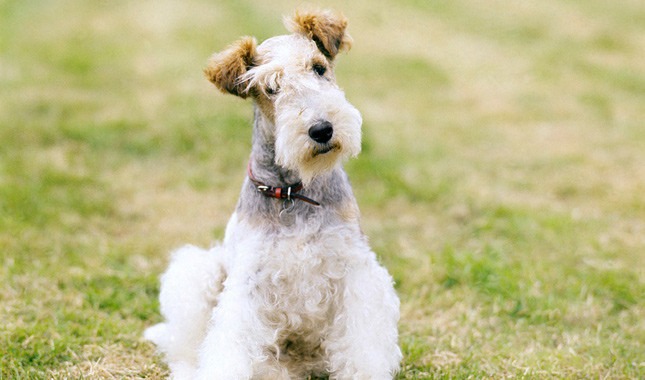
It’s quite hard to find a dog in literature which doesn’t end in a way which has me in floods of tears. Thankfully, the full title of the well-known comic novel by Jerome K Jerome is Three Men in a Boat, To Say Nothing of the Dog! It is a blessed relief to tell you that fox terrier Montmorency makes it through in one piece. Thank goodness, because look at this face:
“To look at Montmorency you would imagine that he was angel sent upon the earth, for some reason withheld from mankind, in the shape of a small fox terrier. There is a sort of Oh-what-a-wicked-world-this-is-and-how-I-wish-I-could-do-something-to-make-it-better-and-nobler expression about Montmorency that has been known to bring tears into the eyes of pious old ladies and gentlemen.”
J and his friends George and Harris are hypochondriacs who are convinced they all have terrible diseases. In order to recouperate they decide to sail a boat along the Thames to Oxford. J’s dog is not impressed:
“The only one who was not struck with the suggestion was Montmorency. He never did care for the river, did Montmorency.
‘It’s all very well for you fellows,’ he says; ‘you like it, but I don’t. There’s nothing for me to do. Scenery is not my line, and I don’t smoke. If I see a rat, you won’t stop; and if I go to sleep, you get fooling about with the boat, and slop me overboard. If you ask me I call the whole thing bally foolishness.’
We were three to one, however, and the motion was carried.”
Usually I’m not keen on anthropomorphism, but with Montmorency it really works. He acts as a slightly detached commentator on his three bally foolish companions and never loses his dogginess – he remains very much the fox terrier. The four of them head off to the water and as anyone who has read the novel will know, very little happens yet much hilarity ensues. The three men are absolutely useless with any practical considerations, such as putting all their food into one disgusting stew:
“Towards the end, Montmorency, who had evinced great interest in the proceedings throughout, strolled away with an earnest and thoughtful air, reappearing, a few minutes afterwards, with a dead water-rat in his mouth, which he evidently wished to present as his contribution to the dinner; whether in a sarcastic spirit, or with a genuine desire to assist, I cannot say”
I love the idea of a sarcastic dog. Three Men in a Boat was apparently first intended as a travel guide, which seems astonishing for such an unrelentingly funny book. Attempts to act as a guide remain, but the humour always forces its way in:
“From Abingdon to Nuneham Courtenay is a lovely stretch. Nuneham Park is well worth a visit, It can be viewed on Tuesdays and Thursdays. The house contains a fine collection of pictures and curiosities and the grounds are very beautiful. The Pool under Sandford lasher, just behind the lock, is a good place to drown yourself in.”
By some miracle they make it to Oxford, and Montmorency shares my love of the city of dreaming spires:
“We spent two very pleasant days in Oxford. There are plenty of dogs in the town of Oxford. Montmorency had eleven fights on the first day, and fourteen on the second, and evidently thought he had gone to heaven.”
I must admit though, I’ve never fought a dog any time I’ve been to Oxford. It’s also safe to say he would not approve of the theme of this post:
“When Montmorency meets a cat, the whole street knows about it; and there is enough bad language wasted in ten seconds to last an ordinary respectable man all his life, with care.”
To end, a reminder that the dividing line between cat & dog may not be as clear-cut as we think:





 madame bibi lophile recommends