Novella a Day in May 2025: No.9

Blue Postcards – Douglas Bruton (2021) 151 pages

Earlier in the month I read With or Without Angels and I’d thought I might save Blue Postcards by the same author until the end of May, but in the end I couldn’t wait 😊Especially as Simon read this as part of his #BookADayInMay and loved it. You can read his review here.
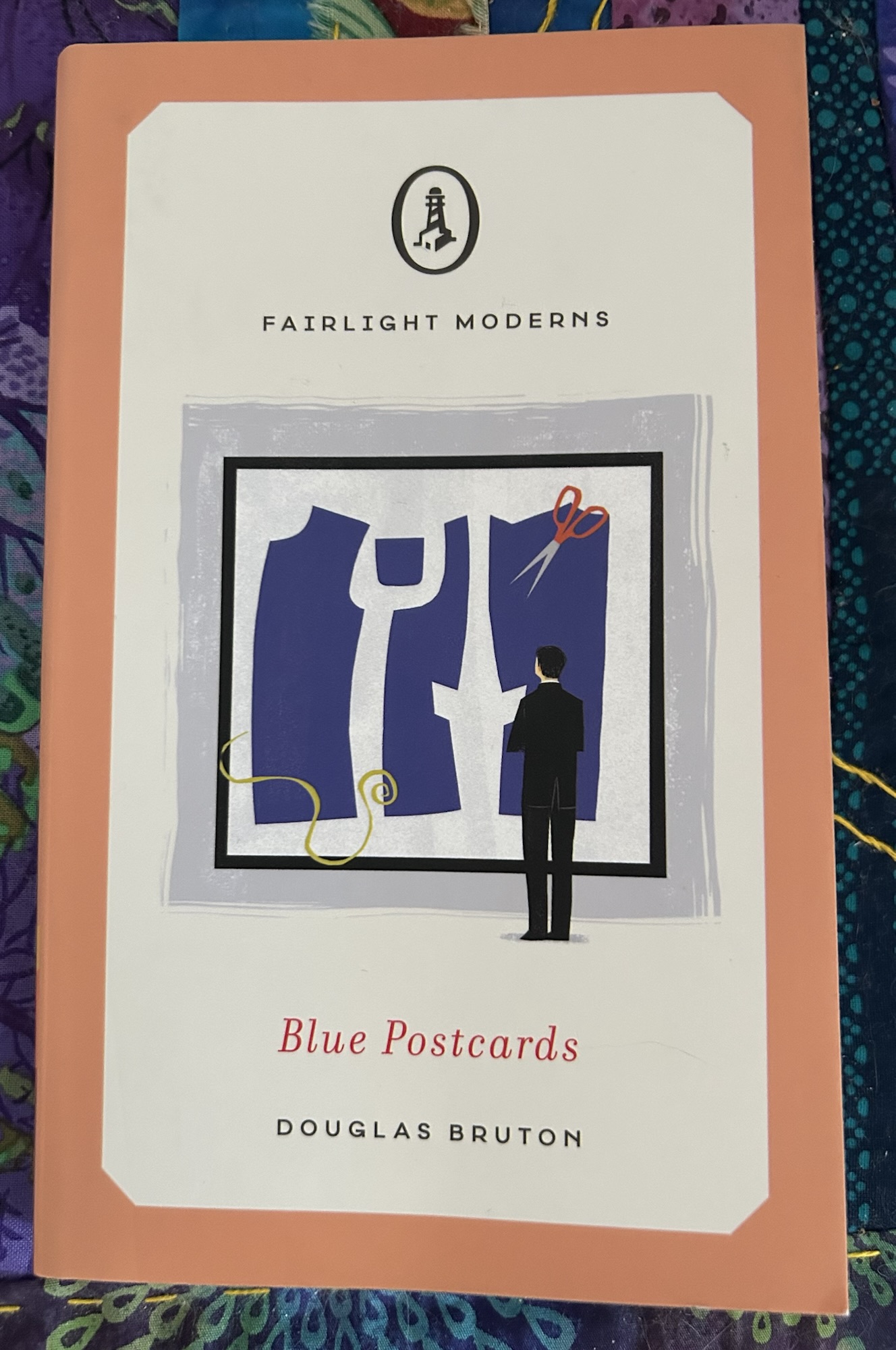
Having now read three of Douglas Bruton’s books the word that comes up for me is tender. His writing is so gentle and subtle, entirely without sentiment but so careful in its construction and treatment of his characters. His tenderness is not a way to turn away from difficult feelings or events, but rather a way to look at them clearly and compassionately.

Blue Postcards is made up of 500 numbered paragraphs/postcards, split into five sections of 100. Almost all of them contain the word ‘blue’ (I recognised one which didn’t, there may be more). If this sounds overly contrived, it really isn’t. As you read, it flows easily and the various story threads are woven together seamlessly.

The contemporary thread involves a man who buys a blue postcard from a stall near the Eiffel Tower. The postcard is by Yves Klein, the French artist who created International Klein Blue. It is addressed to his tailor Henri, and they form the threads in the 1950s.

The narrator of the contemporary thread describes himself as ‘old’. He is aware that as he ages, his eyes perceive yellow and blue differently:

“31. Sometimes I wonder if going back to Nice I would find the sky so blue or if the blue that I found there back in 1981 had something to do with being young or something to do with memory.”

He begins a tentative relationship with Michelle, who sold him the card. Or perhaps not; he is an unreliable narrator and a theme of the book is truth, lies, fiction, and the fallibility of memory.

Henri the tailor sews blue Tekhelet threads secretly into all his suits, to bring his patrons luck.

“109. […] When I am talking about Henri I hope it is understood that we are in his time and not really in our time. If this was a film we might see Henri through a blue filter to show that his time is different.”

Yves Klein is building international success and needs a suit to look the part:

“184. Henri stands in front of the mirror next to Yves Klein in his tacked and pinned-together new suit. ‘You have to imagine it finished and pressed as sharp as knives and not a loose thread anywhere to be seen.’ Henri holds onto the sleeve of the jacket and his blue dream is briefly real.”

The postcards move back and for the between the timelines but this is never confusing or disorienting. There is a reflective, almost melancholic (blue?) tone running through both. They explore the transitory; how our experiences are constantly shifting as we rewrite the past from a changing present and our changing understanding.

The tone is lightened by the Yves Klein strand; his self-promotion and blatant lies therein are audacious, and even breathtaking with his Leap Into the Void.

There is also tragedy that we know exists in Henri’s past. A Jewish man in 1950s France is going to have unspeakable recent memories. The theme of grief runs across the timelines, both for those who have died and for what can never be regained.

I’ve not done any justice to this novella at  all. It is so rich in themes and style, and yet so approachable and readable. I can only urge you to read it for yourself!

“267. I do not think a stone can be said to belong to a person. I tell her about the stone and how I picked it up out of a river and it was blue until it dried and then it was only blue in possibility. I tell her that I like that most especially, that blue can be something that adheres in a thing and at the same time can be something hidden. I do not tell her that I think love is something the same.”

To end, the author reading from his work:

Novella a Day in May 2025: No.3

With or Without Angels – Douglas Bruton (2023) 107 pages

Having loved Hope Never Knew Horizon by Douglas Bruton when I read it in February for #ReadIndies, I was keen to try more by him. With or Without Angels is an intriguing novella, attempting to capture the process of creating art at the end of life.

Written in the third person but mainly from the point of view of “the old artist”, Bruton portrays Alan Smith’s memories and thoughts as he works on his final piece, The New World, which was a response to Giandomenico Tieplo’s Il Mondo Nuovo. (In the Afterword Bruton explains that Alan’s widow had read the novella and she encouraged publication, with permission for the art to be reproduced.)

The New World is a series of images and they are reproduced in the book, after the fictional prose passages which evoke the creation of them. So for the first one, a photograph taken on a trip to Tate Modern:

“Out on the street the air was wet and chill and shifting. It smelled of bus exhausts and damp wool and faintly of cigarettes. And his wife it smelled of, too. Something with flowers in her perfume. Patchouli maybe – a shrub of the mint family – something of wet soil or apples that are past ripe, the smell of a cork pulled from a bottle of strong red wine. It’s the last of the senses to go, smell. He had heard that somewhere and was comforted that when all else failed he would know his wife was at his side by her smell.”

The smell of patchouli is something that is returned to at different sections along with other recurring motifs. This was so clever; it evoked the layering of memory and movement back and forth in time as someone contemplates the past from a present where they know their future is limited. (Also, a special thank you to the woman who stood next to me on the tube and was wearing patchouli as I read this 😊)

Time collapses in on itself at various points for the artist, disorienting but without him losing sight of his work.

“Some things are so familiar that you expect them to be there even when they are not and cannot be. The blue hat had been eaten into holes by moths. But he is sure that he has seen it hanging on the last hook in the hall as recently as a week ago.”

Bruton never attempts to interpret the work or lay claim to an absolute meaning in The New World. He is too subtle for that, and part of what With or Without Angels explores is that there are no final answers to be gleaned from a work of art.

“It’s not that he fears the questions. He wants them to be asked. That’s part of the point. It’s the answers that he frets over. He has come to a time in his life where the answers are like Brighton’s running pebbles under his feet.”

There’s also no sentimentality in the artist nearing the end of his life. Instead it is a gentle, tender, compassionate portrait.

“The thing she did with her hair […] and how he felt when he saw her do that, somehow there was meaning and hope and love in that. The old artist does not tell anyone this, not even his wife, but maybe she knows.”

With or Without Angels captures so much in so few pages. It is a remarkable work which manages to explore enormous themes with such a light touch, without ever seeming superficial.

The New World link at the start of this post will take you to Alan Smith talking about the work.

“‘Hope’ is the thing with feathers.” (Emily Dickinson)

This week as part of Kaggsy and Lizzy’s #ReadIndies event I’m looking at book published by Taproot Press, “an Edinburgh-based publisher committed to presenting challenging, contemporary voices from both Scotland and beyond.”

I was keen to read Hope Never Knew Horizon by Douglas Bruton (2024) as Susan’s review and Kaggsy’s review were both glowing. It sounded truly inventive and unlike anything else I could remember reading.

There are three strands to the story, united by the theme of hope. It opens in 1891 with the Wexford Whale, beached off the coast of Ireland, caught and ultimately sent to the Natural History Museum. One of the locals is sure there is money to be made, but his love interest is sceptical:

“And all Ned Wickham’s spittle-words slap against the walls of the Wexford Arms like the sea in a breached harbour, and they fall back on Ned Wickham and wash over him, and soon enough he slumps in his chair and falls into sleep. And if you lean into the sleeping drunk and listen sharp as pins, you can sometimes still hear the man talking, all his words sluiced and slopping”

The second strand follows Emily Dickinson in the 1850s, through the eyes of her housekeeper Margaret. She sees what no-one else seems to, that Emily is in love with her sister-in-law Susan:

“If I delayed in passing the letter on to Miss Emily it was only briefly and only so I might have something of that love to myself a while.”

The third strand is set in 1880s London, narrated by Ada Alice Pullen, model to famous artists of the day and stage actress under the name of Dorothy Dene. She is painted by Frederick Leighton for the most part, and enters into a Pygmalion-type relationship with him (there is an amusing scene where they are visited by George Bernard Shaw who apparently did base the famous play at least partly on their experience):

“How could I not love the man who made that possible, who took me to the highest point of the world and showed me what was to be conquered – now that I had conquered his heart?”

But it is George Frederic Watts who will capture her as Hope forever.

Bruton is so good at evoking the various voices in his tale. Cheeky, knowing Ada; reverential Margaret, and the various voices that make up the whale strand, which runs up to the twenty-first century, where the whale skeleton has been cleaned and repaired and reinstated at the Hintze Hall. Throughout the bones’ history, people have heard their “hopeful song”:

“Do not think for a moment that the bones in those boxes sat quiet and still […] and if you asked that museum assistant what that sound was he would shrug and say it was like the shushing of the sea, the same that you hear when holding a seashell to the ear, and it was the kick and kick of water and a moaning sound, like music that is wayward and wordless and wild.”

Historical fiction can be hard to pull off and in this short novella Bruton avoids info-dumping. The historical details emerge organically from the narratives, keeping the various stories’ momentum throughout. Similarly, his beautiful prose style never weighs the stories down. There is stunning imagery but it always serves the characters voices.

He also manages the issue of fictionalising real people and events adroitly, not only through an epilogue but also in Margaret’s acknowledgement of her narrative’s shortcomings:

“She din’t actually say that about her heart surely breaking but in what she did say was the sense of what I have written or the feeling anyway.”

“I have perhaps invented a life for her that is more to do with my hopes than hers.”

Which of course aren’t shortcomings at all. We all have faulty memories and we all interpret. Margaret’s story may be hers as much as Emily’s, and it is so moving in her love and hopes for her mistress.

The narratives are united by a theme of love as well as hope. Ada and Frederick’s relationship is filled with love even when not expressed; the whale strand ends on a very moving evocation of the love of teaching and learning. The various parts are finely balanced and I found Hope Never Knew Horizon immensely moving across all three timelines.

What Bruton shows is that hope is an enduring and fundamentally human experience. We live with uncertainty and while there is uncertainty there is hope. He demonstrates that hope can exist alongside the realities of the life that has to be lived. Hope Never Knew Horizon is a gentle, compassionate book to be treasured.

Hope the Whale

“Hope” is the thing with feathers by Emily Dickinson

Hope by George Frederic Watts