Blaming was Elizabeth Taylor’s last novel and features all of her characteristic wit, sharp observation, compassion and lack of sentimentality.
It is the story of a relationship between Amy, a middle-class, middle-aged housewife, and a younger American novelist, Martha:
“Amy seemed to have remained at the age of seventeen, or thereabouts; but it was the English girlhood of her own class and time. The like never come again, Martha, much younger and American, decided.”
They meet on a cruise, and at a desperate time for Amy, Martha is there for her. They have nothing else in common except this shared experience, and when she returns home Amy has no plans to ever see Martha again. Martha has other ideas, and what follows is a brilliant dissection of a relationship built out of a sense of obligation, of politeness, and of unspoken, unacknowledged needs.
What makes this tale so compelling in its characterisation and circumstance is that Martha isn’t a monster. She’s not horrible or domineering or rude, but she’s unaware, a bit selfish and slightly irritating. It’s all so ordinary, and Amy is at a total loss as to what to do:
“Lolling back in her chair, steadily eating biscuits as if to satisfy a long-felt need, Martha dropped crumbs onto her lap, and occasionally brushed them off onto the carpet. She is going to be untidy about the place, Amy was thinking. Two long days. She glanced up at the clock. What could she do with her for all that time? The long evening ahead for instance. They could not – surely – just talk all the time.”
In her portrayal of Amy’s life and wider family, Taylor captures how relatives can also feel a sense of obligation, and even affection, that at the same time is arduous and would easier to live without. Her daughter-in-law and son like Amy well enough, she in turn likes her slightly irritating grandchildren. It would be easier for them all not to spend time together, but that is not how families work:
“He knew she was weeping for herself, not for his mother. She had never been drawn to her – no cosy women’s chats; but in spite of warmth, their relationship was exemplary […]
‘We will make some good plans,’ James said reassuringly. ‘It’s nice of you to care so much. Certainly a long weekend some time can’t be too terrible a strain on anyone.’
So nothing was done.”
In Blaming, Taylor demonstrates how the deepest pain that people experience can – and most often does – live alongside, the boring, the banal, the everyday. She shows how guilt is a powerful motivator for people who aren’t good or bad, just ordinary and fairly decent.
Blaming is a novel where you can sit back knowing you are in the hands of a masterful artist. Taylor is a brilliant, incisive writer, intelligent and humane. Any work of hers is a gift to the reader.
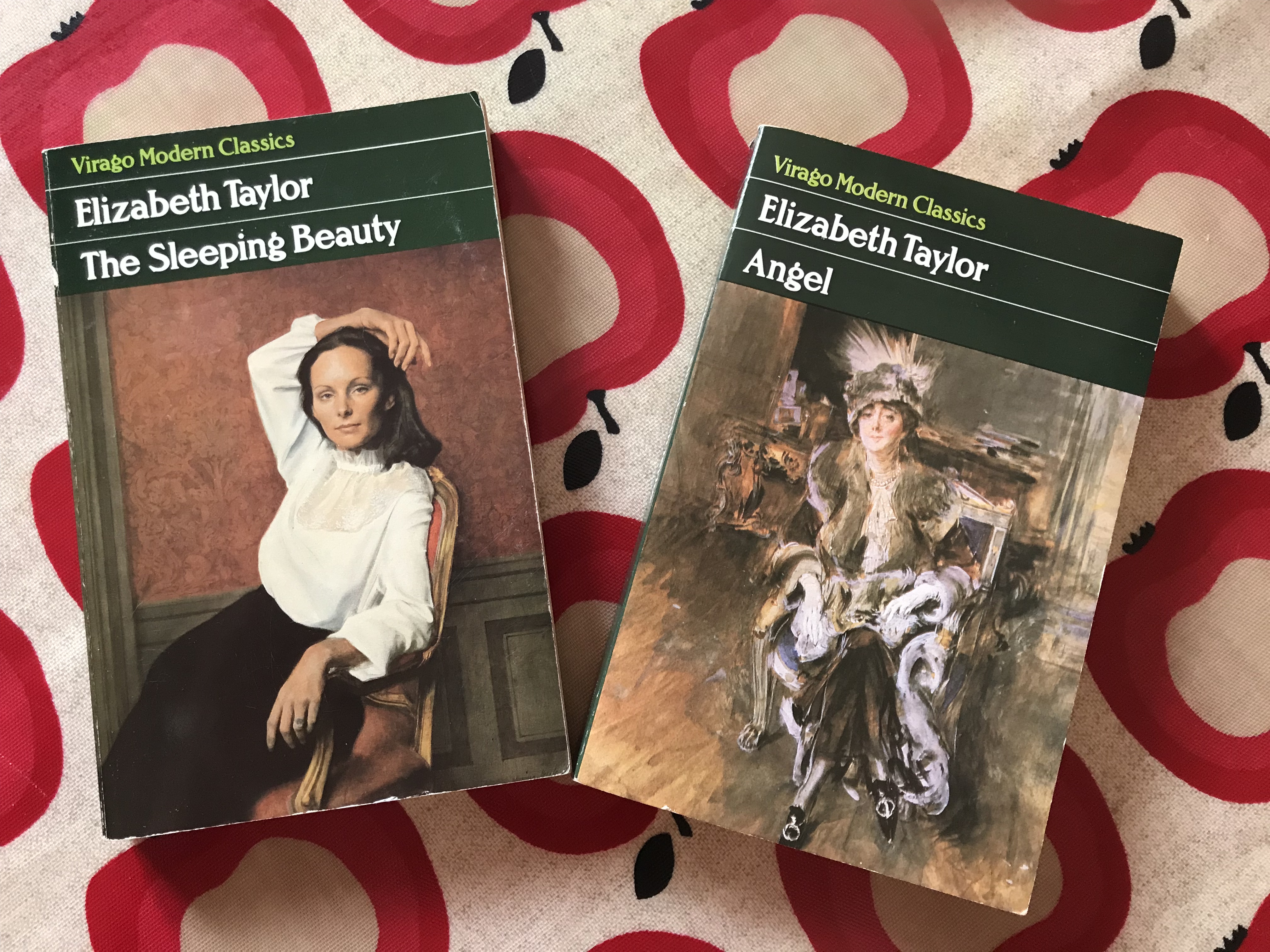
Today is Elizabeth Taylor Day in Jane at Beyond Eden Rock’s Birthday Book of Underappreciated Lady Authors, which gave me a chance to read the last two novels I had of hers remaining in the TBR (thankfully I’ve not yet read all her work – roll on the end of the book-buying ban…).
Firstly, The Sleeping Beauty (1953), which tells the story of Vinny, a man who is a reliable shoulder to cry on for all his female friends.
“It was his business to be loved – a mission created afresh with everyone he met – and he was always conscious of another’s coldness.”
When Isabella’s husband dies, he is down to visit her at her coastal home like a shot.
“ ‘You are welcome to follow me to the ends of the earth’ Vinny seemed to be assuring people when he was introduced.”
Vinny should be seen as a model of compassion, but instead Taylor’s sharp eye shows him as vain and very much driven by his own needs. Isabella’s son Laurence, courting a young nursemaid staying at a local B&B, doesn’t take to him as he thinks he has plans to marry Isabella. The thought crosses Isabella’s mind too, and she finds comfort in planning how she will turn him down. What neither of them know is that firstly, Vinny is already married (though separated) from his wife Rita “[who] had, in fact, a great distaste for the truth and was forever tidying it up or turning her back on it.” and secondly, that Vinny has fallen in love at first sight with Emily, who he saw on the beach.
“When they had gone from view, he turned back to the room, and found it dark now, and very small.”
Emily is a blank canvas in many ways, perfect for Vinny’s romantic sensibility.
“Nearing fifty, Vinny felt more than ever the sweet disappointments only a romantic knows….the imperfectly remembered and the half-anticipated. Past and future to him were the realities; the present dull, meaningless.”
Emily has been in a car accident and her heart was broken when her lover subsequently dumped her, unable to cope with her changed appearance. She is still beautiful, but in a strange way, as Vinny’s mother observes:
“anything passive she abhorred, and Emily’s dead-white skin, her lack of expression, about which Vinny had found no words to forewarn her, no heart to explain or discuss, annoyed and repelled her. She could sense Emily’s life drifting by in an incurious desuetude.”
The Sleeping Beauty has a determinedly unromantic male lead, and a beauty whose awakening is for his benefit not hers. Taylor shows how we attempt to construct our lives around our desires and how that can cause pain rather than delight for ourselves and those we love. She is very funny (such as Isabella and her friend Evalie being avid racing gamblers, hiding this from her son, who is also betting and hiding it from his mother) but overall the tale is unsettling. If the romance will result in happily-ever-after for any of those concerned is left for the reader to decide.
“ ‘Oh, I am nothing without you,’ she said. ‘I should not know what to be. I feel as if you had invented me. I watch you inventing me, week after week.’”
Secondly, Angel (1957) a hilarious portrait of a writer supposedly based on the romantic novelist Marie Corelli. Angelica Deverell decides before she’s even left school that she’s going to be a romantic novelist. This is despite not liking love, or novels:
“Until now she had thought of love with bleak distaste. She wanted to dominate the world, not one person.”
“She had never cared much for books, because they did not seem to be about her”
Angel is one of the most rampant egotists ever committed to paper. She is a terrible writer without life experience, knowledge or taste to draw on, and yet she is hugely popular – her readers don’t care about her error-ridden purple prose. Her fame insulates her from the world and so she is able to continue her entirely ego-driven existence, never bothering to look beyond herself for anything. She is physically astigmatic but psychologically myopic to the point of blindness.
Maybe I’m lacking compassion but I didn’t find Angel remotely sympathetic. She is appalling. The pathos comes through her mother: baffled by her daughter, and yanked from her home by Angel’s material wealth. I found this passage heart-rending:
“At a time of her life when she needed the security of familiar things, these were put beyond her reach. It seemed to her she had wasted her years acquiring a skill which in the end was to be of no use to her: her weather-eye for a good drying day; her careful ear for judging the gentle singing sound of meat roasting in the oven; her touch for the freshness of bacon; and how, by smelling a cake, she could tell if it were baked: arts, which had taken so long to perfect, now fell into disuse. She would never again, she grieved, gather up a great fragrant line of washing in her arms to carry indoors.”
Amazingly, Angel does have people who care about her, repugnant as she is. Theo, her publisher, takes a paternalistic attitude and worries she will never get what she wants:
“Love, which calls for compliance, resilience, lavishness, would be a shock to her spirit, and upset to the rhythm of her days. She would never achieve it, he was sure. For all the love in her books, it would be beyond her in life.”
Nora is a devoted friend and lives with Angel for the majority of their lives, even during Angel’s marriage to Nora’s feckless brother Esme:
“ ‘I read one of your books.’ he said, sounding as if it were rather a surprising thing to do.
She blinked, jolted by what he had said. She always supposed that everyone had read all of her books and had them nearly by heart, that they thought about them endlessly and waited impatiently for the next one to appear.”
Her marriage is held together through Esme’s lies and Angel’s unrelenting capacity for self-delusion, despite the fact she doesn’t enjoy the honeymoon:
“Greece was especially disappointing. It was nothing like her novels.”
Angel is an astonishing character study and the story of one writer’s life. What is most astounding is that the grotesque Angel is apparently not too far from real life; apart from the fact that she was probably gay and more interested in the esoteric, Marie Corelli seems to have been very much like Angel. Certainly like Corelli, Angel refuses to acknowledge her waning star following the First World War when people don’t want overwritten romances anymore.
Angel never has an epiphany, she remains resolutely vain, deluded and solipsistic until the end. The novel is a comi-tragedy, carefully balancing absurd excess with sharp-eyed psychological insight.
“She went to the Royal Garden Party in violet satin and ostrich feathers with purple-dyed chinchilla on her shoulders; amethysts encrusted her corsage and mauve orchids were sewn all over her skirt where they quickly wilted. Glances of astonishment she interpreted as admiration.”
“Arrogant and absurd she had been and remained; she had warded off friendship and stayed lonely and made such fortifications within her own mind that truth could not pierce it”
Ultimately, Taylor treats Angel kindly:
“I am frightened, she suddenly thought. But there was nothing to be frightened of; not even poverty now. I have come such a long way, she told herself, and done all that I wanted and there is nothing to fear.”
In life and in fiction, I like people who walk to the beat of their own drum. Angel certainly does this. I think the reason I couldn’t stand her is because she is so utterly self-focussed. She has zero interest in other people or in the world. Taylor is such a skilled writer that her horrible main character does not detract from the joy of this novel. The comedy is gentle; although we laugh at Angel it is in disbelief rather than cruelty. There is also enough reality and pathos through the characters that surround her to ground the novel away from Angel’s delusions.
Elizabeth Taylor is such a wonderful writer. Any novel of hers is an absolute masterclass in astute, humane, witty style. The fact that she is an Underappreciated Lady Author is an absolute travesty.
To end, I saw a documentary recently about female singers and Annie Lennox was part of it, looking bloomin’ amazing in every shot. Here she is singing about an angel:
We’re having a mini-heatwave in Britain at the moment. Yes, the annual 3 days of summer have finally arrived, hooray! Compared to Spain which is currently experiencing temperatures in the mid-40s we’re positively Artic, but it still counts. I’m taking the lead from my cats, who wait til I appear in order to throw themselves on the floor like Norma Desmond fainting on a chaise longue, to convey to me that its positively balmy and their water dishes need refilling (they’re immigrant cats from NZ, I think their years with me have turned them into Northern hemisphere wusses). This week I’m looking at novels set in summer, quickly before Autumn starts (ie next week).
This is from The Long Hot Summer so it’s totally relevant and not at all gratuitous *cough*
Firstly, Swimming Home by Deborah Levy (2011) set in France in 1994, where Joe, a poet, his wife Isabel, a war correspondent, and their teenage daughter Nina are on holiday with family friends Mitchell and Laura. One day, a naked young woman is floating in their pool. She is Kitty Finch, and Isabel surprises everyone by asking her to stay.
“The young woman was a window waiting to be climbed through. A window that she guessed was a little broken anyway. She couldn’t be sure of this, but it seemed to her that Joe Jacobs had already wedged his foot into the crack and his wife helped him.”
Deborah Levy has a piercing gaze for middle-class mores and Swimming Home could have been a sharp social satire:
“Couples were always keen to return to the task of trying to destroy their lifelong partners while pretending to have their best interests at heart.”
But with the arrival of fragile, destructive Kitty, the novel shifts into a psychological examination of the family unit and the individuals who comprise it. Kitty’s arrival exposes all the faultlines running through the relationships and Levy explores this in a delicate, subtle way, never resorting to caricature or cliche. Isabel is a successful journalist but an absent mother:
“She had attempted to be someone she didn’t really understand. A powerful but fragile female character. If she knew that to be forceful was not the same as being powerful and to be gentle was not the same as being fragile, she did not know how to use this knowledge in her own life or what it added up to, or even how it made sitting alone at a table laid for two on a Saturday night feel better.”
Joe is vain but has also struggled with depression in the past and seems on the precipice of something overwhelming. Nina is coming to terms with her screwed-up parents “Flawed and hostile but still a family” and her burgeoning sexuality. Mitchell and Laura’s business is flagging and they are financially desperate.
Swimming Home is a short novel (157 pages in my edition) that packs a significant punch. The beauty of Levy’s language sometimes belies its violence:
“She was not a poet. She was a poem. She was about to snap in half.”
It is a novel about the psychological warfare that can take place in the most ordinary of families:
“The truth was her husband had the final word because he wrote words and then he put full stops at the end of them.”
and it is about loss and grief and trying to make sense of ourselves and others, and the desperate need to be loved.
I thought Swimming Home was brilliantly written and acutely observed. Levy’s not a comfortable read but in some ways she is reassuring. Everyone’s messed up, and yet somehow we endure.
“This was not so much an unspoken secret pact between them, more like having a tiny splinter of glass in the sole of her foot, always there, slightly painful, but she could live with it.”
Another non-gratuitous clip from The Long Hot Summer…
Secondly, In a Summer Season by Elizabeth Taylor (1961), another of Taylor’s beautifully observed, funny, sad and wholly original gems. Kate is a middle-aged widow, who much to everyone’s surprise has remarried the feckless, significantly younger Dermot. They live in the commuter belt with the slightly batty, cello-playing aunt Ethel, who writes long letters to her friend Gertrude (they were suffragettes together) and who observes Kate thusly:
“A typically English woman, I should say – young for her age, rather inhibited (heretofore), too satirical, with one half of her mind held back always to observe and pass judgement. This temperate climate has its effect – ripeness comes slowly and all sorts of delicate issues find shelter to grow in and so confuse the picture.”
This ‘ripeness’ is a somewhat surprising theme for a Taylor novel; she doesn’t shy away from the fact that Dermot and Kate have a mutually satisfying sex life and this is probably what keeps them together. For their lives are fully of perfectly ordinary but difficult to manage tensions, which create disharmony in their home. Kate’s daughter Louisa is in love with the local curate, who is seen as too High Church for the vicinity:
“This derisive atmosphere [Louisa] could not thrive in. The love there was in the house seemed fitful, leaving uneasiness.”
Kate’s son Tom is a local lothario who seems to want to be tamed by the return of childhood friend Araminta*, who is ambivalent about him at best. He is struggling with the expectations that come with going into the family business.
“ ‘This bloody, damned family gathering,’ he thought furiously. ‘The mix-up of the age groups, the cramping fools, the this, the that, the rubbishy tedium of it all, with the bloody everlasting chatter, sitting for hours at the table with pins and needles in my feet, all the sodding knives and forks. Aunt Ethel with her surreptitious pill taking. ‘Have you seen anything of old so-and-so lately?’ ‘No, old son, I can’t off-hand say I bloody well have.’ “
Dermot never earns any money, his mother Edwina is interfering, their cook Mrs Meacock only makes American cuisine and seems set to leave on travels again… and then old family friend Charles (father of Araminta) starts to confuse Kate’s feelings.
In a Summer Season is an absolute treat. In Taylor’s writing no one word is wasted. She observes unblinkingly but compassionately and while she doesn’t shy away from tragedy, her gentle humour brings a fine balance to the story. It’s pretty easy to see how things will play out in In a Summer Season, but this doesn’t matter. The reader is in the hands of a master craftsman and the joy is the journey.
“She would keep his remark in mind for later and bring it out in the solitude of her bedroom and enjoy it privately, like a biscuit saved from tea.”
To end, Mr Weller in his short-lived Brideshead phase. (This being a book blog, I’m sure some of you will note the video was shot in Cambridge and Brideshead’s set in Oxford, so I’m asking in advance for you to please forgive my lazy shorthand). Because nothing says summer like a man taking a big bite out of a weeping willow:
*This is why children are not in charge of their own names: when I was nine I was adamant I would change my name to Araminta, because I’d just read Moondial. Now I think about it, it’s never too late…
Firstly, A Game of Hide and Seek by Elizabeth Taylor. I loved Mrs Palfrey at the Claremont so once I saw Taylor had a novel published in 1951 this was an easy choice for me. Like Mrs Palfrey, it is a finely observed portrait of a life lived quietly, with its sadness not shied away from but without being depressing.
One summer after World War I, as she is on the brink of adulthood, Harriet falls in love with Vesey. I’ve no idea why as he seems proof that it’s possible for jellyfish to take on human form and he is wholly self-centred, but fall for him she does. It’s testament to Taylor’s writing that the male love-object being determinedly unheroic does not detract from the story at all. People fall for all sorts of unsuitable types and this is one example. Also, Taylor is a nicer person than me and does not judge him as harshly:
“The streak of cruelty which Lilian had perceived in him was real enough, but used defensively. He would not have wished to be cruel to Harriet, who had not threatened him. Indeed it had begun to seem to him that only she was set against the great weight of disapproval he felt upon him. His mother treated him, at best, with an amused kindliness. Among her friends she drew attention to him as if he were a beloved marmoset on a chain, somehow enhancing her own originality, decorating her.”
Their love affair is marked by very little happening. It is a series of minor misunderstandings, things unsaid, feelings unexpressed. This is absolutely Taylor’s strength: she is brilliant at depicting small devastations.
“All through the long winter and the spring, she would not have him near her; yet now, standing so close beside him, the moment which should have been so precious was worse than useless: it shrank, and stopped and curdled. These blue flowers she carried in her hand she would surely hate for the rest of her life.”
The novel then jumps forward fifteen years. Harriet is married to Charles, they have an adolescent daughter who is in love with her teacher, and Harriet has learnt to be a good wife:
“When she married Charles, she had seemed to wed also a social order. A convert to it, and to provincial life, and keeping-house, she had pursued it fanatically and as if she feared censure. No one had entertained more methodically or better bolstered up social interplay. She had been indefatigable in writing letters of condolence, telegrams of congratulation; remembered birthdays and anniversaries; remembered bread-and-butter letters and telephone messages after parties…”
When Vesey reappears, so do Harriet’s long-buried feelings. They embark on an affair, but again, it’s strangely uneventful. Given that Harriet’s mother was a suffragette and is best friends with Vesey’s aunt, the next generation of their families lack volition.
A Game of Hide and Seek is a wonderful novel filled with Taylor’s unblinking observations, humour and compassion. The supporting characters of Harriet’s husband, daughter, work colleagues and dreadful mother-in-law are all brilliantly drawn. There is ambiguity around some fairly major points in the novel, not least the ending. This is not a novel to read if you want answers and ends tied up neatly. But if you want to have your heart broken just a little bit by a portrait of lives lived in quiet desperation, this is for you.
“Against him, against his calm and decision, she felt confused and incoherent; and, looking back on her married life, it seemed a frayed, tangled thing made by two strangers.”
Secondly, The Ballad of the Sad Café by Carson McCullers. This is a collection of short stories, of which the titular story makes up half, which I’ll focus on. This was my first foray into both McCullers and Southern Gothic and I found it compelling. The Ballad of the Sad Café tells the story of Miss Amelia, a lynchpin in her local community despite being wholly unsympathetic to those around her. She runs the store and brews the alcohol and practices effective folk remedies.
“…when a man has drunk Miss Amelia’s liquor. He may suffer, or he may be spent with joy – but the experience has shown the truth; he has warmed his soul and seen the message hidden there.”
A hunchback arrives in town professing to be a distant relation of Miss Amelia and she adores him. He is manipulative and untrustworthy, but things tick along. He persuades her to turn the store into the café and she gives him all he desires, and probably a few things he doesn’t, such as her kidney stones set in a watch chain.
“For the lover is for ever trying to strip bare his beloved. The lover craves any possible relation with the beloved, even if this experience can cause him only pain.”
Things change when Miss Amelia’s estranged husband is released from jail. He adored Miss Amelia and has taken her rejection of him badly. He arrives back in town and tensions begin to build.
“Any number of wicked things could be listed against him, but quite apart from these crimes there was about him a secret meanness that clung to him almost like a smell. Another thing – he never sweated, not even in August, and that surely is a sign worth pondering over.”
McCullers increases the tension throughout this short tale expertly, and her cast of characters are idiosyncratic but never caricatures. Similarly, the gothic elements are not overwrought and fit well within the heady, tense atmosphere. A short portrait of a small town tragedy.
The cultural significance of The Ballad of the Sad Café has been recognised through that most prestigious of accolades: a Sesame Street parody. If I was McCullers I’d be overjoyed 😀
Caroline Aherne, actor and writer, creator of the comedic brilliance that was The Royle Family, died on Saturday. And so 2016 continues as forerunner for the most rubbish year in recent memory. If the political situation and the death of a yet another great person this year is getting you down, I would prescribe YouTubing Caroline’s career for some solace.
If you enjoy someone’s work, there is a consolation that they leave this behind when they are no longer around, so I thought I would look at two novelists last works which were published in their lifetimes.
Firstly, The Old Man and the Sea by Ernest Hemingway (1952), fulfilling the sea-based tale requirement of the Around the World in 80 Books reading challenge hosted by Hard Book Habit. And so my inexplicable love affair with Hemingway continues. I’ve written before about how much I want to dislike Hemingway, but I just adore his writing. Like all great love affairs, we are wholly incompatible, and yet I find myself drawn back time and time again, whilst knowing I cannot change him. The Old Man and the Sea did not succeed in breaking the spell.
Hemingway, rocking a chunky knit to give his best salty old sea dog impression
The titular old man is Santiago, a Cuban fisherman who sails in the Gulf Stream and has gone 84 days without catching a fish.
“Everything about him was old except his eyes and they were the same colour as the sea and were cheerful and undefeated.”
Manolin, a young boy, has known the fisherman his whole life and loves him, and it is through his eyes that we first see Santiago:
“His shirt had been patched so many times that it was like the sail and the patches were faded to many different shades by the sun. The old man’s head was very old though and with his eyes closed there was no life in his face. The newspaper lay across his knees and the weight of his arm held it there in the evening breeze. He was barefooted.
The boy left him there and when he came back the old man was still asleep.
“Wake up old man,” the boy said and put his hand on one of the old man’s knees.
The old man opened his eyes and for a moment he was coming back from a long way away. Then he smiled.”
They head out to fish separately – Manolin is banned from accompanying Santiago due to his salao bad luck – and what follows is the story of Santiago’s lone sea journey. The descriptions have Hemingway’s trademark pinpoint accuracy but this exists alongside metaphorical beauty, which absolutely captures the water and the isolation of the sailor.
“The old man knew he was going far out and he left the smell of the land behind and rowed out into the clean early morning smell of the ocean. He saw the phosphorescence of the Gulf weed in the water as he rowed over the part of the ocean that the fishermen called the great well because there was a sudden deep of seven hundred fathoms where all sorts of fish congregated because of the swirl the current made against the steep walls of the floor of the ocean.”
“The sea was very dark and the light made prisms in the water. The myriad flecks of the plankton were annulled now by the high sun and it was only the great deep prisms in the blue water that the old man saw now with his lines going straight down into the water that was a mile deep.”
The fisherman succeeds in hooking a “great fish” but is unable to bring it aboard, and so is towed by the marlin farther and farther out to sea, as he waits for the fish to die. I can’t say much more as it is only novella length (you can read the full text here) so I’ll just say that The Old Man and the Sea is extraordinary: fable, allegory, elegy, a meditative page-turner which I found truly moving.
“He looked across the sea and knew how alone he was now. But he could see the prisms in the deep dark water and the line stretching ahead and the strange undulation of the calm. The clouds were building up now for the trade wind and he looked ahead and saw a flight of wild ducks etching themselves against the sky over the water, then blurring, then etching again and he knew no man was ever alone on the sea.”
Secondly, Mrs Palfrey at the Claremont by Elizabeth Taylor.
Elizabeth Taylor, the one who didn’t keep marrying Richard Burton
Following the death of her beloved husband, Mrs Palfrey moves to the Claremont Hotel on the Cromwell Road “The porch pillars had been recently painted; there were spotted laurels in the window boxes; clean curtains – a front of emphatic respectability.” to see out her days.
“She was a tall woman with big bones and a noble face, dark eyebrows and a neatly folded jowl. She would have made a distinguished-looking man and, sometimes, wearing evening dress, looked like some famous general in drag.”
Mrs Palfrey and her fellow permanent residents at the hotel are desperately trying to avoid a nursing home and rub along together in a mix of boredom, gossip and barely suppressed disdain. Although Taylor is interested in aging and how to find meaning in a world that considers you finished, this isn’t a depressing novel , but rather a gentle comedy with a melancholic tinge.
“Soon, there was a soft, slapping sound as Mr Osmond shuffled a pack of cards for a game of patience: against this, the knitting sounds, and sighs, and stomach gurglings (quickly coughed over).
‘Well, another Sunday nearly gone,’ Mrs Post said quickly, to cover a little fart. She had presence of mind.”
Mrs Palfrey is a resolute soul, who refuses to feel sorry for herself. Part of the generation who lived through both World Wars, she gets on with things.
“She felt a determination about the lilac trees. They were to be a part of her rules, her code of behaviour. Be independent; never give way to melancholy; never touch capital. And she had abided by the rules.”
On a walk around London, she has a fall and is rescued by a young man, Ludo. He is shaggy-haired, scruffily dressed, good-looking and a wannabe writer. They end up forming an unlikely friendship and the nuances, contradictions, tensions and tenderness between the two are beautifully observed. Taylor is a wonderful writer: sharp, observant, funny and real. She put me in mind of Barbara Pym, and the blurb on the back of my copy of this novel compares her to Jane Austen. Certainly if you like those, you’ll find a lot to love here.
“She could glimpse bed-sitting rooms – like Ludo’s some of them – where once cooks had attended ranges, rattling dampers, hooking off hot-plates, skimming stock pots, while listening to housemaids’ gossip bought from above stairs. Mrs Palfrey went slowly by, imagining those days, which were almost clearer to her than this present structure of honeycomb housing and the isolation of each cell, because they were the days that belonged to her being young, and so were the clearest of all to her.”
To end, if you think Ernest Hemingway and Elizabeth Taylor are an unlikely pairing, here’s a heavy metal band and an orchestra performing a song named after a Hemingway novel:








 madame bibi lophile recommends