“Students, eh? Love ’em or hate ’em, you can’t hit them with a shovel!” (Terry Pratchett, Making Money)

Despite being woefully slow in my blogging, I’ve managed a second post for Reading Ireland Month hosted by Cathy at 746 books and Niall at Raging Fluff. Sláinte!

ireland-month

I’ve picked two novels linked by undergraduate protagonists – one a classic of Irish literature which is on Cathy’s 100 Irish Novels list, the other a little-known first novel by an author who has gone on to huge success.

youngones372_52

Ah, those heady student days…

Image from here

Firstly, the classic At Swim-Two-Birds by Flann O’Brien (1939). The unnamed narrator is in many ways a typical student:

“Whether in or out, I always kept the door of my bedroom locked. This made my movements a matter of some secrecy and enabled me to spend an inclement day in bed without disturbing my uncle’s assumption that I had gone to the College to attend to my studies.  A contemplative life has always been suitable to my disposition.”

His dissolution is perhaps a bit more extreme than most students however:

“It was in the New Year, in February, I think, that I discovered my person was verminous.”

Yuck. Gradually clues emerge that this student may be more literate than he first appears, such as how he describes his friend offering to buy him a drink:

“I rejoined that if his finances warranted such generosity, I would raise no objection, but that I (for my part) was no Rockefeller, thus utilising a figure of speech to convey the poverty of my circumstances.

Name of figure of speech: Synedoche (or Autonomasia)

The three of us walked slowly down to Grogan’s…”

The splintering of the narrative with the definition also hints at what is to come, as soon the story begins to be invaded by other stories the student is writing: about a devil Pooka and a fairy in his pocket; about Furriskey, born a fully grown man; a Western; versions of Irish folklore.  All the narratives start to reflect and echo each other, eventually they overlap and boundaries break down.  In other words, this is classic modernist brilliance, layering up myth and meta-narratives to create something astonishing. If you want to read Ulysses but you’re not sure you’re up to the task, At Swim-Two-Birds could be a good gateway novel 🙂 As Dylan Thomas said:

“This is just the book to give your sister if she’s a loud, dirty, boozy girl.”

In other words, if she’s a student.

Secondly, Stir Fry by Emma Donoghue (1994), who would go on to have enormous success with Room sixteen years later. This is the sort of first novel that doesn’t seem to be published as much now – perfectly decent efforts of thinly disguised biography whereby an author gets to grip with their craft. I’ve no actual facts to back up my theory, but it seems that while more and more books are published, first novels now have to have a huge wow factor – not necessarily a bad thing, but there’s an awful lot of truly dreadful writing being published because it will make money, while these better written but modest efforts flounder. I hope potentially good novelists are not being put off: hang in there budding writers!

Anyway, back to Stir Fry. Maria is seventeen and leaves her rural home to start university in Dublin.

“Dirty blue clouds were scudding over slate roofs. A good cold smell in the air and the whiff of turf smoke as she turned the corner made her think of home. The dusk lasted much longer in the country; nothing to get in the way she supposed. In Dublin there was only half an hour of grey, then the street lamps blinked on and all the shoppers hustled home in the dark.”

She is remarkably naïve, even given her young age, and takes forever to realise that her two flatmates are in a same-sex relationship:

“Now suddenly here were two friends of hers kissing on the table she ate at every night. Rapt faces and library books and garlic, how bizarre.”

She considers moving out, which may seem ridiculous, but Maria’s world sees discussions like this occur in all earnestness:

“‘Look, they’re both very nice. And they wear skirts sometimes too.’

‘Oh, I know,’ said Yvonne wisely, ‘but they’d have to, wouldn’t they, as cover?’”

What follows is a sweet story of Maria coming to realise who she is and what she wants. The characters are all very believable and they and Dublin are drawn with real affection. Stir Fry is a quick read, a bildungsroman in which nothing and everything happens. It doesn’t contain the brilliance Donoghue displayed with Room, but it still made me think it’s a pity we don’t see these types of first novels much anymore.

To end, an Irish band that first came to prominence when I was student – this song was played at many a sticky-floored student club back in my day:
“Adults are just obsolete children and the hell with them.” (Dr. Seuss)

The theme for the post this week was prompted by spending time with friends’ children.  Although I don’t have kids myself, I enjoy their company and the fact that most of my friends have now reproduced works superbly in my favour:  I can spend time with them, then trot off to [insert any number of frivolous time-wasting activities here]. So, my lack of maternal instinct aside, one of the brilliant things about kids is when they start to discover language and approach it with such fresh eyes and ears, making you reconsider the words you use to explain and understand the world.  This got me thinking about novels written from the point of view of children.  It’s a hugely tricky premise to pull off effectively, but done well it can help the author voice something essential about our experiences in the world, that we perhaps lose sight of as we grow into adults.  To Kill a Mockingbird is a perfect example of this – an incredibly well-written, powerful and incisive novel that so many people adore and find profound meaning in.  I decided not to discuss To Kill a Mockingbird as I found it too daunting a task (for the reasons just given), so instead I’ve chosen two fairly recent novels that both employ a child narrator (a five year old boy and an nine year old boy respectively) to explore tragic circumstances through voices that are not typically heard in literature.

Firstly Room by Emma Donoghue.  A few years ago I was doing an evening class with a journalist who was given a proof copy of this novel to read, and she absolutely raved about it.  I was reluctant to read it at the time as I knew it was inspired by the Josef Fritzl case, and I wasn’t sure of the role in literature in fictionalising such recent events.  My only defence is that I’m an idiot, as Room is a wonderful novel which treats its subject matter with great sensitivity.  It tells the story of Jack who has lived all his five years with Ma in Room, an 11×11 foot space.  Within this limited environment, Jack creates richness and stimulus for himself, personifying the objects that surround him to create his friends:

“I count one hundred cereal and waterfall the milk that’s nearly the same white as the bowls, no splashing, we thank Baby Jesus.  I choose Meltedy Spoon with the white all blobby on his handle when he leaned on the pan of boiling pasta by accident.  Ma doesn’t like Meltedy Spoon but he’s my favourite because he’s not the same.  I stroke Table’s scratches to make them better”

Jack is happy in his world (aside from when their captor, “Old Nick” visits), but how much he is shielded from its sinister side becomes apparent when he describes among the games he and Ma play one called Scream, where it’s clear they spend a portion of each day yelling for help.  They have a TV, and for me this really brought home the shock of what they were enduring: the mention of celebrities like Rihanna, Lady Gaga, and Kanye West grounded it very much in the here and now and narrowed the distance between their extreme experience and the contemporary reader.

Jack is remarkably accomplished verbally and numerically for a five year old, and while the cynical side of me thinks this is convenient for Donoghue as she can make a five year old say much more than they would otherwise, I actually think it works.  Ma is college educated and in trying to provide games to keep Jack occupied, she inevitably ends up accelerating his learning in some areas that children with more balanced experiences wouldn’t undertake.  At one point he even paraphrases 1 Corinthians 13:11: “When I was a kid I thought like a little kid, but now I’m five I know everything”.

Jack’s voice is so distinctive and unique, I found myself being completely drawn into his world.  The story is never depressing because although Ma has been through the most horrific ordeal, her love for Jack ensures that while he is scared and often overwhelmed, he is never without an ally.  At one point, considering whether she sees her captor and rapist in Jack, she says: “He reminds me of nothing but himself”.  This is Donoghue’s great achievement as an author; she has created a protagonist who is wholly unique.

Secondly, Extremely Loud and Incredibly Close by Jonathan Safran Foer.  To start I just want to get my one negative point out the way: I found the voice of the narrator, Oskar, entirely unconvincing as a nine year old, even a precocious, highly intelligent, autistic nine year old.  Having said that, Oskar is an engaging, likeable and sympathetic character who easily carries you along on his journey around New York and towards an understanding of what life means following the death of his father.  After his father dies in the events of 9/11, Oskar finds a key labelled “Black” in a vase in his father’s closet.  Oskar decides to unravel the mystery by visiting every New Yorker with the surname Black in New York.  For part of the way he is accompanied by his elderly neighbour, Mr Black (you can probably guess how they meet).  The narrative is interspersed with stories from his grandparents, who witnessed the Dresden bombings, broadening the narrative to consider human trauma across the generations of a family.

The book is inventive in its structure both in narrative terms and physically – there are blank pages, those with only a few words, words crossed out, photographs.  This alongside Oskar’s unique understanding of the world, even in small domestic matters (“I woke up once in the middle of the night and Buckminster’s paws were on my eyelids.  He must have been feeling my nightmares.”) makes for a reading experience unlike any other.  There are ways in which I felt the book wasn’t entirely successful, and certainly not on par with Everything is Illuminated, Safran Foer’s previous novel which I think is one of the best pieces of literature of recent years.  However, I don’t want to dwell on the shortcomings in particular, because I felt the novel succeeded in capturing the most important thing, the grief of a child for his father.

“I loved having a dad who was smarter than the New York Times, and I loved how my cheek could feel the hairs on his chest through his T-shirt, and how he always smelled like shaving, even at the end of the day.  Being with him made my brain quiet.  I didn’t have to invent a thing.”

Extremely Loud and Incredibly Close is as inventive as its main protagonist, and I found it a highly readable and moving novel from an author who strives to create truly original pieces of writing.

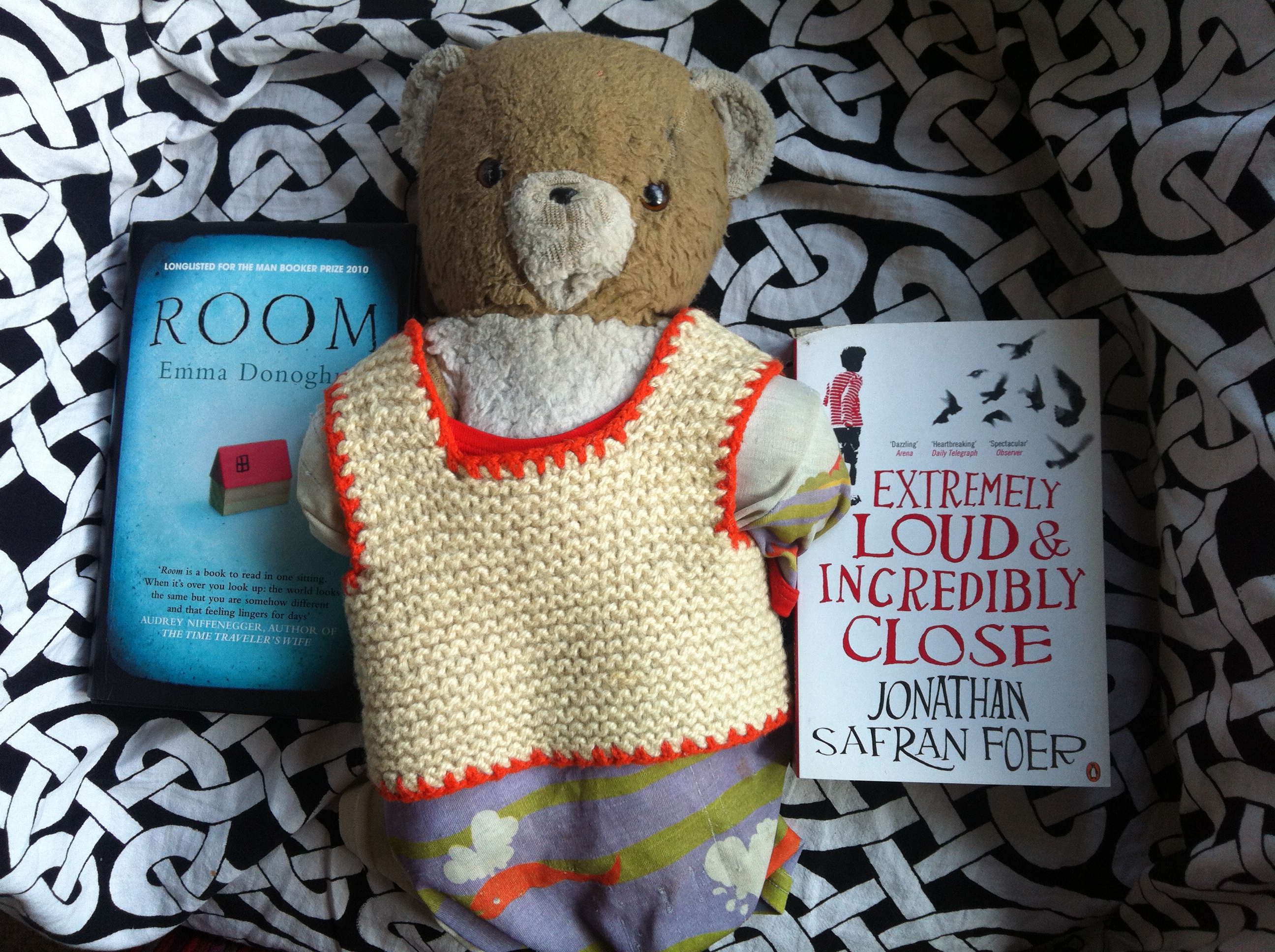
Here are the books with a remnant of my own childhood, Ted (unlike Oskar, I clearly wasn’t an inventive child, at least when it came to naming my toys):

Image