Of course, Orwell’s doublethink, whereby directly contradictory political messages obfuscate any sort of truth, looks completely ridiculous in this day and age…
(Miss you, Carrie)
A slight departure this week Reader, as rather than two books linked by a theme, for this post its one book only. One novel which is the size of 4 novels and has tested my aversion to e-books to the extreme, as lugging it around town on my commute and various evenings out has seen my back reach a place that even the most experienced osteopath would baulk at. Look at the size of this beast:
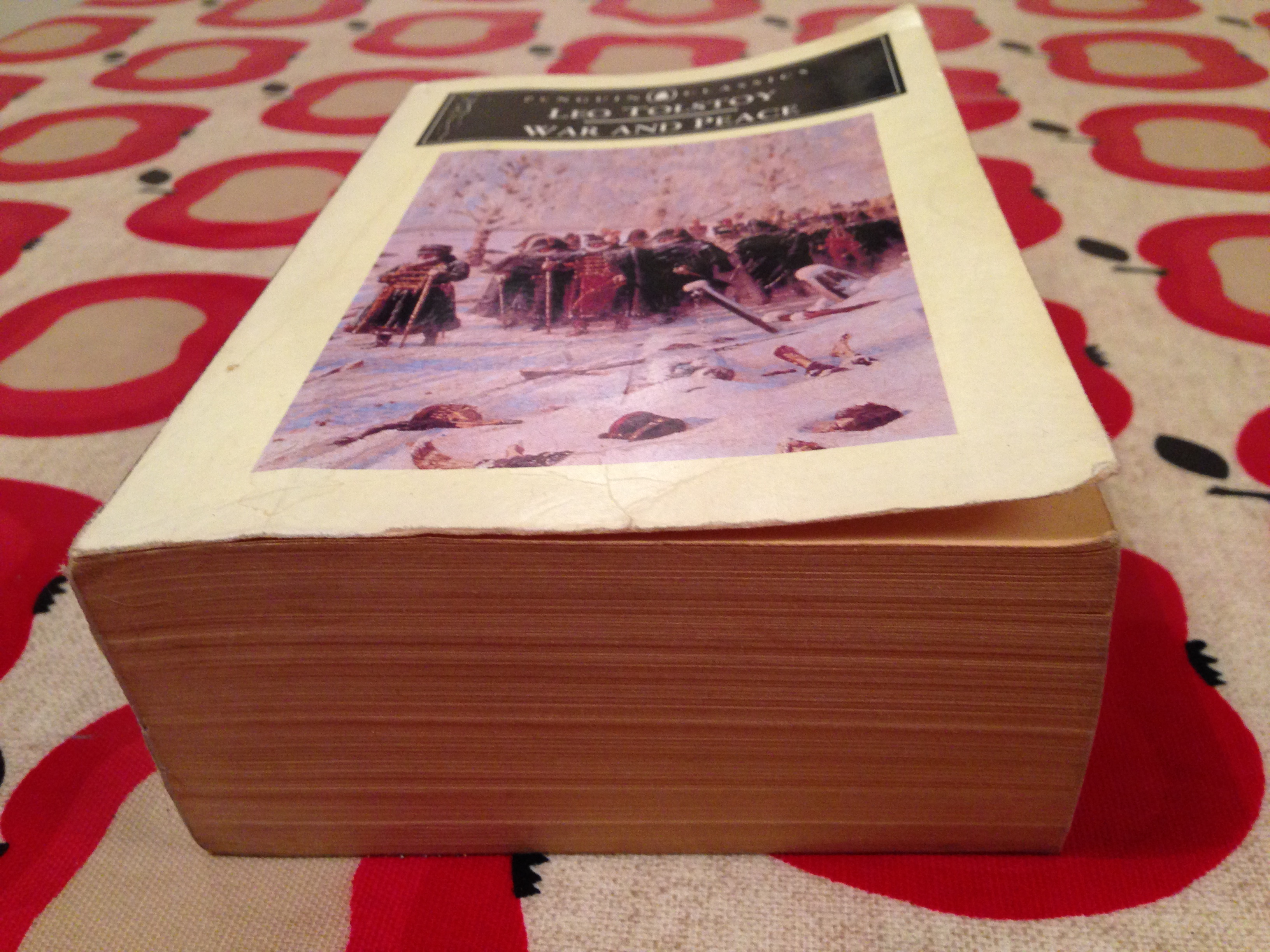
It is of course, War and Peace by Leo Tolstoy (1865-8) and for once a new year’s resolution fulfilled, as I decided 2017 was going to be the year. Such an epic stretches my limited reviewing capabilities so instead I present my War and Peace reading diary. Thrills! Spills! Intrigue! Romance! Or none of the above and instead one bibliophile risking permanent musculo-skeletal damage in the name of experiencing a cornerstone of classic literature – you decide! (Warning: this post is nearly as long as the Russian epic itself, my apologies Reader, I think Tolstoy is catching…)
Day 1
I planned to start reading War and Peace 6 days ago. One day I’ll be a disciplined person. Or possibly not.
There are 1444 pages in my Penguin edition (trans. Rosemary Edmonds, 1962-3, revised 1978). There’s a list of principal characters, which I thought was helpful until Wiki informed me that there are nearly 600 characters in this novel. The list names a full 26. What have I taken on?
As a further incentive to get this read I decide to reward completion with the BBC adaptation which everyone seemed to rate so highly:
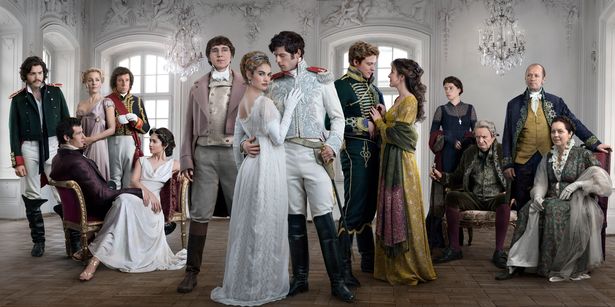
Or more specifically, I choose to reward myself with this (shameless objectification alert):
The foil blanket awaiting the end of this marathon….
Day one and so far I’m finding Tolstoy enjoyably cynical (so long as I forget he was horrible to his wife IRL):
“Never, never marry my dear fellow. This is my advice to you – don’t marry until you can say to yourself that you have done all you are capable of doing, and until you cease to love the woman of your choice and see her plainly, as she really is; or else you will be making a cruel and irreparable mistake. Marry when you are old and good for nothing. Otherwise everything that is fine and noble in you will be thrown away.”
And also a rival to Austen in the bitchy social commentary stakes:
“They wept because they were friends, and because they were warm hearted, and because they – friends from childhood – should have to think about anything so sordid as money, and because their youth was over…But the tears of both were sweet to them.”
Both good things.
Pages read: 65 (pathetic) Pages remaining: 1379
Day 2
It’s predictably British and trite to moan about the patronymic system in Russian novels so I won’t mention the fact that I’m struggling with the fact that everyone seems to have 27 names. Instead I’ll restrict myself to sharing my frustration that three – three! – principal characters are called Nikolai and the narrator refers to ‘the princess’ when there’s more than one princess in the room.
These quibbles aside – I’m hooked. War and Peace is completely brilliant.
Total pages read: 204 (better) Pages remaining: 1240
Days 3 – 5
War and Peace should come with a health warning: will induce antisocial behaviour. I’m really annoyed that social engagements arranged BWP (Before War and Peace) are taking me away from my reading time. I look up at the end of my commute disappointed that no-one around me looks even vaguely Cossack-like and apparently we’re no longer at war with Napoleon.
The peace sections are full of astute observations about socially mannered manipulations:
“Weierother met all objections with a firm and contemptuous smile that was evidently prepared beforehand against any piece of criticism, whatever it might be.”
We’re also getting more into the psychology of soldiering and war, which is bleak and depressing, such as Andrei’s attitude to his loved ones:
“ ‘All the same, the only thing I love and prize is triumph over all of them. I care for nothing but this mysterious power and glory which I seem to feel in the haze that hangs above my head’ ”
Tolstoy is astonishing. Maybe no-one mentions his wit because his psychological insights are so devastating.
Total pages read: 404 (rubbish – stupid social life) Pages remaining: 1040
Day 6 – 7
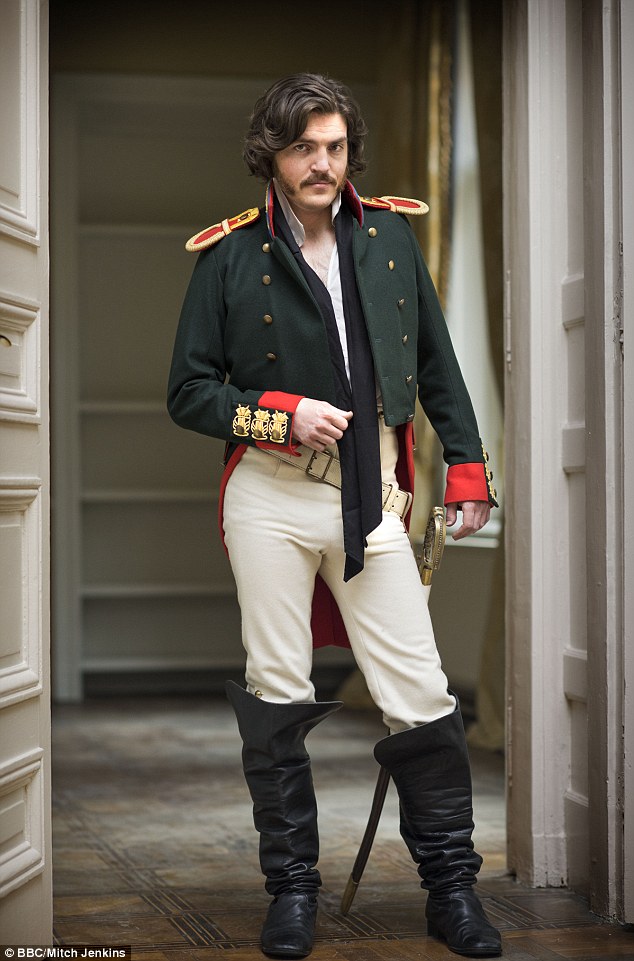
Is it wrong that manipulative, destructive, serial seducer Dolokhov is my favourite character? (Answer: yes.) I know I should prefer sweet Pierre: “Moscow gave him the sensation of peace and warmth that one has in an old and dirty dressing gown”
or noble Andrei “the chief reason for his wanting to weep was a sudden acute sense of the terrible contrast between something infinitely great and illimitable existing within him and the narrow material something which he, even she, was.”
But who are they to this one-man dirty bomb blasting his way through the drawing rooms of Moscow? I wonder who plays him in the BBC adaptation?
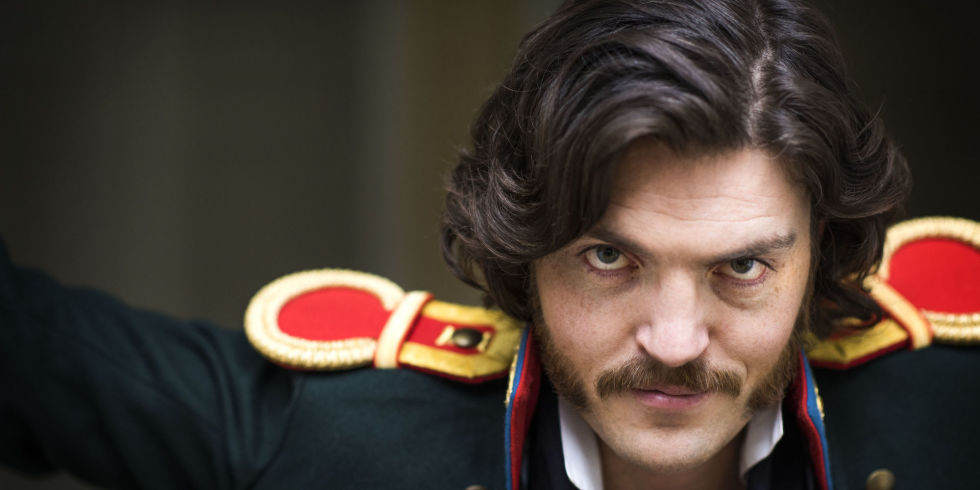
I doff my hat to you, BBC casting director.
Image from here
Bitchy social commentary of the day: “He believed that just as a duck is so created that it must live in water, so he was created by God for the purpose of spending thirty thousand roubles a year and occupying the highest pinnacle of society. He was so firmly grounded in this opinion that others, looking at him, were persuaded of it too, and refused him neither the exalted position in society nor the money, which he borrowed right and left with no notion of ever repaying it.”
Total pages read: 702 Pages remaining: 742 (managed to catch up to my goal of 100 pages a day). Nearly halfway!
Day 8
War! What is it good for?
“The forces of Western Europe crossed the frontiers of Russia, and war began: in other words, an event took place to counter all the laws of human reason and human nature. Millions of men perpetuated against one another such innumerable crimes, deceptions, treacheries, robberies, forgeries, issues of false monies, depredations, incendiarisms and murders as the annals of all the courts of justice in the world could not muster in the course of whole centuries, but which those who committed them did not at the time regards as crimes.”
Absolutely nothing. Say it again, y’all.
Total pages read: 864 Pages remaining: 580
Day 9
The serious tone continues, with the bitchy social commentary sadly no more, but it does sharpen the focus on the horrors of war and the psychological fallout on the characters.
“behind the veil of smoke the sun still stood high, and in front… a turmoil still seethed in the smoke, and the thunder of canon and musketry, far from slackening, grew louder and more desperate, like a man who puts all his remaining strength into one final cry”
A man sat next to me on my commute today sporting an enormous white beard and a Cossack hat. He has no idea how happy he made me.
Total pages read: 1006 Pages remaining: 438
Day 10 -11
The final stretch! I can’t say too much about what I’m reading for fear of spoilers.
Instead I’ll just say that I’ll be sorry to see it go, and frankly, I wonder if Tolstoy could have made it a bit longer.
Although I do think most editors today would try and dissuade authors from ending a 1400+ page novel with an abandonment of all narrative for a 40 page philosophical discussion on the nature of power and freewill…
Total pages read: 1444 Pages remaining: none!
So that’s me done, and I can’t quite believe it. There will be no stopping me now from reading other epics which have lain languishing in my TBR. Next: Ulysses! Infinite Jest! The Count of Monte Cristo! A different translation of War and Peace! I think I need a little lie down…
 madame bibi lophile recommends