“I had a lion inside me that wouldn’t shut up!” (Ingrid Bergman)

This week I’m focussing on Pushkin Press as part of Kaggsy and Lizzy’s #ReadIndies event to finally read four books that have long been in the TBR. Today it is a book of two essays, City of Lions by Józef Wittlin and Philippe Sands.

Pushkin Press’ website describes the volume: “Lviv, Lwów, Lvov, Lemberg. Known by a variety of names, the City of Lions is now in western Ukraine. Situated in different countries during its history, it is a city located along the fault-lines of Europe’s history. City of Lions presents two essays, written more than half a century apart – but united by one city.”

The book comes with maps of Lwów and Lviv within the French flaps and photographs throughout which are both useful and illustrative, making a really lovely edition. It also forms another stop on my Around the World in 80 Books reading challenge.

Józef Wittlin was a poet and novelist and his essay My Lwów (1946, transl. Antonia Lloyd-Jones 2016) beautifully evokes his longing for a city he knows has gone forever, with his writing full of nostalgia and loss.

Wittlin is completely aware of his skewed view of the city, having left in 1922 and writing his essay sat in New York so many years later:

“Nostalgia even likes to falsify flavours too, telling us to taste nothing but the sweetness of Lwów today. But I know people for whom Lwów was a cup of gall.”

Yet still he longs for city of his past.

“Alright, so Lwów hasn’t got a decent river, or a legend. What would it need a river for? The urban planners and tourists say that if Lwów were graced with a river, it would be a second Florence. In my view Lwów has more greenery than Florence, though less of the Renaissance. Moreover, it resembles Rome…”

But as Wittlin evokes the cityscape, its smells, food and people with great artistry and passion, world events – recent at the time of his writing – do filter through. In his evocation of a culturally mixed European city in the early twentieth century, he would have been aware that the Jewish population which had made up around a third of Lwów’s inhabitants had been almost entirely wiped out.

“It is not Lwów that we yearn after all these years apart, but for ourselves in Lwów.”

Philippe Sands essay My Lviv (2016) is written in conversation with My Lwów and views the city through the eyes of someone who never lived there, but whose family history – and the reason they had to leave –  is firmly rooted there.

“I could have chosen to turn away from the stories stuffed into the cracks of each building, or what was hidden behind freshly plastered walls. I could have averted my gaze, but I didn’t want to. Observing with care was part of the reason for being there, seeking out what was left, traces of what came before.”

Sands essay is deeply personal as he revisits his grandfather Leon’s home city. It is an experience he feels deep in his bones:

“I understood it to be part of my hinterland, one that was buried deep because Leon would never speak of that past. His long silence hid the wounds of a family that was left and then lost, but from the moment I set foot in the place it felt familiar, a part of me, a place I had missed and where I felt comfortable.”

At the same time, Sands is visiting with broader knowledge of devastation wreaked by the Holocaust, and he sees these layers within Lviv, even when they aren’t overtly commemorated:

“The first time I stood in the courtyard behind the school, in the autumn of 2012, I had no idea what that yard had been used for. Now armed with that knowledge, that this vast and empty place was a gathering point for thousands of final journeys […] it was a place of terrible silences, the expression of a conscious desire not to remember.”

I found City of Lions a deeply moving read. It is an elegy for a lost time, a eulogy for those lost, and a stark reminder that history is lived and died through by ordinary people. Cities grow and change, but they build upon and contain all that has gone before. It is all there if we take the time and care to look.

At the same time, what these two very different evocations of the same city demonstrate so well is that we experience our surroundings through ourselves. Wittlin and Sands are writing as much about themselves as they are about the city, but the essays are no less fascinating for that.

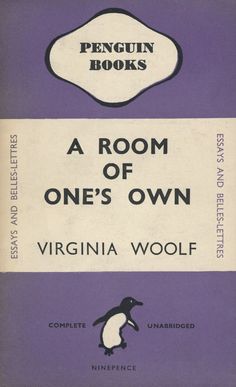
A Room of One’s Own – Virginia Woolf (Le Monde’s 100 Books of the Century #69)

Today’s post is  the latest in a series of occasional posts where I look at works from Le Monde’s 100 Books of the Century.  Please see the separate page (link at the top) for the full list of books and an explanation of why I would do such a thing.

A Room of One’s Own grew out of lectures Virginia Woolf was asked to give at Newnham and Girton Colleges, Cambridge, in 1928. You can read the full essay in various places online. Women were only officially admitted to the university in 1948, and the fact that these talks were given 20 years previously shows just how ground-breaking Woolf was.  A Room of One’s Own is a vital proto-feminist text that remains relevant today.  The fact that you can buy bags, pillows, tea towels, deckchairs, mugs, notebooks ad infinitum with the book cover on is an indicator of how much the central image continues to speak to people, as well as the arguments themselves.

Image

(Image from: https://www.pinterest.com/particularbooks/postcards-from/)

The central image is: “a woman must have money and a room of her own if she is to write fiction.”  In other words, she needs a means to support herself, and space to reflect and think; she needs liberty, and these things have been traditionally denied to women.  They have been dependent on the men in their family for financial support, and not supposed to concern their pretty little heads with intellectual endeavour.  Woolf argues her points forcefully but wittily, you never feel you are being bludgeoned by polemic.  Take for example the opening paragraph:

“But, you may say, we asked you to speak about women and fiction – what, has that got to do with a room of one’s own? I will try to explain. When you asked me to speak about women and fiction I sat down on the banks of a river and began to wonder what the words meant. They might mean simply a few remarks about Fanny Burney; a few more about Jane Austen; a tribute to the Brontës and a sketch of Haworth Parsonage under snow; some witticisms if possible about Miss Mitford; a respectful allusion to George Eliot; a reference to Mrs Gaskell and one would have done.”

The paucity of women writers Woolf has at her disposal to refer to speaks volumes about the male dominance of writing up to this point, and the reliance on male point of view for literary portrayals of women:

“women have burnt like beacons in all the works of all the poets from the beginning of time — Clytemnestra, Antigone, Cleopatra, Lady Macbeth, Phedre, Cressida, Rosalind, Desdemona, the Duchess of Malfi, among the dramatists; then among the prose writers: Millamant, Clarissa, Becky Sharp, Anna Karenina, Emma Bovary, Madame de Guermantes … Indeed, if woman had no existence save in the fiction written by men, one would imagine her a person of the utmost importance; very various; heroic and mean; splendid and sordid; infinitely beautiful and hideous in the extreme; as great as a man, some think even greater.”

Of course, Woolf was a highly accomplished and inventive writer herself, and this is reflected in the lecture which is not traditionally academic but instead illustrated with fictional characters such as Judith Shakespeare, sister of the more famous William:

 “his extraordinarily gifted sister, let us suppose, remained at home. She was as adventurous, as imaginative, as agog to see the world as he was. But she was not sent to school. She had no chance of learning grammar and logic, let alone of reading Horace and Virgil. She picked up a book now and then, one of her brother’s perhaps, and read a few pages. But then her parents came in and told her to mend the stockings or mind the stew and not moon about with books and papers. […]She had the quickest fancy, a gift like her brother’s, for the tune of words. Like him, she had a taste for the theatre. She stood at the stage door; she wanted to act, she said. Men laughed in her face […]who shall measure the heat and violence of the poet’s heart when caught and tangled in a woman’s body? [She] killed herself one winter’s night and lies buried at some cross-roads where the omnibuses now stop outside the Elephant and Castle.”

As my extensive quoting shows, I think this is a fantastic essay, well worth reading. It isn’t flawless, it’s culturally biased towards the speaker and her audience: middle-class, white, Western women.  But Woolf never claims to have all the answers: “women and fiction remain, so far as I am concerned, unsolved problems.” (I think the idea of women as an unresolved problem is ironic and assertive, not derogatory?) A Room of One’s Own highlights enduring problems, relevant to both genders, of how to claim societal freedom that will permit individual voices to be heard. It also makes me very glad that I am a woman in this day and age; I may be embarrassed at how ridiculously over-educated I am (a perennial student) but at least I had the choice to become so.

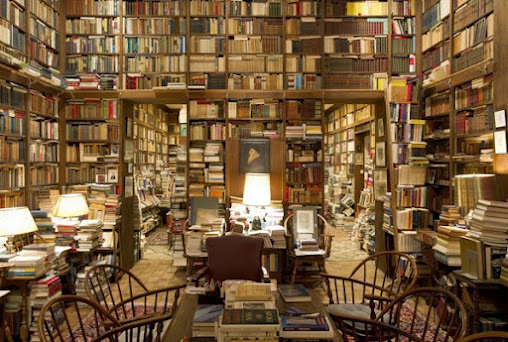
To end, a picture of a room I wish was my own – it could do with a few more books, though…

Image

(Image from http://pawilson.ca/are-there-some-books-you-keep-reading-over-and-over/ )