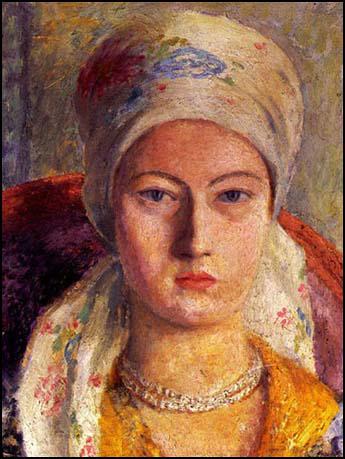
“People are better inside your head.” (Donal Ryan, The Thing About December)

I never take enough books away with me. So having finished The Garden of Evening Mists during my New Forest weekend, I ducked into the Oxfam Bookshop in Lymington and was gratified to find a copy of The Queen of Dirt Island by Donal Ryan (2022). Ryan is one of my favourite contemporary authors and I was yet to read his most recent novel.

Characters from his previous novel Strange Flowers make a reappearance here, but they are not the main focus. The story belongs to Saoirse Aylward, her mother Eileen, and her paternal grandmother Nana who all live together in Nenagh, County Tipperary.

We follow Saoirse from her 1980s childhood to her thirties, with the tensions and strains, and unwavering warmth and love that the women create within their family home.

Saoirse’s father died a few days after she was born and she sometimes feels guilty for not feeling his loss.

“Every other house in the small estate that had children in it also had a father, a living one.

None of them looked like they were of much use except for cutting grass with the same shared lawnmower, taking turns to cut the verges in the small green area at the front of the estate and the smaller green at the back.”

The Aylward women are an enclosed, loving unit, viewed as somewhat eccentric by the rest of the town. Eileen is uninterested in men for the most part, her heart lying with her dead husband. She is sweary and gruff and no-one understands why she and her mother-in-law are living together.

“She realised that she and her mother rarely spoke properly at all. That most of mother’s speech was indirect, utterances flung around like fistfuls of confetti, vaguely aimed and scattering randomly. But she supposed this to be the way of all parents and child relationships. Her mother told her every single night that she loved her.”

Nana might be less sweary, but in her own way she is just as direct, such as when speaking to Saoirse about her Uncle Chris:

“Whatever he was at inside me he made a pure hames of my pipework. He started as he meant to go on, anyway, that’s for sure.”

His brother Paudie has a dramatic and mysterious life, helping on the farm until he is suddenly arrested and sent to prison.

“They never looked comfortable down here in the angular lowlands of the estate. They were shaped to the contours of hills and hedgerows, their feet only sure on giving ground.”

Yet it is Saoirse’s teenage years that bring the most disruption to the house. Ryan is excellent at capturing this time, such as this description of Saoirse’s first boyfriend:

“His miasma of Lynx and sweat and stolen cigarettes, his uncertain swagger, his damp hand in hers.”

But Saoirse is learning about the darker sides of life too, which have previously not infiltrated her safe home: self-harm, domestic abuse, suicide, sexual assault. Her mother and Nana can’t protect her from everything.

And within her family, there is a threatening presence: her uncle Richard. He is her mother’s brother, and while Eileen is estranged from her family, her father has left her the titular land. Richard wants it back, and this tension bubbles in the background through the years.

The tone of The Queen of Dirt Island felt very well-balanced, not shying away from trauma but not unrelentingly bleak either. Nana in particular provided humorous moments. The women all felt fully realised and believable, their voices beautifully evoked.

This is not a novel to read for positive portrayals of men, however. Nana advises young Saoirse:

“You only get one life, and no woman should spend any part of it being friends with men. That’s not what men are for.”

The Queen of Dirt Island is a warm-hearted book, compassionate to its flawed characters, which was a joy to read. I could have spent another 200 pages at least with the Aylward women.

Ryan writes with a poetic restraint, and the story is told through a series of vignettes. Each section is 500 words including a title, and at just 242 pages it’s a really quick read. Thankfully I’d also found a collection of Dorthe Nors short stories in the Oxfam bookshop so I managed to keep myself going on the return journey home 😉

“She was glad of mother’s unwavering impolitic nature, her peculiar loving manner, and she knew that Nana loved mother with the same gruff constancy.”

To end, the author reading one of the vignettes, which I read in an interview was based on a childhood experience with his mother:
“Happiness is having a large, loving, caring, close-knit family in another city.” (George Burns)

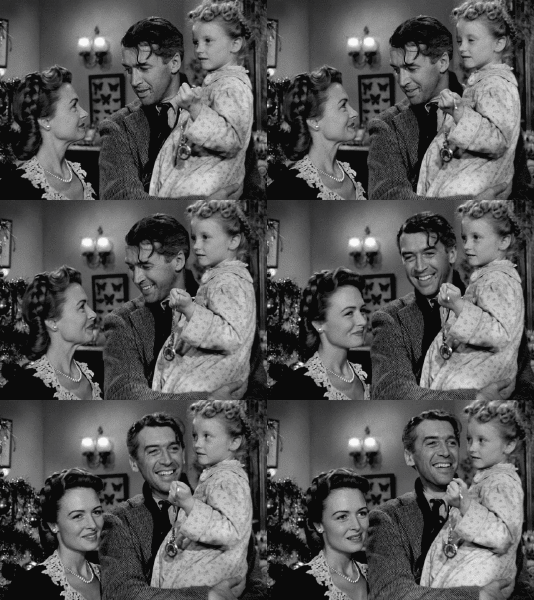
I hope you all had a wonderful Christmas! From my twitter feed, I know for some that means being as far away from relatives as possible 😉 If Christmas advertising were to be believed, we should all have families like this:

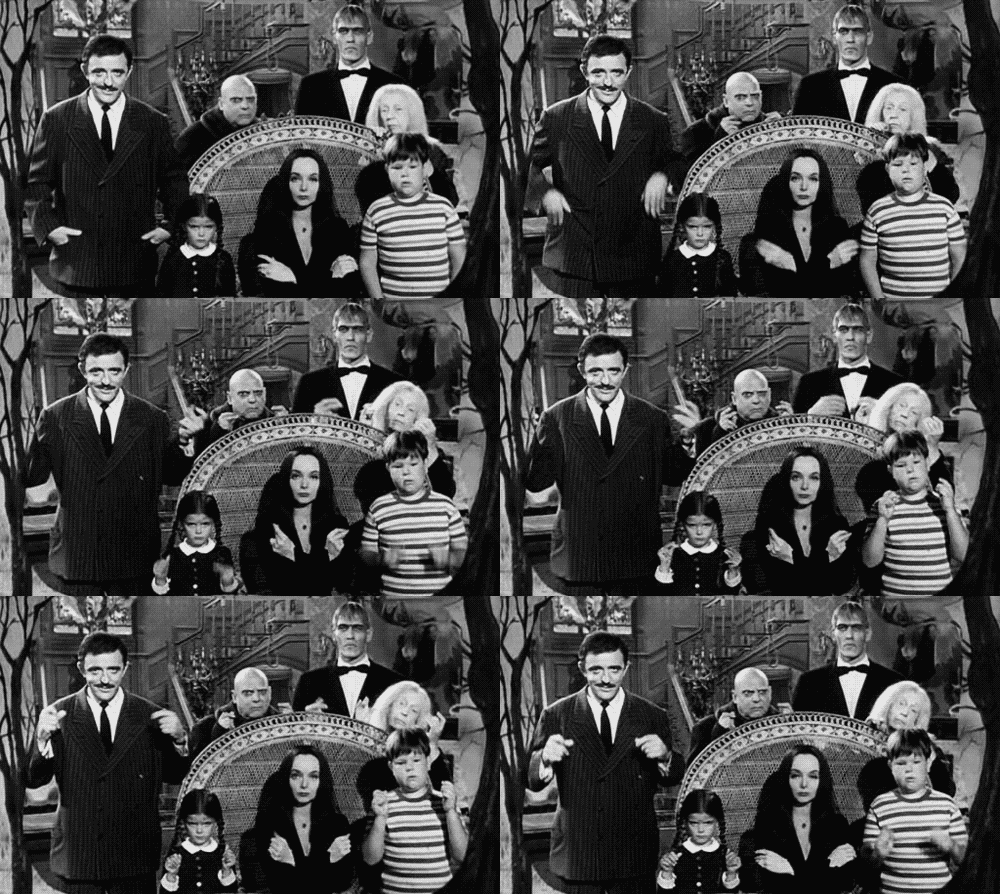
Whereas in fact the reality may be closer to this:

In which case I would say well done you, because I’m the only person alive who doesn’t like It’s a Wonderful Life *ducks for cover* whereas the Addams Family are awesome.  Whether you spent Christmas with George Bailey or Uncle Fester,  I thought this week might be a good time to look at families that are found in unexpected places.

Firstly, Plainsong by Kent Haruf (1999) which I picked up after loving Our Souls at Night so much and many bloggers recommended I start the Plainsong trilogy. All the things I enjoyed about Our Souls at Night were here: a gentle, unshowy voice, believable idiosyncratic characters, ordinary lives shown to have a delicate beauty.

Set in the fictional prairie community of Holt, Colorado, Plainsong focusses on a pregnant schoolgirl, Victoria Roubideaux, and one of her teachers, Tom Guthrie, who is splitting up with his wife. After Victoria is thrown out by her mother, another teacher, Maggie Jones, suggests to a pair of elderly brothers, Harold and Raymond McPheron, that they take her in.

“ You’re getting goddamn stubborn and hard to live with. That’s all I’ll say. Raymond, you’re my brother. But you’re getting flat unruly and difficult to abide. And I’ll say one thing more.

What?

This ain’t going to be no goddamn Sunday school picnic.

No it ain’t, Raymond said. But I don’t recall you ever attending Sunday school either.”

They offer Victoria a home, and the portrayal of their developing relationship with the young woman is just lovely. The brothers are set in their ways and unused to female company. Victoria is shy and unsure. The tentative gestures they make towards one another pay off and a tender, mutually nurturing affection develops.

“The brothers were watching her closely, a little desperately, sitting at the table, their faces sober and weathered but still kindly, still well meaning, with their smooth white foreheads shining like polished marble under the dining room light. I wouldn’t know, she said. I couldn’t say about that. I don’t know anything about it. Maybe you could explain it to me.

Well sure, Harold said. I reckon we could try.”

Meanwhile, Tom’s sons Ike and Bobby are struggling to come to terms with their mother’s depression and subsequent leave-taking. A similarly unexpected yet gentle cross-generational relationship develops between the boys and elderly, isolated Mrs Stearns who they know from their paper round.

“The timer dinged on the stove. They took the first oatmeal cookies out of the oven and now there was the smell of cinnamon and fresh baking in the dark little room. The boys sat at the table and ate the cookies together with the milk Mrs Stearns had poured out into blue glasses. She stood at the counter watching them  and sipped a cup of hot tea and ate a small piece of cookie, but she wasn’t hungry. After a while she smoked a cigarette and tapped ashes in the sink.

You boys don’t say very much, she said. I wonder what you’re thinking all the time.

About what?

About anything. About the cookies you made.

They’re good, Ike said.”

Plainsong is a gentle tale about all that human beings can give and be to one another, but it is not remotely sentimental or rose-tinted. Haruf shows, he doesn’t tell, with a restraint and subtlety that is easy to underestimate but is absolutely masterful. I find his writing incredibly moving. It’s going to be a real strain on my 2018 book buying ban not to rush out and buy the novels of his I don’t yet own.

Secondly, Sweet Bean Paste by Durian Sukegawa (2013, trans. Alison Watts, 2017). Again, this is a simply told tale of ordinary people, and it is truly heartwarming. The main protagonist is the decidedly unheroic Sentaro. He has a criminal record and is employed by people he owes money to. He sells dorayaki – pancakes filled with the titular paste – with no pride in or commitment to his work. One day Tokue, an elderly lady with a visible disability in her hands and face arrives in the shop:

“ ‘I had one of your dorayaki the other day. The pancake wasn’t too bad, I thought, but the bean paste, well…’

‘The bean paste?’

‘Yes. I couldn’t tell anything about the feelings of the person who made it.’

‘You couldn’t? That’s strange.’ Sentaro made a face as if to show how regrettable that was, though he knew full well his bean paste could to reveal no such thing.”

Sentaro employs Tokue on the understanding that she will not interact with the customers who he thinks will be put-off by her disability. Tokue’s delicious bean paste brings more customers to the shop and business begins to boom. As Sentaro and Tokue’s relationship develops, he begins to understand that she has survived Hansen’s disease (leprosy) but is still subject to significant stigma around the disease. One of the schoolgirl customers, Wakana, becomes very attached to Tokue, and they visit her at the asylum she continues to live in although the government has passed an act which means those with Hansen’s disease are no longer kept in isolation.

“Nevertheless human lives had been swallowed up by this place and for a hundred years, continually spurned. It felt to Sentaro as if the singular silence rose from the very earth beneath their feet, steeped as it was in sighs and regrets.”

Sweet Bean Paste is about living life to the full even when society is circumscribing it in cruel ways. It is about friendship’s power to heal and to empower. It is also about opening ourselves to experience the world in new and surprising ways, no matter our age. Tokue has an almost mystical relationship with her cooking, which enriches both her and those who consume her food.

“When I make sweet bean paste I observe closely the colour of the adzuki beans faces. I take in their voices. That might mean imagining a rainy day or the beautiful fine weather they have witnessed. I listen to their stories of the winds that blew on their journey to me.”

And so in the end, I think Sweet Bean Paste is about nourishment in all its forms; it is there for the taking if we have the wisdom to see it and the open hearts to embrace it.

To end, never let it be said that I shy away from the obvious:

“One fine day.” (Carole King)

Last week I mentioned that 2016 has been a terrible year so far. I don’t follow sport in any shape or form, but even I know Andy Murray has done his best to cheer up a post-Brexit UK by winning the men’s singles final at Wimbledon. Congratulations to all the winners!

andy-murray-wimbledon-tennis_3741489

Image from here

Obviously these wins are the result of years of dedicated training, but we all experience things that culminate in one day now and again. So to celebrate I’ve picked two novels that deal with the events of one day.

Firstly, Cheerful Weather for the Wedding by Julia Strachey (1932), who was one of the Bloomsbury group; this novel was originally published by Leonard and Virginia Woolf’s Hogarth Press, she was a niece of Lytton Strachey and was painted by Dora Carrington:

ARTstracheyJ2

This novella details the morning of a wedding: the preparations, the arrival of guests, the bustling of servants. The bride doesn’t make an entrance for a while, instead we are treated to her mother, Mrs Thatcham, giving contradictory instructions to all and not seeing that this why things are not organised as she expects:

“with a look of sharp anxiety on her face as usual – as though she had inadvertently swallowed a packet of live bumble-bees and was now beginning to feel them stirring about inside her. She stopped and looked at the clock.

‘I simply fail to understand it!’ burst from her lips.

She trotted briskly out of the drawing-room in the direction of the kitchen.”

Apparently this woman, who veers between being frustratingly tedious and a downright bully, was based on Strachey’s mother-in-law…

Meanwhile, the guests start to arrive. There are some lovely character sketches of family members and assorted hangers-on, told with gentle – in the main – humour.

“a tall, grey-haired man, in black clerical clothes, with a gaunt white face reminiscent of a Pre-Raphaelite painting of Dante. It was Canon Dakin, or Cousin Bob of Hadley Hill as the family called him.”

There is a hilarious description of a lampshade wedding gift and Aunt Katie’s verdurous wedding hat. My favourite little scene was between deluded Aunt Bella, who is busy boring her nephew Lob with tales of how her servants “simply cherish me”, and is met with the following non-sequitur:

“‘My dear lady,’ replied the cheerful Lob, speaking unexpectedly loudly, and holding his glass of wine up to the light for a moment, “I don’t care two pins about all that! No! The question, as I see it, is quite a different one. The whole thing is simply this: Is it possible to be a Reckless Libertine without spending a great deal of money?’”

When we finally meet the bride, Dolly, it is clear all is not well. For starters, she has put away most of a bottle of rum to enable her to stagger down the aisle:

“At this moment Dolly was trailing slowly down the back staircase (which was nearer to her part of the house than the main one), her lace train wound round and round her arm. From out of the voluminous folds of this there peeped a cork and the top of the neck of the bottle. In her other hand was her large bunch of carnations and lillies.” 

As Dolly is unsure of what she is doing and why, simultaneously there is an admirer of hers, Joseph, who may at any minute stop the wedding, though he is not sure of his motivations for doing so. Apparently Strachey was a fan of Chekov, and Cheerful Weather for the Wedding shows this influence in domestic subject matter and conflicted characters unable to take action. The humour is bittersweet: while the preparations and family members are portrayed with a light irreverence, the drunk bride and her inert friend? lover? – we are never told – bring a genuine sadness to proceedings. I couldn’t help feeling they were both on the brink of disaster.

“Dolly knew, as she looked around at the long wedding-veil stretching away forever, and at the women too, so busy all around her, that something remarkable and upsetting in her life was going steadily forward.”

Virginia Woolf’s opinion of Cheerful Weather for the Wedding was high: ‘I think it astonishingly good – complete and sharp and individual.’ Strachey doesn’t explain everything and leaves many questions in the reader’s mind as to what is going unsaid and undone on this nuptial morning (looking at the trailer for the 2012 film it looks as if everything is spelled out, so I will not be watching the film version – why? WHY??)  While it is short, Cheerful Weather for the Wedding is not slight – witty, sardonic, sad and wise – it is a fully realised portrait of everyday tragedy.

400x400_1335564193597-drunkbride

Image from here

Secondly, A Single Man by Christopher Isherwood (1964) tells a day in the life of George Falconer, an ex-pat English professor living alone in California just after the Cuban missile crisis, and grieving the loss of his partner Jim, killed suddenly in road traffic collision.

“And it is here, nearly every morning, that George, having reached the bottom of the stairs, has this sensation of suddenly finding himself on an abrupt, brutally broken off, jagged edge – as though the track had disappeared down a landslide. It is here that he stops short and knows, with a sick newness, almost as though it were for the first time: Jim is dead. Is dead.”

In the midst of this enormous pain, George carries on with his life: teaching a class, shopping, going to the gym, getting drunk with a friend.

“In ten minutes, George will have to be George; the George they have named and will recognise. So now he consciously applies himself to thinking their thoughts, getting into their mood. With the skill of a veteran, he rapidly puts on the psychological makeup for this role he must play.”

A Single Man is perfectly paced, capturing George’s numb putting-on-foot-in-front-of-the-other coping without losing narrative drive. The tone is gentle, treating George kindly, but without sentimentality – he is not always kind himself, and his views on those he encounters are unblinking. However, as we spend the day with George, we start to get glimmers of his desire to keep living, a sense that he will find meaning in carrying on. But then his grief completely side-swipes him:

“He pictures the evening he might have spent, snugly at home…only after a few instants does George notice the omission which makes it meaningless. What is left out of the picture is Jim, lying opposite him at the other end of the couch, also reading; the two of them absorbed in their books yet so completely aware of the other’s presence.”

There is sadness in A Single Man but it is not depressing. Rather it shows how life goes on in all its messy imperfection, and that can be OK, even when you are feeling far from fine.

 A Single Man was made into a film in 2009, the directorial debut of fashion designer Tom Ford. It certainly looked amazing and had some wonderful performances by Colin Firth and Julianne Moore, but the screenplay made some significant changes and unsurprisingly, I prefer the book for its subtlety and nuance. Kudos to Ford though, for filming a book that takes place almost entirely within one man’s head.

I hope you all have a great day ahead 🙂

“Mothers are all slightly insane.” (JD Salinger)

You’re not wrong, JD. Mine is in definite box-of-frogs territory. It’s the thing I like most about her. I’ve been extraordinarily lucky, but a relationship such as ours will never be immortalised in literature given that we get on well and it would be inexorably dull. So for mother’s day (which it is today in the UK) I’m looking at two portrayals of mothers that are nothing like my own but which make for great reads. This post is dedicated not only to my own mother, but also to my sister-in-law, for whom today is her first mother’s day as a mother 🙂

My mother and I have never been this adorable

My mother and I have never been this adorable

Image from here

My first literary mother is Mrs Ramsay from To the Lighthouse by Virginia Woolf. I chose this because Virginia Woolf is one of my mother’s favourite writers, and like the homebrew peach schnapps I once allowed past my lips, I deeply regret this now. How on earth do you write about anything by Virginia Woolf? Her writing is so rich, so multi-layered, so dense and yet so subtle that I don’t feel adequate to the task – which I’m sure the following discussion will prove beyond a doubt 😉

In To the Lighthouse, the Ramsay family descend on their holiday home in the Isle of Skye. Woolf’s stream-of-consciousness technique is perfect at capturing everything that occurs beneath the surface of an ordinary day, the deep significance below the seemingly insignificant:

“the monotonous fall of the waves on the beach, which for the most part beat a measured and soothing tattoo on her thoughts and seemed consolingly to repeat over and over again as she sat with the children the words of some old cradle song, murmured by nature, ‘I am guarding you – I am your support’, but at other times suddenly and unexpectedly, especially when her mind raised itself slightly from the task in hand, had no such kindly meaning, but like a ghostly roll of drums remorselessly beat the measure of life, made one think of the destruction of the island and its engulfment in the sea and warned her whose day had slipped past in one quick doing after another that it was all as ephemeral as a rainbow – this sound which had been obscured and concealed under the other sounds suddenly thundered hollow in her ears and made her look up with an impulse of terror.”

Mrs Ramsay is a nurturing and dedicated mother but here Woolf exposes the fractures that threaten a seemingly harmonious exterior.  I think this passage is just brilliant – the setting up of the monotonous background noise that lulls yet twists in a moment, the mind rebelling against the self, the pure terror that we can be overwhelmed by our own feelings – all while domesticity continues undisturbed.

The family are surrounded by Mrs Ramsay’s nuturing love and the sea, and as the passage  above shows, these are bound together in their constancy being mistaken for predictability. To the Lighthouse uses water imagery to great effect, the sustaining essence that can imperil and kill:

“how life, from being made up of little separate incidents which one lived one by one, became curled and whole like a wave which bore one up with it and threw one down with it, there, with a dash on the beach”

This is my experience of reading Woolf: small incidents, layered up into writing of such power that you surface from her novels feeling dashed by a powerful force.

If you’d like to read some proper reviews of this wonderful novel, there have been insightful and interesting posts written lately by bloggers including Lady Fancifull and Simon at Stuck in a Book. If you’d like to know more about the man Mrs Ramsay married, a man given to views such as: “He wondered if she understood what she was reading. Probably not, he thought. She was astonishingly beautiful.” Sarah has written a typically witty and entertaining post over at Hard Book Habit.

Secondly, The Blue Room by Norwegian author Hanne Orstavik (trans. Deborah Dawkin) one more stop on my Around the World in 80 Books Reading Challenge, hosted by Hard Book Habit. I can’t remember which blogger made me aware of this so if it was you please leave a comment! Peirene Press publish contemporary European novellas, and group them in sets of three, linked by theme. The Blue Room is part of the Coming-of-Age series, and concerns Johanne’s intense relationship with her mother; they live together while Johanne trains to be a psychologist. Her career choice is deeply ironic, given that she has no insight into the manipulative, controlling behaviour her mother directs towards her, or her own victimhood.

“She’s right, I thought, we belong together like two clasped hands.”

Well, two clasped hands can be affectionate, reassuring, but also restraining and restrictive. The novel takes place over the course of a day, when Johanne was due to leave to spend six weeks in the States with her boyfriend, yet wakes to find herself locked in the titular space and unable to leave. As she thinks back over recent events, relationships with her mother, boyfriend and God emerge and the reader is left to piece together what is going on beyond what Johanne doesn’t say. She is an unreliable narrator of her own life as we all are, because her perspective is limited by what she cannot see.

Her mother is deeply controlling and Johanne has the victim’s hypersensitivity to her abuser’s every need and whim. At no point does she articulate that it is her mother who has locked her in, unwilling to let her leave.

“Perhaps I’m locked in here as part of an experiment. Perhaps somebody’s pumping gases in and changing my consciousness.”

Johanne’s sexual fantasies abruptly break into the narrative, filled with violence,  with herself as the dominated party in BDSM scenarios. Again, despite her training, she cannot see how this is bound up in her relationship with her mother:

“And what exactly, I asked, is the meaning of this pain? Don’t we grow when we’re happy? Mum looked at me: she seemed angry and said nothing.”

Johanne is young and naïve, lacking insight, both sweet and shocking. The Blue Room is a powerful novella about our closest relationships and how they influence us in ways we barely comprehend.

To end, a little treat for my mother and any other LDP fans out there – enjoy!

https://www.youtube.com/watch?v=5f9cyTBYEss