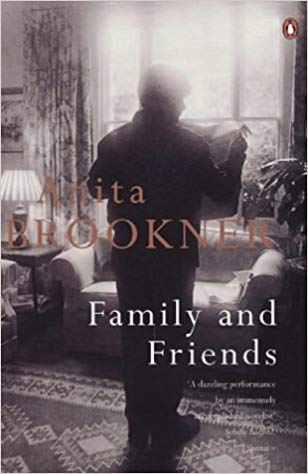
Family and Friends – Anita Brookner (1985) 187 pages
Many years ago I read Anita Brookner’s Booker-winning Hotel du Lac and although I remember very little about it I remember that I didn’t like it much. Recently I’d begun to think I should give her another try; I suspect my early 20s was a bit too young for Brookner and her incisive consideration of loneliness and disappointment. I was discussing this with a colleague, and so she lent me Family and Friends, Brookner’s follow-up to Hotel du Lac. A novella seemed a perfect way to dip my toe in again, and I’m so glad I did. I loved it.
It is the study of the Dorn family: matriarch Sofka and her children Frederick, Alfred, Betty and Mimi, beginning in the 1920s. The unnamed narrator is gazing at a wedding photograph of them all:
“I find it entirely appropriate that Sofka should have named her sons after kings and emperors and her daughters as if they were characters in a musical comedy. Thus were their roles designated for them. The boys were to conquer, and the girls to flirt. If this implies something unfinished, as if the process were omnivorous but static, that too would be characteristic. Sofka sees her children’s futures as being implicit in their names, and she has given much thought to the matter; indeed, one wonders whether she thinks about anything else.”
Throughout the novel this device is repeated: the photograph with the aging subjects and their relationships unwittingly captured over the years. Brookner’s portraits of her characters are unflinching:
“Betty is one of those women who believe in acting out a passion before they really feel it […] Mimi is not the type of girl who will, or indeed, can, do anything independently. But Betty knows that her mission in life is to be a woman who prevents men from staying with their virgin loves, and she is eager to embark on this career.”
Betty is keen to escape and uses one man to get to Paris – thwarting Mimi’s delicately-held fantasies in the meantime, and being quite aware of doing so – and then another man to get to the States, from where she never returns.
Likewise, Frederick, who is supposed to be running the family empire, flees to the French Riviera with a woman deemed wholly unsuitable by Sofka, but who makes feckless Frederick quite happy and contented. The responsibility of the business therefore falls to Alfred before he is out of his teens:
“He has, above all, obeyed his mother in everything. He does not yet know that men who obey their mothers in everything rarely win the admiration of other women.”
Over the years, perhaps only Frederick is happy. Betty is selfish and untalented, with zero insight and so unable to work out why her life is not evolving as she hoped. Alfred is disappointed in life generally, and delicate, beautiful Mimi is prone to depression.
“She has been questing unconsciously for that man, that alien, that stranger, that appointed one, who will deliver her, the sleepwalker, from her sleep. Thus, in the bosom of her family, Mimi, the good daughter, has been one of the most ready, the most willing, to defect.”
Family and Friends is about precisely what the title says. It is a study of these people over several years, with very little plot other than the typical events of people’s lives, and sparse dialogue. Although Brookner is unflinching, she is not without compassion. She sees plainly, but doesn’t sit in judgement on her characters, despite her clear-sighted discernment of all their weaknesses and the hurt they cause one another and themselves.
Anita Brookner is the ideal writer of novellas. She is so concise, not a word is wasted and every word carries its full weight. Her skill is astounding.
Despite only starting to write novels at the age of 53, Brookner was prolific and produced around a book a year for the rest of her writing life. I’m looking forward to exploring more of these now I know what I’m missing. And first on the list is a re-read of Hotel du Lac 😊
 madame bibi lophile recommends