“When I was a teenager, I read a lot of Poe.” (Dario Argento)

It’s Hallowe’en!  OK, it was Hallowe’en.  I delayed this post slightly to make it a joint one for my friend D’s birthday, as she is a massive fan of Gothic. Happy Birthday D!

While the cooler kids are no doubt watching films by Dario Argento last Thursday, (who I’ve quoted above) there are some for whom nothing says horror like Hammer.  Hammer Films are a British production company whose classic output you can see clips from here:

http://www.youtube.com/watch?v=MyltXEDiXKM

Some insight into my upbringing there: as a teenager my mother fell in love with Christopher Lee in those roles; it’s a wonder I’m so normal (I always brush my fangs every night before bed).  Also, one of my long-standing girl crushes, Valerie Leon, makes an appearance in the Blood From the Mummy’s Tomb.  She’s the one the narrator describes as “smoking hot”, and indeed she is.  Oh Valerie, how I wish I looked like you, even a little bit would do…  If you think To the Devil a Daughter looks amusing, well, you are probably right.  I’ve never seen it, but a few years back I took my mother to a talk by Richard Widmark.  Christopher Lee made an impromptu appearance in the audience (my mother is still recovering, as am I, to be honest) and the two of them reminiscing about that film was the funniest part of the night.  Definitely worth a look, I’d say.

But this is supposed to be about books, right?  Well, I’m getting there.  Hammer have produced some pretty high-profile films in recent years, including The Woman in Black.  As part of their raised profile, they’ve gone into partnership with Arrow books, and asked contemporary authors (Helen Dunmore, Julie Myerson, Sophie Hannah, Melvin Burgess) to write some creepy stories.  I thought it was the perfect marriage for a Hallowe’en book blog post, so my first choice is The Daylight Gate by Jeanette Winterson (Arrow Books in association with Hammer, 2012). The novel tells the story of the Lancashire Witch trials of 1612.   Winterson has taken this real-life story and woven it with her own fiction to brilliantly evoke a nation caught up in paranoia around the power of women, of ritual, and of a new Protestant faith trying hard to establish itself over the old Catholic one.  Lancashire was a Catholic stronghold, and it’s where the conspirators of the 1605 Gunpowder Plot sought refuge:

“The north of England is untamed.  It can be subdued but it cannot be tamed.  Lancashire is the wild part of the untamed.  The Forest of Pendle used to be a hunting ground, but some say that the hill is the hunter – alive in its black-and-green coat cropped like an animal pelt.”

Alice Nutter is a rich woman who lives alone, rides astride, engages in falconry, and rescues witches from a ducking.  Given these unwomanly ways, she naturally raises suspicions.  She studied under the occultist John Dee, and invented a deep magenta dye “like looking into a mirror made of mercury” which made her fortune. Alice struggles to remain apart from the society she is surrounded by, and eventually gets drawn into the town politics that have seen several women arrested on witchcraft.  The Daylight Gate is a short novel and I don’t want to give too much away, but what I will say is that amongst the witchcraft (severed heads talking with other people’s blackened tongues, people transforming into hares, familiars, elixirs of youth and the like) what is truly shocking is the state-sanctioned capture and torture, based entirely in reality.  Brace yourselves:

“In the cell was a rack, a winch, a furnace, a set of branding irons, a pot for melting wax, nails of different lengths.  A thumbscrew, a pair of flesh tongs, heavy tweezers, a set of surgical instruments, a series of small metal trays, ropes, wire, preparations of quicklime, a hood and a blindfold […] They made a small neat cut in his side and drained a quart of blood to weaken him.  Then they forced him to drink a pint of salt water.  They did not break his fingers joint by joint or pull out his teeth one by one.  They were relaxed. They drew pictures on his chest with delicate knives…they pinned back his eyelids with metal clips and dropped hot wax into his eyeballs. When he screamed they debated whether or not to take out his tongue.  But they wanted his tongue for confession.”

Eek.  I’m not a big fan of horror, but I imagine part of the appeal is that it’s a safe way to scare yourself, secure in the knowledge that Freddy Kruger et al are entirely removed from your life.  In The Daylight Gate, Winterson shows us the horrors that really aren’t so far removed, and as such offers very little comfort.  A truly chilling read for Hallowe’en.

Secondly, The Monk by Matthew Lewis (1796, my copy Oxford University Press 1995).  The Monk was written by Lewis in 10 weeks, shortly before he turned 20.  I decided to read it as at least 3 people, including my friend D, told me it was the most barking mad novel they’d ever come across.  How could I resist?  They were so right, I had no idea how right they were.  The Monk is so insane, to try and review it is near impossible.  Its plot is so convoluted, I can’t give you a summary in a single blog post. Instead, let’s make a list of typical Gothic tropes:

  • Virginal, beautiful young maidens who struggle to remain so
  • Old crones, often in caretaking capacity to the young maiden
  • People with obscure origins inc. family members pretending to be other than they are, to get close to family who for some reason have spurned them
  • Large buildings, many rooms/corridors/secret passageways
  • Large building probably also crumbling
  • Large building has garden where weather ably reflects psychological states of characters
  • Curses – which are ignored at peril also, oaths of vengence
  • Transgressions – religious/sexual (forbidden desires)/moral/societal (leading to or caused by isolation from society)
  • Supernatural – ghosts/spontaneous bleeding inc. signs in blood/resurrections
  • Magic – inc. witches/objects that provide user with all they desire/potions
  • Death and feigned death, murders
  • Dungeons
  • Torture
  • And, of course – Satan

Yep, The Monk has them all.  I can’t believe Lewis forgot to include vampires.  Maybe he thought that was going too far…

Here is a trailer for the most recent adaptation of the novel; the makers should be commended for even attempting it.  No-one does insanity-induced eye-rolls like Vincent Cassell:

http://www.youtube.com/watch?v=WJ5lDIOV_pI

“The apparition of these faces in the crowd;/Petals on a wet, black bough.” (Ezra Pound, In a Station of the Metro)

This week’s post was prompted by an elastic band.  But first let me confess to a bad habit: I make up stories about people.  I’m sure lots of people do.  I sit on the train/in the café/bored out of my mind in the supermarket queue and I’ll notice someone and start concocting a whole story about them.  Half the time I don’t even realise it’s what I’m doing.  A lot of the time I forget this means I can end up staring quite intently at someone, and it’s frankly somewhat of a miracle that I’ve reached my ripe old age without getting my face punched in. If you suffer from this affliction and live in the UK, may I recommend the National Portrait Gallery?  A safe space where you are actively invited to go round staring at faces, it’s a haven for the fantasist of this type.  So, with my anti-social habit established, let me rewind to the elastic band…

I was on the train to Brighton (hence the title quote about Metro passengers, and an excuse to highlight one of my favourite poems).  The man across the aisle from me, facing away, was reading a book whose cover I couldn’t see, and on the little pull down table in front of him he had a bag of crisps.  This was a mammoth bag of crisps, and he’d eaten about half, folded over the top of the packet, and secured it with an elastic band wrapped round the packet.  After I’d admired his restraint – because if I open a big bag of crisps the entire contents of that bag is getting eaten – I became mesmerised by this elastic band.  Where had it come from?  Had he brought it with him, planned in advance for just such an eventuality?  Or did he carry round bits of stationery (is an elastic band stationery?) just in case events took a turn and he would be called on to secure something? Did he buy the elastic band having eaten half the packet and deciding the crisps needed better containment that just folding the top over?  How the hell had this circumstance arisen? He didn’t appear to have any bags with him, just the book and the crisps, so it wasn’t like he had an elastic band conveniently buried in a capacious man bag.

I realise thinking about almost anything other than this elastic band would have been a better use of my time, but I couldn’t help it.  This coupled with the man’s appearance – shoulders so big he was halfway in the aisle despite sitting fully in his seat, and a shaved head – convinced me he must be some ultra-capable marine/secret agent type.  I was certain the book he was reading was by Andy McNab.  And now a shoddy visual representation to keep you going through this long, waffly post:

Image

When he got up to leave I saw the front cover of the book and I couldn’t have got it more wrong. Most unexpected.  It was a book the BBC adapted for a Sunday night TV programme, that’s how cosy it was.  As my visions of him as MacGyver (or a more recent reference for the youngsters, Michael Weston from Burn Notice) crumbled to dust, I realised that I am rubbish at judging people.  I’d either got it totally wrong, or he was some hardcore daredevil marine, who just happened to like cosy reading. Either way my ideas about him based on elastic band usage and reading matter were entirely false.  By way of recompense I offer this book recommendation, which I think someone who is fastidious enough to wrap his crisps in an elastic band might enjoy (and yes, I realise this is still me being judgemental – and probably getting it wrong again – sorry, sorry, sorry):

So Many Ways to Begin by Jon McGregor (2006, Bloomsbury) tells the story of David, a museum curator.  Working in museums is his vocation, he has loved them since childhood:

“He liked the smell of museums, the musty scent of things dug from the earth and buried in heavy wooden store cupboards.  He liked the smell of the polish on the marbled floors, and the way his shoes squeaked as he walked across them.  He liked the way people’s voices would drift up and be lost in the hush of the high-ceilinged rooms.  He liked the coldness of the glass cases when he pressed his face against them.  He liked looking at the dates of the objects , and trying not to get dizzy as he added up how long ago that was.  He didn’t understand why people had to ask, why they didn’t enjoy museums as much as he did…”

A friend of his mother’s accidently exposes a family secret, one which sends David into free-fall.  As he struggles to comprehend his present in light of his altered past, he curates his own belongings.  Each chapter has a heading which refers to an object in David’s life: “handwritten list of household items c.1947”, “pair of cinema tickets annotated 19 May 1967”, “cut fragments of surgical thread, in small transparent case, dated July 1983”.  As we learn the meaning these objects hold, we understand David and the life he leads, alongside his mother, wife and daughter.  David fully realises the meaning of the minutiae in our lives when he curates an exhibition on the immigrants arriving in Coventry after the war:

“He wasn’t surprised by the interviewees eagerness to loan him their few treasured keepsakes –the watches, the framed photographs, the religious artefacts – trusting him to keep their last attachments to a lost home safe, pushing them gladly into his arms.  But what he hadn’t quite been expecting was just how readily people held these things to hand, arranged together in the alcoves of their front rooms, or across a chest of drawers in a bedroom, or filling a glass-fronted cabinet in a kitchen, like miniature museums of their own.”

So Many Ways to Begin is a sensitive portrayal of the intensely personal nature of the physicality of lives, how we ground ourselves in objects and are keepers of our own histories.  It is also about the shifting nature of those histories, and how relationships with others, the intangible, is what gives meaning to the tangible.

My second recommendation I give to the man who was sitting directly opposite me, (facing me) on the same journey.  You, sir, are beautiful.  This adjective is overused, applied with alarming regularity to people who simply have capped teeth and a good blow-dry.  But you are beautiful: you look like Henry Cavill and Toby Stephens had a baby together, then got Michelangelo in to complete the job.  (Seriously, why are you on a train in south London?  Shouldn’t you be in a convertible in the south of France?) Shoddy visual representation to keep you going through this long, waffly post:

Image

While I’m on this judgemental trip, I’ll assert that I think you owe it to the world to ensure your mind is as beautiful as your face.  Stop reading the free newspapers that litter every train compartment.  Yes, that’s what you were doing.  It only serves to sully you.  I know they’re free, I know everyone does it, but do you know the free paper is owned by the same group as the Daily Mail?  And frankly there isn’t a blog post long enough for me to tell you all that’s wrong with that newspaper.  So here is my recommendation for reading matter as lovely as your face:

The God of Small Things by Arundhati Roy (1997, Flamingo) is novel that takes joy in language and is beautifully written.  I know some people found it a bit over the top in this regard, but I really enjoyed losing myself in this lyrical novel.  It tells the story of a family through the eyes of twins, Estha and Rahel.  Roy is a political activist (this is her only novel so far) and there are strong political themes running through the novel, around India’s caste system, economics, and communism.  She considers the effect these large forces can have on families and individuals:

“it was a skyblue day in December sixty-nine (the nineteen silent).  It was the kind of time in the life of a family when something happens to nudge its hidden morality from its resting place and make it bubble to the surface and float for a while. In clear view. For everyone to see.”

The conflict between the family morality and societal constructs results in tragedy that tears the family apart. The twins are separated at age 7 and only reunited at age 31, where the damage that has been done continues to exert its power.  It’s difficult to go into details without giving away great swathes of plot, so I’ll just give you a few little bits.  Estha reacts to the events by becoming increasingly silent:

“A raindrop glistened on the end of Estha’s earlobe.  Thick, silver in the light, like a heavy bead of mercury.  She reached out. Touched it. Took it away.  Estha didn’t look at her.  He retreated into further stillness.”

The Kerala setting is vividly evoked, such as in the opening paragraph to the novel:

“May in Ayemenem is a hot, brooding month.  The days are long and humid. The river shrinks and black crows gorge on bright mangoes in still, dustgreen trees. Red bananas ripen. Jackfruits burst. Dissolute bluebottles hum vacuously in the fruity air.  Then they stun themselves against clear windows and die, fatly baffled in the sun. The nights are clear but suffused with sloth and sullen expectation.”

The God of Small Things takes controversial issues shows the impact on individuals bound up in circumstances they cannot control.  The beauty of the prose emphasises the drama rather than disguises it, making a powerful and highly readable novel.

Here are the novels with a scene from Strangers on a Train:

Image

“Everyone talks about the weather, but no one does anything about it.” (Mark Twain)

Being a Brit, I love talking about the weather.  Seriously.  I love the fact that it’s the usual conversation opener for the stranger next to you in the queue (another great British past time). I never tire of it.  There’s always something to say.  At the moment, that thing is: “Will this never end?  I’m melting. I’m honestly melting.  Look, my feet are fusing with the tarmac.  Look.” Yes, we are having a heat wave.  And my usual refrain in hot weather of “At least it’s not as bad as 2006” won’t work, because it is as bad as 2006. It’s too hot.  I live in London.  Over 30C is fine by the coast, but in a city that is ill-equipped to deal with it (there’s not exactly an abundance of air-conditioning; the Tube is like some sort of medieval torture oven masquerading as public transport; the shops are selling out of water, and people are leaving huge chunks of their own scorched skin in their wake) it’s truly revolting.  We had respite of one blissfully grey day and then that blistering ball of fire was back in the sky.  So I’m afraid there was only one choice for a theme for this week’s post, and it has to reflect my current obsession with all things meteorological (I’m checking the BBC weather pages every few hours in the delusional hope the forecast changes to gale-force winds and squally showers.  Not that I know what squally showers are but I’m pretty sure I’d welcome them right now. Although last night there was a thunderstorm & all that’s done is make the humidity worse.) I’ve chosen two novels that use stifling hot weather to further the oppression felt by their protagonists. For those of you suffering a heat wave, I hope it helps in the way CS Lewis identified: “We read to know we are not alone.”  For those of you in colder climes, I hope you feel a reflected warmth from the stories, you lucky, chilly people.

Firstly, A Crime in the Neighbourhood by Suzanne Berne (Penguin,1997).  This was Suzanne Berne’s first book and was pretty well-hyped, winning the Orange Prize and being compared to To Kill a Mockingbird. I’m sure the comparisons were well-intentioned, but who can live up to that?  To Kill a Mockingbird is about as perfect a piece of writing as you’ll come across.  It’s hardly a major criticism if I say this isn’t as good; few books are.  But A Crime in the Neighbourhood is still a well-written, atmospheric and insightful novel with plenty to say.

Set in 1972 with the Watergate scandal playing out in the background, 10-year-old Marsha tells the story of her suburban neighbourhood, where the  body of a 12-year-old boy has been found, raped and strangled.  Marsha has broken her ankle and so is somewhat confined, and her father has left the family for his wife’s sister.  As both her family and the wider community try to deal with the acts of violence that have been perpetrated, Marsha watches and tries to make sense of it all.

“It had been wet in March and early April, then suddenly it got very hot.  In just a few days, our big front yard went from a brown mat to a seething tangle of colour […] Blooming saturated the air, seeping in through open windows and under doors and into the sofa’s upholstery […] A kind of lawlessness infected everything.  Next door, eight-year-old Luann Lauder decorated herself with toothpaste one Sunday morning and ran across the lawn in only her underpants.  Boyd Ellison appeared on the playground one afternoon with a ten-speed bicycle he said was a birthday present but which looked just like our neighbour David Bridgeman’s bicycle, which had recently been stolen.  Blue jays screamed all day long. Even the grass looked unearthly green, as it does right before an electrical storm, when the air starts to hum and your hair stands on end.  And yet our neighbourhood was anything but lawless.”

The atmosphere in the neighbourhood becomes stifling both physically and psychologically.  Berne creates a sense of things quietly building towards a denouement, but not an outcome that can be trusted to bring resolution (we know from the start that the boy’s killer is never found).  When Marsha’s mother says “I sometimes think the suburbs are a distortion.” she picks up on the way human beings can warp what they see when emotions are heightened, and how dangerous this can be when it happens as a group.  Within this atmosphere, Marsha builds her notebook of Evidence:

“Among the details I overheard from my post on the porch, all of which I printed in my notebook with Julie’s Bic pen, are the following: Boyd Ellison was alive and had told the police everything. A man on a motorcycle had attacked him. A man with a beard attacked him. It was a bearded man with a foreign accent, maybe Dutch or Turkish. It was a hippie on drugs. Boyd was in a coma. Boyd had called out his mother’s name. He didn’t know who his parents were.  He was dead. He was alive. He was alive but just barely. He was dead.”

Marsha’s distortions will have a cataclysmic effect when she decides to voice them.  Although taking a single crime in the neighbourhood as its starting point, the novel actually concerns itself with many types of violence human beings can enact on each other, almost with indifference. However, the tone is realistic rather than downbeat, and so the novel is thought-provoking without being depressing.

A very different tale takes place within the sultry weather of The Mango Season by Amulya Malladi.  Now, this is a slight departure for me because generally I’ll only write about books I really rate, whereas I think The Mango Season is…OK.  It’s not a terrible book by any stretch, but it’s quite pedestrian in its language and the story is somewhat slight. However, I decided I would write about it as generally “summer reads” are usually something light by definition, nothing too taxing while you’re roasting your body by the pool.  And as a summer read The Mango Season fits the bill fine. Priya is living in the US, engaged to an American.  She returns home to India to meet her family for the first time in seven years, to try and deal with the fact that they want to arrange a marriage for her.  She returns in mango season, the hottest time of year:

“It was overpowering, the smell of mangoes – some fresh, some old, some rotten.  With a large empty coconut straw basket, I followed my mother as she stopped at every stall in the massive mango bazaar.  They had to taste a certain way; they had to be sour and they had to be mangoes that would not turn sweet when ripened. The mangoes that went into making mango pickle were special mangoes. It was important to use your senses to pick the right batch.”

The story plays out as you’d expect – Priya struggles to adjust to being back at home and the differences between America and India, and between her and her family. This is a light book and the dramas play out comfortably, The Mango Season is a comforting read. Malladi writes about India evocatively and with affection:

“Yellow and black auto rickshaws drove noisily on the thin, broken, asphalt road as I walked on the dirty roadside, sidestepping around rotten banana peels and other unidentified trash.  […] I stopped in front of a small paan and bidi shop where they sold soda, cigarettes, bidis, paan, chewing gum and black market porn magazines, the covers of which you could only see through shiny plastic wrappers. They were hidden, but not completely; you could once in a while catch a naked thigh or dark nipple thrusting against the plastic wrap. A man sat in a hole in the wall and looked at me questioningly.

Goli soda hai?” I asked.”

The Mango Season is a pleasant read, and when it’s this hot, that’s enough.

Here are the books basking:

Image

“If you think you are too small to be effective, you have never been in bed with a mosquito.” (Betty Reese)

My mother was telling me this week that she has had a lot of ideas for short stories come to her, and was asking me for collections of short stories to read to update herself with the form.  It was a coincidence as I’d just finished reading Miranda July’s No-one Belongs Here More than You (Canongate, 2007) which is a highly readable collection of odd, unsettling stories that were both challenging and compassionate.  So there’s my first recommendation.  I’ve talked about short story collections in other posts: James Joyce’s Dubliners, Jeremy Dyson’s Never Trust a Rabbit, but I thought I’d write a post specifically around this type of fiction, as according to Truman Capote, the short story is “the most difficult and disciplining form of prose writing”. Good luck Maman!

Firstly, Sea Monster Tattoo and Other Stories by Ruth Thomas (1997, Polygon).  This was Ruth Thomas’ debut, and it is a confident and varied collection of stories, some of which are only a few pages.  “In Love” is one such story, an entire love affair described over 2 and half sides.  Thomas is such an accomplished writer than the brevity doesn’t result in a lack of depth.  Rather, she is able to create a sense of things distilled to their essence, but lightly, looking at the meaning of everyday occurrences.  Sometimes her imagery is startling:

“In February her flatmate said, “I can’t stand the strain,” and moved out. Everything had ice on it, even eyelashes.”

This almost seems like a non-sequitur, then the meaning hits you, all the more forcefully for allowing the reader to connect the dots.  Some of the stories read like that as a whole; Thomas takes snapshots of lives and then leaves you to find the meaning in the picture.  The title story tells the tale of a group of girls travelling in southern Europe.  Rather than a time of youthful exuberance, it’s an experience of dreary surroundings and small niggles.  As the narrator feels distanced from her companions, we are brought alongside her thoughts:

“I’m thinking of the last time I was on a ferry, in Scotland.  It was cold then too, at a strange time in the morning; I had got off some coach, woken up from some strange dream, and I think there were also sheep in a lorry.  But I was much younger, travelling with my family.  When we got on board there was a fruit machine and decks of cards sticky with beer.  The crossing took over four hours.  My mother tried to get me to sleep on an orange plastic sofa in the lounge but I just sat and stared out of the window at the sea , which was dark and wide and smooth as chocolate.”

The stories in Sea Monster Tattoo are full of such small observances, both of surroundings and of people.  Through these details, Thomas shows great empathy and understanding, and just how much a short narrative can express.

Secondly, Here’s Your Hat What’s Your Hurry by Elizabeth McCracken (1993, Turtle Bay Books).  Again, this was a writer’s debut, but I confess I read it after I’d read her first novel, The Giant’s House, because I’d loved it so much.  I wasn’t disappointed.  The things I’d loved about the novel: inventiveness, compassion, quirkiness, are all present in McCracken’s short fiction.  In “It’s Bad Luck to Die”, a woman tells of her love for her tattoo artist husband.  She’s six feet tall:

“Years later he told me how he was bowled over by all those square inches of skin, how I was so big and still not fat.  “I fell for you right away,” he said.

[…] but he didn’t give me my first tattoo till a year later, the day after we were married: a little butterfly pooled in the small of my back.  Five years later, he began referring to it as his “early work,” even though he’d been tattooing for twenty-five years before he met me.  That didn’’t rankle me as much as you might think – I liked being his early body of work, work-in-progress, future.  That little butterfly sat by itself for a while, but in five years time Tiny flooded it with other designs: carnations, an apple, a bomber plane, his initials.”

The tattoos are a living part of her, she almost expects to prick herself on a rose etched on her body.  In the course of 22 pages McCracken portrays this couple and their method of communication that no-one around them understands with such delicate sensitivity that I was really moved by the story; I found the final line brought tears to my eyes. Proof that in the right writer’s hands, you don’t need a whole novel.

In the title story, McCracken’s offbeat humour is at the fore, with a tale of Aunt Helen Beck, who claims to be peoples’ aunt even though they don’t know her, and in this way travels around the country taking advantage of their hospitality. She is a forceful presence:

They went around back and walked into a bright kitchen, full of the sorts of long skinny plants Aunt Helen Beck had always distrusted: they looked like they wanted to ruffle your hair or sample your cooking.  The boy followed them into the house…

“So,” she said. “what’s your name?”

“Mercury,” he said.

“I beg your pardon?”

Ford shrugged. “His mother likes planets.”

“I like vegetables,” said Aunt Helen Beck, “but I wouldn’t name my child Rutabaga.”

Aunt Helen Beck isn’t quite as morally upright and conservative as she likes to convey, and she and Mercury bond in what is a truly touching, unlikely friendship. I think this is McCracken’s great strength: her characters are always unusual but not self-consciously quirky, and her writing reminds us of all the ways human beings can reach out to each other across seeming differences.

Both these collections contain lots of little gems, great stories by accomplished writers with distinctive voices.

Here are the books with a pea, and any princess who’s had a sleepless night can attest to how powerful this small thing can be:

Image

“I find television very educating. Every time somebody turns on the set, I go into the other room and read a book.” (Groucho Marx)

Unlike Groucho Marx, I quite like television.  I say this in the full acknowledgement that at least 99% of it is shocking in its lack of aspiration towards anything other than cheaply-made sensationalist drivel.  And (unsurprisingly) it will never be as rewarding to me as reading is.  But some of the programmes of recent years have just been astonishing.  I’m careful how I use TV, which essentially means I never channel surf to sit mindlessly in front of  America’s Next Top Gypsy Teenage Mom Hoarder Bounty Hunter Bride’s Got Talent or whatever else the channels are filling their many hours with repeats of.  I choose what I’m going to watch, and then my addictive personality traits emerge as I stack up hour upon hour to watch in a big binge.

This is why I’ve only just started on Mad Men Season 6. But aside from my unhealthy habits, there was another reason why I stacked up the episodes.  Fear.  I was so worried it wouldn’t live up to itself.  Surely, I thought, they’re due to screw it up?  They’ll take this piece of TV perfection and turn it into yet another series that lost its way and sends fans apoplectic with grief at the betrayal?  I needn’t have worried.  A few minutes in to the first episode, there was a moment so completely perfect I nearly wept with relief at the beauty of it all. (For those of you who haven’t sold your soul to Rupert Murdoch in the name of timely programming, and therefore haven’t seen season 6 yet, don’t worry, this isn’t a spoiler). Here it is, the moment: Don Draper is on the beach in Hawaii reading Dante’s Inferno.  That’s it. Damn, Matthew Weiner is a bona fide genius.  Everything you need to know about a character distilled into one perfect moment.  Don Draper, living the life everyone wants: gorgeous and successful, beautiful loving wife sipping cocktails next to him, relaxing on a beach in luxury, reading about the nine circles of Hell.  I could’ve kissed the screen.  If I wasn’t such an appalling housekeeper & so my TV covered in dust, I would have.

And then this got me thinking about other moments in TV where books are used as a visual clue to as to the reader’s personality.  There’s the time in The Wire where McNulty (police officer) goes to Stringer Bell’s (drug lord’s)apartment, picks up a copy of Adam Smith’s The Wealth of Nations and is so wrong-footed by it he wonders aloud “Who the fuck was I chasing?” But often it’s unspoken, and funny: Marcus, the scarily shark-eyed ten- year- old in Spy, reading The Slap (Christos Tsiolkas) or Machiavelli’s The Prince; Gromit’s many punning titles of great novels (my favourite: Crime and Punishment by Fido Dogstoyevsky).  It’s a great opportunity to flesh out a character (even a plasticine dog) without using any dialogue, in a matter of seconds.  A wordless conversation between the programme makers and the viewer.  So in celebration of such moments, here are two TV characters and the books I’d like to see them read (and proof, if proof were needed, that Matthew Weiner is not lying awake at night worrying that I’m about to emerge as a rival TV-producer-of-substantial-genius)…

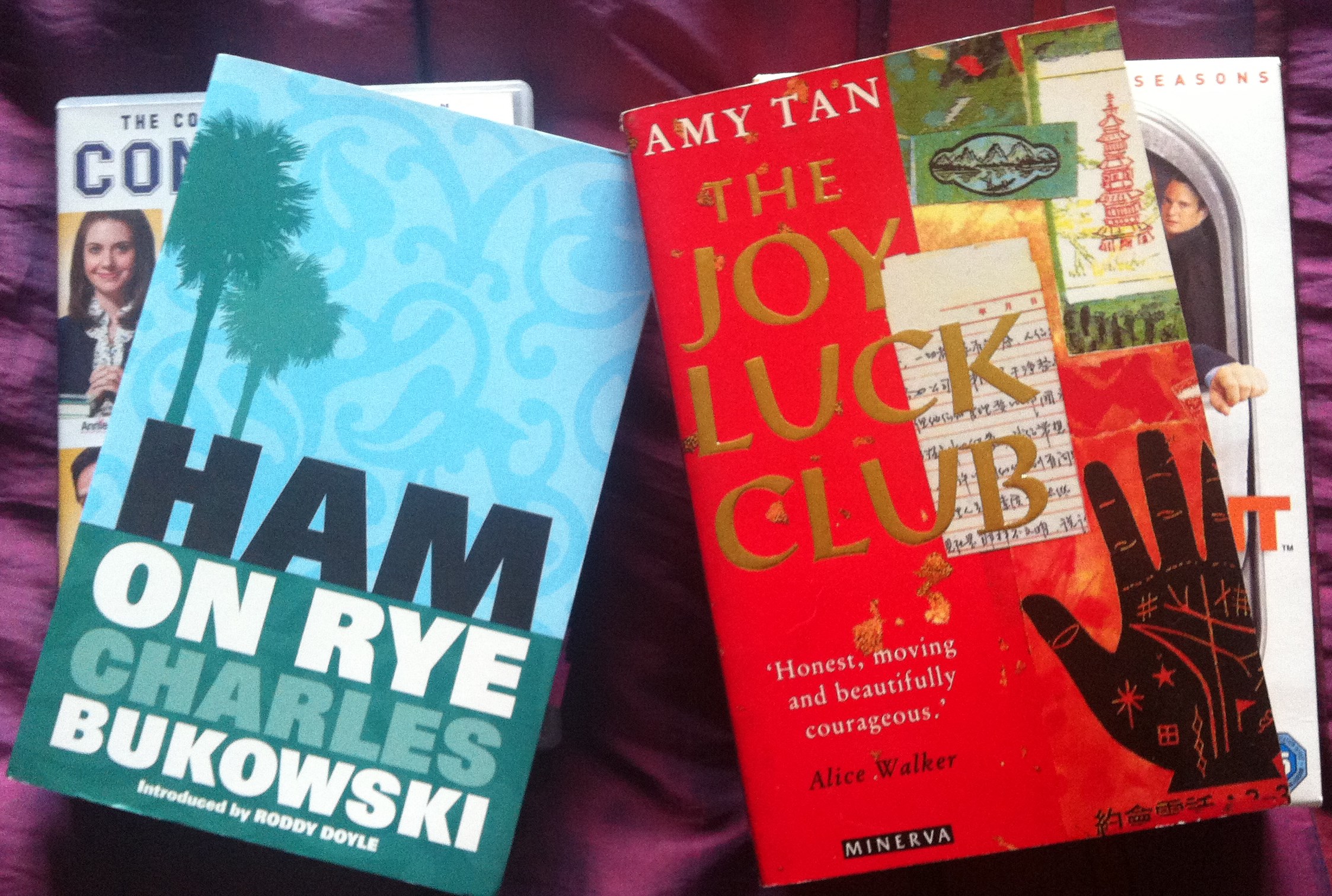
Firstly, in celebration of the series return via Netflix, Gob from Arrested Development, for whom I recommend The Joy Luck Club by Amy Tan (1989, my copy 1996, Minerva).  The uninitiated can view some of Gob’s moments here:

Gob is a lunatic, obsessed with stage magic but woefully inept at its execution, a wannabe alpha male who will never lead the pack, despised by his mother and barely tolerated by the rest of his family.  And he travels everywhere by Segway.  I decided on The Joy Luck Club because I feel Gob could benefit from some positive female energy in his life, and this tale of two generations of mothers and daughters will immerse him in oestrogen-fuelled drama.  It will also show him the power of unconditional love of parents for their children, something entirely lacking in his own life.  The club of the title is a group of Chinese immigrant women who are living in San Francisco, and who get together to play mah jong.  At the start of the novel one of the women, Suyuan, has died, and her daughter, Jing-Mei/June has been asked to take her place.  The novel is divided into four sections as the three remaining mothers and each of the four daughters tells their story.  The tales explore the experience of the women back in China, and their daughters’ experiences as the first generation growing up in San Francisco.  The communication difficulties across the generations are contextualised within an Asian-American experience, but are really universal:

“For all these years I kept my mouth closed so selfish desires would not fall out.  And because I remained quiet for so long now my daughter does not hear me.  She sits by her fancy swimming pool and hears only her Sony Walkman, her cordless phone, her big, important husband asking her why they have charcoal and no lighter fluid….I did not lose myself all at once. I rubbed out my face over the years washing away my pain, the same way carvings on stone are worn down by water.” (Ying-Ying St.Clair)

“During our brief tour of the house, she’s already found the flaws.  She says the slant of the floor makes her feel as if she is “running down”.  She thinks the guest room where she will be staying – which is really a former hayloft shaped by a sloped roof – has “two lopsides”.  She sees spiders in high corners and even fleas  jumping up in the air – pah! pah! pah! – like little spatters of hot oil.  My mother knows, underneath all the fancy details that cost so much, this house is still a barn.  She can see all this.  And it annoys me that all she sees are the bad parts.  But then I look around and everything she said is true.” (Lena St.Clair)

The novel has been accused by some of dealing in racial stereotypes, but I think what limits this is Tan’s ability to create seven strong, original, fully drawn female characters and explore their idiosyncratic relationships.  The voices of the members of The Joy Club Club are memorable and distinctive.

Secondly, Annie from Community, for whom I recommend Ham on Rye by Charles Bukowski (1982, my copy 2000, Canongate). The uninitiated can view some of Annie’s moments here:

http://www.youtube.com/watch?v=JUKDfOWGVQY

Oh, Annie, with your relentlessly perky expression and upbeat attitude, your array of tastefully coloured angora jumpers and perfectly organised stationery.  Every now and again the strain shows and the façade crumbles, and Bukowski will teach you that that is where the interesting stuff happens.  Come join us on the darkside, Annie, you know you want to…… Ham on Rye is Bukowski’s most autobiographical novel, and follows his alter-ego Henry Chinaski through an abusive childhood and into an early adulthood where his main source of support and meaning is found in a bottle.   After his first experience with alcohol, drinking his friend’s father’s wine, Henry sits on a bench and reflects:

“I thought, well, now I have found something.  I have found something that is going to help me, for a long time to come.  The park grass looked greener, the park benches looked better and the flowers were trying harder.”

The only other positive experience Henry has in a childhood filled with violence and deprivation is when a teacher praises his creativity and reads aloud an essay he has written:

“Everybody was listening.  My words filled the room, from blackboard to blackboard, they hit the ceiling and bounced off, they covered Mrs Fretag’s shoes and piled up on the floor… I drank in my words like a thirsty man.  I even began to believe some of them[…]So that’s what they wanted: lies. Beautiful lies. That’s what they needed. People were fools.”

Bukowski is a legend of the beat generation and his reputation for hard-living precedes him.  In some ways this is unfortunate, as it suggests a reputation built on image rather than skill.  But he’s a really beautiful writer who Capote could never accuse of typing, not writing.  For all you fellow bibliophiles out there, here is what happens when Henry discovers the joys of the library:

“It was a joy. Words weren’t dull, words were things that could make your mind hum.  If you read them and let yourself feel the magic, you could live without pain, with hope, no matter what happened to you.”

Gorgeous.  Moments like that shine out like beacons amongst the violence and bleakness of Henry’s existence; Ham on Rye is a fantastic reminder of why we read.

Here are Gob and Annie with their books:

Image

“There is no surer foundation for a beautiful friendship than a mutual taste in literature.” (P.G. Wodehouse)

Usually I try and pick books that explore a similar theme in different ways, but this week the choices aren’t linked thematically in any way except how they came into my life.  Both were given to me as gifts recently and I enjoyed them both, but couldn’t think what else to pair them with for a post.  Then I realised that for me they were sort of tied together, and this was a good enough (flimsy, lazy, what you will) reason for them to occupy the same post.  It’s unusual for friends to by me books – I think one sight of my overflowing bookshelves sends them scurrying to the nearest smellies store for presents, in the mistaken belief that any book they buy me I will have already read/somehow owned for years even if it’s just released/view with barely disguised contempt.  I’ve recently put the kibosh on toiletries by developing mad allergies, cause unknown, that make me look like Father Bigley (as my ever-sympathetic brother pointed out, for all you Father Ted fans out there) so this may explain the sudden enthusiasm for printed matter amongst my cohorts.  Either that, or I’ve finally taken control of my body odour, negating the need for bags of stuff from L’Occitane. Whatever the reason, two of my friends did sterling work with these recent offerings.

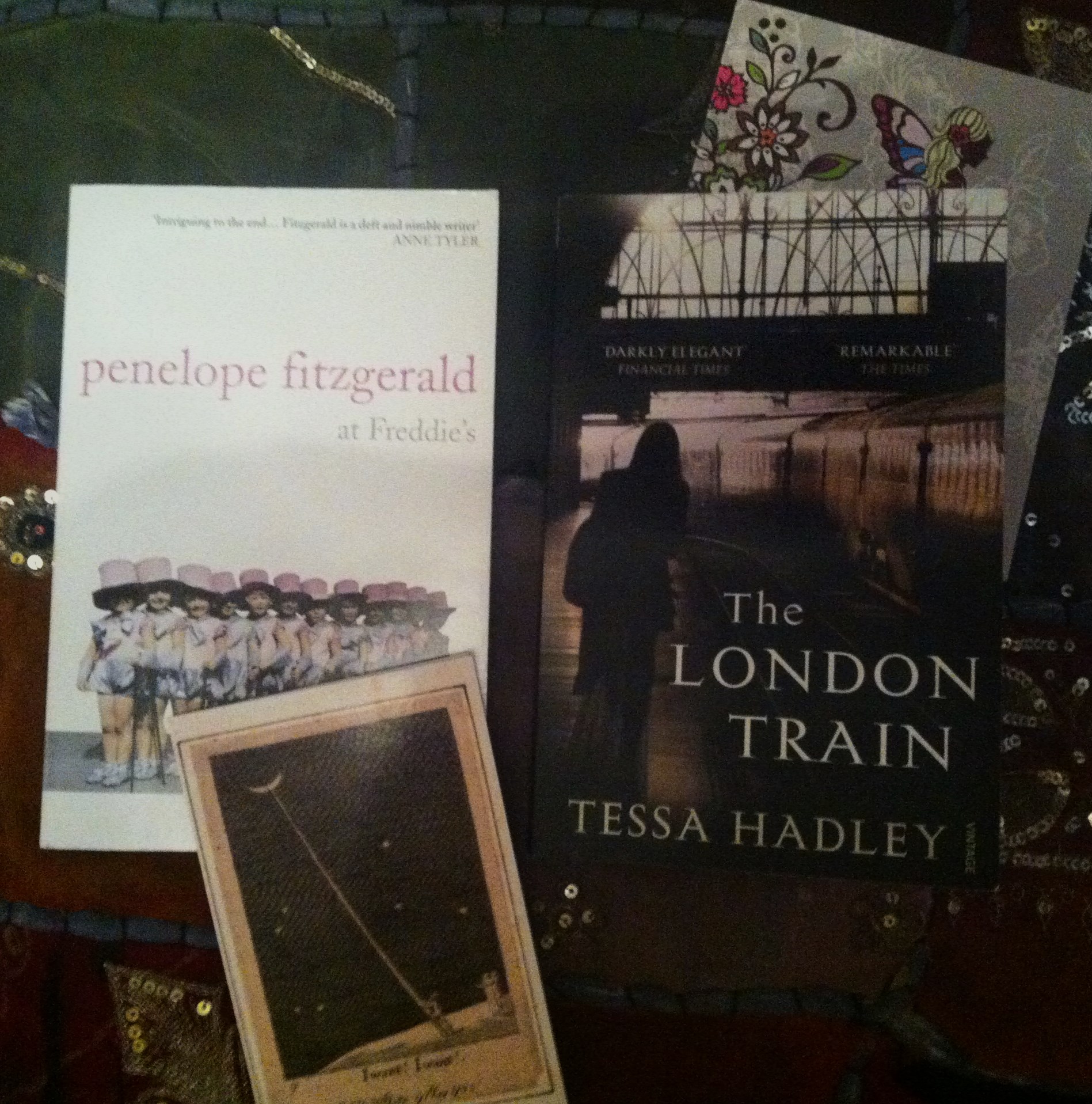
Firstly, At Freddies by Penelope Fitzgerald(1982, my copy 2003, Flamingo), given to me by my lovely friend C, who is an academic mega-brain, filled with boundless enthusiasm for literature, and despite these gifts and being quite beautiful as well, carries it all with such an unassuming genuine pleasantness as to make her completely likeable.  She can now add gift-giving to her long list of talents.  C chose this for me because firstly, she’d read and enjoyed it, and secondly because it concerns the theatre, which is one of my great loves.  But although it does have a dry, knowing humour about the theatre, At Freddies is much more about being a child in an adults world, about school and those teachers whose main qualification is their force of personality, and about trying to find your place in the world, which is after all, a stage (at least according to one highly regarded writer).  Freddie runs a dilapidated stage school for children in 1960s Covent Garden.  There is no money but somehow she keeps it all hanging together by being someone who everyone knows, and who no-one can refuse.

“Insane directors, perverted columnists cold as a fish, bankrupt promoters, players incapable from drink, have all forgiven each other and been forgiven, and will be, until the last theatre goes dark, because they loved  the profession.  And of Freddie – making a large assumption – they said: her heart is in it.”

There is a lot of humour in this book, the precocious kids who are manipulative and knowing, but still just children, are hilarious.

“You saved me Miss Wentworth…I’d be out of work, I’d never get work again, if you hadn’t spoken to Mr Lightfoot…I owe everything to you…”

Freddie paid no attention whatsoever.

….Mattie, with an expression of deep malignance, departed.

“He’s acting,” said Miss Blewett.

“Worse than that,” said Freddie.  “He’s acting being a child actor.”

Apparently Penelope Fitzgerald did teach at a theatrical school for a time, and some of her portrayals of theatrical professionals are drily presented, such as the director who wants to “underline Shakespeare’s concepts in the way he’d do it himself if he were here” – apparently this means having young boys played by very old men, and everyone on stage except the person going mad acting a breakdown while the character experiencing it remains stock still.  Not sure that’s quite what Shakespeare had in mind…  All this mayhem revolves around Freddie who remains resolute but ultimately enigmatic.  No-one quite knows her background, motivation or purpose, except to keep going.  When one of the teachers finds her collapsed, he reflects “No, she won’t die…She won’t change her habits so easily.” At Freddie’s is a short novel (230 pages my edition), highly readable and very enjoyable, but also unnerving and thought-provoking, as much about what isn’t said as what is.  I highly recommend it.

Secondly, The London Train by Tessa Hadley (2011, Vintage) given to me by my also very lovely friend K, who is as creative as she is kind as she is gorgeous.  I’ve got to stop hanging round with such thoroughly brilliant women, it only highlights my own shortcomings (except when it comes to choosing friends, which I am inordinately talented at). K chose this for me because again, she’d read and enjoyed it, and secondly, because it was set partly in London, another of my great loves.  See what thoughtful friends I have? The London Train is a book of two halves.  In the first half, Paul is looking for his missing daughter, Pia, who he finds living in north London with her slightly controlling boyfriend and his sister.  In the second half, Cora is travelling in the opposite direction, back to Wales, to escape a failing marriage.  I enjoyed Tessa Hadley’s first novel, Accidents in the Home, a great deal but I hadn’t kept up with her writing since, and The London Train made me regret this, as she writes with such sparse beauty:

“He wished he could remember better those passages in The Aeneid where Anchises in the Underworld explains to his son how the dead are gradually cleansed in the afterlife of all the thick filth and encrusting shadows that have accumulated through their mortal involvement, their living; when after aeons they are restored to pure spirit, they long, they eagerly aspire, to return to life and the world and begin again.  Paul thought that there was no contemporary language adequate to describe the blow of his mother’s vanishing. A past in which a language of such dignity as Virgil’s was possible seemed to him itself sometimes only a dream.”

Hadley is also brilliant at capturing small moments, both between people and within individuals:

“Her speech wasn’t slurred, but aggressive, some layer of concealment had been stripped from between them. Where their feet bruised it, the grass sent up its yearning green smell, tugging at his emotions.”

“In the library Cora sometimes felt as if she had fallen to the bottom of a deep well.  It wasn’t an unpleasant feeling.  She hadn’t known there could be a job like this, pressing so weightlessly on the inner self, allowing so much space for daydreaming.”

This great skill, at pinpointing the significance of moments that are barely tangible, make Hadley’s writing both incisive and sympathetic.  The London Train is about the journeys we take both physically and psychologically, and how we construct notions of home, sometimes in the entirely wrong places.  I’ll be seeking out the novels by Hadley that I haven’t read as a matter of urgency.

Here are the books alongside the cards which accompanied them – thanks again, C&K!

Image

“It is the test of a novel writer’s art that he conceal his snake-in-the-grass; but the reader may be sure that it is always there.” (Anthony Trollope)

Happy Chinese New Year!  This year is the Year of the Snake, so I chose a snake related quote to start, and had originally planned to take a snakey, not-too-obvious look at literature for Chinese New Year, but sadly my brain failed me.  So I’ve gone the more obvious route of choosing two authors of Chinese origin; there are two great novels and I hope you like them.  (I had intended to be much more timely and publish this post on 10 February, but with a belly full of celebratory Peking duck and seafood noodles working their soporific effect, I failed in this also.  So far it’s fair to say that the year of the snake is not off to a flying start with me).

Firstly, A Concise Chinese-English Dictionary for Lovers by Xiaolu Guo (Vintage 2007).  The female protagonist of the novel, Z (because the Brits can’t pronounce Zhuang), arrives in London speaking minimal English.  Over the course of a year in which she has a relationship with an older British man, she learns the language and some life lessons.  The novel is divided up into months, charting Z’s year, and each section has chapter headings of words and definitions that Z learns as she masters the English language.  For example:

“Confusion

Confuse v mix up; perplex; disconcert; make unclear

English food very confusing. They eating and drinking strange things. I think even Confucius have great confusion if he studying English.

….I confusing again when I look at whipped cream on little blackboard. What is that mean? How people whip cream? I see a poster somewhere near Chinatown. On poster naked woman wears only leather boots and leather pants and she whipping naked man kneeling down under legs.  So a English chef also whipping in kitchen?”

This fresh take on the English language makes for a really entertaining read.  Obviously the image of some sort of BDSM kitchen in a café offering afternoon tea is funny, but it also makes you consider why we use the words we use, and the way language can seem arbitrary.  Certainly she highlights oddities like:

“why there two go for one sentence? Why not enough to say one go to go?…”I go” is enough expressing “I am going to go…”Really.”

She’s right – why do we say “go” twice?  And language snobs take note, language is not set down in golden, irrefutable, unchanging rules :

“One thing, even Shakespeare write bad English.  For example, he says “where go thou?” If I speak like that Miss Margaret will tell me wrongly.”

While exploring language in a truly inventive way, Guo has done a great job of creating a distinct character’s voice, and not just because she starts off in stilted English and becomes more fluent throughout the year (by the end of the book Z writes: “I take the snowdrops. I gaze at the flowers in my hand. So delicate, they are already wilting in the heat of my palm.”)  It’s because Z is forceful, unique and engaging person who you really feel you know by the time you turn the last page.

For the second book I thought I’d look at Sour Sweet by Timothy Mo (Abacus 1982). The voice in this novel is very different to Z’s.  Guo’s novel is written in the first person, a very forthright engagement with the reader including direct questions. Sour Sweet is written in the third person and takes a broad look at the Chinese community in 1960s London through the Chen family and the Triads.  When these two “families” intersect, tragedy ensues.  The third person narrative allows for an ironic distance, but simultaneously you really feel for the characters.  When Chen meets the Triads to ask for a loan he constantly tops up the tea they aren’t drinking and fears his fruit offering is damaged:

“He noticed his best shoes had become quite sodden with tea. He exclaimed and moved away, seeing that the fruit in the bags had indeed been squashed and, as he had feared, there were greasy-looking patches on the brown paper.  The bags were already starting disintegrate.  Perhaps this was why they had rejected his offering.”

This passage demonstrates so much about the novel as a whole: the insight into a culture and power that operates across countries, the pathos of every day life, the humour of every day life.  Small tragedies that can escalate.  Failures to communicate even when you speak the same language.

And I suppose the idea of communication is what unites these novels as well as their consideration of Chinese cultures.  Both highlight the inadequacies of language, and the inadequacies of language users, as we try to reach out to others through imperfect means. Both are funny, both are sad.  Sour Sweet indeed.

Here are the books with a laden plate of what I know, from having read these novels, is wholly inauthentic  Chinese food.  (Which looks awful – I’m clearly not cut out to be a food blogger). But it was delicious.  I wish I could tell you that the picture represents all the Chinese food I ate that night, but that would be so very untrue…

Image

“There are two types of women in the world: those who like chocolate and complete bitches” (Dawn French)

Happy New Year! (for those of you using the Gregorian calendar).  It is one of life’s small cruelties that if you live in the Northern hemisphere, a grey, dark, cold time of year is also inexorably bound with resolutions to lose weight.  It’s entirely illogical: your body is bound up in layer upon chunky layer of clothing, and all you want to eat is comforting, stodgy carbs.  Far better to start a diet in March – its brighter, starts getting warmer, the prospect of salad is less likely to send you howling in despair from the room (unless that’s your modus operandi all year round, and you are not alone).  There’s a sense of approaching summer and the associated disrobing to act as an incentive to lose those extra layers you’ve acquired that you can’t hang in the wardrobe.  But right now its January. So, until those spring-like days, let us glory in girth, fellow book-lovers, and embrace loose baggy monsters.  This was Henry James’ term for those long Victorian novels, and they are perfect for this time of year.  If the holiday season has left you feeling like a baggy monster yourself, settle down with a huge book: you can wallow, a verb that suits your newly enormous body, in its vastness & lose yourself and the dark days that surround you; you can claim it’s a novella and make your body look smaller by comparison, optical illusion being so much easier than giving up all the fun stuff; and if you go for a paper version rather than an e-book the weight itself will act equally as well as a gym workout for your biceps (er, maybe). ‘Tis the season of the baggy monster!

I’ve gone for an obvious choice of baggy monster, George Eliot’s Middlemarch (published 1871-2. My copy: Penguin Classics 1965). Writing about Middlemarch is really difficult for me as it’s my favourite novel ever.  Ever.  And I find when things are that close to me, I can’t really explain them or talk about them objectively.  Lots of people can’t bear George Eliot and find her too intellectual and moralising.  Fine – I have no come back.  She’s both of those things.  But if you give Middlemarch a chance, the rewards can be huge.  The characterisations of the inhabitants of this middle-England town are fully drawn, as the length of the novel allows for such scope.  There is no reliance on stereotypes (Mr Dickens, take note), and even the unlikeable characters are understandable.  Eliot can be as witty and incisive as Jane Austen (“plain women he regarded as he did the other severe facts of life, to be faced with philosophy  and investigated by science”/ “she held it still more natural that Mr Lydgate should have fallen in love at first sight of her.  These things happened so often at balls, and why not by morning light, when the complexion  showed all the better for it?”), but for those of you who share my brother’s view that Austen is just “full of silly girls giggling behind fans” rest assured she’s also very different.  Virginia Woolf called Middlemarch “one of the few English novels written for grown up people”, by which I think she means that the story continues beyond marriage – the ultimate purpose of the plot is not achievement of a socially acceptable breeding arrangement but more a study of how people work, individually and within society.  There are big themes tackled: politics, education, professional fulfilment, religion…If that sounds dry, I promise there’s enough plot to keep you going, with the various stories of the ambitious Dr Lydgate, idealistic Dorothea, vacuous Rosamond, immature Fred Vincy… and now I’ll stop reducing Eliot’s great characters to a single adjective.  It’s also got Will Ladislaw in it, a Byronic hero who can easily equal Darcy in the “pouting air of discontent” love-god stakes, it’s just that the latter’s PR is so much more tenacious.  One of my tutors once told me he re-read Middlemarch regularly, and the final few paragraphs always made him cry (not that it’s  a tragic ending, just realistic).  I hope if you give Middlemarch a go, that it truly moves you.

In the course of writing the above paragraph I’ve realised that this post will turn into a baggy monster itself if I continue to attempt to capture these vast panoramic books in any sort of meaningful description.  So, like so many New Year’s resolutions, I’m going abandon my good intentions and instead write about a book that (in my copy) runs to a comparatively succinct 222 pages. Like Water for Chocolate by Laura Esquivel (published 1989. My copy: Black Swan, 1994), unlike the baggy monsters, keeps the plot fairly simple – Tita and Pedro love each other, tradition dictates they can’t be together, so he marries her sister to be around her.  You may not get a wallow in the depths of 800+ pages but it’s still a great choice for this time of year.    Firstly, its set in Mexico (and I should admit I read it in translation, if you can read it in the original Spanish so much the better) so if you can’t afford a warm holiday away from all the grey you can at least travel between the pages of a book.  Secondly, each chapter has a month title and an associated recipe and is hugely evocative around food: vicarious calories are delicious and also involve no cheating from your diet if you are insane enough to try and lose weight in January.  Amongst quail in rose petal sauce (March) and northern style chorizo (May) there is also a recipe for making matches (June), just in case you wondered. Finally, it is magic-realist in style: the female protagonist’s birth sees the kitchen awash in tears “When the uproar had subsided and the water had been dried up by the sun, Nacha swept up the residue the tears had left on the red stone floor. There was enough salt to fill a ten-pound sack – it was used for cooking and lasted a long time.” A bit of unreality – just what you need to help face the harsh realities of a northern winter.

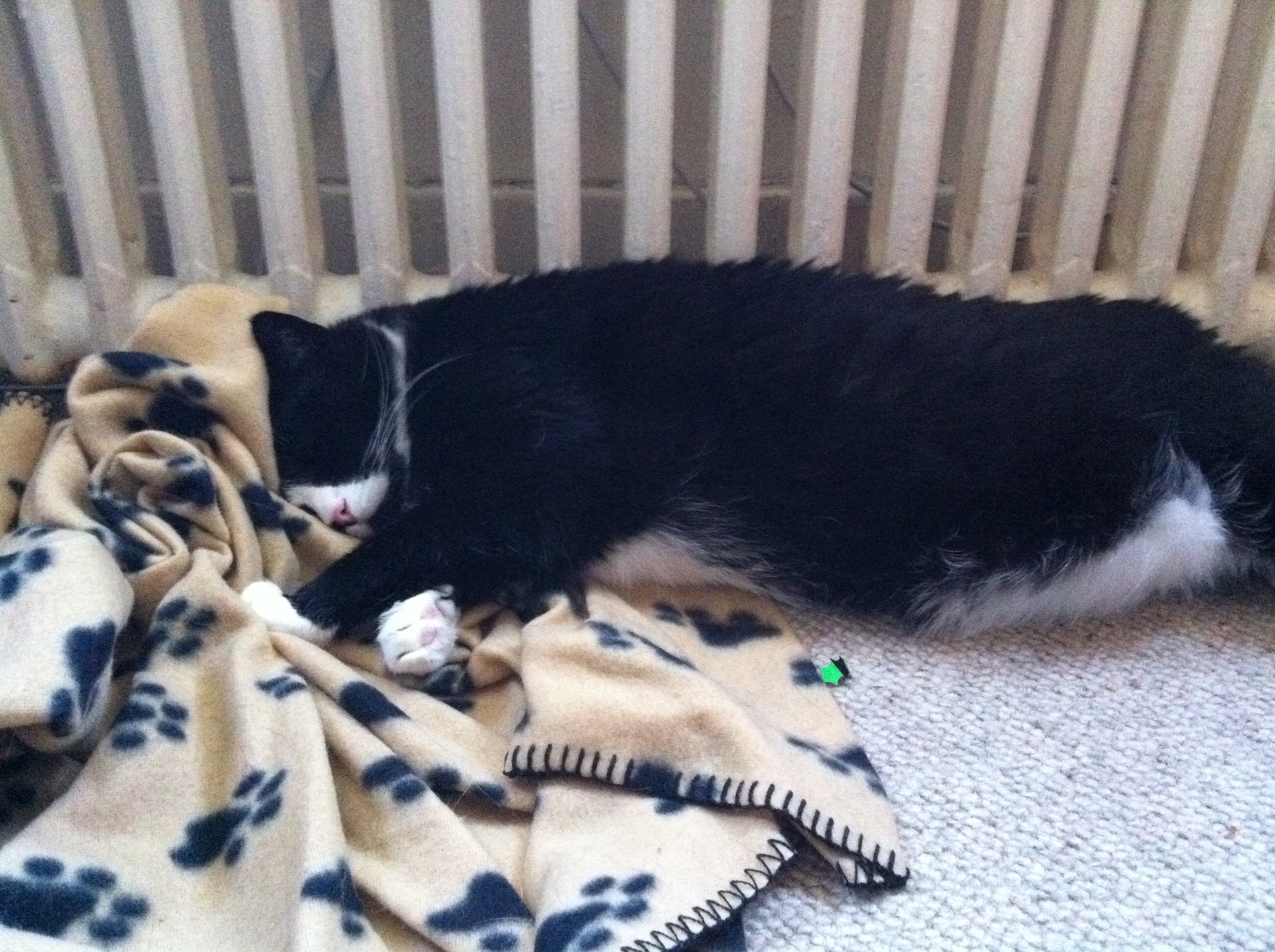
So settle down with a great (in terms of both literary value and/or size) book and enough provisions to see you through (e.g. Kendal mint cake, or a family bar of chocolate.  With the latter you can always claim to be striking a blow against sociocultural constructions as a method of control (or something) by eating it all yourself.  This also works for family bags of crisps) and enjoy! I was planning to picture the books alongside some mojito cupcakes that I’d made for a friend’s birthday, but they went totally wrong – possibly due to the fact that my scales broke and so I guessed all the ingredients weights.  Hmmn, thinking about it, that’s almost definitely where my error lay. This succeeded in putting me in a cranky mood and incapable of thinking of another picture so instead here is a baggy monster who lives with me.  Proof, if proof were needed, that the world is a better place for having baggy monsters in it.

Image