“All fiction is about people, unless it’s about rabbits pretending to be people.” (Margaret Atwood)

This is my first contribution to Kaggsy and Lizzy’s wonderful #ReadIndies event, running all month. The Rabbit Factor by Antti Tuomainen (2021, transl. David Hackston 2021) is published in the UK by Orenda Books, who describe themselves on their website as: “a small independent publisher based in South London. We publish literary fiction, with a heavy emphasis on crime/thrillers, and roughly half the list is in translation.”

The Rabbit Factor is the first in a trilogy about actuary Henri Koskinen, which had somehow completely passed me by until I read Annabel’s review of the final part, The Beaver Theory. A little while later I saw The Rabbit Theory in my local charity bookshop and took it as A Sign. (As I have mentioned before, I’ll take pretty much anything as A Sign in that shop, and it always results in me buying more books 😀 )
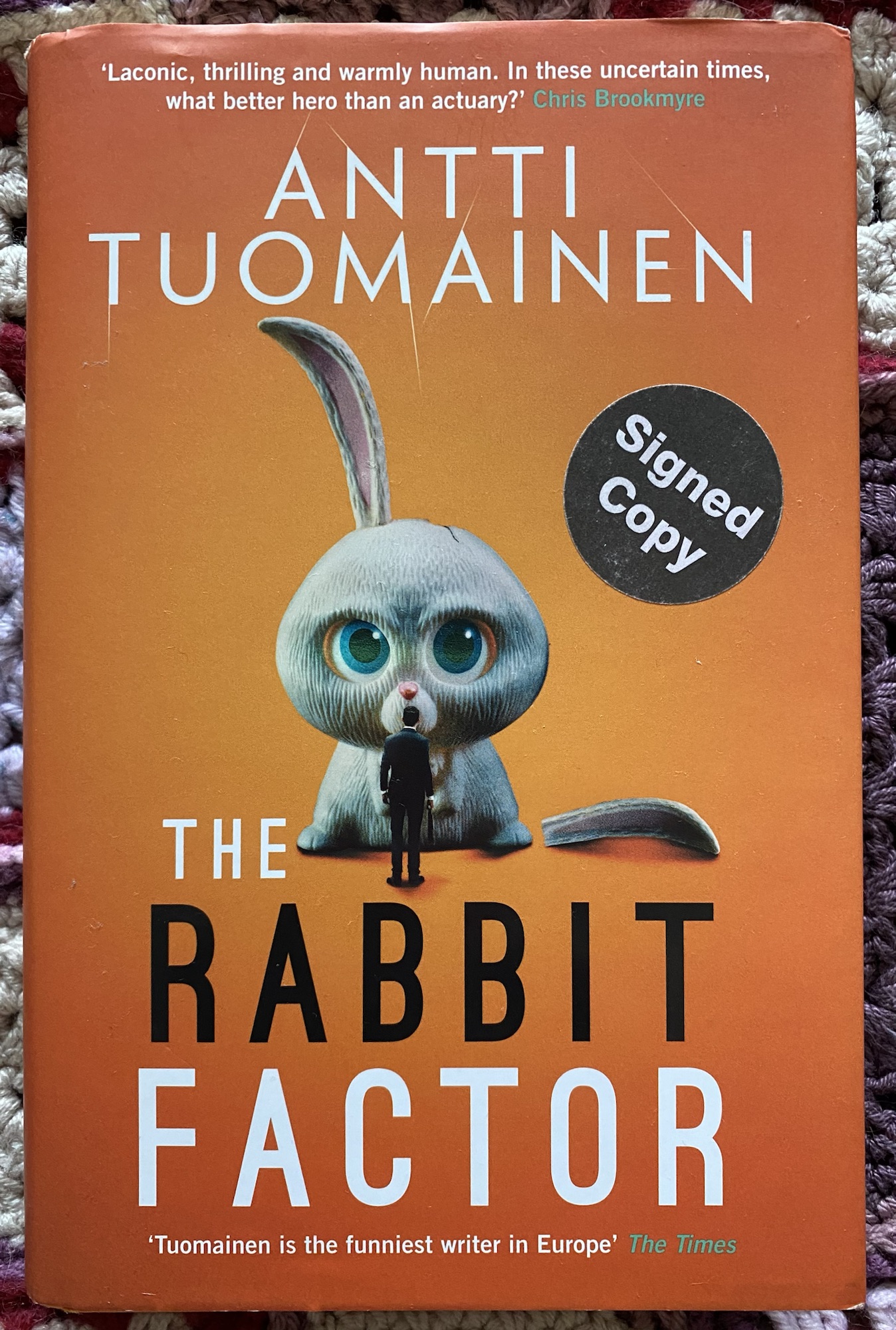
Henri is a man who likes a well ordered, predictable life: “At the age of forty-two I had only one deep-held wish. I wanted everything to be sensible.”

His job as an actuary suits him, using mathematics to predict risk. Unfortunately, what doesn’t suit him is the modern workplace – open plan, noisy and full of corporate-speak about self-actualisation. He is forced into resigning by his boss who hides his bullying behind pseudo-beneficent jargon.

Not long after, Henri is told his brother Juhani has died and he has inherited YouMeFun, an adventure park (not an amusement park) in Vantaa. Unfortunately, before he died his brother inherited their parents’ chaotic approach to life and so Henri finds himself faced with:

“An unbearable lack of organisation, staggering maintenance bills, unproductive use of man hours, economical recklessness, promises nobody could keep, carts that quite literally moved at tortoise speed? I raised my fingers to my throat and checked the position of my tie. It was impeccable.”

Juhani was also in hock to gangsters, two of which – Lizard Man and henchman AK – keep turning up to menace Henri with horrible regularity and conviction. No less threatening, but considerably less violent, is police officer Osmala who similarly seems very interested in YouMeFun and Henri. And so Henri finds himself under enormous pressure and with only his maths skills to fall back on.

“I resigned because I couldn’t stand watching my workplace turn into a playground. Then I inherited one.”

I think maybe this novel passed me by because it can be classified under Nordic-noir, and I don’t read a great deal of that. What I read I enjoy, but I choose carefully because I am a delicate flower and not really in the market for gruesome crimes. Now, there are gruesome deaths in The Rabbit Factor, but I managed these fine. The details aren’t dwelt upon and they are surrounded by such surreal silliness that the focus is more on the ridiculousness of Henri’s situation than violence.

The tone is also not noirish. One of the blurbs in my edition mentions the Coen brothers, and this is a good parallel: while there is darkness to the tale, there is also humour and humanity. Henri’s unlikely colleagues include Esa, the US-marine obsessed security officer; sweet Kristian who is unable to see that his total ineptitude is what prevents him from becoming general manger; Minttu K who seems to know about marketing if she could only stop self-medicating with alcohol; Venla who never arrives for a shift; and quietly efficient Johanna who runs the kitchen and actually seems able to do her job.

There is also Laura Helanto, manager and frustrated artist, who causes feelings to arise in Henri that he doesn’t fully understand. It’s a confusing time for him all round…

“But recent events have taught me that what once seemed likely, as per the laws of probability, is more often than not in the realm of the impossible. And vice versa: what once I would have been able to discount through a simple calculation of probability ratios and risk analysis is now in fact the entirety of my life.”

I really enjoyed The Rabbit Factor. The deadpan narration of Henri is so well-paced that it manages to also be completely engaging. His focus on detail grounds the ridiculousness of his situation so it remains believable, carrying the reader along on Henri’s absurd journey.

“Even as a child I saw mathematics as the key. People betrayed us, numbers did not. I was surrounded by chaos, but numbers represented order.”

The characterisation is equally finely balanced. Henri and his colleagues could so easily be caricatures but instead you end up rooting for these disparate individuals. Tuomainen isn’t remotely sentimental but he is kind to the people he creates. The humour is derived from the situation, never laughing at the people themselves. They change under Henri’s stewardship, and he in return finds himself behaving in ways that surprise him more than anyone:

“I say something I could never have imagined hearing myself say. ‘This doesn’t make any sense. But it has to be done.’”

Last year I decided I would buy one book a month from an independent publisher or bookshop. I think Henri would agree that the probability of my next two purchases in this regard being his adventures in The Moose Paradox and The Beaver Theory are pretty high…

To end, I was so tempted to choose Chas & Dave’s Rabbit, as I absolutely loved that song when I was little (it was released when I was four years old, and I thought they were singing about actual rabbits). But alas, my adult sensibilities prevent me from adding a song about silencing women to the blog 😀 So instead here is a literature-inspired song about drugs rabbits:
“Increasingly I have felt that the art of writing is itself translating, or more like translating than it is like anything else.” (Ursula K. Le Guin)

Oh dear, my blogging mojo is taking a while to get back. It’s been weeks since I read these two short story collections for Women in Translation Month and I’m only writing this now. Given that I find writing about short story collections difficult at the best of times, I beg your indulgence, Reader…

Firstly, Dark Paradise by Rosa Liksom (1989 trans. David McDuff, 2007) which I picked up having greatly enjoyed Compartment No.6 back in 2016. This was a dark, violent collection of stories, split into two sections, Domestic and Foreign. The stories are not titled otherwise and are very short, frequently only a few pages, with unnamed narrators describing their extreme actions in a matter-of-fact voice. Hence I’m going to have to give a trigger warning for descriptions of violence and blood.

In the first story, a woman locks herself in her bedroom after the death of her husband:

“She took a heavy vase from the floor and threw it at the mirror which shattered into large and small pieces. The shards cut her all over. Some of the wounds were deep – they gaped and spurted blood. The sheets were stained red, her body throbbed, and the blood smelled of something old and oppressive.”

This is a choice image to begin the collection, as it captures what is in store: sharp, fragmentary glimpses into violent and unhinged worlds. Unlike the first story, many that follow are told in the first person. A woman who viscerally hates her husband of two weeks; a man who obsessively cleans his flat; a social outcast who lives with his mother:

“It all started some time before my eighth birthday. I was lounging in an armchair in the parlour watching Mom make dinner in the kitchen. That was the first time the realisation came to me. I got this terrible nauseous feeling, a flash of lightening cut right through my brain and Mom suddenly looked to me like some sort of mutant, a caricature of a human being. I know that’s when it started, and the years have only made it clearer to me that even then, as a little kid, I was one hundred percent correct: I hate all women.”

There are some brief glimpses of light. Not every encounter ends in violence, though most do, and there are some affectionate relationships, like the woman and her daughter who are chocoholics:

“Then I walk home and my daughter is back, she’ll have had three mugs of cocoa and a package of chocolate biscuits. She eats chocolate too, and biscuits, and potato chips. I’ve hardly had time to get the door open when she’s shouting for chocolate. But she has to wait until I’ve taken off my coat and sat down in front of the TV. Then I give her one of the bars and take the other for myself. We watch TV, eat chocolate and occasionally I have a cigarette.”

Liksom is such an accomplished writer. In just a few lines she establishes character, tone, setting. She’s sparse and uncompromising. This is not the collection to read when you’re feeling fragile or want characters to root for, but if you feel like being pummelled into nihilistic despair for about an hour (and sometimes I do, sometimes I want a truly destabilising read) then this is for you.

Secondly, Death of an Ex-Minister by Nawal el-Saadawi (1987, trans. Shirley Eber 1987). I first looked at el-Saadawi’s work for WITMonth 2018 and then again this year when I was undertaking Novella a Day in May, and I’m always so impressed by how she weaves her politics into stories that never suffer under the weight of the issues she’s addressing: often corruption, the role of women, and sexuality.

The titular story has a government employee talking to his mother as silent interlocutor, about a junior colleague that has incurred his ire:

“But I was angry Mother, because when she talked to me she raised her eyes to mine in a way I’d never seen before. Such a gaze, such a strong and steady look, is daring in itself, even impudent, when it comes from a man. So what if it comes from an employee, a woman? I wasn’t angry because she did it, but because I didn’t know how she did it, how she dared do it.”

I thought this was such a clever way to explore a man realising that he has been a cog in machine, a subservient bureaucrat, and send him spiralling into crisis.

In The Veil, el-Saadawi deals with female sexual desire completely unabashed:

“My eyes fall on to his naked body and hairy thighs once more. The expression on my face, as I look at his body, is not the same when I look into his eyes, for my problem is that what I feel inside shows instantly on my face. His eyes are the only part of his body with which I have real contact. They dispel strangeness and ugliness and make my relationship with him real in the midst of numerous unreal ones.”

She always has plenty to say but is never preachy and often has an underlying humour. The tone in Masculine Confession (another silent female interlocutor, this time a sex worker) is wry:

“I loved my masculinity and from the start I realised it was the reason for my being privileged. I always had to prove its existence, declare it, show it to people to make it clear and visible and that it was not open to doubt […] I love my wife like I love my mother, with the same sort of spiritual, holy love. In other words, a love in which I take everything and to which I give nothing. That’s ideal love.”

In Camera is perhaps the most powerful and tender, where a young woman accused and tortured by the state is watched in a courtroom by her family:

“I feel the air when it touches you and hunger when it grips you. Your pain is mine, like fire burning in my breast and stomach. God of Heaven and Earth, how did your body and mine stand it? But I couldn’t have stood it were it not for the joy of you being my daughter, of having given birth to you. And you can raise your head high above the mountains of filth.”

Death of an Ex-Minister captures a variety of voices finding their way in late twentieth century Egypt. El-Saadawi is all the more powerful because of her compassion – she writes about flawed humans, fighting, loving, scared and brave. Her characters are always believable and always compelling.

To end, a move that will shock regular readers of this blog to their core: I’m going to end on some tasteful music for once 😀 Stunning harmonies from singers of traditional Finnish Sami music:

Novella a Day in May 2019 #23

The Year of the Hare – Arto Paasilinna (1975, trans. Herbert Lomas 1995) 135 pages

Following on from The Cat yesterday, I thought I’d look at another novella about a relationship with an animal today; the international bestseller about a man who leaves his life behind after injuring a wild hare.

Vatanen is a journalist deeply unhappy with his career, metropolitan life, and his marriage.

“Their flat had become an extravagant farrago of shallow and meretricious interior-decoration tips from women’s magazines. A pseudo-radicalism governed the design, with huge posters and clumsy modularised furniture. It was difficult to inhabit the rooms without injury; all items were at odds. The home was distinctly reminiscent of Vatanen’s marriage.”

The novel opens with him in a car with his photographer, hitting a hare with their car. The hare limps off and Vatanen follows it. He splints its leg and takes care of it, deciding never to return to his life.

What follows is a series of episodes in which Vanaten meets various eccentric characters as he travels further north in Finland, having adventures and finding the presence of the hare promotes honest and open conversations with people.

“If it’s difficult to teach an old dog to sit, as they say, then it’s even more difficult to teach an old Lapland roue to swim.”

The Year of the Hare is picaresque, and the emphasis is on the escapades rather than the characters. I didn’t feel I really knew Vananten any better by the end of the novella, but it had been mostly fun spending time with him and the hare.

I say mostly, because there were a couple of episodes I had to skip. These involved cruelty to animals. There was one particularly horrible incident where Vatanen tortures a raven, and there’s an extended bear hunt towards the end. But skipping over these parts still left a lot to enjoy, and the sense of Finland and its landscape is beautifully evoked.

“When, that evening, Vatanen slowly ski’d back from Vittumainen Ghyll to Laahkima Gorge, accompanied by his hare, he no longer thought about Kaartinen’s strange world. There was a half-moon, and the stars were glimmering faintly in the frozen evening. He had his own world, this one, and it was fine to be here, living alone in one’s own way. The hare ambled silently along the trail ahead of the skier, like a pathfinder. Vatanen sang to it.”

A slightly bonkers, occasionally surreal tale about following your own path and keeping an open mind as to who might accompany you part of the way.

The Year of the Hare was made into a film two years after publication, but I can’t find a trailer for that Finnish version. Its been a bestseller in France, so here is a trailer for the French film adaptation from 2006. Christophe Lambert is immediately too likeable as Vatanen but the atmosphere and scenery look spot-on: