Novella a Day in May 2020 #26

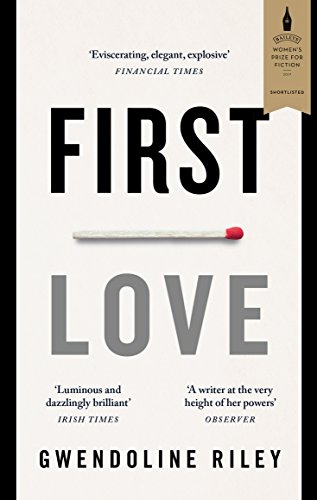
First Love – Gwendoline Riley (2017) 167 pages

Trigger warning: discussions of an abusive marriage and strong language

First Love is told from the point of view of Neve, a youngish writer married to the significantly older Edwyn. Their marriage is horrific; a battleground of manipulations, gaslighting, verbal abuse, withholding, blaming and bitterness. The blurb quotes on my paperback edition mention tenderness, humour and bittersweet truth. I can’t say I really saw these elements in the story…

“When we cuddle in bed at night, he says ‘I love you so much!’ or ‘You’re such a lovely little person!’ There are pet names too. I’m ‘little smelly puss’ before a bath, and ‘little cleany puss’ in my towel on the landing after one [….]

There have been other names, of course.

‘Just so you know,’ he told me last year, ‘I have no plans to spend my life with a shrew. Just so you know that. A fishwife shrew with a face like a fucking arsehole that’s had…green acid shoved up it.”

Yes, Edwyn is an outright misogynist who clearly despises women, blames them for his own extensive inadequacies, and seems to take his insults from the early seventeenth century.

Even when he’s not explicitly abusive, he’s monumentally detached, such as when Neve’s father dies:

“ ‘I don’t understand,’ he said. ‘You’re an intelligent woman. Did you imagine he was going to live for ever?’

‘No.’

‘We all feel guilt honey. Guilt is just what you feel when this happens.’

‘OK. Fine.’

‘He’s dead, you’re alive, you’re guilty, it’s desolate,’ Edwyn said. ‘Sooner or later you’re going to have to get over this.’

We then go back in time as Neve considers her upbringing and romantic past. Her father was a horrible bully, her mother given to attachments to grim men with no real reflection to prevent her from repeatedly following the same pattern. Neve moves from place to place – Liverpool, Manchester, Glasgow and London – and keeps her family at a distance. Eventually her mother visits after leaving her second husband:

“I stood by the door as she stepped into the flat, as she bared her teeth and crept forward. This was my home, and I was letting her into it. I’d never done that before. I haven’t since. It gave me a strange feeling. Revulsion, I suppose you’d have to call it.”

For all the emotional desperation in First Love, there is no self-pity or victimhood. Neve has a complex family, narcissistic ex-boyfriends and self-involved friends, but she never sees herself as any better than them, or any more put upon than they are.

“When I least expect it, my instincts are squalid, vengeful. And for what? What am I so outraged by? … My parents were hopeless. And? Helpless, as we all are. Life is appalling.”

First Love is definitely the strongest of Riley’s novels that I’ve read. She’s intelligent, uncompromising and incisive: 

“Considering one’s life requires a horribly delicate determination, doesn’t it? To get to the truth, the heart of the trouble. You wake and your dreams disband, other shadows crowd in: dim thugs (they are everywhere) who’d like you never to work anything out.”

I’ve probably given a very skewed impression of  First Love because I thought the central relationship so horrible and Edwyn so repulsive. It’s not relentlessly bleak or brutal; the sense I was left with after reading made me think that the ambiguous title isn’t scathing, more highly sceptical.

“People we’ve loved, or tried to: how to characterise the forms they assume?”
Colette Week: Day 5 – Ripening Seed (1923)

I’ve a stinking cold Reader, please bear with me if this post is even more rambling and incoherent than usual…

Ripening Seed (original title: Le Ble en Herbe trans. Roger Senhouse 1955) has a subtitle on my old orange Penguin edition ‘An idyllic tale of a modern Daphnis and Chloe’, which I think is misleading. I didn’t find the tale idyllic; Colette is far too psychologically astute for that. So although its about a young couple discovering themselves and their love for each other over a long hot summer, its about pain as well as joys, and how the two can be hard to disentangle. It has similarities to Daphnis and Chloe, but departs from that story too.

Vinca “the Periwinkle, with eyes the colour of April showers” and Philippe who “radiated intolerance and a sort of traditional despair…for the period when body and soul are like buds ready to burst into flower” have known each other for years as their families holiday together in Brittany each year. Now Vinca is 15 and Philippe is 16, their feelings are starting to change toward one another. So far, theirs is a chaste romance, full of high adolescent feeling but without physical expression.

I’m not really in the market for teen romance – even Romeo and Juliet tries my patience – but Colette held me with this. Her evocative depictions of nature are to the fore as she captures a hot coastal summer:

“An offshore breeze wafted the scent of the new-mown after-crop, farmyard smells, and fragrance of bruised mint: little by little, along the level of the sea, a dusty pink was usurping the domain of blue unchallenged since the early morning […] the bleat of a goat and the tinkle of the cracked bell round its neck were enough to make the corners of his mouth quiver with anguish and his eyes fill with tears of pleasure. He did not let his eyes linger on the rocks where Vinca was roaming”

I also didn’t mind Vinca and Philippe’s contrariness towards one another. It seemed very believable for two young people who don’t know what to do with their feelings.

“There were still times when they could forget their love, despite the force that daily increased its tentacle hold and slowly but surely sapped their mutual trust and gentleness; and despite their very love itself, though it was changing the essence of their tender affection as coloured water changes the complexion of the rose that drinks it.”

Philippe is seduced by the older Mme Dalleray and so for the latter half of the novel the reader is waiting for the fallout from this sexual awakening away from Vinca. The title in French is from the phrase ‘manger son blé en herbe’/’to eat the wheat that has just sprouted’. In other words, people who are impatient end up denying themselves the benefit of a situation they should have let develop. As I mentioned at the start of this post, this is a story that deals with the pain of love as much as the joys…

Ripening Seed is a novella (122 pages in my edition) focused on building atmosphere and capturing a moment in time for two young protagonists. It’s beautifully written and Colette drew me into Vinca and Philippe’s world from the start.

Le Ble en Herbe has been adapted for the screen a few times (of course it has, young good-looking people in love a cinematic mainstay). Here’s a clip from the 1954 version:

Novella a Day in May #9

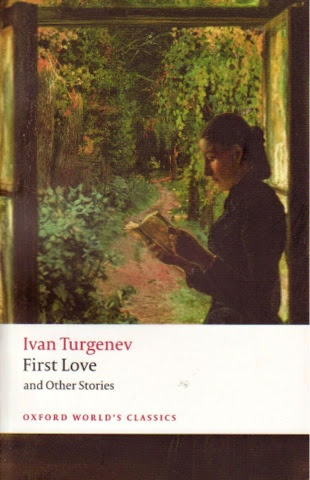
First Love – Ivan Turgenev (1860, trans. Isiah Berlin, 1950) 106 pages

This short tale of thwarted first love, told by a man, Vladimir Petrovich, looking back on the summer of 1833 when he was 16, manages to be both moving and funny. I felt for the pain of the young boy, whilst simultaneously rolling my eyes at the self-importance of teenagers (a bit how I feel watching Romeo and Juliet these days – kids!)

A young man is on the brink of adulthood, having just said goodbye to is tutor, when Princess Zasyekin moves in next door. The princess is uncouth and her house shabby:

“She took snuff as noisily as ever, and fidgeted and turned about on her chair as much as before. It never seemed to have entered her head that she was a princess.”

However, her daughter Zinaida is beautiful and poised, and has suitors in abundance. She teases them all, keeping them in a state of anticipation whilst remaining just out of reach. The young Petrovich is no different:

“But through the tears and the melancholy, inspired by the music of the verse or the beauty of the evening, there always rose upwards, like the grasses of early spring, shoots of happy feeling, of young and surging life.”

Yet there is always the sense that things are happening with Zinaida that our protagonist is too green to recognise. She seems genuinely fond of him and at one point even tells him so after he nearly breaks his neck jumping from a high wall (told you – kids!) yet there is something worldly and slightly damaged about her which Petrovich cannot begin to understand.

 “My arms were smarting from the nettles, my back ached, my head swam, but at that moment I experienced a sense of bliss such as I never again felt in the whole of my life. It flowed like a delicious pain through all my limbs and finally resolved itself in rapturous leaps and cries. Yes, indeed, I was still a child.”

First Love reminded me of The Go-Between and Great Expectations whilst being resolutely its own tale. In a short space it conveys a detailed, effective portrait of the awakening of a young person to both the love and corruption that the adult world has to offer.