“Keep the circus going inside you.” (David Niven)

I really enjoyed Elisa Shua Dusapin’s debut novel Winter in Sokcho so I was looking forward to picking up Vladivostok Circus (2022, transl. Aneesa Abbas Higgins 2024) for Women in Translation Month this year. The two novels share the setting of tourist attractions out of season, and of carefully evoked relationships defined as much by distances as by intimacies.

Nathalie is twenty-two and has graduated in costume design in Belgium. She arrives in Vladisvostok – a place she knows from childhood – to spend time with an acrobat trio who are working on their Russian bar performance. They will be performing at Ulan-Ude, seeking to perform a triple jump four times in a row.

“They communicate in Russian, constantly interrupting each other. Anton gives directions, demonstrates a move to Nino, who listens, hands on hips, visibly impatient. Anna climbs back onto the bar. Their movements synchronise. Anna sets the beat, a rhythmic pulse, rising and falling, like a breath being pushed out and sucked back into the lungs, a beating heart at the centre of the ring.”

Ukrainian trampoline champion Anna is their new ‘flyer’ after the previous acrobat, Igor, was injured in an accident five years previously. Nino is from a German circus family and has worked with Anton since he was eight years old. They are both haunted by what happened with Igor.

The four of them are left in the empty winter circus with manager Leon, and Dusapin expertly portrays the barren environment absent of tourists and glitter, smelling of the departed animals.

Nathalie feels awkward from the start, when she arrives before she is expected. She is unsure of her designs and she talks too much, straining the polite interest of the men. Anna is openly hostile and there is a shaved cat called Buck wandering around, adored by Leon. The atmosphere is unsettling and uneasy.

“By the end of the evening, they all have their headphones on. They each go back to their own room listening to music. I put my headphones on too, but without any music. I sit there, focusing on the sounds inside my own head. It makes me feel closer to the others somehow.”

Gradually however, the relationships deepen. This occurs in a believable way, by increments and without sentimentality.

“‘Aren’t you ever scared?’ I ask after a while.

‘All the time,’ he says. ‘I’m terrified with every new jump. Scared of getting hurt. Scared of hurting Anna. I’m scared of the audience too; I get stage fright.’”

Physical forms are flawed in this novel: Anna worries she is too heavy, Anton is nearing retirement, both men nurse injuries and Nathalie has psoriasis. This emphasises human frailty, building tension throughout this short novel as the group strive for their bodies to achieve this dangerous spectacle.

I think Winter in Sokcho is the stronger novel and if you’ve not read this author before then I would recommend that as the place to start. But there is still plenty to enjoy in Vladivostok Circus; Dusapin is so good at creating an unnerving quality to her settings and characterisation which somehow still manages to be entirely believable and warm.

“It occurs to me that my materials can have an impact on their act too. Smoothing out the skin, tapering the body, enabling it to rise more quickly and to a greater height. And at the same time, accelerating the fall.”

Novella a Day in May 2025: No.8

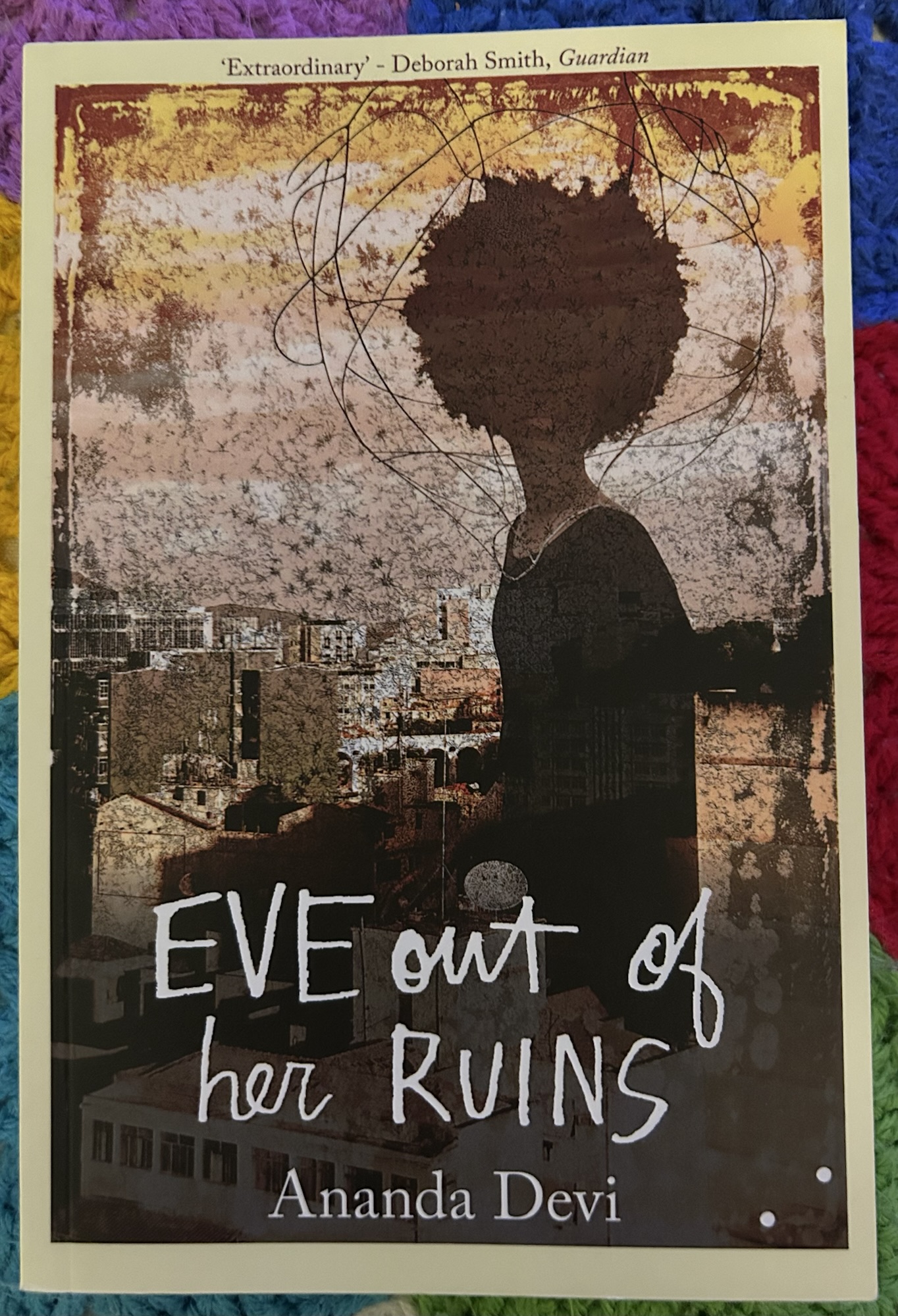
Eve Out of Her Ruins – Ananda Devi (2006, transl. Jeffrey Zuckerman, 2016) 164 pages

I picked up Eve Out of Her Ruins as I hadn’t read any Mauritian literature before and I’m enjoying seeking out new-to-me authors as part of my Around the World in 80 Books reading challenge.

The story is told from the point of view of four young people: Eve, Saad, Savita and Clélio who live in Troumaron, a cité geographically close to and societally far away from the capital Port-Louis. As Saad observes:

“Our cité is our kingdom. Our city in the city, our town in the town. Port Louis has changed shape; it has grown long teeth and buildings taller than its mountains. But our neighbourhood hasn’t changed. It’s the last bastion.”

Saad runs with the gangs to not draw attention to himself, but he loves poetry ever since he discovered Rimbaud, and he dreams of being a writer and escaping the ghetto.

“Just as the island unfurled it’s blues and oranges, so the words unfurled still more vividly purple rages in my head.”

He is in love with Eve, who learnt early on that although she had nothing, she still had something to sell. She has been trading her body to boys and then men, for school supplies and other things she needs, since she was a child. At 17, she is still a child, but a worn-out one.

“Saying no is an insult, because you would be taking away what they’ve already laid claim to.”

“I think I look like lots of things — organic, or mineral, or strange and sloughed off, but I don’t look like a woman. Only a reflection of a woman. Only an echo of a woman. Only the deformed idea of a woman.”

Eve’s sex work is portrayed carefully. It’s not explicit but nor is it obfuscated. I thought this was responsible without being overly harrowing or voyeuristic.

Clélio likes to sing from the rooftops, but is bewildered at how to escape the cité when he is already known to the police. He pins his hopes on his elder brother who has escaped to France, while simultaneously recognising that his brother’s life may not be going well, and he is unlikely to return to collect Clélio as he promised.

“I am Clélio. Dirt poor bastard, swallower of everyone else is rusty nails. What can you do? Nobody changes just like that.”

Eve and her friend Savita are in love, and it is Savita who recognises that Eve is getting more and more closed off as she tries to protect herself from the impact of her sex work and the domestic violence her father metes out at home. It is also Savita who recognises that as they get older, the boys’ anger is growing and the girls are increasingly vulnerable.

Saad sees this too, but knows Eve won’t listen to him however desperately he tries to reach her. There is real tension in the narrative as the sense of imminent violent explosion grows.

Eve Out of Her Ruins is a tough read and a million miles away from the paradisical tourist resorts of Mauritius. It is not poverty porn though, or voyeuristic. The voices of the young people ring true and lack any self-pity. The reader is not asked to pity them, but recognise their resilience and feel the desperation of seeking a way out when the odds are against you.

“They tell me I’ll succeed. But success does not mean the same thing for everyone. It’s a slippery word. In my case, it simply means that locked doors could open just a bit and I could, if I sucked in my stomach, slip through and escape Troumaron.”

In the Author’s Preface, Devi explains “I loved them and wanted to find a way out for them. I couldn’t, not for everyone. So I have left a trail of crumbs for some of them to follow.” Hence, there is hope in Eve Out of Her Ruins, it is not relentlessly bleak. But neither is it unrealistic or sentimental. It definitely doesn’t promise a happy-ever-after for the youngsters of Troumaron.

“I read in secret, all the time. I read in the toilets, I read in the middle of the night, I read as if books could loosen the noose tightening around my throat. I read to understand that there is somewhere else. A dimension where possibilities shimmer.”

Novella a Day in May 2020 #12

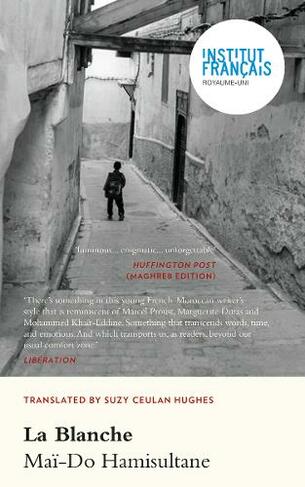
La Blanche – Mai-Do Hamisultane (2013, trans. Suzi Ceulan Hughes 2019) 80 pages

La Blanche is set largely in Casablanca, and so forms another stop on my much-neglected Around the World in 80 Books reading challenge, hosted by Hard Book Habit who sadly don’t seem to be blogging any more but it’s a great challenge so do join in if you can!

 La Blanche is narrated by a young woman whose grandfather was murdered in their home in 1992. Along with her mother she flees Morocco to France, but following a painful break-up of a relationship finds herself heading back to the land of her birth.

“It rained heavily in the night. Torrential summer rain. I didn’t sleep a wink. Perhaps partly too, because I’m anxious about going back to Morocco. It’s as though I’d been bracketing off my childhood for years. Once I’d arrived in France I’d never thought about my childhood in Casablanca again. I’d left it all over there, apart from a little scrap of white paper, folded in four, that I always keep with me.”

The narrative moves back and forth across time, building a picture of her privileged childhood in Casablanca, the violence that shattered it, and the psychological fall-out from a disintegrating romantic relationship as an adult. This is handled expertly and is never confusing, blending together with ease to create a fully realised portrait of this young woman’s life.

The language is taut and every word placed carefully – hence this novella only comes in at 80 pages – but the story is in no way underwritten. Hamisultane has a startling and inventive way of writing, such as here, when the narrator awakes to realise her lover has left:

“It’s morning. The bed is empty. Light is flowing across the room. I close the shutters because I’m afraid it might flow straight though my body.”

It’s so impressive that La Blanche was a debut novel. The time shifts, language and characterisation are handled so deftly making for a satisfying and evocative read.

“My grandfather wakes me.

It is dawn.

He’s taking me out with him.

‘As quick as you can,’ he says to me. ‘While we can still see the morning dew beading the blooms on the rose bushes.’”