“Words burst forth, recognised at last, while underneath other silences start to form.” (Annie Ernaux, The Years)

#ReadIndies is running all month hosted by Kaggsy and Lizzy and it has meant I’ve finally got to a book that I’ve been meaning to read for ages: The Years by Annie Ernaux (2008, transl. Alison L. Strayer 2018) published by Fitzcarraldo Editions.
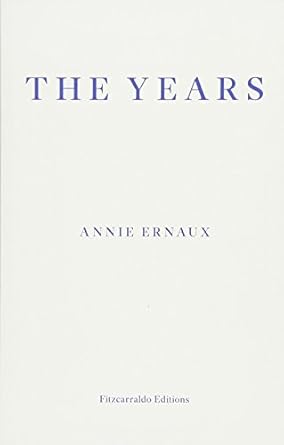
A further incentive was that I really want to see the theatre adaptation which is currently running, and now I’ve read the book I have bought my ticket 😊

The Years is a book which deliberately avoids categorisation. Told in chronological order from 1941 to 2006 but in a fragmentary style, it is a memoir/autobiography/autofiction where Ernaux never uses the first person. She refers to ‘she’ for the more personal memories triggered by photographic images, and ‘we’ for considerations of the society and cultural influences experienced by ‘she’ at the time.

Growing up, she is aware of the poverty of her family, and dreams of escape. Ernaux captures so well the confusion of trying to find an authentic escape, trying to determine what she truly wants, alongside what advertising tells her she wants:

“Meanwhile, as we waited to be old enough to wear Rouge Baiser lipstick and perfume by Bourjois with a j as in joy, we collected plastic animals hidden in bags of coffee, and from Menier chocolate wrappers, Fables of La Fontaine stamps that we swapped with friends at break time.”

“It seems to her that education is more than just a way to escape poverty. It is a weapon of choice against stagnation in a kind of feminine condition that arouses her pity, the tendency to lose oneself in a man.”

There are strong feminist themes running throughout The Years, as she grows up on the brink of societal change. At the start:

“Nothing, not intelligence, education, or beauty mattered as much as a girl’s sexual reputation, that is, her value on the marriage market, which mothers scrupulously monitored as their mothers had done before them.”

Yet the 1960s are on their way… Ernaux pulls no punches in detailing the tyranny of menstrual cycles, and of “kitchen table abortions” before the contraceptive pill arrives and pregnancy terminations are legalised.

“Between the freedom of Bardot, the taunting of boys who claimed that virginity was bad for the health, and the dictates of Church and parents, we were left with no choices at all.”

The Years is lightened by humour too, such as this wry observation regarding her young feminist:

“Two future goals coexist inside her: (1) to be thin and blonde, (2) to be free, autonomous, and useful to the world. She dreams of herself as Mylène Demongeot and Simone de Beauvoir.”

The Years is a powerful evocation of a woman’s life at a specific time. Ernaux demonstrates so clearly how lives are bound up with the culture and the wider political forces in which they take place. It is impossible to consider the life in The Years without considering France in the same period. Yet this is an observation which occurs as she looks back, not at the time:

“Between what happens in the world and what happens to her, there is no point of convergence. They are two parallel series: one abstract, all information no sooner received them forgotten, the other all static shots.”

But as she grows older:

“What is most changed in her is the perception of time and her own location within it.”

And yet,plus ca change plus c’est la même chose, as Ernaux notes consumerism and its false promises endure:

“More than a sense of possession it was this feeling people sought on the shelves of Zara and H&M, instantly granted upon acquiring things, a supplement of being.”

The fragmentary style in The Years is perfect example of an experimental style being grounded by the story it wishes to tell, rather than being employed just for the sake of being different or to demonstrate the author’s cleverness. It conveys the experience of memory as well as the memories themselves. As a reader you are drawn into the layering of images, feelings and experiences in such a direct and immersive way, with all the intimacy of a first-person narrative despite the fact that Ernaux never articulates ‘I’.

“Everything will be erased in a second. The dictionary of words amassed between cradle and death bed, eliminated. All there will be is silence and no words to say it. Nothing will come out of the open mouth, neither I nor me. Language will continue to put the world into words. In conversation around a holiday table, we will be nothing but a first name, increasingly faceless, until we vanish into the vast anonymity of a distant generation.”

Novella a Day in May 2019 #13

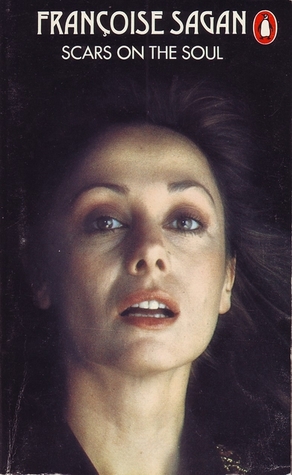
Scars on the Soul – Francoise Sagan (1972 trans. Joanna Kilmartin 1974) 124 pages

This is a strange novella. It’s a story of a Swedish brother and sister living in France, and an extended reflection on Sagan’s writing life: a direct address to the reader.

“It isn’t literature, it isn’t a true confession, it’s someone tapping away at her typewriter because she’s afraid of herself and the typewriter and the mornings and the evenings and everything else.”

Sagan tells the story of Sebastian and Eleanor van Milhelm who are entirely feckless and devoted to one another.

“Life without her, drink without her, were like lukewarm water, Not a bad thing, all said and done, to have one’s life circumscribed to that extent by someone who – whatever she might say – was as much his slave as he was hers.”

While they are not quite incestuous, they certainly have an unhealthy attachment to one another. They move around living off their looks, finding benefactors who will pay for their lifestyle so that neither have to get jobs.

“ ‘Someone’ being that providential person who, because of their charm, their wit, their luck, would act as temporary provider for brother and sister. This person so far had never failed to materialise and was usually discovered by Sebastian, Eleanor, as in this case, being too lazy to go out.”

Yet the van Milhelms are not despicable. They are not malicious or even particularly manipulative; there is the sense that those they live off share an understanding whereby everyone knows what the deal is. There is a sense of ennui as their lives are essentially empty, yet it’s a sad story rather than a depressing one.

Scars on the Soul is certainly a post-modern novella, drawing attention to the art of Sagan as a writer and the artifice of the novel.

“There are moments when I’m on the point of writing ‘But I digress,’ an old-fashioned courtesy to the reader, but pointless in this case, since my purpose is to digress. Nevertheless, this blow-by-blow account of eroticism has irritated me. I’m returning to my van Milhelms ‘who frequently indulge in that sort of thing but never talk about it.’”

I think this novella wouldn’t be for everyone, as it is neither one thing nor the other – not fiction or non-fiction, not short story or essay. Yet I found it satisfying. I was invested in the van Milhelms story and I enjoyed Sagan’s witty reflections on writing and her fame after many years (this was written in her late 30s after the success of Bonjour Tristesse at the prodigiously young age of 18). It’s not something to read when you want a meaty, plot-driven story but Sagan is a hugely talented, skilled writer and there is much of interest here both in the fiction and in the portrait of one writer’s life.

Novella a Day in May 2019 #5

Breaking Away – Anna Gavalda (2009, trans. Alison Anderson 2011) 143 pages

Breaking Away is a simply plotted novella which appears deceptively straightforward in its storytelling, but builds towards a meaningful resolution.

Garance is in her late twenties and cadges a lift to a wedding with her brother Simon and annoying sister in law Carine. The characterisation of Carine starts the novella off on an enjoyably bitchy note as the chaotic Garance, who has stayed up all night playing poker and is waxing her legs on the backseat, offends beauty pharmacist Carine’s sensibilities.

“Carine is utterly perplexed. She consoles herself by stirring sugarless sugar into a coffee without caffeine.”

They stop and pick up another sibling, Lola, who likes to conspire with Garance to wind up Carine. At which point I began to feel for Carine – maybe she wouldn’t be such a nightmare if the siblings weren’t so cliquey and excluding. At this point though, the portrait of Carine does modify slightly.

“She may be a first class pain but she does like to please others. Credit where credit is due.

And she really doesn’t like to leave pores in a state of shock. It breaks her heart.”

Their fourth sibling, Vincent, isn’t at the wedding, so the three of them leave Carine and bunk off to go and collect him. Garance reflects on her various siblings’ trials and tribulations and how their upbringing has influenced who they are. She decides her parents are culpable:

 “Because they’re the ones who taught us about books and music. Who talked to us about other things and forced us to see things in a different light. To aim higher and further. But they also forgot to give us confidence, because they thought that would come naturally. That we had a special gift for life, and compliments might spoil our egos.

They got it wrong.

The confidence never came.

So here we are. Sublime losers.”

But the humour in the novella stops it being self-pitying. In fact, the four of them are doing OK. They’re just enjoying taking a rare moment to spend time together.

Breaking Away captures a moment in time for the four siblings, and has an elegiac quality, for time past and relationships that must inevitably change. The tone isn’t sad however, more resolute; it’s about how love endures beyond all the external changes.

“What we were experiencing at that moment – something all four of us were aware of – was a windfall. Borrowed time, an interlude, a moment of grace. A few hours stolen from other people.”

To end, plenty of songs are name-checked in Breaking Away, including this one which “taught us more English than all our teachers put together”:

Novella a Day in May 2019 #2

The Reader on the 6.27 – Jean-Paul Didierlaurent (2014, trans. Ros Schwartz 2015) 194 pages

Easily the worst part of my day is my commute. If London rush hour had existed in fourteenth century Italy, I’m sure Dante would have made it one of his circles of hell.

But if Guylain Vignolles was on my morning tube, I’m sure things would be vastly improved. This titular hero is thirty-six years old and lives alone save for a goldfish named Rouget de Lisle V. He finds people difficult and so he has become something of a loner.

“His aim was to be neither good-looking nor ugly, neither fat nor thin. Just a vague shape hovering on the edge of people’s field of vision. To blend into his surroundings until he negated himself, remaining a remote place never visited.”

However, there is one point in his day when he does not blend into his surroundings. On his morning commuter train he reads the passengers excerpts from random books. They are pages he has rescued from his job at a book-pulping plant, a job he hates. Stealing the pages away from under the surveillance cameras of his horrible boss and disturbingly enthusiastic colleague is an act of rebellion, of resistance against the disregard shown to the books and all they contain.

“When the train pulled out of the station and the passengers alighted, an outside observer would have had no trouble noticing how Guylain’s listeners stood out from the rest of the commuters. Their faces did not wear that off-putting mask of indifference. They all had the contented look of an infant that has drunk its fill of milk.”

Despite his odd manner and social reluctance, Guylain does have friends. There is the security guard who only speaks in a very particular poetic style:

“The day he discovered the alexandrine, Yvon Grimbert had fallen head over heels in love. Faithfully serving the twelve-syllable line had become his sole mission on earth.”

There is also his ex-boss, who had a terrible accident at work:

“Giuseppe Carminetti, former chief operator of the TERN treatment and recycling company, ex-alcoholic and ex-biped, was going to do his utmost to recover the books that contained what was left of his pins.”

Yes, you read that correctly. Giuseppe’s legs were pulped along with some books and subsequently turned into paper. He is now fixated on hunting down all the books that were printed on such paper, thereby reclaiming his legs.

You may have realised by now that you need a pretty high tolerance for whimsy when reading The Reader on the 6.27. I have a high threshold and so I really enjoyed this novella. The idiosyncratic characters are still believable, and their relationships touching. The power of the spoken word and of literature in all its forms is comically evoked – particularly when Guylain gets recruited to read at a retirement home – but is still a powerful message.

Guylain’s reading matter changes when he finds a memory stick in his usual seat which contains the diary of Julie. While it’s undoubtedly intrusive that he reads the diary its believable that he is trying to do so in order to return the stick to its owner.

Unlike with whimsy, my tolerance for male protagonists falling in love with objectified female fantasy figures is rock-bottom. For me, Didierlaurent got the balance for this part of the story right, and Julie has strong, authentic female voice.

There’s no sense at any time that this sweet story isn’t going to play out in a truly cockle-warming way so it’s not a surprising read, but then it’s not trying to be. A tale of outsiders who, though they would never realise it, are absolutely charming.