“Words burst forth, recognised at last, while underneath other silences start to form.” (Annie Ernaux, The Years)

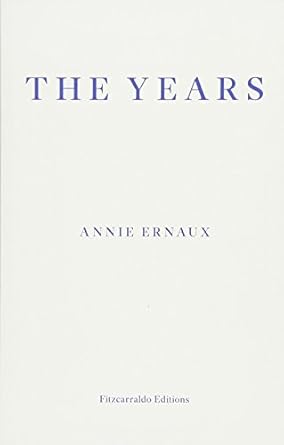
#ReadIndies is running all month hosted by Kaggsy and Lizzy and it has meant I’ve finally got to a book that I’ve been meaning to read for ages: The Years by Annie Ernaux (2008, transl. Alison L. Strayer 2018) published by Fitzcarraldo Editions.

A further incentive was that I really want to see the theatre adaptation which is currently running, and now I’ve read the book I have bought my ticket 😊

The Years is a book which deliberately avoids categorisation. Told in chronological order from 1941 to 2006 but in a fragmentary style, it is a memoir/autobiography/autofiction where Ernaux never uses the first person. She refers to ‘she’ for the more personal memories triggered by photographic images, and ‘we’ for considerations of the society and cultural influences experienced by ‘she’ at the time.

Growing up, she is aware of the poverty of her family, and dreams of escape. Ernaux captures so well the confusion of trying to find an authentic escape, trying to determine what she truly wants, alongside what advertising tells her she wants:

“Meanwhile, as we waited to be old enough to wear Rouge Baiser lipstick and perfume by Bourjois with a j as in joy, we collected plastic animals hidden in bags of coffee, and from Menier chocolate wrappers, Fables of La Fontaine stamps that we swapped with friends at break time.”

“It seems to her that education is more than just a way to escape poverty. It is a weapon of choice against stagnation in a kind of feminine condition that arouses her pity, the tendency to lose oneself in a man.”

There are strong feminist themes running throughout The Years, as she grows up on the brink of societal change. At the start:

“Nothing, not intelligence, education, or beauty mattered as much as a girl’s sexual reputation, that is, her value on the marriage market, which mothers scrupulously monitored as their mothers had done before them.”

Yet the 1960s are on their way… Ernaux pulls no punches in detailing the tyranny of menstrual cycles, and of “kitchen table abortions” before the contraceptive pill arrives and pregnancy terminations are legalised.

“Between the freedom of Bardot, the taunting of boys who claimed that virginity was bad for the health, and the dictates of Church and parents, we were left with no choices at all.”

The Years is lightened by humour too, such as this wry observation regarding her young feminist:

“Two future goals coexist inside her: (1) to be thin and blonde, (2) to be free, autonomous, and useful to the world. She dreams of herself as Mylène Demongeot and Simone de Beauvoir.”

The Years is a powerful evocation of a woman’s life at a specific time. Ernaux demonstrates so clearly how lives are bound up with the culture and the wider political forces in which they take place. It is impossible to consider the life in The Years without considering France in the same period. Yet this is an observation which occurs as she looks back, not at the time:

“Between what happens in the world and what happens to her, there is no point of convergence. They are two parallel series: one abstract, all information no sooner received them forgotten, the other all static shots.”

But as she grows older:

“What is most changed in her is the perception of time and her own location within it.”

And yet,plus ca change plus c’est la même chose, as Ernaux notes consumerism and its false promises endure:

“More than a sense of possession it was this feeling people sought on the shelves of Zara and H&M, instantly granted upon acquiring things, a supplement of being.”

The fragmentary style in The Years is perfect example of an experimental style being grounded by the story it wishes to tell, rather than being employed just for the sake of being different or to demonstrate the author’s cleverness. It conveys the experience of memory as well as the memories themselves. As a reader you are drawn into the layering of images, feelings and experiences in such a direct and immersive way, with all the intimacy of a first-person narrative despite the fact that Ernaux never articulates ‘I’.

“Everything will be erased in a second. The dictionary of words amassed between cradle and death bed, eliminated. All there will be is silence and no words to say it. Nothing will come out of the open mouth, neither I nor me. Language will continue to put the world into words. In conversation around a holiday table, we will be nothing but a first name, increasingly faceless, until we vanish into the vast anonymity of a distant generation.”

Novella a Day in May #14

The Panda Theory – Pascal Garnier (2008, trans. Gallic Books 2012, 143 pages)

This is the first Pascal Garnier I’ve read, and while I’ve heard he can be a bit read-one-read-them-all, I enjoyed this quick, noir read.

Gabriel arrives in a Breton town and begins to get to know the locals, without revealing very much about himself or why he is there.

“a completely nondescript town…the sea was far away, its presence unimaginable. There was nothing picturesque here.”

Jose owns the local bar and is struggling while his wife Marie is in hospital. Gabriel can cook and so takes on this domestic duty while Jose flounders.

“With his elbows on the table, Jose hoovered up his meal. The tomato sauce ran from the corners of his mouth, to his chin and down his neck. Like an ogre.”

Gabriel wins the titular stuffed toy on the shooting range at the fair, and gives it to Jose for his children, but it stays in the bar, its impassive gaze surveying the customers, arms outstretched.

Gabriel attracts the interest of lonely, cat-obsessed Madeleine, and befriends lonely drug-addict Rita.

“ ‘I love you, Gabriel. It’s stupid but it’s true.’

The blind man turned a corner. The sound of his stick gradually faded away before disappearing completely. The town lay still, bathing in dreams in which everybody was a hero. He had to sleep. Sleep.

‘I’m going back to the hotel, Madeleine. It’s late.’

She’d never been as beautiful as she was then. Much more beautiful than her geranium.”

Gradually we learn about Gabriel’s family and why his wife and children are no longer with him. It also emerges why he is in the town and what his purpose is. The Panda Theory doesn’t hold any great surprises but it’s a well-paced, atmospheric tale that builds effectively to its conclusion. I would happily read more by Garnier, even if it is more of the same.

Novella a Day in May #5

Cliffs – Olivier Adam (2005, trans. Sue Rose, 2009) 147 pages

Set over the course of a single night, Cliffs shows the enduring damage caused to the child – now a grown man – of a parent who dies by suicide.

The narrator is sitting on a balcony on the Normandy coast in the middle of the night, gazing at the cliffs where his mother died, while his partner and child lie sleeping in the room behind him. As he sits and smokes, he reflects on his life with his abusive father and his traumatised brother:

“We weren’t supposed to breathe move speak feel. We weren’t supposed to need anything, pocket money or comfort or affection or smiles or advice, we weren’t supposed to expect anything except the slaps, smacks or wallops he dealt out”

Later he meets other damaged souls, drawn together by a mutual recognition:

 “We’ve grown up in fear of our fathers, the troubled silence of our mothers, the empty space formed by abstract, imaginary places, without edge or centre.”

Cliffs isn’t a depressing book; it is a story of survival, of endurance even when we are irrevocably damaged by experience.

 “This way of life didn’t cure me of anything, it was merely possible when I couldn’t cope with any other kind of life, particularly the one I’d just left behind. It was a life of silence, space and absence, of maintaining an acute presence within objects, the shifting play of light, the still motion of water, the perfumes, the texture of the air. It was a life in which I finally found a niche, quiet but peaceful, a body filled with air and fog, a mind completely given over to the noise of the sea and the wind, the company of birds.”

Cliffs is beautifully written, but the beauty in no way detracts from the raw hurt experienced by narrator. It is an intense read, haunting and memorable.