Last week I mentioned the indulgence of good friends, so this week I thought I would look at novels capturing female friendships. I’ll try and redress the balance at some point by looking at male friendships, but this week, in the words of Lesley Knope, its ovaries before brovaries 😀
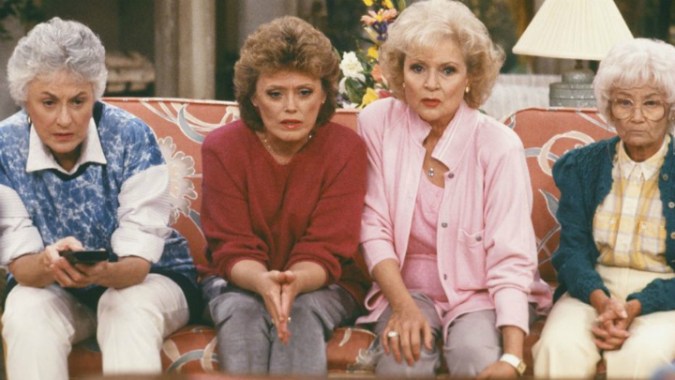
My future – I sincerely hope
Image from here
Firstly, Animals, the second novel from Emma Jane Unsworth, described on the cover by Caitlin Moran as “Withnail with girls”, which pretty much sums it up. Laura lives with her friend Tyler, a one-woman tornado:
“She didn’t just change the temperature of rooms, she changed their entire chemical make-up so that anyone in the room would only be aware that the room was an extension of her and she was the thrumming nucleus.”
Tyler is indulgent, defensive, funny, clever – a total nightmare with whom Laura feels an immediate bond:
“Someone who sees right to your backbone and simultaneously feels their backbone acknowledged.”
But Laura is in love with Jim and is planning to get married, introducing a tension into the women’s friendship. Tyler wants life to continue as it is, Laura is not so sure. It’s not plot-heavy, as Tyler and Laura ricochet from one substance-fuelled experience to another, it’s funny and sad and so very believable:
“And there it was, as always, swinging my way: The Night. With its deals, promises and gauntlets, by turns many things: nemesis, ally, co-conspirator, master of persuasion. It tosses its promises before you like scraps on the road, crumbs leading into the forest: pubs, parties, booze, drugs, dancing, karaoke…”
Amongst all this eventful partying, there is an elegiac quality to Animals: both the women are in their thirties and there’s a sense that their life together cannot continue for much longer, and that it might not be so entertaining if it did:
“Next to the sink, two folded banknotes balanced on a rung of the towel rail, drying. I stood and looked into the bowl before I flushed, recalling the adage of a girl I’d once worked with: White piss good; amber piss bad. Orwellian in its visceral simplicity. Meanwhile the liquid I had dispatched into the toilet bowl was almost ochre.”
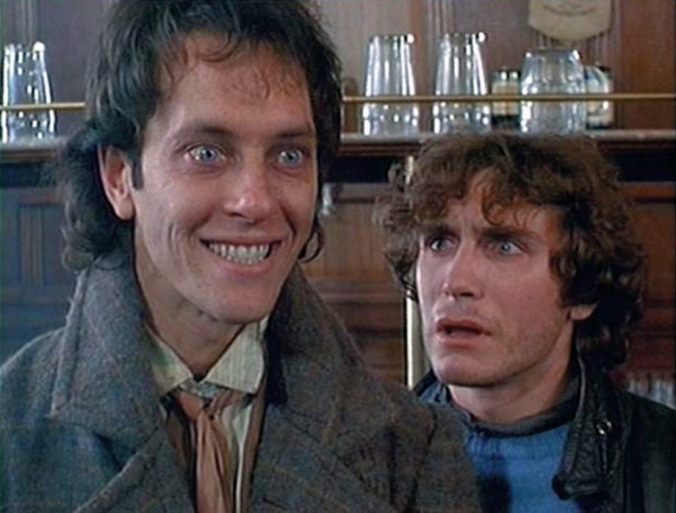
A great film, but not a wise lifestyle choice, kids
Image from here
The bawdy chaos of Animals is presented through considered, inventive storytelling; Unsworth’s voice is compelling and like Laura on a night out with Tyler, I found myself carried along for the ride.


Secondly, the publishing phenomenon that is Elena’s Ferrante’s My Brilliant Friend (tr. Ann Goldstein, Europa editions 2012) and one more stop on my Around the World in 80 Books reading challenge, hosted by Hard Book Habit. This is the first in a quartet known as the Neapolitan novels which have sold millions worldwide, no doubt to the chagrin of authors everywhere stuck on a PR treadmill, as Ferrante remains determinedly anonymous. The novels detail the friendship between Elena and Lila from the 1950s onwards.
“She stopped to wait for me, and when I reached her she gave me her hand. This gesture changed everything between us forever.”
I’m grateful to Kate’s recent review which tempered my expectations somewhat. While I did like the novel, I think had I gone in with the astronomical expectations created by all the hype I would have been disappointed. As it was, I went in with moderate expectations and enjoyed being pulled into the poor Neapolitan neighbourhood Ferrante so vividly evokes. Elena summarises: “I feel no nostalgia for our childhood: it was full of violence.” She’s not wrong. Violence between strangers, friends and families seems to be constant. The poverty and accompanying lack of horizons takes its toll:
“At the Bar Solara, in the heat, between gambling losses and troublesome drunkenness, people often reached the point of disperazione – a word that in dialect meant having lost all hope but also being broke – and hence of fights.”
Within this environment, Lila and Elena form a friendship that is full of the unspoken. Elena is mesmerised by Lila, who is tough, independent, and highly intelligent. Despite the time they spend together, the core of Lila – what she really wants, her hopes and dreams – remain mysterious to Elena.
“Would she always do the things I was supposed to do, before and better than me? She eluded me when I followed her and meanwhile stayed close on my heels in order to pass me by?”
It is this competitiveness, this desire to be like Lila, which spurs Elena on, to the point where this motivation becomes indistinguishable from her own preferences. She continues at school long after Lila leaves, her academic commitment a mixture of wanting to outstrip Lila, wanting to do well because it is what Lila wants, and wanting to do well for herself. Ferrante has an excellent understanding of how these early friendships are so vitally important, how they form us in ways we barely understand and how quickly it is impossible to say what feels intrinsic to us and what is the influence of others. She captures the ambivalence of friendships that are formed out of deep love and conflict:
“When school started again, on the one hand I suffered because I knew I wouldn’t have time for Lila anymore, on the other I hoped to detach myself from the sum of the misdeeds and compliances and cowardly acts of the people we knew, whom we loved, whom we carried – she, Pasquale, Rino, I, all of us – in or blood.”
While I’m not quite ready to proclaim myself a fully paid-up Ferrante acolyte, the quartet supposedly gets better as it goes along, so by book four I could well be (Marina Sofia has written a really interesting review of the quartet here).
To end, two celebrities (one of whom plays the aforementioned Lesley Knope) who claim to be BFFs and I actually believe them:
 madame bibi lophile recommends