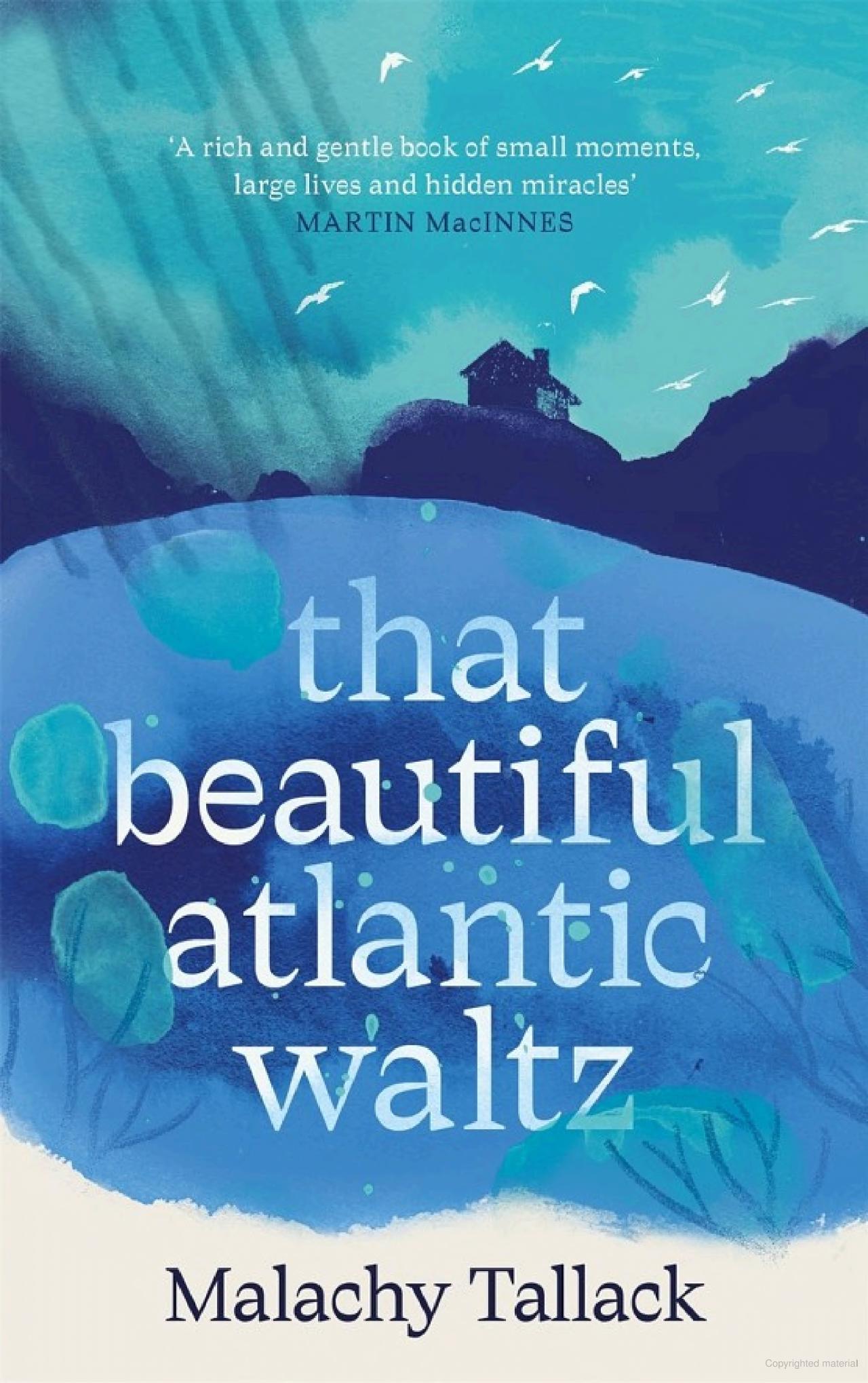
I wanted to read That Beautiful Atlantic Waltz by Malachy Tallack (2024) ever since I heard about it on Susan’s blog where it also made her Books of the Year. Everything about it appealed: the Shetland setting, the portrait of a life quietly lived, the theme of friendship and the concise but descriptive style. My hopes were ridiculously high; they were also fully met.
There are two timelines, one which begins in the late 1950s with Sonny on a whaling ship, following his marriage to Kathleen and family life with their son Jack and her uncle Tom, ending in the 1970s. The other follows solitary Jack in late middle-age, in the present day.
Apart from a brief few weeks in Glasgow, Jack has always lived in the same house on the croft in Shetland:
“He had so many memories of this room that it seemed not separate from him at all but a part of who he was and who he had always been. He had done so much of his living in this room.”
He is for the most part content with his life: taking walks, keeping his part time job ticking over, listening to his beloved country music and writing songs no-one will hear.
Tallack is a musician and he writes beautifully about music and all it can mean to people; how listening to it can be transcendental and how writing it can be a solitary act which simultaneously opens you up to the world. Jack’s handwritten songs punctuate the story and expand his portrayal beyond his immediate situation.
“To love was an act of imagination. It was to create possible futures, to build new and better selves. When love ended, those futures and those selves were what was lost. Jack knew something of loving from writing love songs. And he knew something of heartbreak, too.”
Jack is not especially damaged or traumatised, but he is a man whose solitary nature has found a space where it is never needed to be otherwise. He grew up in a house where feelings, worries and hopes were not discussed. His father Sonny is a man quick to anger who finds:
“So often feelings came to him like that: in a knot he was ill equipped to undo.”
While his more gregarious mother Kathleen doesn’t know how to broach her son’s silence:
“She listened, feeling the tears creep down her cheeks, not thinking of anything in particular, just hearing that cumbersome music, with a closed door between herself and her son.”
Life changes for Jack when someone leaves a kitten on his doorstep. He doesn’t want the cat but sometimes we share our lives with those we could never imagine choosing, and so Jack finds himself no longer living alone but with energetic, cheeky Loretta (named after Lynn). And his life begins to expand in ways he could not foresee.
In That Beautiful Atlantic Waltz, Tallack has crafted a story of such humane understanding and kindness. It isn’t remotely sentimental in its portrayal of the capacity of human beings to reach one another and to change.
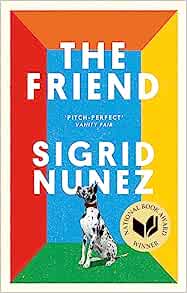
After a focus on cats last week, I thought this week I’d look at a book with dog, The Friend by Sigrid Nunez (2018).
The novel is addressed to ‘you’ throughout: a friend and mentor of the narrator who has died by suicide. They were friends for many years and her grief is deep.
“The dead dwell in the conditional, tense of the unreal. But there is also the extraordinary sense that you have become omniscient, that nothing we do or think or feel can be kept from you. The extraordinary sense that you are reading these words, that you know what they’ll say even before I write them.”
The person was a writer and teacher, as is the narrator. What I thought worked well was that the dead person didn’t sound particularly likeable – a vain, slightly arrogant man who used his moderate fame and academic position to sleep with lots of women, and became angry and bitter when his looks faded and the world moved on. The narrator doesn’t seek to excuse or validate this behaviour. She didn’t approve of it, but she valued her friend and the relationship they had for many years. She is grieving an imperfect person and she is wise enough not to try and make him anything other than who he was.
Wife Three visits her and pulls a guilt trip about the man’s Great Dane dog, who is pining.
“You can’t explain death.
And love deserves better than that.”
And so Apollo, the only named being in the story, moves into her tiny apartment, where her lease forbids dogs. And he is a lot of dog:
“Thirty-four inches from shoulder to paw. A hundred and eighty pounds. Attached was a photograph of the two of you, cheek to jowl, the massive head at first glance looking like a pony’s.”
The descriptions of the grieving dog, of his subdued, baffled silence are heartbreaking, and an effective display of grief alongside a human who is expected to get up, go to work, smile and be polite, do her shopping, clean her home. Apollo can behave more honestly:
“He walks with his head lowered, like a beast of burden.”
As the narrator talks to her friend, we get a sense of her emerging relationship with Apollo, his learning to trust her, and their deepening bond. There is no doubt the relationship is bound up in her deep grief and Apollo becomes a focus for her feelings.
Unlike the narrator’s friends though, I didn’t think it was particularly unhealthy or dysfunctional. There is a sense of the narrator as a writer trying to work through her feelings, sometimes intellectually by falling back on the writers and books she has spent her entire working life with, (including JR Ackerley’s My Dog Tulip, which I thought documented a much stranger relationship with a dog) and at other times by physically massaging the enormous canine.
“The friend who is most sympathetic about my situation calls to ask how I am. I tell him about trying music and massage to treat Apollo’s depression, and he asks if I’ve considered a therapist. I tell him I’m sceptical about pet shrinks, and he says, That’s not what I meant.”
This gentle humour runs throughout The Friend and stops it becoming mawkish. As the story is one writer talking to another, there are some spiky observations about the literary scene, such as at his funeral:
“It was not very different from other literary gatherings. People mingling at the reception were heard talking about money, literary prizes as reparations, and the latest die, author, die review.”
And also a repeated motif of the relief of writers who have found Something Else to do:
“Are you kidding? says a friend who raises goats on a farm upstate and makes award-winning chèvre. Writers block was the best thing that ever happened to me.”
I’ve seen The Friend described as stream of consciousness. It is a conversation with a silent interlocutor (apart from one section, the only part that felt a bit clunky to me) but it has a structure, if not a plot. To me this was an effective portrayal of grief, which isn’t linear or logical.
“Is this the madness at the heart of it? Do I believe that if I am good to him, if I act selflessly and make sacrifices for him, do I believe that if I love Apollo – beautiful, ageing, melancholy Apollo – I will wake one morning to find him gone and you in his place, back from the land of the dead?”
Nunez mentions more than once: “There’s a certain kind of person who, having read this far, is anxiously wondering: Does something bad happen to the dog?” I am definitely that kind of person. If you are too, I don’t want to give spoilers but what I will say is that The Friend is a book about grief, and so it is a sad read, but it’s not a traumatic one.
The Friend isn’t a book to read for plot, or even for story. It is a reflection on friendship, writing, reading, aging; and a meditation on grief and grieving, and joys and pains of sharing our lives with humans and with animals. There is sadness and there is humour, and there is never a sense that grief is a price not worth paying, however painful.
“Your whole house smells of dog, says someone who comes to visit. I say I’ll take care of it. Which I do by never inviting that person to visit again.”
This is a contribution to the wonderful #ReadIndies2 events hosted by Kaggsy and Lizzy.
The two books for this post were buried in my TBR, so I’ve put them together as they are linked by the theme of friendship.
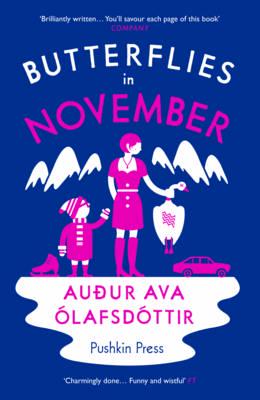
Firstly, Butterflies in November by Auður Ava Ólafsdóttir (2004 trans. Brian FitzGibbon 2013) published by Pushkin Press (which I thought was an indie, then panicked that it had been bought by Penguin, but which Lizzy has helpfully reassured me is definitely an indie!)
I really enjoyed Miss Iceland by this author so I was looking forward to this. Like Miss Iceland, this novel has a central female protagonist whose voice is bone dry, determinedly going her own way.
At the start of the novel, the unnamed narrator returns home to her husband after a meeting with her lover, one of her translation clients as she speaks 11 languages. She doesn’t seem especially attached to either man:
“After we had slept together for the first time, he looked surprised when I handed him the bill with the VAT clearly highlighted.”
Her husband announces he is leaving, to be with his pregnant girlfriend. This doesn’t seem like any great loss, given that as he’s going, he details her failure to live up to his ideals of womanhood:
“‘The amount of times I’ve prayed to God to ask him to make you buy a skirt suit.’
‘Wouldn’t it have been simpler just to ask me?’”
She moves to a new apartment but her wet blanket husband keeps turning up, so she starts daydreaming of foreign travel somewhere warm. However, her best friend Auður is pregnant with twins, and needs to stay in hospital for the late stages of the pregnancy. This means she finds herself driving round the Icelandic ring road which circles the whole island, with Auður’s son Tumi:
“a deaf four-year-old clairvoyant boy with poor eyesight and one leg three centimetres shorter than the other, which makes him limp when he is only wearing his socks.”
There seems little worry that Tumi will miss any education, as his teacher demonstrates ableism, gender stereotyping and racism, all within a remarkably short conversation.
The plan is to travel east to a prefab cottage that she won in a lottery for the Association for the Deaf. This involves her returning homewards, and we get glimpses of her past which may explain some of her detachment, although things are never fully explained.
What follows is a road trip story – funded by her and Tumi winning another lottery, which they split 50/50 – whereby the two meet a variety of characters. My personal favourite was the Estonian choir who kept turning up. There are also some lovers, as predicted by a clairvoyant at the start of the novel:
“three men in your life over a distance of 300 kilometres, three dead animals, three minor accidents or mishaps, although you aren’t necessarily directly involved in them, animals will be maimed, but the men and women will survive. However, it is clear three animals will die before you meet the man of your life.”
The animals: suffice to say there were passages I had to skip. But skipping those didn’t detract from the overall story at all so I would still recommend this novel, even if you share my sensitivities.
Tumi is a sweet, self-possessed boy “He always stands at the back of the group, avoiding conflict.” and I thought his relationship with the narrator was nicely evoked without sentimentalism.
Looking on goodreads, the reviews for this are a very mixed bag. My tolerance from whimsy is pretty high and I don’t mind things left unexplained, so I enjoyed this novel, and I do really like Ólafsdóttir’s detached female voices.
“A relationship for me is all about the right body and the right smell, the home is a shell for the body, not a place for exchanging existential views and having discussions. Even though you still have to load the washing machine and cook for the body.”
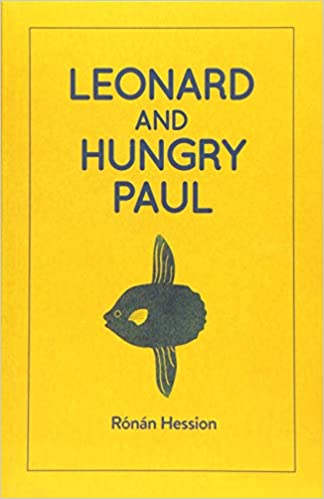
Secondly, Leonard and Hungry Paul by Rónán Hession published by Bluemoose Books, an independent publisher based in Hebden Bridge, whose manifesto explains “At Bluemoose our aim is to publish cracking stories that engage and inspire.”
I tried to read L&HP back in the summer and totally failed, but it had a lot of positive reviews in the blogosphere and so I gave it another shot. Now my reading is recovering somewhat I zipped through it with ease, so I’m sure my earlier troubles were indicative of my reading slump and not Hession’s writing.
The titular friends are men around their mid-thirties, who are easily overlooked. Leonard is grieving his mother, who he lived with in the family home until she died, never moving out because they got on well and there was no reason to. I found this relationship very touching. So often parent/child relationships are dramatized as being full of unspoken judgements and resentments, and it was a pleasant change to see someone who loved his parent, but also liked and respected them.
“Had he the courage, Leonard would have spoken up and said that his mother looked after everyone in her life as though they were her garden birds: that is to say, with unconditional pleasure and generosity.”
Leonard’s grief is of the quiet, ordinary kind where you still get up and go to work every day, carrying a deep sadness with you. In other words, the type pretty much everyone experiences.
“Leonard took off his noise-cancelling society-repelling headphones and went to the kitchenette for a mid-morning cup, even though he always disliked the awkward wait for the water to boil and the prospect of kettle-related time-killing small talk.”
I am with you Leonard.
Hungry Paul – whose attributive adjective is never explained – still lives at home with his parents, happy to bumble along, working as a casual postman and seeing Leonard regularly for their boardgame nights.
“He had no interest in, or capacity for, mental chatter. He had no internal narrator. When he saw a dog he just saw a dog, without his mind adding that it should be on a lead or that its tongue was hanging out like a rasher.”
Paul’s quiet stillness comes into its own when his mother insists he join her as a volunteer hospital visitor. While his extrovert mother chats away happily with one patient, Paul becomes the only one another patient will tolerate “He sat there calmly, simply sharing the moment with the woman.”
Not very much happens in L&HP but there is enough plot to pull the reader along. Paul’s sister Grace is getting married; Leonard begins a tentative romance; Hungry Paul enters a competition at the Chamber of Commerce. Really though, the novel isn’t so much about what happens as providing a glimpse into ordinary, quiet lives, and showing how they are worthy of attention:
“Their friendship was not just one of convenience between two quiet, solitary men with few other options, it was a pact. A pact to resist the vortex of busyness and insensitivity that had engulfed the rest of the world. It was a pact of simplicity, which stood against the forces of competitiveness and noise.”
I found L&HP to be a paean to the kindness and the gentleness found in the everyday small gesture:
“She was a person for whom kindness was a very ordinary thing, who believed that the only acceptable excuse for not having a bird feeder in the back garden was that you had one in the front garden”
(Or in my case, because you live in a London flat and the management company have banned them because the rats feast on them ☹)
It’s not an overly worthy novel though, there is plenty of humour. No-one is put down, but the absurdities of people are gently ribbed, such as Leonard’s colleague “Okey dokey. This will take just one minutiae. Take a load off, compadre,’ said Greg, unable to complete one conventional sentence.”
As an introvert who despairs at the relentless noise of modern life (why do shops think blaring out music will entice you to spend more time and money there? Why are cinema volumes now kept at ear-bleeding decibel levels?!) and who firmly believes in the meaning of the everyday, I was definitely the target audience for L&HP. If this sounds like you too, then I think you’ll enjoy this novel.
“We live in an age of cacophony. Everyone talking and thinking out loud, with no space or oxygen left for quiet statements and silence.”
To end, one of the best TV theme songs ever, all about being a friend:
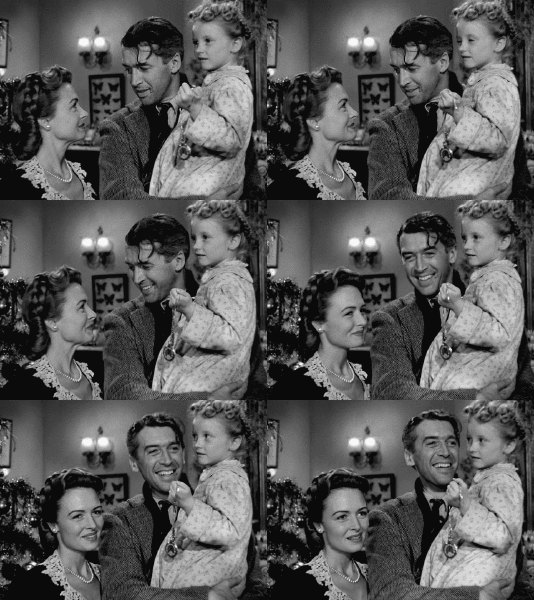
I hope you all had a wonderful Christmas! From my twitter feed, I know for some that means being as far away from relatives as possible 😉 If Christmas advertising were to be believed, we should all have families like this:
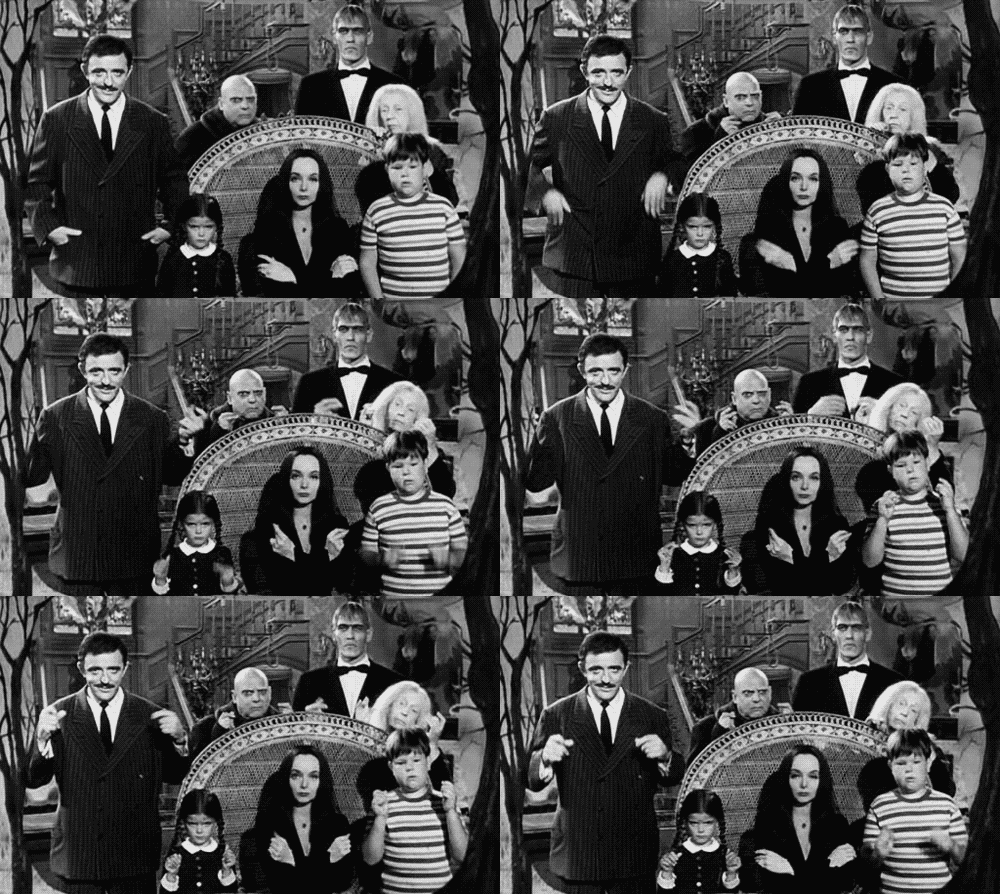
Whereas in fact the reality may be closer to this:
In which case I would say well done you, because I’m the only person alive who doesn’t like It’s a Wonderful Life *ducks for cover* whereas the Addams Family are awesome. Whether you spent Christmas with George Bailey or Uncle Fester, I thought this week might be a good time to look at families that are found in unexpected places.
Firstly, Plainsong by Kent Haruf (1999) which I picked up after loving Our Souls at Night so much and many bloggers recommended I start the Plainsong trilogy. All the things I enjoyed about Our Souls at Night were here: a gentle, unshowy voice, believable idiosyncratic characters, ordinary lives shown to have a delicate beauty.
Set in the fictional prairie community of Holt, Colorado, Plainsong focusses on a pregnant schoolgirl, Victoria Roubideaux, and one of her teachers, Tom Guthrie, who is splitting up with his wife. After Victoria is thrown out by her mother, another teacher, Maggie Jones, suggests to a pair of elderly brothers, Harold and Raymond McPheron, that they take her in.
“ You’re getting goddamn stubborn and hard to live with. That’s all I’ll say. Raymond, you’re my brother. But you’re getting flat unruly and difficult to abide. And I’ll say one thing more.
What?
This ain’t going to be no goddamn Sunday school picnic.
No it ain’t, Raymond said. But I don’t recall you ever attending Sunday school either.”
They offer Victoria a home, and the portrayal of their developing relationship with the young woman is just lovely. The brothers are set in their ways and unused to female company. Victoria is shy and unsure. The tentative gestures they make towards one another pay off and a tender, mutually nurturing affection develops.
“The brothers were watching her closely, a little desperately, sitting at the table, their faces sober and weathered but still kindly, still well meaning, with their smooth white foreheads shining like polished marble under the dining room light. I wouldn’t know, she said. I couldn’t say about that. I don’t know anything about it. Maybe you could explain it to me.
Well sure, Harold said. I reckon we could try.”
Meanwhile, Tom’s sons Ike and Bobby are struggling to come to terms with their mother’s depression and subsequent leave-taking. A similarly unexpected yet gentle cross-generational relationship develops between the boys and elderly, isolated Mrs Stearns who they know from their paper round.
“The timer dinged on the stove. They took the first oatmeal cookies out of the oven and now there was the smell of cinnamon and fresh baking in the dark little room. The boys sat at the table and ate the cookies together with the milk Mrs Stearns had poured out into blue glasses. She stood at the counter watching them and sipped a cup of hot tea and ate a small piece of cookie, but she wasn’t hungry. After a while she smoked a cigarette and tapped ashes in the sink.
You boys don’t say very much, she said. I wonder what you’re thinking all the time.
About what?
About anything. About the cookies you made.
They’re good, Ike said.”
Plainsong is a gentle tale about all that human beings can give and be to one another, but it is not remotely sentimental or rose-tinted. Haruf shows, he doesn’t tell, with a restraint and subtlety that is easy to underestimate but is absolutely masterful. I find his writing incredibly moving. It’s going to be a real strain on my 2018 book buying ban not to rush out and buy the novels of his I don’t yet own.
Secondly, Sweet Bean Paste by Durian Sukegawa (2013, trans. Alison Watts, 2017). Again, this is a simply told tale of ordinary people, and it is truly heartwarming. The main protagonist is the decidedly unheroic Sentaro. He has a criminal record and is employed by people he owes money to. He sells dorayaki – pancakes filled with the titular paste – with no pride in or commitment to his work. One day Tokue, an elderly lady with a visible disability in her hands and face arrives in the shop:
“ ‘I had one of your dorayaki the other day. The pancake wasn’t too bad, I thought, but the bean paste, well…’
‘The bean paste?’
‘Yes. I couldn’t tell anything about the feelings of the person who made it.’
‘You couldn’t? That’s strange.’ Sentaro made a face as if to show how regrettable that was, though he knew full well his bean paste could to reveal no such thing.”
Sentaro employs Tokue on the understanding that she will not interact with the customers who he thinks will be put-off by her disability. Tokue’s delicious bean paste brings more customers to the shop and business begins to boom. As Sentaro and Tokue’s relationship develops, he begins to understand that she has survived Hansen’s disease (leprosy) but is still subject to significant stigma around the disease. One of the schoolgirl customers, Wakana, becomes very attached to Tokue, and they visit her at the asylum she continues to live in although the government has passed an act which means those with Hansen’s disease are no longer kept in isolation.
“Nevertheless human lives had been swallowed up by this place and for a hundred years, continually spurned. It felt to Sentaro as if the singular silence rose from the very earth beneath their feet, steeped as it was in sighs and regrets.”
Sweet Bean Paste is about living life to the full even when society is circumscribing it in cruel ways. It is about friendship’s power to heal and to empower. It is also about opening ourselves to experience the world in new and surprising ways, no matter our age. Tokue has an almost mystical relationship with her cooking, which enriches both her and those who consume her food.
“When I make sweet bean paste I observe closely the colour of the adzuki beans faces. I take in their voices. That might mean imagining a rainy day or the beautiful fine weather they have witnessed. I listen to their stories of the winds that blew on their journey to me.”
And so in the end, I think Sweet Bean Paste is about nourishment in all its forms; it is there for the taking if we have the wisdom to see it and the open hearts to embrace it.
To end, never let it be said that I shy away from the obvious:
This week’s post is about friendship, as I’ve returned home from uni and had a great time catching up with friends I haven’t seen for a while.When I was thinking of title quotes for this theme, the phrase that immediately sprang to mind was too long. However, it’s lovely, so here it is:
“Piglet sidled up to Pooh from behind. “Pooh?” he whispered.
“Yes, Piglet?”
“Nothing,” said Piglet, taking Pooh’s hand. “I just wanted to be sure of you.” (A.A. Milne, Winnie-the-Pooh)
If that doesn’t make you go “aww..” you are a cold, cold person.
Firstly, Embers by Sandor Marai (1942, my copy Penguin 2001 trans. Carol Brown Janeway). Embers is a deceptively simple novel, set over one evening, running to only 250 pages in my edition. An elderly general lives in a castle, in melancholy stasis:
“The castle was a closed world…it also enclosed memories as if they were the dead, memories that lurked in damp corners the way mushrooms, bats, rats and beetles lurk in the mildewed cellars of old houses”
He prepares for a supper with his childhood friend, Konrad, who he hasn’t seen in 41 years. Over the course of the evening, the betrayal that tore them apart will be voiced and answers sought. Within this simple framework Marai explores the complexity of human relationships, with great delicacy:
“Their friendship was deep and wordless, as are all emotions that will last a lifetime”
“Their friendship, fragile and complex in the way of all significant relationships between people”
With a lesser writer the novel would be heavy-handed, clichéd, sentimental. But Marai avoids these pitfalls by refusing to make things – feelings, events, motivations – simple or captured in reductive explanations.
“The magical time of childhood was over, and two grown men stood there in their place, enmeshed in a complicated and enigmatic relationship commonly covered by the word ‘friendship’”
I can’t really say much more without giving away spoilers, but Embers is a beautifully written, intelligent book about the complications of the loves we have in our lives. Marai never wastes a single word. I highly recommend it.
Secondly, Utterly Monkey by Nick Laird (4th Estate, 2005). Danny is living in London, doing a job he hates to pay for a flat he’s ambivalent about. He has physically moved away from Northern Ireland, but his childhood follows him in the form of his oldest friend:
“Geordie Wilson was standing on the step. His small frame was silhouetted against the London evening sky. He looked charred, a little cinder of a man […] He could have been Death’s apprentice.”
Geordie’s in trouble, and seeks refuge with Danny. Their lives easily become as intertwined as when they were kids, despite the years apart, and as they infuriate each other they never really consider leaving the other one to cope alone. The notion of loyalty as a choice, and yet one that is rarely questioned, is given a further resonance by the fact that Danny and Geordie grew up through the Troubles. Now both have left Belfast, but Utterly Monkey queries how much we ever leave our childhoods behind, and how feelings can remain inexplicable but powerful motivators for the action we take.
It’s a touching story, and I actually felt the over-arching plot was unnecessary, the carefully drawn characters would be enough to carry the story along. However, this isn’t to suggest the plot is clumsy, and Laird uses his considerable skill as a poet to write effective prose, finding surprising and evocative images in the everyday:
“Outside the pub a tattered newspaper was lying against the kerb and the wind was freeing it sheet by sheet. Some pages blew about restlessly further up the pavement. One had managed to wrap itself around a lamppost and was flapping gently like a drunkard trying to hail a taxi.”
Laird is also funny (“He was an East Londoner, and appeared to suffer from the East London disorder of considering accidental eye contact an act of overt aggression.”) and this stops a tale that could be full of bitterness and regret from ever becoming recriminatory. In fact, it makes it more realistic – there are friends who drive you mad, who make you wonder why the friendship continues, but the ties that bind somehow endure and stop life becoming too predictable.
To end, the trailer for one of my favourite films, The Station Agent (2003), which charts the beginnings of friendship between 3 people. Peter Dinklage is now uber-famous as Tyrion Lannister, but here he is many years before, giving a very different, equally wonderful performance:
This week I went to a reunion, which wasn’t nearly as traumatic an experience for me as it is for Martin in Grosse Pointe Blank, partly because I gave up contract killing years ago, but mainly given that we meet regularly every six months, but we call it a reunion to make it a slightly bigger deal to try and ensure all six of us make an effort to be there. In trying to decide which books to discuss, I found those treating the subject of reunions a bit sparse. As a result, I’ve picked two that share a lot of similarities; both are written by British male authors, both consider the subtleties of male friendship, and both won the Booker prize. So there may not be as much contrast this week as I normally aim for in my book choices, but I hope you enjoy them. I will also claim that together they represent the characters’ relationships in both books as they are united yet disparate, sharing a common ground but a very different language. While this is true, I’m not clever enough to have made this my reasoning at the time. The reason was they were all I could come up with. I hope you enjoy!
Firstly The Finkler Question by Howard Jacobson. This was the first book by Jacobson that I’d ever read, and I think on the basis of this I will hunt down more of his work. I found The Finkler Question funny, intelligent and thought-provoking, not an easy balance to achieve. After a reunion with his schoolfriend Sam Finkler and their teacher Libor, Julian Treslove walks home and is mugged by a woman who he believes says “You Jew” to him, despite the fact that he’s not Jewish (both Sam and Libor are). Following this incident Treslove begins to explore Jewish culture and identity further, struggling to work out his place amongst it. Meanwhile, both Finkler and Libor are grieving widows, searching for ways to stop themselves drifting rudderless with grief.
All three characters are fully drawn, but it is Treslove who provides the main point of view, and he is an incredible creation, because frankly, he is a monumental prick, and yet Jacobson manages to make you not despise him. He would claim he loves women, but really only sees them as a vehicle for his over-developed sense of sentimentality, continuously picturing them on their deathbed, himself wracked with grief, living out the operas he adores. When Libor, who actually is wracked with grief for a woman he genuinely loved, mentions trying to cope with the pathos of life: “Treslove couldn’t bear the thought. Why did anyone want a defence against pathos?” Alongside this sentimentality he is fixated with Judaism, but doesn’t think of himself as an anti-semite, despite the fact of referring to all Jewish people by the name of his Jewish friend, to construct thoughts such as: “if you were a Finkler you just found it in your genes, along with other Finkler attributes it was not polite to talk about.” He is so self-deluding that: “For a moment he wondered if that was the reason he had fared so badly at the BBC himself –anti-semitism.”
Oh boy. What an arsehole. An yet the humour of the novel lends it such a lightness of touch that you end up seeing the pathos of Treslove, not the one he wants whereby he can rend his garments, but a more ordinary pathetic quality, of someone trying desperately hard to understand the life they are living, and failing. Even at the small level, things are baffling: “At a certain age men began to shrink, and yet it was at precisely that age that their trousers became too short for them. Explain that.” So Treslove’s attempt to understand Middle East politics is bound to fail. It’s here that the book becomes more complex, as Jacobson uses the lives of these characters to explore wider notions of identity, history and politics, particularly regarding Jewish culture. At this point I felt I wasn’t clever enough for this story, as Jacobson is so adept at painting the various shades of grey that I felt my understanding wasn’t subtle enough. One of the characters realises “What she might be wrong about today she will be right about tomorrow.” That’s what I took away from this novel, that there are no easy answers, no one story to be told, either on a personal level or a worldwide stage. But it is better to laugh than cry: “He did something with his shoulders which he hoped she would interpret as emotional pain, but not too much.”
Secondly, Last Orders by Graham Swift. The reunion in this novel is defined by who doesn’t attend: the friends of Jack Dodds meet in south London (Bermondsey) to travel to Margate (a seaside town in Kent) to scatter his ashes at sea. The characters take it turns to tell the story of that day and the history that binds them. His son Vince, Ray the lucky gambler, Lenny, whose daughter had a baby with Vince, and Vic, the undertaker. Jack’s wife Amy stays behind but also narrates (as does Jack and Vince’s wife Mandy at points). It is determinedly ordinary: although an unusual day nothing extraordinary occurs, there is no great drama. As they tell their stories you begin to understand what binds these men together, and what the great moments and great disappointments of their daily lives have been. Some of the chapter headings take their names not from the narrator, but geographical locations along the way. I’ve decided to quote from “Canterbury” because it reminded me (deliberately, I’m sure) of Chaucer’s pilgrims, who also travel from south London (Southwark) to Kent. The men in this group aren’t Knights and Squires, they aren’t captured in epic poetry, but Swift shows us the grandeur of daily life:
“I sit there, keeping an eye out, but I don’t see them anywhere, so I get up and find the way out, and then I spot them, standing on the paved area, looking out for me. I think, Friends. The sky’s dark and threatening, and the wind’s cold but they don’t look like they’re getting peeved. They look like they’re glad to be here together, like all’s forgiven. I think, maybe….I can feel the cathedral behind me, looking at me.”
This quote also highlights the main drawback of the book. Swift has attempted to capture vernacular south London speech (of which I am a native speaker), but he doesn’t quite manage it. I think with this sort of thing you’ve either got to go all out (like Trainspotting) or ignore it completely. What Swift ends up with is a mixture of the two and as such the voices don’t sound authentic. What is authentic however, is the characters’ experience, feelings and reactions, and this is the story’s great strength. Not a flawless novel, but still a moving one.
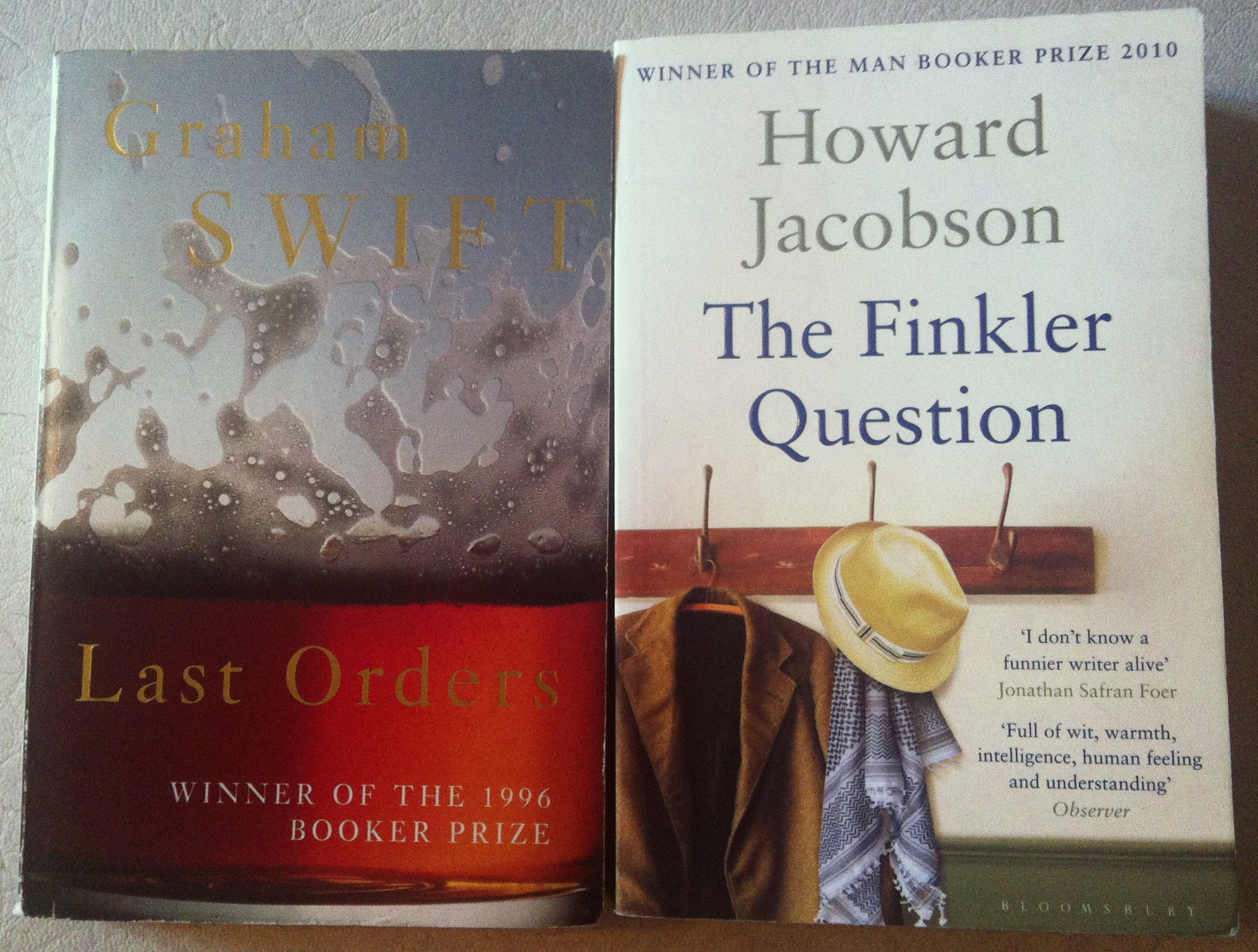
Here are the books, reunited (I know, totally uninventive photo, but how to portray a reunion?):




 madame bibi lophile recommends