Novella a Day in May 2025: No.22

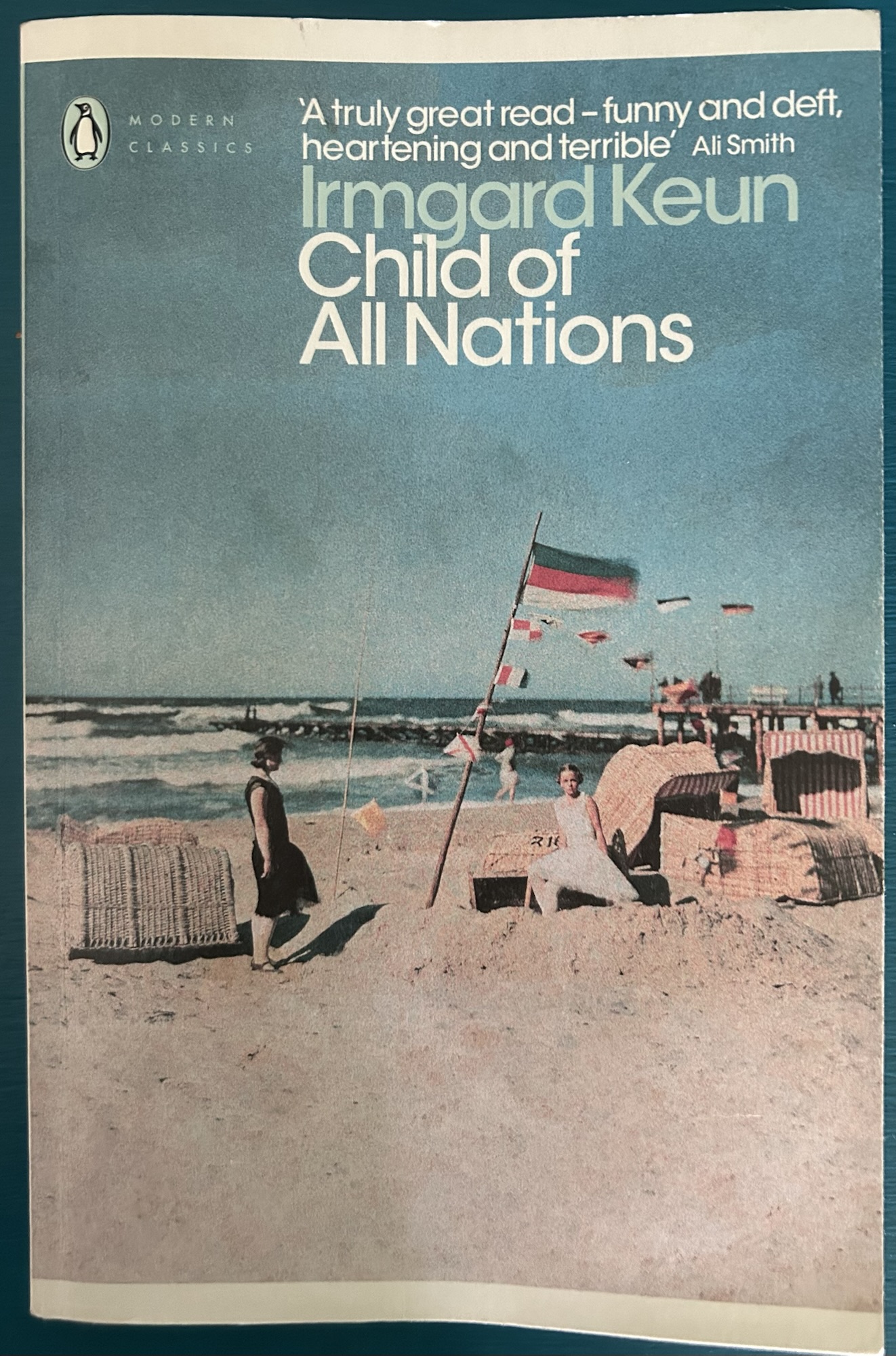
Child of All Nations – Irmgard Keun (1938 transl. Michael Hofmann 2008) 183 pages

I’m sticking with a child’s perspective with today’s novella, by an author I’ve been meaning to read for so long. Child of All Nations by Irmgard Keun is told from the point of view of nine-year-old Kully as she and her parents ricochet around immediate pre-war Europe.

“We left Germany when my father couldn’t stand it anymore, because he writes books and articles for newspapers. We emigrated to find freedom. We’re never going to go back to Germany. Anyway, we don’t need to, because the world is a very big place.”

There’s no doubt that Kully’s father is an important and talented writer, as we see from the responses he gets from other adults. However, he is also self-centred, feckless, and disregards his wife and child to the point of cruelty.

“Sometimes my father loves us, and sometimes he doesn’t. When he doesn’t, we can’t do anything about it, my mother and me. Nothing is any good when he doesn’t love us. Then we’re not allowed to cry in his presence or laugh, mustn’t give him anything, or take anything from him either. Any steps we might take only have the effect of delaying even more the time when he will love us again. Because he always comes back to us.”

From my twenty-first century perspective, they’d be better off without this man and his relentless need for the stimulation of the new, spendthrift ways and constant affairs with other women.

“I look a lot like my mother, only she has bluer eyes than me, and bigger legs, and she’s bigger all round. She wears her hair combed back, and in a knot at the back of her head. My hair is short and unruly. My mother’s much prettier than I am, but I don’t cry so much.”

However, the child’s perspective is so clever in the characterisation of the father, because he is never demonised. Thus, trailing round various countries; being abandoned as surety in various hotels and restaurants; and dragged into his schemes to get loans on promises of work which never appears; are not judged, because Kully just accepts things as they are.

He is also complicated in that his uselessness with money comes from a total material disregard. So while he gambles and drinks away their money, he also gives a lot of it away to people in a worse position than he is. This behaviour, and his writing, shows a compassion for others which unfortunately doesn’t extend to those closest to him.

My father often tells fibs to get a bit of peace and quiet… Sometimes, though, he performs miracles and everything he says comes true.”

What Keun also does well is presenting Kully’s voice directly, so that while it is unmediated and so distinct, adult readers are still able to pick out where she echoing what adults have said to her:

“We only eat once a day, because that’s cheaper, and it’s perfectly adequate. I’m always hungry anyway, even if I eat seven times a day.”

You just know that an adult, most likely her father, has told her that one meal is “perfectly adequate”.

Written in 1938, the shadow of war looms large. Unsurprisingly, Kully only just grasps some of it and her naivete is heartbreaking:

“I’m not afraid, because I’ve got my mother with me, the waiter who brings us our breakfast in the morning has said he’s not afraid either, and there isn’t going to be any war. And if there is, and we’re put in a camp, then he will continue to bring us our meals.”

What is apparent to the reader now, too, is that some of the countries Kully’s family head to as places of safety are not going to remain as such.

There’s a heartbreaking scene where just briefly, Kully’s mother gets what she wants: a small place with a kitchen where she can cook her own food. But inevitably, Kully’s father is bored within days and it is all taken away again.

What Kully recognises, which her father fails to understand, is that constant movement does not automatically mean freedom:

“Because we never have any money, we feel imprisoned by any hotel in any city, and from the very first day we think of our liberation.”

Child of All Nations documents an episodic, transitory life and the lack of plot is reflective of this, with the novella form suiting the story well. Kully’s voice was so clear from the first page and she remains resilient and with astonishing equanimity to the end. Knowing that the Europe in which Kully moves was about to change beyond all recognition gives it an extra resonance, and I think Keun already knew this too.

So, my first Keun read was a success, and I’m keen to read more!
Novella a Day in Day 2025: No.19

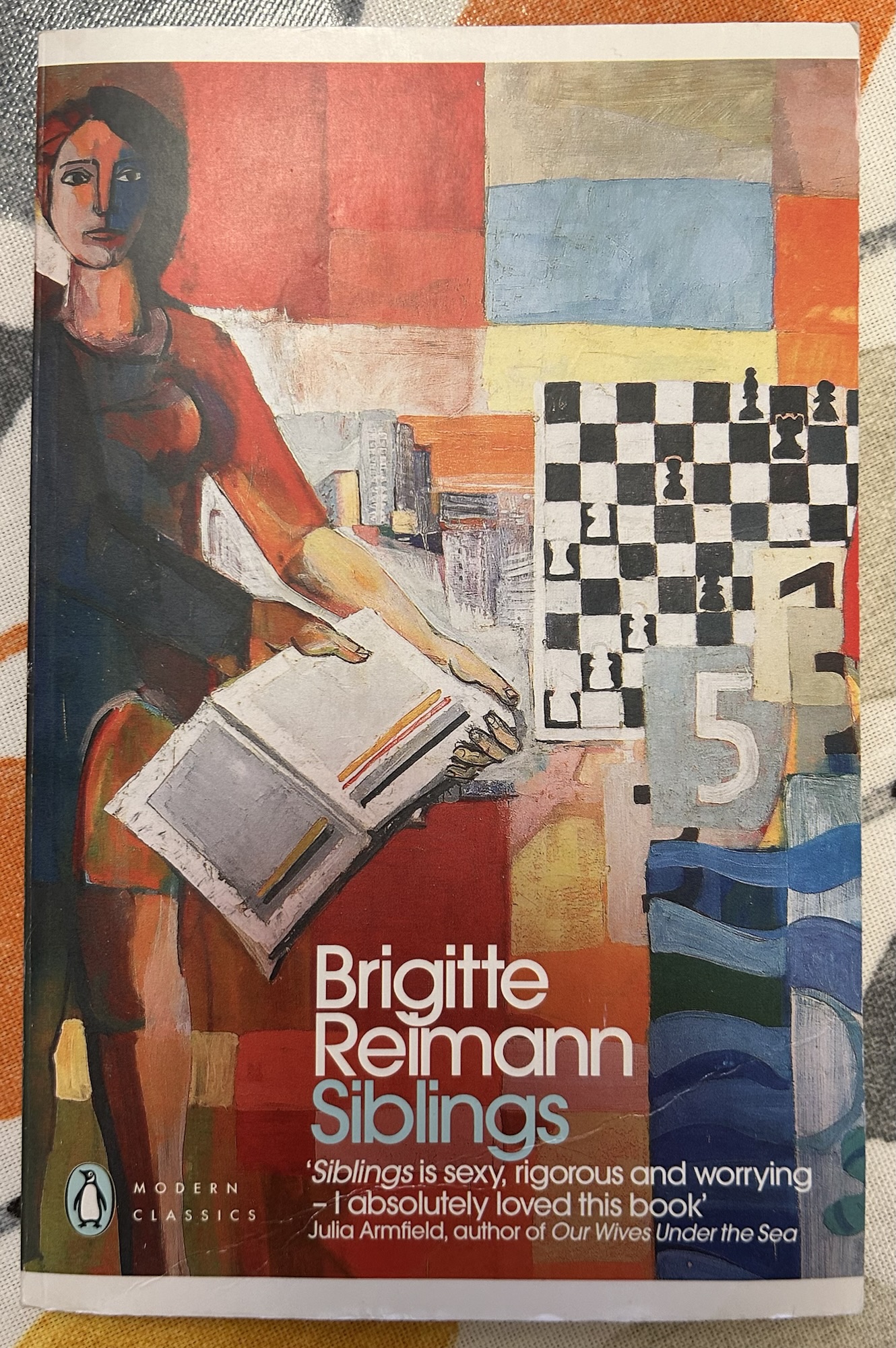
Siblings – Brigitte Reimann (1963, transl. Lucy Jones 2023) 129 pages

Summarising Siblings makes it sound incredibly clunky. A brother and sister living in the GDR find themselves separated ideologically as one of them wants to leave for the West. However, Brigitte Reimann’s writing is so skilled that the relationship between the siblings is rounded. The novella never feels like a construct in order to explore two forms of government in opposition to one another.

We know from the start that there has been some sort of significant betrayal. It opens:

“As I walked to the door, everything in me was spinning.

He said, ‘I won’t forget this.’ He was standing very straight and not moving in the middle of the room. He said in a cold, dry voice, ‘I’ll never forgive you.’”

The story is told from the point of view of Elisabeth (Betsy/Lise) and each chapter opens with the current situation (1960, prior to the Berlin Wall being built) before looking back in time. We learn of her close relationship with her brother Uli.

“I trusted him in every way and was vain enough to think I knew everything or almost everything he thought and planned. But in truth, back then, which was only the day before yesterday, I didn’t have a clue about the person closest to me.”

They are young people from a previously privileged family (who voted for Hitler), although they no longer have access to their industrialist family’s assets or wealth. Elisabeth is an artist and has a job working in an industrial plant painting the workers and teaching, which she enjoys despite the frustrations of dealing with colleagues and pressures from the Stasi.

“As soon as I’ve warmed myself in the lap of my family for a few days, I feel homesick for its adventurous, daring atmosphere; and for the sight of the huge, white and yellow excavators; for the mountains of sand blown haphazardly by the wind, under which lies the dark brown, damp coal seam; and for the drivers up in their peaceful cabins, shields lowered, patiently shovelling tonnes of earth…”

Uli is an engineer but he is unable to get a job due to being blacklisted by association with a professor who defected, despite him knowing nothing about the defection. Unlike Elisabeth and her boyfriend Joachim who works for the Party, Uli struggles with the immense bureaucracy and lack of choices he has in the GDR.

The siblings’ brother Konrad went to the West with his wife, and Elisabeth sees this as a huge betrayal, despising the materialism she feels drove the decision.  He was part of Hitler Youth, while Elisabeth and Uli were both small children during the war. Hence her feelings about the West and her immediate family are bound up with and complicated by Germany’s recent past.

A further complication is that Elisabeth and Uli have stayed close throughout their lives and she describes Uli romantically, dwelling on his handsomeness and appealing qualities more than on those of Joachim. I found her response in this way to her brother odd and unnerving, but I don’t know if that is a cultural difference or a deliberate decision by Reimann to make the siblings’ bond overly intense.

Uli tries to explain to Elisabeth the difference between him and Konrad; why he needs to leave, despite still believing in socialism:

“‘Before I’m ground to pieces here,’ he added, not quite as loudly, not quite as confidently. ‘I’ll always stand up for the public ownership of industry over there.’

‘Even in your shipyard?’

‘Even in my shipyard.’ He paused then smiled uncertainly.

‘How come your shipyard?’ I said quickly. ‘You’ll have to stop using communist phrases, you know.’”

Having Uli still believe in the system of government but finding himself unable to live under it complicates the opposing views of the siblings and exposes the layers of experiences which can lead to vastly different life decisions.

Another clever decision is to not paint the GDR as a bleak wasteland. As well as Elisabeth’s romantic view of the plant, the natural environment is beautifully evoked:

“The morning sun had moved on, and the sky stood flat and pale blue above the trees lining the avenue; from the kitchen window, above the cottages, I could see stables and small courtyards nestling closely together in this bucolic area of town. Raindrops sparkled on the walnut tree branches and the tips of its leaves in the slanting sunshine.”

The narrative circles back to end where it began, perhaps indicating the circular nature of the political arguments that neither Uli or Elisabeth will win. By the time we return, the reader is fully aware of the various ambivalent, contradictory bonds which tie Elisabeth and Uli. Siblings is a heartbreaking portrait of how wider political pressures can fracture the closest of relationships, irretrievably.

“‘I can’t explain anything to you,’ he said after a while. ‘Because our views on freedom, among other things, are too far apart.’”

Novella a Day in May 2025: No.10

Marzahn, Mon Amour – Katja Oskamp (2019, transl. Jo Heinrich 2022) 141 pages

Marzahn, Mon Amour is a novella I’d been meaning to read for a while and I’m delighted to have finally got to it. Based on the author’s experience of retraining as a chiropodist in her middle-age, it is essentially a series of character sketches of her clients.

Initially her training is a struggle and she’s unsure of her new career:

“We had reached a low point, at people’s feet, and even there we were failing.”

“From writer to chiropodist – what a spectacular come down. I had forgotten how much people, the looks on their faces and their well-meant advice, got on my nerves.”

But on qualifying she gets a job in a salon in the titular area of Berlin, and begins to find her vocation:

“As always, the weather here in Marzahn, once the biggest expense of plattenbau prefab tower blocks in the former East Germany, seems more intense than in the centre. The seasons have more of a smell about them.”

Her boss is Tiffy “a grandmother, albeit a non-practising one”; Flocke is the chaotic nail technician. The chapters take the names of her clients, and Oskamp expertly captures a sense of the person in very few words:

Herr Paulke: “whenever I laughed at something that Herr Paulke said in his matter-of-fact way, emotion almost imperceptibly flashed across his face, a mix of incredulity, pride and shame. He was no longer used to anyone paying him any attention.”

The Mon Amour affection the author feels for her clients shines through. Often these are elderly people, disregarded by society, and Oskamp gets to know them over a period of months and even years. The act of caring for their feet is intimate, especially for those who may now be alone and not have much gentleness in their lives.

They all have stories to tell, such as Gerlinde Bonkat, who arrived as a refugee:

“She formulates crystal clear, quotable sentences and speaks an accentless German, with a faintly Nordic hint to its melody.”

Which isn’t to say Oskamp likes all her clients. Herr Pietsch is a former government worker who fails to realise his days of power are over: “All your life you’ve mistaken your position for your personality.” And there’s a disturbing portrait of a mother and daughter who visit where there is a query of elder abuse.

But generally Marzahn, Mon Amour is a gentle read.

“Frau Frenzel is seventy years old. She views the world with a cheerful contempt and won’t let anything or anyone spoil her mood. She reminds me of a hedgehog, with her nose perkily pointing upwards, lively button eyes and grey spiked mullet straight out of the 80s […] Amy, with whom Frau Frenzel shares her life, is a short haired dachshund.”

A lovely read and a wonderful tribute to the writer’s clients.

Blog Tour: Nightingale & Co by Charlotte Printz (2023, transl. Marina Sofia 2024)

I do enjoy a cosy crime novel, and one with a 1960s Berlin setting ticked so many boxes I jumped at the chance to take part in this blog tour from the ever-wonderful Corylus Books.  I hope they carry on asking me to take part in these tours even though I feel like my posts for their books are getting very formulaic: “I loved it! I want more translations!” Take a guess as to whether this one will be any different… 😉

Nightingale & Co. is the first in a series written by Charlotte Printz and translated by a blogger many of you know, Marina Sofia. Here is the blurb from Corylus Books:

“Berlin, August 1961.

Since the death of her beloved father, Carla has been running the Nightingale & Co detective agency by herself. It’s a far from easy job for a female investigator.

When the chaotic, fun-loving Wallie shows up at the door, claiming to be her half-sister, Carla’s world is turned upside down. Wallie needs Carla – the Berlin Wall has been built overnight, leaving her unable to return to her flat in East Berlin.

Carla certainly doesn’t need Wallie, with her secret double life and unorthodox methods for getting results. Yet the mismatched pair must find a way to work together when one of their clients is accused of murdering her husband.

Nightingale & Co is the first in a cosy historical crime series featuring the sisters of the Nightingale & Co detective agency in 1960s Berlin.”

The story gets off to a fun, engaging start. Carla receives a call from her aunt Lulu telling her she’s waving an airgun on the set of the Billy Wilder film One, Two, Three, seemingly in a deeply flawed attempt to secure a role. As Carla sets off across Berlin at pace, the 1960s city is evoked organically, without seeming like an info-dump.

This trailer for the film includes some external shots:

Yet despite the joy of these opening scenes, we are quickly shown the psychological impact of living in Berlin as the Wall goes up:

“‘They’re building a wall,’ said Lulu. The words were like a punch to her stomach. Carla felt faint. Ulbricht had lied to them. That was why there were so many guards at the Brandenburg Gate yesterday. How naïve of them to believe it was merely for the film set.”

Carla lives with her mother in the same building that houses the agency her father built. The domestic scenes with her bitter, passive-aggressive, baiting parent were so well-realised. Printz really captured the psychological warfare that people can tie themselves into, unable to see an escape route however desperately they want one. Carla is also grieving her father, who died in the crash which left her with enduring head injury symptoms.

When her half-sister Wallie arrives having been cut off from her home in the East by the rapid installation of the Wall, she couldn’t be more different. Physically Carla is compared to Audrey Hepburn, Wallie to Marilyn Monroe. Wallie gives free rein to all her appetites and doesn’t mind dubious means to achieve her ends, while Carla is controlled and keen to remain above reproach. Carla’s mother is entirely charmed by Wallie, although she believes her to be a cousin of her dead husband.

In less skilled hands the contrasting sisters could seem cliched and merely vehicles for dramatic tension. But both Carla and Wallie were entirely believable and well-rounded. The tensions between them arising from Carla not knowing about Wallie’s existence until she turns up on the doorstep, and what this means for her memories of her father, was lightened by their very different attitudes. Their growing but begrudging respect for one another as they find themselves an effective team made them an endearing pair.

The central strand of the story concerns Alma, a beautiful rich woman who asks the agency for help due to her husband’s domestic violence. Carla is sympathetic but realistic about Alma’s options:

“I’m afraid that’s no motive for divorce. A man who beats his wife is regarded by the courts as quick tempered and they usually advise the wife not to annoy him.”

The 1960s are a time of change but some changes aren’t occurring quickly enough. (I was reminded this week that it wasn’t until 1975 that women in Britain were allowed their own mortgage!)

When Alma’s husband is killed and her subsequent behaviour leads to her arrest, the sisters investigate. The plot is satisfyingly complex without being overly convoluted and frustrating.

The shadows of the war, less than twenty years previous, still loom large and Printz manages to capture how the fallout is interwoven with the modernising present.

 “Hadn’t they learnt anything from the past? It wasn’t enough to just stand there and repeat slogans. Everyone had to contribute.”

It’s hard to judge a translation when you don’t speak both languages, but I was struck by how Marina Sofia managed a sensitive balance in providing an English translation that flowed so well, yet also kept sense of place and contributed to Berlin being evoked so clearly in my mind. The significances of formal/informal address were conveyed without any clunkiness.

What I really enjoyed in Nightingale & Co was the mix of compassion and cynicism displayed by both the sisters in their different ways. It made them, and the story, humane without being sentimental, hopeful in the face of horrors.

“In the end, that was all that anyone wanted: forgiveness. And to be loved. Which made everyone predictable.”

So in summary: I loved it! I want more translations!

Here are the rest of the stops on the tour, do check out how other bloggers found Nightingale & Co:

“I have looked for life, but I can’t find it.” (Vicki Baum, Grand Hotel)

November is the month of sooooo many reading events, and I’m hoping to take part in Margaret Atwood Reading Month and Novellas in November, but I thought I’d start with German Literature Month XIV, hosted by Caroline at Beauty is a Sleeping Cat and Lizzy Siddal at Lizzy’s Literary Life.

Grand Hotel by Vicki Baum (1929, transl. Basil Creighton 1930-1 revised by Margot Bettauer Dembo 2016) is a novel I’ve been meaning to get to for some time, republished by the wonderful New York Review of Books Classics.

I find a Weimar Republic setting always so enticing, and this novel was a bestseller in it’s day, originally serialised in a magazine. Sometimes with serials you can really see the joins when they are placed in novel form, but the episodic nature of hotel stays by various guests works well and Grand Hotel felt entirely coherent.

The titular building is opulent and glamorous:

“The music of the jazz band from the Tearoom encountered that of the violins from the Winter Garden, and mingled with the thin murmur of the illuminated fountain as it fell into its imitation Venetian basin, the ring of glasses on tables, the creaking of wicker chairs and, lastly, the soft rustle of the furs and silks in which women were moving to and fro.”

As readers we know that momentum for World War Two is building, but for the guests at this time it is the shadow of World War I which still looms large. Doctor Otternschlag’s face has been severely damaged by a shell. Every day he asks if a letter has arrived for him which it never has. We don’t know what this quiet, traumatised man is waiting for.

“Doctor Otternschlag lived in the utmost loneliness – although the earth is full of people like him…”

Glamour is brought by Grusinskaya, a prima ballerina desperately trying to hang on to physical vigour against the forces of aging. She is somewhat ambivalent, feeling driven to be as she has always been, and exhausted by it all:

“Perhaps the world would have loved her as she really was, as she looked now, for example, sitting in her dressing room – a poor, delicate, tired old woman with worn out eyes, and a small careworn human face.”

The most pathos occurs in the guest who doesn’t fit in: Kringelein, a clerk from Fredersdorf, given a terminal prognosis and determined to squeeze the pips from life before it’s too late. He chooses the Grand Hotel as his boss, Herr Preysing, stays there when in Berlin.

“He felt again, here in the bar of Berlin’s most expensive hotel, the same intoxication, a sense of exuberant plenty as well as of anxiety and alarm, the faint threat haunting the wicked joy of wrongdoing, the excitement of an escapade.”

Kringlein’s difficulty is, he is unsure of how to achieve his somewhat nebulous aim. Doctor Otternschlag tries to help but fails, unsurprising given his jaded, damaged view of the world. More successful is gentleman thief Gaigern, a dashing young nobleman who charms everyone:

“I am quite without character an unspeakably inquisitive. I can’t live an orderly life and I’m good for nothing. At home I learned to ride and play the gentleman. At school, to say my prayers and lie. In the war, to shoot and take cover. And beyond that I can do nothing. I am a gypsy, an outsider, an adventurer.”

He kits out Kringelein in fine clothes and takes him for fast drives in cars and up in a plane, but what are his motives? As Kringelein throws his hard-earned but limited money around, what will Gaigern do?

“Human kindness and warmth was so much a part of his nature that his victims always received their due share of them.”

Baum weaves together these disparate lives expertly, as they bump against each other within the Grand Hotel to a greater or lesser extent. There are overarching plots that draw characters together but Baum demonstrates that while hotels are places where change may occur, they do not lend themselves to resolution so easily. Hotels are by nature transitory and lives must be continued, consequences dealt with, once the guests pass through the revolving doors and back into the world.

Perhaps there is no such thing as a whole, completed destiny in the world, but only approximations, beginnings that come to no conclusion or conclusions that have no beginnings.

The tone is so well-balanced, with moments of light humour, almost slapstick, alongside darker elements. I did feel a constant undercurrent of sadness, but this highlighted the resilience of the characters who keep on keeping on during this interwar period, rather than being depressing.

Grand Hotel provides a compelling evocation of the Weimar era too, with glamour, seediness, riches and poverty all bound together in a vibrant, intoxicating, overwhelming Berlin. I’m so pleased to have finally read this novel.

“The room had taken on that utterly strange and enchanted appearance often encountered in hotel bedrooms.”

Grand Hotel was adapted by Hollywood in 1932, which despite my love of Garbo I’ve never seen. Time to remedy the situation!

Novella a Day in May 2022 No.2

The Mussel Feast – Birgit Vanderbeke (1990 trans. Jamie Bulloch 2013 Peirene) 105 pages

Trigger warning: discussion of domestic violence

Peirene Press are one of my favourite publishers, with a focus on European contemporary novellas which so far have given me some wonderful reading experiences. The Mussel Feast is no exception, as it carefully and precisely builds a picture of a family tyrannised by the father, over the course of one evening.

Narrated by the teenage daughter of the family as she prepares the titular celebratory meal alongside her mother and brother, they await the return of their father who has bagged a promotion. The daughter doesn’t much like mussels, but it is how the family traditionally celebrates.

“Anyway, the noise came from the pot and as I glanced over I couldn’t help looking at the clock, too: it said three minutes past six. And at that moment my mood changed abruptly. I stared at the noisy pot […] it was a distinctly strange noise, which made me feel creepy; we were already twitchy and nervous, and now there was this noise.”

The father is late back, and the narrator reflects on what is happening that evening and on what has gone before:

“He couldn’t stand my mother’s knackered face, and so she switched to her after-work face, which she would paint on quickly in the bathroom at half-past five, before my father came home. But this after-work face only lasted for an hour and needed reapplying.”

Everyone in the family remains unnamed, fitting with thesense that they are all trying to fulfil a role for the father and that who they actually are is of secondary importance:

“We all had to switch for my father, to become a proper family as he called it, because he hadn’t had a family, but he had developed the most detailed notion of what a proper family should be like, and he could be extremely sensitive if you undermined these notions.”

The father is a deeply inadequate man, ashamed of his past in the GDR, and trying to convince his family of his superiority. His children don’t conform to gender stereotypes which annoys him. His wife isn’t pretty enough by his standards. The fact that he squanders their money and is fairly useless all round, is by-the-by:

“My mother earned money and did menial work, boiling the nappies in a huge pot, and cooking and shopping and children, all of which drove him nuts; my father was not cut out for such trivial jobs , and back then we would have frozen if my mother hadn’t lugged sacks of coal.”

By the time the following passage came I already had a clear idea of what was going on in this family, but I still found the matter-of-fact tone in describing such abuse truly shocking:

“He was extremely assured in his taste; he didn’t like his taste being questioned. I couldn’t bear the wall unit, as I told them that evening, due to my head having been smashed against it on a number of occasions.”

The tension in the novella builds expertly as, like the family, we wait for the father to return. The ending is ambiguous, but we know there are huge ramifications, because at the start of the novella the narrator tells us:

“what came in the wake of our abortive feast was so monumental that none of us have got over it yet”

Birgit Vanderbeke wrote this just before the fall of the Berlin Wall because “I wanted to understand how revolutions start.” In The Mussel Feast, it is a long time coming and also a matter of a few moments:

“Suddenly I no longer wanted him to come home, […] Mum looked at me, not as horrified as I’d expected, but with her head to one side, and then she smiled and said, well, we’ll see, and she didn’t sound as if she’d find it surprising or even terrible if he didn’t come home.”

The Mussel Feast has become a set text in Germany and deservedly so – the domestic setting is completely compelling but also has wider resonance which it carries lightly, the metaphorical never undermining the portrayal of abuse.

Novella a Day in May 2019 #1

Portrait of the Mother as a Young Woman – Friedrich Christian Delius (2006, trans. Jamie Bulloch 2010) 125 pages

Dear Reader, I’ve been somewhat absent from the blogosphere recently and I’ve really missed it. This was because at the end of March I decided on the spur of the moment to apply for a PhD which caught my eye. I had no plans for further study and so this meant April was spent in whirlwind of desperately trying to get my reading up to date, meeting with old tutors to remind them who on earth I am and begging for a reference, and then writing my application. The deadline is this Friday but I’ve now submitted my application and I’m hoping I might regain my sanity in the meantime. I don’t think I’ll get it, but my tutors have been really supportive and its good to shake things up now and again.

Aaaaaaannnnyway, I really enjoyed blogging on a novella a day in May last year, so I’m throwing myself back into it this year. I had such plans…. NADIM this year was going to be carefully thought through, with a good spread of countries (last year I ignored the southern hemisphere completely and lovely Naomi pointed out I’d also skipped Canada) and a wonderful balance of styles and subjects… yeah, that’s not happening. Instead this month (and I really hope to make it to the end) will be hastily cobbled together posts which completely fail to do the wonderful form of the novella any justice at all. But I still hope I manage to spread some novella love along the way 😊

I thought it apt to start with one from a publishing house that has done so much to champion the form: Peirene Press, who specialise in publishing contemporary European novellas, aimed to be read in one sitting. I’m a big fan of theirs and so I swooped down on Portrait of the Mother as a Young Woman when I saw it in my favourite charity bookshop.

Portrait of the Mother as a Young Woman is set over the course of one afternoon in Rome in 1943. Margherita is 19 years old, pregnant and alone as her husband is serving in the German army in Tunisia. She feels alien in a city where she doesn’t speak the language, and she is walking to a Bach concert at the Lutheran church.

“the immense city of Rome, still seemed to her like

a sea which she had to cross, checked by the fear of all things unknown, of the yawning depths of this city, its double and triple floors and layers, of the many thousand similar columns, towers, domes, facades, ruins and street corners, of endless number of pilgrimage sites for cultured visitors, which she walked past in ignorance, and of the faces of people in the streets, which were difficult to make out, in these stormy times of a far-off war which was drawing nearer every day”

And now, bear with me as I break something to you which you may have gathered from the quote above, which sounds awful but I promise it isn’t: the entire novella is one sentence. Wait, come back! It’s ok, really. Trust me 😉

There are paragraphs which make the whole thing easier, and Delius, possibly because he is a poet, has a great ear for rhythm. This means the sentence, broken by commas, works well in capturing the sense of someone walking, their thoughts falling into the pattern of their steps. I thought it was really effective and such an impressive feat of translation by Jamie Bulloch too.

“for two months she had crossed the Tiber almost every day via the Ponte Margherita, as if that were totally normal, but nothing was totally normal, especially not in these times, each day was a gift, each of the child’s movements in her belly a gift, each verse from the Bible and each glance across the Tiber”

Throughout her journey across the city, we learn about Margherita’s life in Germany and her new marriage. She is religious – daughter of and wife to clergymen – but not given to much reflection, preferring to stay silent in political discussions. Her husband and father are somewhat sceptical of the Reich, but Hitler has been in power throughout Margherita’s childhood and adolescence, she was part of the League of German Girls and it is only now, away from home, that she finds herself beginning to feel confused.

“On her own she could not work out what you were allowed and not allowed to say, what you should think and what you ought not to think, and how to cope with her ambivalent feelings”

Even though nothing of great note happens in the course of the novel, there is still an effective and believable character arc. Cut adrift, Margherita is beginning to learn who she is. There is a sense that this naïve, unquestioning woman is potentially quite steely, and as readers we know she will need that in the months and years to come.

 “She sensed something within her rebelling against the constant obligation to stifle the feeling of longing with her reason and her faith, because feelings were forbidden in wartime, you were not allowed to rejoice with happiness, you had to swallow your sadness, and like a soldier you were forced to conceal the language of the heart”

Novella a Day in May #1

For a while now I’ve been enamoured of the novella. I enjoy sparse writing styles (not so good at this myself 😉) and at its best a novella gives us a narrative distilled to its essence for maximum impact. To spread novella love I’ve decided to post about a novella each day for the whole month. There’s no fixed definition of a novella so for my purposes I’ve decided its longer than 70 pages and shorter than 200. This will definitely work! It won’t peter out and die in a heap by 5 May at all! Onwards…

The Game of Cards – Adolf Schroder (trans. Andrew Brown, 2008) 143 pages

The Game of Cards  is not ostensibly gothic or a thriller, and yet it is both these things. The story of how student Markus Hauser is employed by Selma Bruhns for a week to put several trunks worth of letters into chronological order is truly creepy and suspense-filled.

Selma is a terse, uncommunicative employer, who lives in an old house with a vast number of cats at varying stages of disease. Markus is constantly at the point of leaving, unable to stomach the “stench” of the house, the feral occupants, his awkward employer and the seemingly pointless nature of his repetitive task:

“He squatted down between the piles of letters lying on the floor, but when her resumed his work…looking for the pile in which he was putting the letters from 1943, laying the pages of the letter on it and reaching out for the next one, he paused, as if he’d only just realised that he had absolutely no idea what he was doing”

Gradually however, Markus is drawn into the letters, all written to a woman named Almut.  Very little is given away, but Markus finds himself compelled to continue, without really understanding why.

 “Words from the letters that he had read came alive. He found himself in streets where he had never been, heard the shrieking and whistling of creatures that he could not see but whose presence he surmised, felt on his skin the burning sun whose strength he had never yet felt, saw a woman coming up to him who spoke in a language that he did not understand.”

This chronology is interspersed with the investigation being conducted by Superintendent Berger, who suspects Markus of having strangled Selma with her own scarf on his last day of work. Thus we are drawn into not only the mystery of who Almut is and why Selma is obsessively writing to her, but also who killed Selma and why. Schroder jumps between the two timelines without preamble and so the reader is drawn into the disorienting, imperfectly understood situation of the all the characters.

 “With a sudden move that took Markus by surprise, she threw the animal towards him, it crashed into his chest, and only because Markus reacted quickly and caught the animal could he prevent I from falling onto the ground.

‘You are working slowly and without much concentration,’ said Selma Bruhns, turning round and stepping into the house.”

There is also the question of what happened – and what the stake was – in the titular match between Markus and Selma…

The Game of Cards is a deeply disturbing read, and a powerful portrait of enduring psychological trauma. It will stay with me for a long time.