Novella a Day in May 2025: No.22

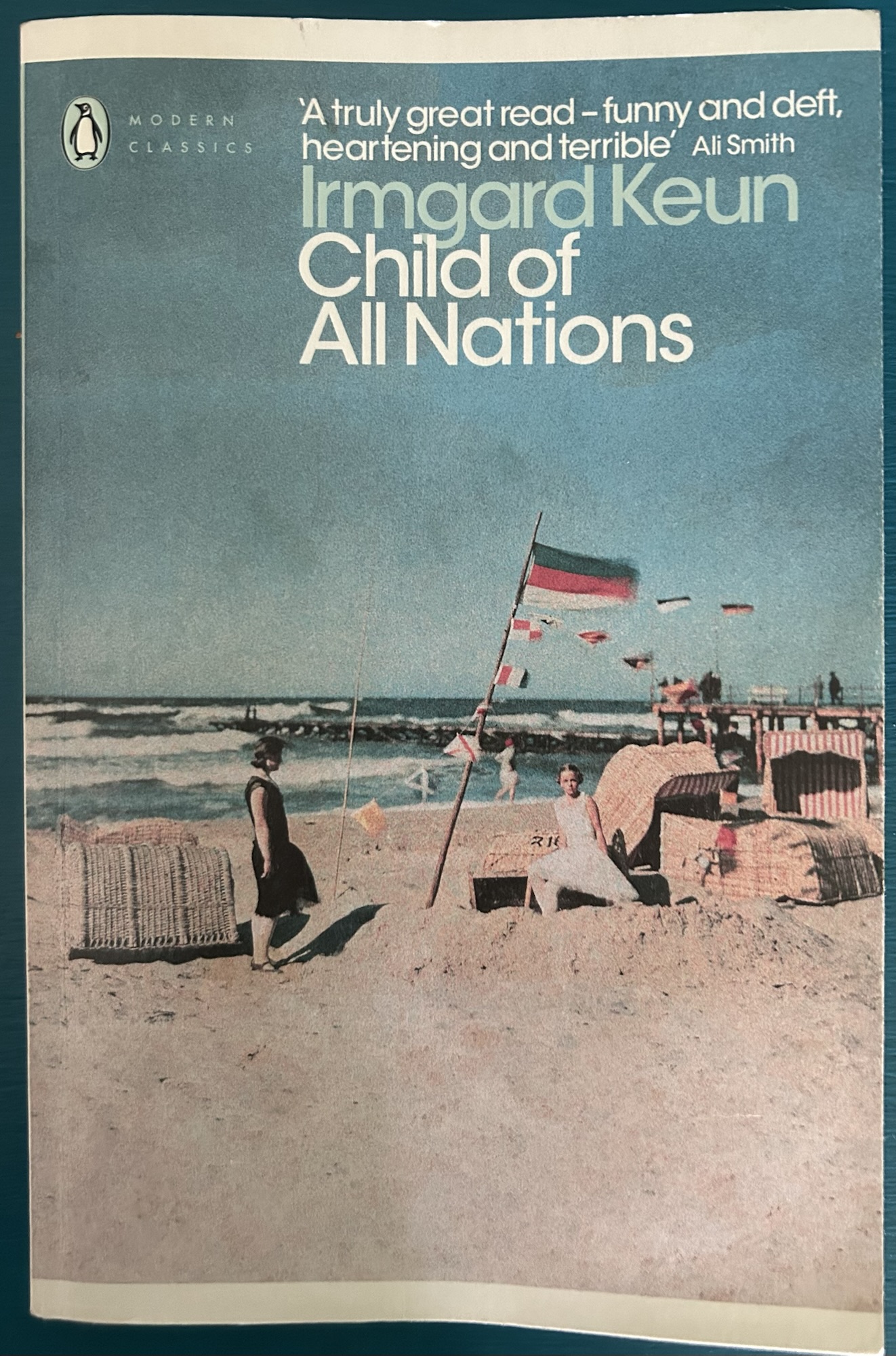
Child of All Nations – Irmgard Keun (1938 transl. Michael Hofmann 2008) 183 pages

I’m sticking with a child’s perspective with today’s novella, by an author I’ve been meaning to read for so long. Child of All Nations by Irmgard Keun is told from the point of view of nine-year-old Kully as she and her parents ricochet around immediate pre-war Europe.

“We left Germany when my father couldn’t stand it anymore, because he writes books and articles for newspapers. We emigrated to find freedom. We’re never going to go back to Germany. Anyway, we don’t need to, because the world is a very big place.”

There’s no doubt that Kully’s father is an important and talented writer, as we see from the responses he gets from other adults. However, he is also self-centred, feckless, and disregards his wife and child to the point of cruelty.

“Sometimes my father loves us, and sometimes he doesn’t. When he doesn’t, we can’t do anything about it, my mother and me. Nothing is any good when he doesn’t love us. Then we’re not allowed to cry in his presence or laugh, mustn’t give him anything, or take anything from him either. Any steps we might take only have the effect of delaying even more the time when he will love us again. Because he always comes back to us.”

From my twenty-first century perspective, they’d be better off without this man and his relentless need for the stimulation of the new, spendthrift ways and constant affairs with other women.

“I look a lot like my mother, only she has bluer eyes than me, and bigger legs, and she’s bigger all round. She wears her hair combed back, and in a knot at the back of her head. My hair is short and unruly. My mother’s much prettier than I am, but I don’t cry so much.”

However, the child’s perspective is so clever in the characterisation of the father, because he is never demonised. Thus, trailing round various countries; being abandoned as surety in various hotels and restaurants; and dragged into his schemes to get loans on promises of work which never appears; are not judged, because Kully just accepts things as they are.

He is also complicated in that his uselessness with money comes from a total material disregard. So while he gambles and drinks away their money, he also gives a lot of it away to people in a worse position than he is. This behaviour, and his writing, shows a compassion for others which unfortunately doesn’t extend to those closest to him.

My father often tells fibs to get a bit of peace and quiet… Sometimes, though, he performs miracles and everything he says comes true.”

What Keun also does well is presenting Kully’s voice directly, so that while it is unmediated and so distinct, adult readers are still able to pick out where she echoing what adults have said to her:

“We only eat once a day, because that’s cheaper, and it’s perfectly adequate. I’m always hungry anyway, even if I eat seven times a day.”

You just know that an adult, most likely her father, has told her that one meal is “perfectly adequate”.

Written in 1938, the shadow of war looms large. Unsurprisingly, Kully only just grasps some of it and her naivete is heartbreaking:

“I’m not afraid, because I’ve got my mother with me, the waiter who brings us our breakfast in the morning has said he’s not afraid either, and there isn’t going to be any war. And if there is, and we’re put in a camp, then he will continue to bring us our meals.”

What is apparent to the reader now, too, is that some of the countries Kully’s family head to as places of safety are not going to remain as such.

There’s a heartbreaking scene where just briefly, Kully’s mother gets what she wants: a small place with a kitchen where she can cook her own food. But inevitably, Kully’s father is bored within days and it is all taken away again.

What Kully recognises, which her father fails to understand, is that constant movement does not automatically mean freedom:

“Because we never have any money, we feel imprisoned by any hotel in any city, and from the very first day we think of our liberation.”

Child of All Nations documents an episodic, transitory life and the lack of plot is reflective of this, with the novella form suiting the story well. Kully’s voice was so clear from the first page and she remains resilient and with astonishing equanimity to the end. Knowing that the Europe in which Kully moves was about to change beyond all recognition gives it an extra resonance, and I think Keun already knew this too.

So, my first Keun read was a success, and I’m keen to read more!
Novella a Day in Day 2025: No.19

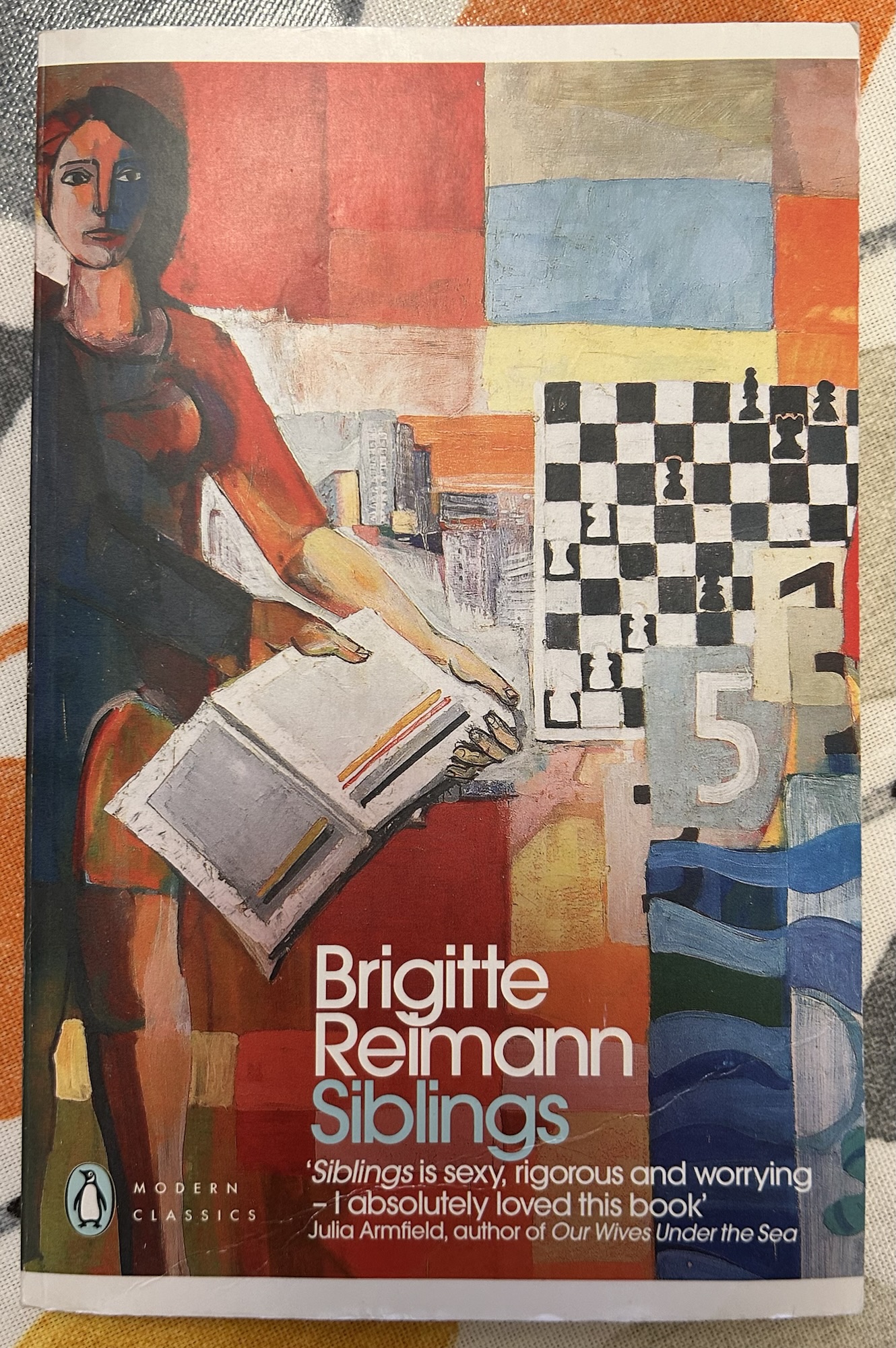
Siblings – Brigitte Reimann (1963, transl. Lucy Jones 2023) 129 pages

Summarising Siblings makes it sound incredibly clunky. A brother and sister living in the GDR find themselves separated ideologically as one of them wants to leave for the West. However, Brigitte Reimann’s writing is so skilled that the relationship between the siblings is rounded. The novella never feels like a construct in order to explore two forms of government in opposition to one another.

We know from the start that there has been some sort of significant betrayal. It opens:

“As I walked to the door, everything in me was spinning.

He said, ‘I won’t forget this.’ He was standing very straight and not moving in the middle of the room. He said in a cold, dry voice, ‘I’ll never forgive you.’”

The story is told from the point of view of Elisabeth (Betsy/Lise) and each chapter opens with the current situation (1960, prior to the Berlin Wall being built) before looking back in time. We learn of her close relationship with her brother Uli.

“I trusted him in every way and was vain enough to think I knew everything or almost everything he thought and planned. But in truth, back then, which was only the day before yesterday, I didn’t have a clue about the person closest to me.”

They are young people from a previously privileged family (who voted for Hitler), although they no longer have access to their industrialist family’s assets or wealth. Elisabeth is an artist and has a job working in an industrial plant painting the workers and teaching, which she enjoys despite the frustrations of dealing with colleagues and pressures from the Stasi.

“As soon as I’ve warmed myself in the lap of my family for a few days, I feel homesick for its adventurous, daring atmosphere; and for the sight of the huge, white and yellow excavators; for the mountains of sand blown haphazardly by the wind, under which lies the dark brown, damp coal seam; and for the drivers up in their peaceful cabins, shields lowered, patiently shovelling tonnes of earth…”

Uli is an engineer but he is unable to get a job due to being blacklisted by association with a professor who defected, despite him knowing nothing about the defection. Unlike Elisabeth and her boyfriend Joachim who works for the Party, Uli struggles with the immense bureaucracy and lack of choices he has in the GDR.

The siblings’ brother Konrad went to the West with his wife, and Elisabeth sees this as a huge betrayal, despising the materialism she feels drove the decision.  He was part of Hitler Youth, while Elisabeth and Uli were both small children during the war. Hence her feelings about the West and her immediate family are bound up with and complicated by Germany’s recent past.

A further complication is that Elisabeth and Uli have stayed close throughout their lives and she describes Uli romantically, dwelling on his handsomeness and appealing qualities more than on those of Joachim. I found her response in this way to her brother odd and unnerving, but I don’t know if that is a cultural difference or a deliberate decision by Reimann to make the siblings’ bond overly intense.

Uli tries to explain to Elisabeth the difference between him and Konrad; why he needs to leave, despite still believing in socialism:

“‘Before I’m ground to pieces here,’ he added, not quite as loudly, not quite as confidently. ‘I’ll always stand up for the public ownership of industry over there.’

‘Even in your shipyard?’

‘Even in my shipyard.’ He paused then smiled uncertainly.

‘How come your shipyard?’ I said quickly. ‘You’ll have to stop using communist phrases, you know.’”

Having Uli still believe in the system of government but finding himself unable to live under it complicates the opposing views of the siblings and exposes the layers of experiences which can lead to vastly different life decisions.

Another clever decision is to not paint the GDR as a bleak wasteland. As well as Elisabeth’s romantic view of the plant, the natural environment is beautifully evoked:

“The morning sun had moved on, and the sky stood flat and pale blue above the trees lining the avenue; from the kitchen window, above the cottages, I could see stables and small courtyards nestling closely together in this bucolic area of town. Raindrops sparkled on the walnut tree branches and the tips of its leaves in the slanting sunshine.”

The narrative circles back to end where it began, perhaps indicating the circular nature of the political arguments that neither Uli or Elisabeth will win. By the time we return, the reader is fully aware of the various ambivalent, contradictory bonds which tie Elisabeth and Uli. Siblings is a heartbreaking portrait of how wider political pressures can fracture the closest of relationships, irretrievably.

“‘I can’t explain anything to you,’ he said after a while. ‘Because our views on freedom, among other things, are too far apart.’”

Novella a Day in May 2025: No.10

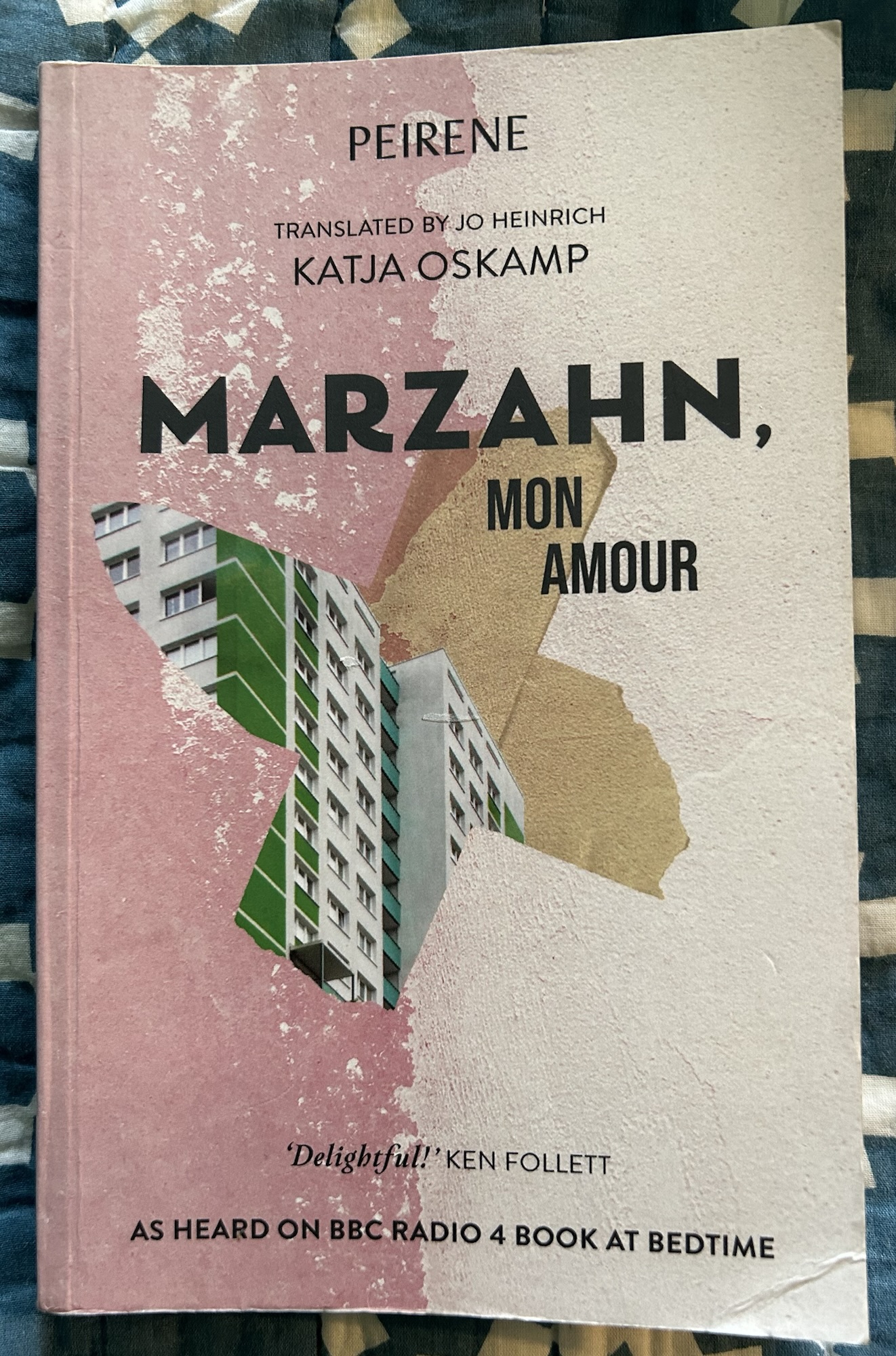
Marzahn, Mon Amour – Katja Oskamp (2019, transl. Jo Heinrich 2022) 141 pages

Marzahn, Mon Amour is a novella I’d been meaning to read for a while and I’m delighted to have finally got to it. Based on the author’s experience of retraining as a chiropodist in her middle-age, it is essentially a series of character sketches of her clients.

Initially her training is a struggle and she’s unsure of her new career:

“We had reached a low point, at people’s feet, and even there we were failing.”

“From writer to chiropodist – what a spectacular come down. I had forgotten how much people, the looks on their faces and their well-meant advice, got on my nerves.”

But on qualifying she gets a job in a salon in the titular area of Berlin, and begins to find her vocation:

“As always, the weather here in Marzahn, once the biggest expense of plattenbau prefab tower blocks in the former East Germany, seems more intense than in the centre. The seasons have more of a smell about them.”

Her boss is Tiffy “a grandmother, albeit a non-practising one”; Flocke is the chaotic nail technician. The chapters take the names of her clients, and Oskamp expertly captures a sense of the person in very few words:

Herr Paulke: “whenever I laughed at something that Herr Paulke said in his matter-of-fact way, emotion almost imperceptibly flashed across his face, a mix of incredulity, pride and shame. He was no longer used to anyone paying him any attention.”

The Mon Amour affection the author feels for her clients shines through. Often these are elderly people, disregarded by society, and Oskamp gets to know them over a period of months and even years. The act of caring for their feet is intimate, especially for those who may now be alone and not have much gentleness in their lives.

They all have stories to tell, such as Gerlinde Bonkat, who arrived as a refugee:

“She formulates crystal clear, quotable sentences and speaks an accentless German, with a faintly Nordic hint to its melody.”

Which isn’t to say Oskamp likes all her clients. Herr Pietsch is a former government worker who fails to realise his days of power are over: “All your life you’ve mistaken your position for your personality.” And there’s a disturbing portrait of a mother and daughter who visit where there is a query of elder abuse.

But generally Marzahn, Mon Amour is a gentle read.

“Frau Frenzel is seventy years old. She views the world with a cheerful contempt and won’t let anything or anyone spoil her mood. She reminds me of a hedgehog, with her nose perkily pointing upwards, lively button eyes and grey spiked mullet straight out of the 80s […] Amy, with whom Frau Frenzel shares her life, is a short haired dachshund.”

A lovely read and a wonderful tribute to the writer’s clients.

Novella a Day in May #1

For a while now I’ve been enamoured of the novella. I enjoy sparse writing styles (not so good at this myself 😉) and at its best a novella gives us a narrative distilled to its essence for maximum impact. To spread novella love I’ve decided to post about a novella each day for the whole month. There’s no fixed definition of a novella so for my purposes I’ve decided its longer than 70 pages and shorter than 200. This will definitely work! It won’t peter out and die in a heap by 5 May at all! Onwards…

The Game of Cards – Adolf Schroder (trans. Andrew Brown, 2008) 143 pages

The Game of Cards  is not ostensibly gothic or a thriller, and yet it is both these things. The story of how student Markus Hauser is employed by Selma Bruhns for a week to put several trunks worth of letters into chronological order is truly creepy and suspense-filled.

Selma is a terse, uncommunicative employer, who lives in an old house with a vast number of cats at varying stages of disease. Markus is constantly at the point of leaving, unable to stomach the “stench” of the house, the feral occupants, his awkward employer and the seemingly pointless nature of his repetitive task:

“He squatted down between the piles of letters lying on the floor, but when her resumed his work…looking for the pile in which he was putting the letters from 1943, laying the pages of the letter on it and reaching out for the next one, he paused, as if he’d only just realised that he had absolutely no idea what he was doing”

Gradually however, Markus is drawn into the letters, all written to a woman named Almut.  Very little is given away, but Markus finds himself compelled to continue, without really understanding why.

 “Words from the letters that he had read came alive. He found himself in streets where he had never been, heard the shrieking and whistling of creatures that he could not see but whose presence he surmised, felt on his skin the burning sun whose strength he had never yet felt, saw a woman coming up to him who spoke in a language that he did not understand.”

This chronology is interspersed with the investigation being conducted by Superintendent Berger, who suspects Markus of having strangled Selma with her own scarf on his last day of work. Thus we are drawn into not only the mystery of who Almut is and why Selma is obsessively writing to her, but also who killed Selma and why. Schroder jumps between the two timelines without preamble and so the reader is drawn into the disorienting, imperfectly understood situation of the all the characters.

 “With a sudden move that took Markus by surprise, she threw the animal towards him, it crashed into his chest, and only because Markus reacted quickly and caught the animal could he prevent I from falling onto the ground.

‘You are working slowly and without much concentration,’ said Selma Bruhns, turning round and stepping into the house.”

There is also the question of what happened – and what the stake was – in the titular match between Markus and Selma…

The Game of Cards is a deeply disturbing read, and a powerful portrait of enduring psychological trauma. It will stay with me for a long time.

“A writer is somebody for whom writing is more difficult than it is for other people.” (Thomas Mann)

Well, I’m off to an unbelievably slow start with German Literature Month, hosted by Caroline and Lizzy, given that we’re more than halfway through the month and this is my first post. I’m hoping I’ll get some more posts in before the month is out, but clearly myself and productivity are not friends right now.

A picture of sloths in a pathetic and failed attempt to make my laziness more endearing

Image from here

Firstly, The Glass Bees (Gläserne Bienen, 1957) by Ernst Junger (trans. Louise Bogan & Elizabeth Mayer, NYRB, 2000), which was frankly, completely terrifying. Generally I’m not one for sci-fi/speculative fiction and now I know why, because they scare me silly. Written in the 1950s, the story is set in an undisclosed time and place sometime in future. At the time of publication, my edition tells me it was dismissed as irrelevant. To which I can only respond:

And commend those critics for their optimism. See if you can find any contemporary parallels: a powerful and ruthless business man has developed advanced technology and uses this to assert control of society through media and entertainment. Now I think about it, a more appropriate David Tennant gif would have been:

The tale is narrated by Richard, a war veteran and ambiguous character, who is considering being employed by the Donald Trump/Rupert Murdoch hybrid business man Zapparoni as a security chief/spy on his workers:

“The people employed by Zapparoni were an extremely difficult lot. Engaged in a most peculiar kind of work – the handling of minute and often extremely intricate objects – they gradually developed an eccentric, over-scrupulous behaviour, and they developed personalities which took offense at motes in a sunbeam.”

Zapparoni uses microtechnology but he has also developed automatons who are more than human. There are those that look like him and enable him to be in more than one place at once, and those who are used to promote an idealised form through film and media:

“Thus one might say that these figures did not simply imitate the human form but carried it beyond its possibilities and dimensions…the movements and expressions indicated that nature had been studied and surpassed.”

Likewise, the titular bees are micro-robots much more efficient at collecting nectar than actual bees. This unstable reality is part of the novel’s overall feel of not being able to trust what you see and struggling to understand feelings that are evoked by such odd circumstances. Richard is a cavalry soldier, and as such is an anachronism, harking back to days of animal and human power when the world has moved on. He is virtually unemployable, which is what leads him to Zapparoni in the first place, wholly aware that if he takes the job, at some point he is likely to meet with an ‘accident’.

Events at his job interview are equally discombobulating, with the elderly Zapparoni living in surprisingly old-fashioned surroundings and sending Richard into the garden for a gruesome test. I won’t say much more for fear of spoilers as The Glass Bees is a short (209 pages in my edition), tightly written novel set over 2 days. It packs a lot into such a short space though, as Richard’s immediate experiences and reminiscences give much food for thought on the nature of human beings, their relationship with technology, how power is wielded, where morality lies… big questions which mean The Glass Bees certainly leads itself to re-reading.

It is not a bleak novel; there is an enduring faith in humankind:

“I came to recognise that one single human being, comprehended in his depth, who gives generously from the treasures of his heart, bestows on us more riches than Caesar or Alexander could ever conquer. Here is our kingdom, the best of monarchies, the best republic. Here is our garden, our happiness.”

However, this faith is constantly under assault and The Glass Bees acts as a stark warning on the human price of technological progress:

“Human perfection and technical perfection are incompatible. If we strive for one, we must sacrifice the other; there is, in any case, a parting of the ways. .. Technical perfection strives towards the calculable, human perfection towards the incalculable.”

I’m not sure we’ve really learnt the lessons The Glass Bees presents. As I said at the start, terrifying.

From a speculative future to a novel that shows the fallout of the recent past, The Emigrants (Die Ausgewanderten, 1992) by WG Sebald (trans. Michael Hulse, Harvill Press, 1996). The Emigrants is familiar territory for readers of  Sebald, dealing with displacement, memory and loss with a deceptively simple voice and a narrative that blurs the lines between fiction and autobiography, complete with illustrative photographs. Narrated by an emigrant who comes to England and settles in Manchester, its four sections tell the stories of different emigrants with whom he comes into contact. The first section, ‘Dr Henry Selwyn’ tells of his eccentric landlord.

“Dr Selwyn liked to be out of doors, and especially in a flint-built hermitage in a remote corner of the garden, which he called his folly and which he had furnished with the essentials. But one morning just a week or so after we had moved in, I saw him standing at an open window of one of his rooms on the west side of the house. He had his spectacles on and was wearing a tartan dressing gown and a white neckerchief. He was aiming a gun with two inordinately long barrels up into the blue.”

As this passage captures, the short section (around 20 pages) is both whimsical and yet with an underlying sense of something much more serious. It shows how, following the second world war, what we see on the surface belies the enduring damage and pain that persists.

The second section ‘Paul Bereytyer’ begins with a suicide. The narrator’s childhood teacher has lain on the train tracks and the narrator pieces together his past in an attempt to understand why. Paul is a quarter Jewish and during the war “out of blind rage or even a sort of perversion” he returns to Berlin and gets called up into the artillery. What is truly haunting in this section is that the clues to his end are there all along for those who knew him:

“Railways had always meant a great deal to him – perhaps he felt they were headed for death. Timetables and directories, all the logistics of the railways, had at times been an obsession with him… I thought of the stations, tracks, goods depots and signal boxes that Paul had so often drawn on the blackboard  and which we had to copy into our exercise books as carefully as we could.”

The third section tells the story of the narrator’s Great-Uncle Adelwarth who travels around the world but ultimately ends up in an institution. In the final section, ‘Max Ferber’, an artist tells the narrator the story of his mother and the impact of the holocaust on his family.

“Memory…makes ones head heavy and giddy, as if one were not looking back down the receding perspectives of time but rather down on the earth from a great height, from one of those towers whose tops are lost to view in the clouds.”

The Emigrants is an incredible novel. Sebald writes with simplicity yet great beauty, building a picture of enduring war wounds. He demonstrates how the legacy of conflict is still to be felt, if only we open our eyes to see it.

“I now sometimes feel that at that moment I beheld an image of death [it] lasted only a very short time, and passed over me like the shadow of a bird in flight.”

To end, the trailer for the most expensive German TV series ever made, apparently. It’s set during the Weimar Republic, I’m 4 episodes in and enjoying it so far (contains scenes of drug taking and sauciness):

https://www.youtube.com/watch?v=SBgAlOb2niY

The Lost Honour of Katharina Blum – Heinrich Boll (Le Monde’s 100 Books of the Century #64)

This is part of a series of occasional posts where I look at works from Le Monde’s 100 Books of the Century.  Please see the separate page (link at the top) for the full list of books and an explanation of why I would do such a thing.

The Lost Honour of Katharina Blum or, how violence develops and where it can lead by Heinrich Boll (1974, tr. Leila Vennewitz 1975) is a satire on anti-communist paranoia written in a reportage style. If that summary and the cumbersome title of the novel makes you feel like this:

gepoe

Stick with me. Boll manages to convey the story with a fast pace and a light touch which means that the narrative carries you along and you don’t feel bludgeoned with polemic. He also undercuts the objectivity that his narrator is proclaiming, questioning the facts that are presented, even when we know what has happened – that Katarina Blum has shot and killed Totges, a journalist for a (fictional) newspaper Die Zeitung.

“Let there not be too much talk about blood here, since only necessary differences in level are to regarded as inevitable; we would therefore direct the reader to television and movies and the appropriate musicals and gruesicals; if there is to be something fluid here, let it not be blood […] Totges was wearing  an improvised sheikh costume concocted from a rather worn sheet, and the effect of a lot of blood on a lot of white is well known; a pistol is then sure to act almost like  spray gun, and since in this instance the costume was made out of a large square of white cotton, modern painting or stage effects would seem to be more appropriate here than drainage. So be it. Those are the facts.”

How Katharina came to do such a thing is told from a variety of viewpoints, capturing the events of four days from when she meets Gotten, a bank robber and suspected radical at a party, to the time when she commits the murder. Die Zeitung spins its own story around events, outraged that one of their own has been killed. The newspaper reporting is comical:

“The pastor of Gemmelsbroich had the following to say: ‘I wouldn’t put anything past her. Her father was a Communist in disguise, and her mother, whom on compassionate grounds I employed for a time as a charwoman, stole the sacramental wine and carried on orgies in the sacristy with her lovers.’”

Yet at the same time this is the crux of satire. The newspaper is able to spin such tales, eagerly gobbled up by its readers, without censure. The print media both perpetuates and exacerbates the tragedy, as the lies spun around the ‘Red’ Gotten and Scarlet Woman Katharina cause the hard-working, honest Katharina to become so desperate as to take a life.

Of course, The Lost Honour of Katharina Blum was written over 40 years ago so the reality it portrays is barely recognisable now. An irresponsible sensationalist press, whipping up public feeling, vilifying marginalised groups, passing judgement on female sexuality…nope, can’t think of a single contemporary parallel.

1273

“Everything will be done to avoid further blockages and unnecessary buildups of tension. It will probably not be possible to avoid them entirely.”

Much as I enjoyed the novel and fancy admire the brilliant mind of Kris Kristofferson, I think I’ll be skipping this made-for-TV adaptation (cue 80s-tastic trailer):

https://www.youtube.com/watch?v=axfk88o0WCM