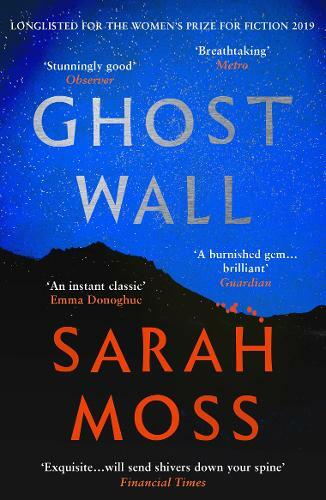
Ghost Wall – Sarah Moss (2018) 149 pages
Trigger warning: discusses domestic abuse
Ghost Wall is the first of Sarah Moss’ work that I’ve read, despite hearing wonderful things about her in the blogosphere. My excuse is I kept getting her confused with another author with whom I’ve had a mixed experience, in other words, I’m an idiot 😀 Turns out the blogosphere was absolutely right, Moss is an immensely skilful writer.
Ghost Wall begins with a young woman being sacrificed, probably in pre-Christian England. That brief but deeply disturbing description over, the story picks up in the latter part of the twentieth century.
Silvie is spending the summer with her parents and some students re-enacting Iron Age life: living in a hut, cooking foraged food over fires.
“When I woke up there was light seeping around the sheepskin hanging over the door. They probably didn’t actually have sheep, the Professor had said, but since we weren’t allowed to kill animals using Iron Age technologies we would have to take what we could get and sheepskins are a lot easier to pick up on the open market than deerskins. While I was glad…I thought the Professor’s dodging of bloodshed pretty thoroughly messed up the idea that our experiences that summer were going to rediscover the lifeways of pre-modern hunter gatherers.”
Silvie’s teenage scepticism brings a dry humour to what would otherwise be a very bleak tale. Her father is a bus driver obsessed with British pre-history. He is a misogynist and domestically violent, and he uses this period in history to justify his beliefs and actions:
“women in the family way and feeding babies the way nature intended as long as they could, which was also what he said whenever he caught me or Mum buying sanitary protection. Women managed well enough, he said, back in the day, without spending money on all that, ends up on the beaches in the end, right mucky. Or they died, I said, in childbirth, what with rickets and no caesarians, but you won’t be wanting me pregnant, Dad, for authenticity’s sake? … Hush, said Mum, cheek, but she was too late, the slap already airborne.”
The experiment simultaneously excites and challenges Sylvie’s father. He is not wholly unsympathetic – Moss shows how it is the limitations placed on him that lead to his frustration, but plenty of people have those without beating their nearest and dearest. He is a racist and a fantasist:
“He wanted his own ancestry, wanted a lineage, a claim on something. Not people from Ireland or Rome or Germania or Syria but some tribe sprung from English soil like mushrooms.”
Yet Silvie shares her father’s interest in history, and his intelligence. She doesn’t despise everything about the experiment and she has better knowledge than the slightly disengaged archaeology students who are helping out.
“The edges of the wooden steps over the stile touch your bones, an unseen pebble catches your breath. You can imagine how a person might learn a landscape with her feet. But we hadn’t yet crossed any bog and I was pretty sure it would feel different in winter.”
Silvie’s mother is utterly cowed – as far as we can tell – by the man she married.
“Mum often spoke of sitting down as a goal, a prize she might win by hard work, but so rarely achieved that the appeal remained unclear to me.”
Although in some ways a resolutely domestic tale – albeit in a replica Iron Age hut – what emerges from the context of the human sacrifice at the beginning to Silvie and her mother’s subservient roles in the experiment, is how women have frequently paid the price of the systems and structures that powerful men erect to serve their own ends while claiming a higher purpose.
Moss slowly builds the tension in this novel as the experiment exerts pressure on the family and exposes its faultlines. I found it unbearably tense and a perfect example of the power of a novella which is tautly written.
It is this power which means this could be a very triggering read for people and I do advise to proceed with caution, but if you’re in a position to read it, Ghost Wall is an immersive and gut-wrenching read.
 madame bibi lophile recommends