“Compared to memory, every possession can only ever seem disappointing” (Giorgio Bassani)

This is my final post for the 1962 Club, hosted by Simon and Kaggsy, which has been running all week. It’s been a great event as always, and I’m really pleased it prompted me to pick the three I’ve read off the TBR pile at long last!

(Please note, despite the subject matter I’ve made a deliberate choice not to draw contemporary parallels. I think Lisa explained this decision really well in her blog post here.)
I adored Giorgio Bassani’s The Gold-Rimmed Spectacles (1958) when I read it last year, so I had high expectations when I approached The Garden of the Finzi-Continis (transl. Jamie McKendrick, 2007), the third book in his Romanzo di Ferrara cycle. It fully lived up to those expectations.
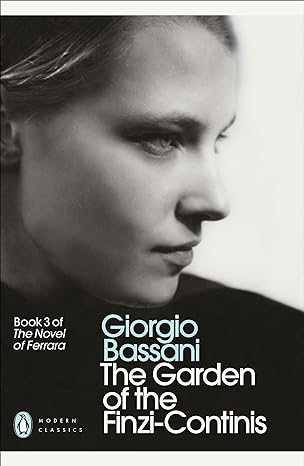
The unnamed narrator tells us in the Prologue that he is looking back from 1957 to a time before World War II. However the tone is more elegiac than nostalgic, as he also tells us that those he recalls perished in concentration camps.

Before the war the Finzi-Continis were a prosperous family, but the conflict destroyed them and all they owned. The large house is now squatted in, and the titular space:

“All the broad-canopied trees, limes, elms, beeches, poplars, plane trees, horse chestnuts, pines, firs, larches, cedars of Lebanon, cypresses, oaks, holm oaks, and even the palm trees and eucalyptuses planted in their hundreds by Josette Artom during the last two years of the first world war, were cut down for firewood, and for some time the land had returned to the state it was in when Moisè Finzi-Contini acquired it”

So it is with this knowledge that we then meet the younger, somewhat callow narrator, and follow his developing friendship with the younger Finzi-Contini’s, Alberto and Micòl, son and daughter of Professor Ermanno and Signor Olga.

Racial laws are coming into effect in Italy in the late 1930s, and this sees the narrator invited into the walled estate, as Jewish people are banned from places such as the local tennis club.

“They entirely left aside the existence of a far greater intimacy, a secret one, to be valued only by those who shared it, which derived from the fact that our two families, not by choice, but by virtue of a tradition more ancient than any possible memory, belonged to the same religious observance, or more accurately to the same ’School’”

Despite the growing pressures of the outside world, within the Finzi-Continis walls the narrator remembers a time where:

“The weather remained perfect, held in that state of magical suspension, of glassy, luminous, soft immobility which is the special gift of some of our autumns. In the garden it was hot, just slightly less than if it was summer.”

In this enchanted space the narrator falls for Micòl, but their relationship never develops, characterised by misunderstandings and ambiguity that they are too young to resolve. Being too young for what life throws at you is also shown through the political conversations with Giampi Malnate, an older Christian friend of Alberto, as well as an experience of terminal illness.

What I thought was so subtle and clever from Bassani is that nothing overly dramatic happens. Rather, things fade out. The huge events that we know are looming take place outside of the novel, and instead we are shown how we can take for granted the moments that seemingly have no wider ramifications. Except of course, they do. This is a formative time for the narrator.  

The Garden of the Finzi-Continis is not a plot-driven novel. It is a beautifully written evocation of a time before unimagined horrors. It is reflective and elegiac in tone without ever letting sentimentality lessen the portrait of a family obliterated by the Holocaust. It’s a truly devastating read.

The novel was adapted into a film in 1970, which won the Best Foreign Language Oscar that year. Has anyone seen it? It looks pretty faithful to the book so I’m interested to watch it:
Novella a Day in May 2022 No.29

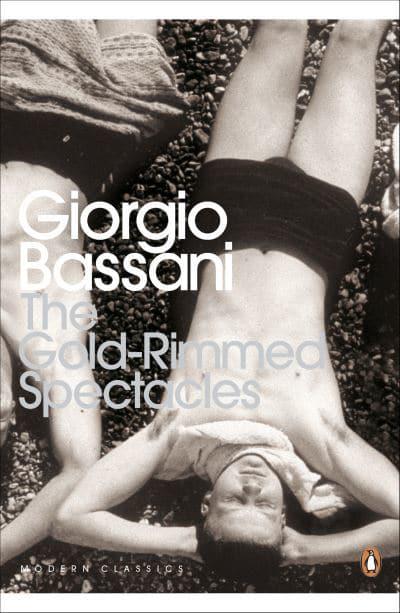
The Gold-Rimmed Spectacles – Giorgio Bassani (1958 trans. Jamie McKendrick 2012) 125 pages

I’ve been meaning to read Giorgio Bassani for a while and have The Garden of the Finzi-Continis in the TBR. This project in May seemed the ideal opportunity to read the first of his novels set in Ferrara, The Gold-Rimmed Spectacles. From this first encounter I can say I found Bassani to be a truly devastating writer.

The titular eyewear belongs to Dr Athos Fadigati, who has left Venice to settle in Ferrara. His story is told by a narrator looking back to when he was a young man and knew the doctor:

“It was in 1919, just after the other war. Because of my age, I who write this can only offer a rather vague and confused picture of that period. The town centre caffes spilt over with officers in uniform; lorries bedecked with flags continually passed by […] in front of the north face of the castle, a huge, scarlet advertising banner had been unfurled, inviting the friends and enemies of Socialism to come together to drink APERITIF LENIN”

The doctor is well-liked in the town, affable and competent at his work, a breath of fresh air after the old-fashioned medics previously available. In a small town though, people take an interest in everyone’s business, and no-one can work out why Dr Fadigati is single, or where he goes of an evening. When they realise he is gay, no-one cares so long as he is discreet. An insidious homophobia that can easily become explicit and threatening.  

“Yes – they said – now that his secret was no longer a secret, now that everything was as clear as could be, at least one could be sure how to behave towards him. By day, in the light of the sun, to show him every respect; in the evening, even if pressed chest to chest against him in the throng of Via San Romano, to show no sign of recognising him.”

Dr Fadigati starts commuting to Bologna along with the young university students of the town. He is such a sweet, kind man, who only wants to connect with others.

“He was happy, in the end, with the least thing, or so it seemed. He wanted no more than to stay there, in our third-class compartment, with the air of an old man silently warming his hands in front of a big fire.”

Unfortunately, the students – who have known him and been cared for by him their whole lives – do not always behave well: “little by little, without meaning to, all of us began to show him scant respect”. This includes a humiliating exchange with one of the young men, Deliliers, who doesn’t respect the doctor’s privacy and alludes to his sexuality in derogatory ways.

Things escalate during the annual family holiday to Riccione. The narrator sees the doctor and Deliliers together, and the town can no longer ignore the doctor’s sexuality. Around the same time, the narrator faces increasing antisemitism, demonstrated by fellow holiday-maker Signora Lavezzoli’s support of Hitler. The family find themselves treading a similar tightrope to the one Dr Fadigati has had to navigate, trying to stay safe amongst a discriminatory and prejudiced society.

“Romantic, patriotic, politically naive and inexperienced like so many Jews of his generation, my father, returning from the Front in 1919, had also enrolled in the Fascist Party. He had thus been a Fascist ‘from the very beginning’, and at heart had remained one despite his meekness and honesty. But since Mussolini, after the early scuffles, had begun to reach an agreement with Hitler, my father had started to feel uneasy.”

The Gold-Rimmed Spectacles makes full use of the reader’s knowledge of history. It is a deeply upsetting read, showing how quickly unspoken prejudice can escalate and be supported by wider political and legal frameworks. It demonstrates how easy it is for ordinary people to become part of widespread evil – one of the narrator’s friends decides to join the government, not through any ideological belief but because it is a useful opportunity. The ease with which it happens and the casual acceptance of the racial laws, is horribly believable.

Bassani uses the story of Dr Fadigati to fully drive home the consequences of the rise of Fascism and Nazism. It’s remarkable in portraying the tragedy that ensues in a deeply emotional but also carefully restrained way.

“The setting sun, cleaving through a dark cope of cloud that lay low on the horizon, vividly lit up everything: the Jewish cemetery at my feet the apse and bell tower of the Church of San Cristoforo only a little further on, and in the background high above the vista of brown roofs, the distant bulk of the Estense Castle and the Duomo. It was enough for me to recover the ancient, maternal visage of my hometown, to reclaim it once again all for myself, that atrocious feeling of exclusion that had tormented me in the last days to fall away instantly. The future of persecution and massacres that perhaps awaited us – since childhood I had heard them spoken of as always a possible eventuality for us Jews – no longer made me afraid.”

I’m so glad I finally picked up Bassani and I’ll be returning to him for sure. Just as soon as I’ve recovered from this novella, which could take some time…