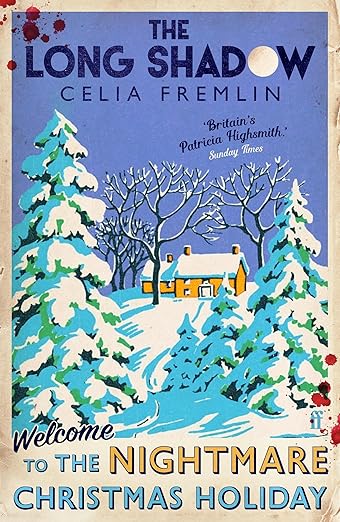
I’ve been meaning to read Celia Fremlin for a while, encouraged by JacquiWine’s excellent reviews. Happily, this coincided with my plan to read some Christmas-set golden age/cosy mysteries in December, as The Long Shadow (1975) builds its tension through a haunted group of houseguests throughout the festive period.
I immediately knew I was in for a treat with Fremlin. We join Imogen at the first party she’s attended since her husband died two months ago. We quickly learn that while she is grieving, she also recognises that Ivor was not a pleasant person. There is no sentimentality in her reflections.
“How Ivor would have loved being dead! It was a shame that he was missing it all. How he would have loved to watch the letters pouring in, day after day, by every post, in their tens and in their dozens, each one a tribute to himself.”
She also casts a critical eye over the niceties of solo party attendance:
“She’s a widow, that’s what she is. With wooden detachment, Imogen watched Myrtle’s social aplomb faltering before the task of finding something intriguing to say about Imogen: something at least as amusing as Dutch Elm disease.
She gave it up.”
There’s also some astute observations about the deeply odd ways that the English approach the bereaved:
“Even Edith Hartman from next door had at last stopped popping in with cups of tepid Oxo and soothing stories about people who had died of cancer recently.”
But soon Imogen has more to worry about than navigating social mores, as someone rings in the middle of the night, telling her they know she killed her husband.
Told from Imogen’s point of view, she is clear she didn’t kill him. She has little time to reflect though, as it’s not long before her adult step-children turn up; the somewhat reprobate son Robin, and acquisitive daughter Dot, with her husband Herbert and their two young sons, Vernon and Timmie.
More bafflingly, Robin brings an almost silent girl to the house who wafts around preparing macrobiotic food, and Ivor’s scatty second wife Cynthia flies in from Bermuda to also take up residence. Then someone starts moving Ivor’s papers and updating them, the children have faces visiting them in nightmares and see a man in a Santa costume sat in Ivor’s study, and Imogen begins to wonder if a ghost isn’t part of the company too…
“It was high time Ivor got moving. It wasn’t fair to be dead and yet to stay around like this, in every room, in every corner of the house”
As a reader we are meant to be sceptical of ghosts and suspect everyone else, and they certainly act suspiciously! All of the adults seem to be Up To Something but I certainly couldn’t work out what was going on.
The Long Shadow is well-paced at only 242 pages, with a finale that is satisfying and believable. There’s even a final comic twist right at the last sentence. It’s certainly made me keen to read more Fremlin and thankfully Faber have made more reissues available.
Although not heavily Christmas-themed, it’s a great Christmas read with its house full of extended family, things unspoken, and would be easily digested after a dinner of heavier festive fare 😊
To end, two of my favourite folk singers coming together to sing insults at each other in honour of Christmas (please note, they have updated some of Kirsty MacColl and Shane MacGowan’s name-calling, but the language remains decidedly colourful):
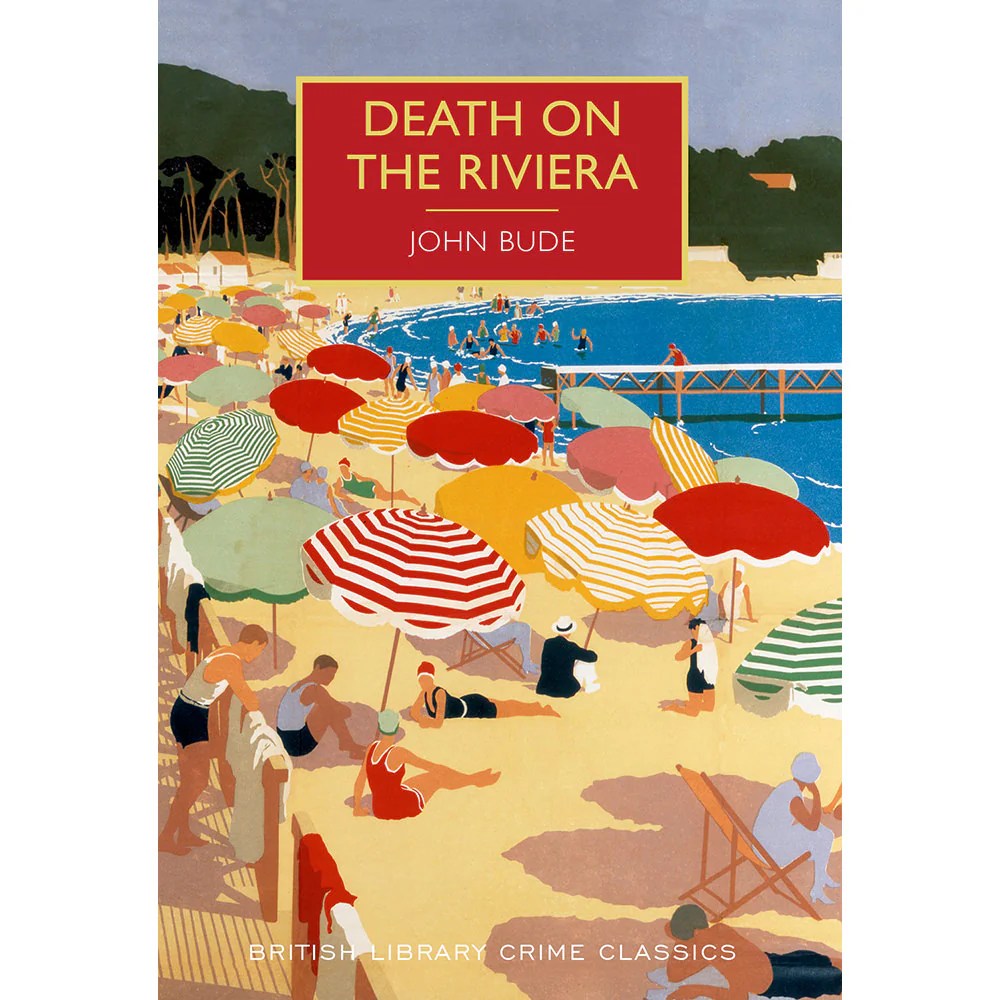
This is my final contribution to Kaggsy and Simon’s1952 Club which has been running all week. So far I’ve read two golden age mysteries for the club and I’m finishing with one too: Death on the Riviera by John Bude, in a pleasing British Library Crime Classics edition.
I read The Cheltenham Square Murder for the 1937 Club last year, and while I had enjoyed it, I didn’t think it was the strongest of Bude’s novels or a particularly perplexing mystery. This, I’m happy to report, was much stronger.
The story centres around the rich and privileged Nesta Hedderwick and her various assorted guests at her villa in the south of France.
“But for the nagging accusations of her weighing-machine life might have been perfect. She’d money; one of the loveliest villas in Menton; A large … collection of friends; splendid health; a sense of humour; and a virile capacity for enjoyment. Her husband, a successful but dyspeptic stockbroker, had died between the wars of ptomaine poisoning.”
Staying with Nesta are her niece Dilys; “smooth-faced bounder” Tony Shenton; Nesta’s companion Miss Pilligrew; beautiful Kitty; and a decidedly shifty artist:
“When Nesta had an artist living in the house she expected him to behave like one. Paul Latour certainly did his best to live up to the fin de siècle Bohemianism on which Nesta had directed her romantic ideas of the genre.”
Bude clearly has a lot of fun with Paul’s artistic swizz:
“A cod’s head capping the naked torso of a woman, balanced onto cactus leaves and garnished with the motif of lemons and spaghetti… Paul shrugged hopelessly.”
Although Dilys’ attitude to where she has found herself suggests Paul isn’t alone in his pretence:
“Just paste and cardboard and tinsel, like most of my aunt’s insufferable friends. Actually I find it rather boring. It gets that way after a time.”
So it seems the French Riviera is the perfect place for a counterfeiting operation, which is what brings DI Meredith and Acting-Sergeant Freddy Strang across La Manche, searching for Tony ‘Chalky’ Cobbett.
They work closely with Inspector Blampignon and refreshingly, the local police are shown to be entirely competent and pleasant to work with.
As the British and French police investigate the local forgers, Freddy runs into Dilys and they begin a very sweet romance, which brings the two threads smoothly together. When an acquaintance of the villa coterie goes missing, the police investigation widens.
One of my complaints with The Cheltenham Square Murder was that something completely and utterly obvious takes forever to be recognised by Meredith and I thought the same had happened here. Fortunately it turned out I’d fallen into exactly the assumption Bude had set up for the reader: at one point he has Meredith explain that when such an occurrence happens in mystery novels it always means the following…. a nice little meta joke with the reader which I appreciated 😊
Oddly, given the novel’s title, no-one is murdered until around page 160 of a 223 page novel. For my tastes, too long was spent on the counterfeiting and too little on people getting bumped off, but the investigation worked well and it was a steady police procedural without being plodding:
“He was visited by one of those revealing flashes of deduction that spring, not from any inspirational source, but from a clearly realised and logical appreciation of the facts.”
Death on the Riviera is well-paced and enjoyable, with enough characters for plenty of suspects without being completely baffling. The humour is gentle and light, and the setting beautifully evoked:
“It wouldn’t be easy, he realised, to take leave of this sunlit, sparkling coast with its terraced vineyards and olive groves, it palms and oleanders, it’s fantastic cacti, it’s mimosa-scented streets and impossibly blue seas. He thought of the Old Kent Road on a wet February night and shuddered.”
Today for the 1952 Club hosted by Kaggsy and Simon I’m looking at another golden age mystery. The Singing Sands by Josephine Tey features her regular detective, Inspector Alan Grant. It was found in her papers after she died and published posthumously, which usually makes my heart sink, but the novel seems pretty complete so I hope it was as she planned.
You can come across all sorts prejudices and snobberies in golden age crime and The Singing Sands has a strong one running throughout, which admittedly I’ve not encountered before in the genre: Tey is a total snob about Scotland. As far as I can work out her rules are:
Be Scottish
But speak with an English accent (by which I assume she means RP – I doubt my south London tones would cut the mustard)
Don’t be from the city
Especially don’t be from Glasgow
Be from the Highlands
Don’t be a nationalist
Really don’t be from Glasgow
I take great exception to her attitude to Glasgow – it’s a beautiful city full of friendly people. Every time I go I’m knocked out and I’m still giving serious consideration to moving there. In the end when I came across these attitudes I just rolled my eyes and skipped on, and it didn’t affect my enjoyment of the novel. But as a counterbalance I urge everyone to (re)visit wonderful Glasgow!
On with the novel! It opens with Grant struggling with his mental health and deciding to visit his cousin Laura (Lalla) and her family in the Highlands to recuperate. The background of what led to Grant reaching this point is never quite specified but he seems to be experiencing burnout/PTSD.
As he disembarks the train, the grumpy attendant is trying to rouse the passenger in berth B Seven. Grant realises he is dead, and his interest in faces (detailed extensively in The Daughter of Time which is where the title quote comes from but would have worked very well in this novel too) is piqued:
“What would bring a dark, thin young man with reckless eyebrows and a passion for alcohol to the Highlands at the beginning of March?”
He also picks up B Seven’s newspaper, which has some cryptic verse scribbled on it. Much as Grant tries to focus on his family and the fishing expeditions he had planned, his mind keeps being drawn back to B Seven. The verse leads him to visit some of the islands to identify the landmarks mentioned:
“There was nothing else in all the world but the green torn sea and the sands. He stood there looking at it, and remembering that the nearest land was America. Not since he had stood in the North African desert had he known that uncanny feeling that is born of unlimited space. That feeling of human diminution.”
Although his colleagues in London have identified the body and ruled accidental death, Grant thinks both these conclusions are questionable. Despite trying to recover from his work, he can’t let it go. He is aware that keeping his mind occupied can be useful, but it is a fine balance:
“Grant was very conscious that his obsession with B Seven was an unreasonable thing; abnormal; that it was part of his illness. That in his sober mind he would not have thought a second time about B Seven. He resented his obsession and clung to it. It was at once his bane and his refuge.”
We follow Grant as he heals, with the help of his beautiful environment, the understanding of his family, and his pursuit of the truth.
“But for B Seven he would not be sitting above this sodden world feeling like a king. New born and self-owning. He was something more than B Seven’s champion now: he was his debtor. His servant.”
The Singing Sands is not heavily plot-driven and the mystery is slight, but it is still an enjoyable read, if a slightly unusual approach to the genre. Grant’s dogged pursuit of the truth of a death which others seem quick to disregard makes him endearing, and there are lovely descriptions of the Highlands. It’s a quick read that doesn’t outstay its welcome, and it is compassionate in its portrayal of mental health.
“In matters where A was at spot X at 5:30pm on the umpteenth inst, Grant’s mind worked with the tidiness of a calculating machine. But in an affair where motive was all, he sat back and let his mind loose on the problem. Presently, if he left it alone, it would throw up the pattern that he needed.”
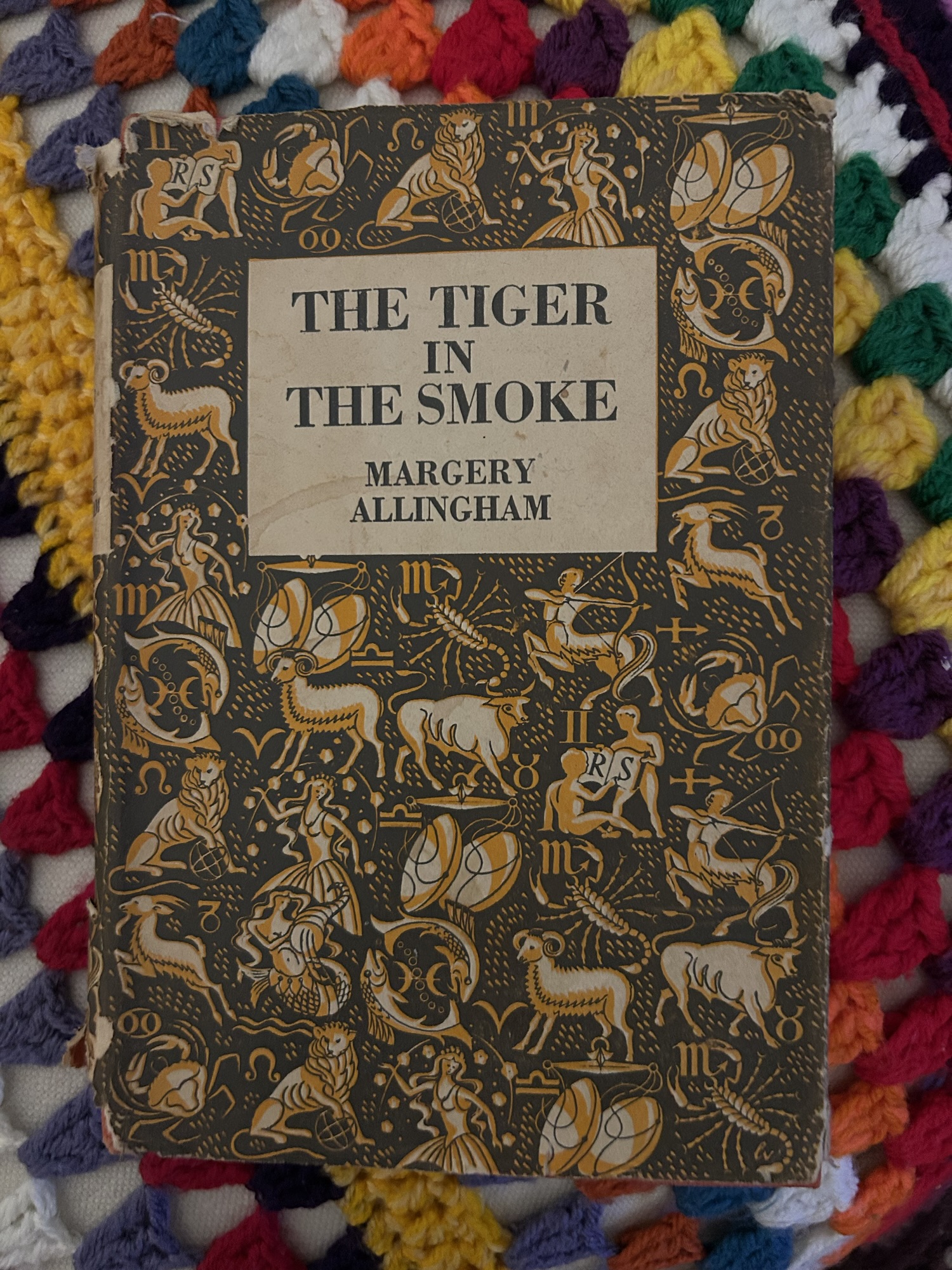
This is a contribution to Kaggsy and Simon’s 1952 Club, running all week. I found a few contenders in the TBR including several golden age mysteries, so I’m starting today with a pretty famous one, Tiger in the Smoke by Margery Allingham.
The titular smoke is a London pea-souper, a thick smog that chokes the airways and severely limits visibility – perfect for dastardly crimes to be committed!
“The fog was like a saffron blanket soaked in ice-water. It had hung over London all day and at last was beginning to descend. The sky was yellow as a duster and the rest was a granular black, overprinted in grey and lightened by occasional slivers of bright fish colour as a policeman turned in his wet cape.”
The story opens with Geoffrey Levett and Meg Elginbrodde crawling through the fog-bound traffic in a taxi. They are one of those wonderful postwar stiff-upper-lipped couples whose romantic chit-chat takes place along the following lines:
“Look, we’ll get out of this somehow and we’ll go through with the whole programme. We’ll have everything we planned, the kids and the house and the happiness, even the damned great wedding. It’ll be alright, I swear it, Meg.”
Love it!
The blight on their nuptials is that someone has been sending blurry photos to Meg of someone who could be her first husband Martin, presumed dead in the war. So she meets friend of the family – and Allingham’s regular detective – Albert Campion, along with Inspector Charlie Luke, at a train station.
It quickly emerges that the man is not her husband but a criminal named Duds Morrison. As the group begin to unravel what is going on and why, there is less mystery and more of a character study of a truly sinister criminal named Havoc. Inspector Luke is unnerved:
“Just then he had a presentiment, a warning from some experienced-born six sense, that he was about to encounter something rare and dangerous. The whiff of tiger crept to him through the fog.”
A gang of criminals appear and my heart sank a bit, as they all had various physical differences and I was braced for ableism. But while that is certainly present, the real menace in the book lies with Havoc, and Allingham labours over how physically perfect he is:
“His beauty, and he possessed a great deal […]
His face was remarkable, in feature it was excellent, conventionally handsome […]
Jail pallor, which of all complexions is the most hideous, could not destroy the firmness of his skin […]
He was a man who must have been a pretty boy, yet his face could never have been pleasant to look at. Its ruin lay in something quite peculiar, not in expression only but in something integral to the very structure. The man looked like a design for tragedy. Grief and torture and the furies were all there naked, and the eye was repelled even while it was violently attracted. He looked exactly what he was, unsafe.”
In other words, as beautiful and deadly as a tiger.
In comparison there is my favourite character, Canon Avril, Meg’s father:
“he asked so little of life that its frugal bounty amazed and delighted him. The older he grew and the poorer he became, the calmer and more contented appeared his fine gentle face.”
In fact, Tiger in the Smoke had an increasing amount of religious references and imagery as it went along (though it isn’t didactic at all) and I found myself reminded of Muriel Spark. I ended up googling Margery Allingham to see if she had a strong faith like Spark but couldn’t find it referenced. Tiger in the Smoke isn’t like Spark tonally, but it is certainly concerned with notions of good and evil in a similar way to her novels.
Although this is a Campion mystery, he barely features. Apparently the 1956 film cut him out entirely, and this wouldn’t be difficult at all. His sarcastic retainer Lugg also appears, and his wife Amanda along with Oates from Scotland Yard “a drooping figure in a disgraceful old mackintosh” but this could just as easily be a standalone novel.
While there isn’t a mystery as such, the plot is satisfyingly complex and the novel is expertly paced. The foggy atmosphere is used to full effect and Allingham creates a real page-turner. I was whizzing through Tiger in the Smoke to find out what happened.
It leads to a tense denouement, underpinned by a real sadness. A hugely satisfying start to my 1952 Club reading!
“Havoc was ‘police work’. There was no mystery surrounding his guilt. He was something to be trapped and killed, and Campion was no great man for blood sports.”
Maigret Mystified – Georges Simenon (1932, trans. Jean Stewart 1964) 139 pages
This is the first Maigret I’ve read, despite Simenon being such a prolific writer and despite my love of golden age detective fiction. I picked it up in a pleasingly battered old green Penguin edition and I enjoyed it greatly. I’m sure it won’t be the last time I accompany the insightful French detective in his ruminations 😊
This may well be the shortest post I ever write, given that it’s about a novella and a mystery, so I want to avoid spoilers!
Maigret is called to the scene of a murder in an office of a pharmaceutical company, Doctor Rivière’s Serums. Monsieur Couchet, the owner, has been shot dead. The mystifying element is that he was also robbed of 360,000 francs, but his chair was jammed against the safe. So did he face his murderous thief? Or did he not know of the theft? Did the same person carry out both crimes?
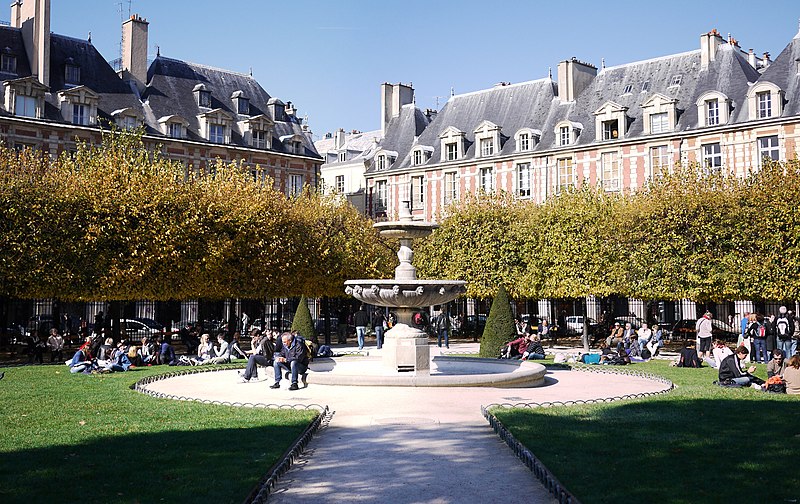
As the office is adjacent to a block of flats, Maigret must interview possible witnesses from the various homes in Place des Vosges.
There is the concierge who called the police; Madame Martin who seems to torture her husbands with their failure to live up to her expectations (the first of whom was the murdered man, their son now self-medicates with ether and lives close by); Mathilde who eavesdrops on everyone; new parents the de Sant-Marcs…
There are also the lovers of the victim to contend with: his second wife and his girlfriend Nine, a cabaret dancer, the portrayal of whom is pleasingly non-judgemental.
I suspect this isn’t the greatest Maigret offering, but it is a quick, entertaining and atmospheric read. I also found it a welcome antidote to the overly convoluted plot lines of many contemporary detective dramas – much as I enjoy those, it was a nice change to just see Maigret get on with it, in no time at all.
“ ‘You old rascal, Couchet!’
The words had sprung to his lips as if Couchet had been an old friend. And he felt this impression so strongly that he could not realise he had only seen him dead.”
A previous English title used for this mystery was The Shadow in the Courtyard, which to me is a much better. After all, at 139 pages, Maigret isn’t mystified for long…
“It was ten o’clock at night. The iron gates of the garden were shut, the Place des Vosges deserted, with gleaming car tracks on the asphalt and the unbroken murmur of the fountains, the leafless trees and the monotonous outline of identical roofs silhouetted against the sky.”
To end, this year sees a cinematic outing for Maigret:
You may remember, back in the mists of time (14-20 October), the 1930 Club, hosted by Karen at Kaggsy’s Bookish Ramblings and Simon at Stuck in a Book. Although I took part, I’d hoped to do two posts, but was far too disorganised with the second one. Karen kindly said I could sneak in a late entry, so here it is, very much overdue and very much overlong!
My excuse is I’m having renovations done in my tiny flat and the whole place is in disarray to say the least. It has made me clear out 19 sacks of books to the lovely charity bookshop, but the overall effect on my shelves has been negligible. Which makes me think I should just give in and accumulate books until they take over entirely and smother me. A good way to go in my opinion.
Back to 1930! Do have a look at all the wonderful posts from people who managed to post on time – it turned out to be a great year 😊
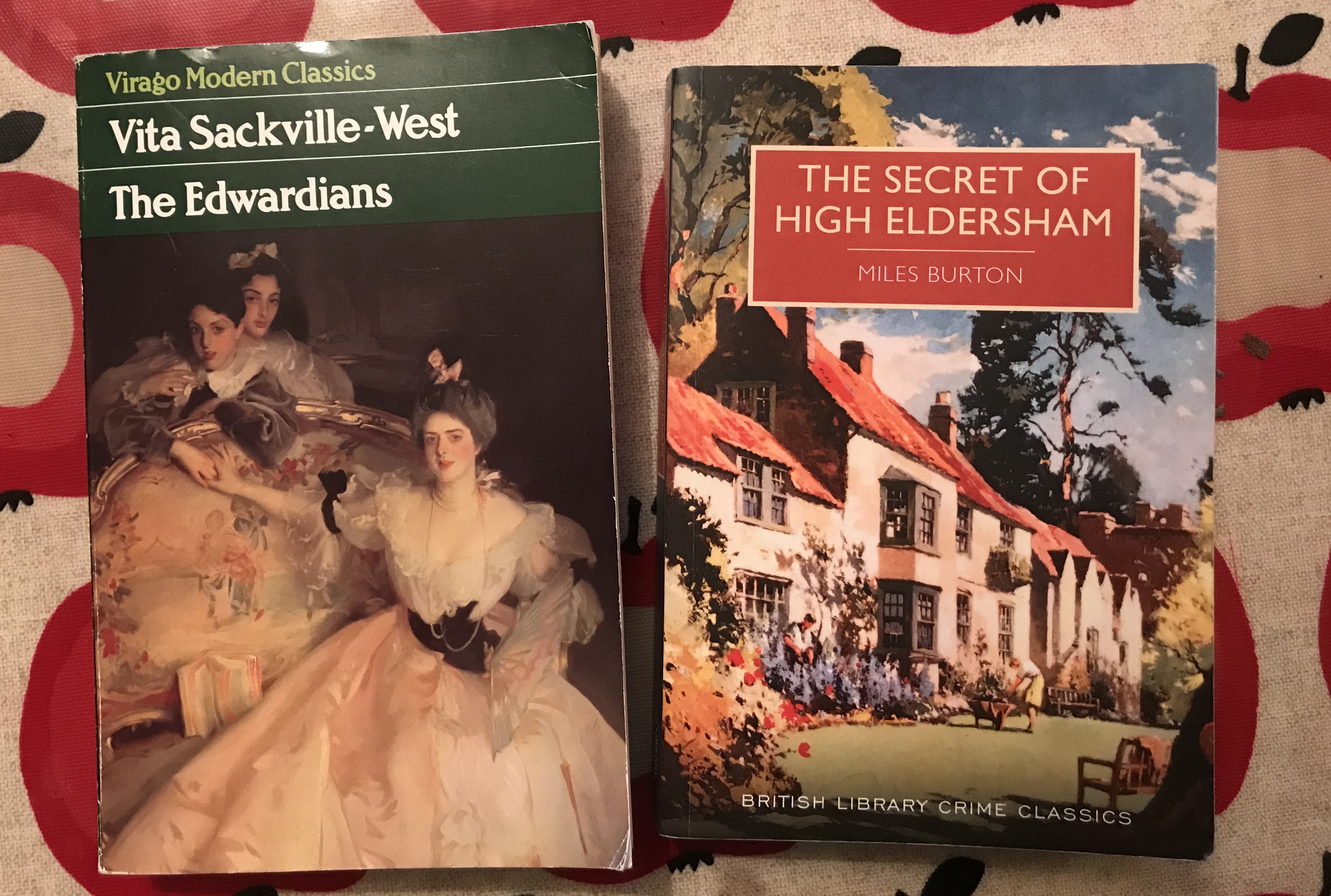
Firstly, some cosy crime courtesy of the British Library Crime Classics series, The Secret of High Eldersham by Miles Burton.
The titular village is a pretty place in East Anglia, but somewhat isolated and insular “with that curious half-mistrustful air not uncommon among the natives of East Anglia.” 😀
Strangers are not welcome in High Eldersham, and Samuel Whitehead, retired police officer and local publican, was one such stranger. Still, he seemed to have settled in relatively well right up until the point that someone stabbed him to death. Inspector Young is called in from Scotland Yard and immediately suspects one of the locals:
“He knew from experience that brutal murders, inspired by some entirely inadequate motive, were not uncommon. They were nearly always due to the workings of an unbalanced mind, brooding over some fancied grievance until the lust of blood was awakened. Then the hitherto harmless and peaceful individual became a criminal… He would await his opportunity and deliver the blow. And, the deed once perpetrated, he would return to normal sanity. It was not unlikely that the murder of Whitehead was due to such causes.”
It’s hardly a robust theory. Young is not an idiot though, and he quickly unearths the titular secret, although that doesn’t tell him who murdered the pub landlord, or why. He decides to call on his old friend Desmond Merrion “a living encyclopaedia upon all manner of obscure subjects which the ordinary person knew nothing about.”
And so the professional and amateur detective set about solving the mystery, which to modern readers won’t be much mystery at all – its very clear what’s going on. That’s not a criticism though. I suspect in 1930 it wasn’t quite so obvious, and it doesn’t matter now – the comfort of these plot-driven golden age stories is watching everything play out exactly as it’s supposed to, and I enjoyed following Young and Merrion as they discovered the extent of the dastardly deed.
While it’s not the most sophisticated in terms of plot or characterisation, The Secret of High Eldersham still has enough about it to pull you along. It also doesn’t fall foul of many of the prejudices of GA detective fiction either. Despite the bizarre opinion of East Anglians that I quoted at the beginning, in fact the residents aren’t made too yokely; there’s no racism/anti-Semitism that I can remember; and the loveliness of the female love interest isn’t dwelt upon and she’s actually allowed to have a personality.
Burton doesn’t hang about – there’s very little filler here. He gets on with telling the story and once that’s done, it ends. So, a quick, cosy crime read, perfect autumnal reading as the nights get longer for those of us in the northern hemisphere.
In my last post I looked at EM Delafield’s Diary of a Provincial Lady which included this entry:
“August 31st.—Read The Edwardians which everybody else has read months ago—and am delighted and amused. Remember that V. Sackville-West and I once attended dancing classes together at the Albert Hall, many years ago, but feel that if I do mention this, everybody will think I am boasting—which indeed I should be—so better forget about it again, and in any case, dancing never my strongest point, and performance at Albert Hall extremely mediocre and may well be left in oblivion.”
Although I don’t have much in common with the Provincial Lady’s life of ease, like her I enjoyed The Edwardians, which Sackville-West told Virginia Woolf she was writing to ‘make my fortune. Such a joke it will be, and I hope everybody will be seriously annoyed.’
Although she saw it as a joke, its not really a comic novel. It tells the story of Sebastian, heir to the country estate of Chevron, and his sister Violet. Chevron is VSW’s beloved Knole, which she couldn’t inherit due to having ovaries, and which Virginia Woolf also immortalised as the home of Orlando.
The chapters are told from the point of view of different characters, beginning with adventurer Leonard Anquetil, who is not of the same class as the rest but has been invited to Sunday dinner because they think he will be amusing.
“And now the rest of the day must be got through somehow, but the members of the house-party, though surely spoilt by the surfeits of entertainment that life had always offered them, showed no disposition to be bored by each other’s familiar company, and no inclination to vary the programme which they must have followed on innumerable Sunday afternoons since they first emerged from the narrowness of school or schoolroom, to take their place in a world where pleasure fell like a ripened peach for the outstretching of a hand. Leonard Anquetil, watching them from outside, marvelled to see them so easily pleased. Here are a score or more of people, he thought, who by virtue of their position are accustomed to the intimate society of princes, politicians, financiers, wits, beauties, and other makers of history, yet are apparently content with desultory chatter and make-believe occupation throughout the long hours of an idle day. Nor could he pretend to himself that on other days they diverted themselves differently, or that their week-end provided a deserved relaxation from a fuller and more ardent life.”
Through Anquetil, our introduction to the lives of the privileged class is a sceptical one at the least, scathing at most. Yet VSW adored Knole, and through Sebastian’s feelings for Chevron we learn how feelings of home run deep, even when that home is a vast estate populated by many.
“Everybody, from Sebastian downwards, obtained exactly what they wanted; they had only to ask, and the request was fulfilled as though by magic. The house was really as self-contained as a little town; the carpenter’s shop, the painter’s shop, the forge, the sawmill, the hot-houses, were there to provide whatever might be needed at a moment’s notice. So the steward’s room, like the dining-room and the schoolroom, was never without its fruit and delicacies.”
Meeting Anquetil has an enduring effect on both Sebastian and Violet. Sebastian’s conflicted feelings about his class, privilege and the society he operates within are brought more to the fore.
“One half of Sebastian detested his mother’s friends; the other half was allured by their glitter. Sometimes he wanted to gallop away by himself to the world’s ends, sometimes he wanted to give himself up wholly to the flattering charm of pretty women. Sometimes he wished to see his whole acquaintance cast into a furnace, so vehemently did he deprecate them, sometimes he thought that they had mastered the problem of civilisation more truly than the Greeks or Romans. “Since one cannot have truth,” cried Sebastian, struggling into his evening shirt, “let us at least have good manners.” The thought was not original: his father had put it into his head, years ago, before he died. But this brings us to Sebastian’s private trouble: he never could make up his mind on any subject. It was most distressing. He had, apparently, no opinions but only moods,—moods whose sweeping intensity was equalled only by the rapidity of their change.”
We follow Sebastian as he has affairs, becomes a fashionable man about town, and tries to figure out what he wants. In the background of this is his younger sister Violet, who seems a more determined and clear-sighted individual:
“She felt inclined to say, “Very well, if you want the truth, here it is. The society you live in is composed of people who are both dissolute and prudent. They want to have their fun, and they want to keep their position. They glitter on the surface, but underneath the surface they are stupid—too stupid to recognise their own motives. They know only a limited number of things about themselves: that they need plenty of money, and that they must be seen in the right places, associated with the right people. In spite of their efforts to turn themselves into painted images, they remain human somewhere, and must indulge in love-affairs, which sometimes are artificial, and sometimes inconveniently real. Whatever happens, the world must be served first. In spite of their brilliance, this creed necessarily makes them paltry and mean. Then they are envious, spiteful, and mercenary; arrogant and cold. As for us, their children, they leave us in complete ignorance of life, passing on to us only the ideas they think we should hold, and treat us with the utmost ruthlessness if we fail to conform.””
The plot is slight but I think it’s meant to be – one of VSW’s points is that nothing much happens to these people. I came away with a mixed picture of aristocratic life; on the one hand there is an unflinching portrayal of wasteful, privileged lives, but on the other hand, they are never entirely condemned. I suspect this mirrors VSW’s conflicted feelings on the issue, and it also stops the novel from being too judgemental and bitter.
I didn’t enjoy The Edwardians as much as the other Sackville-Wests I’ve read ( All Passion Spent and Family History) but maybe that’s because I didn’t find Sebastian particularly engaging. I felt Violet was off having a far more interesting time, living in her own flat, hanging out with Bohemians and falling in love. I would have liked to hear more about that, or even some more about their wonderfully bitchy mother. But that’s just personal preference and I do find VSW’s writing to be a great read.
To end, the classic musical Puttin’ on the Ritz was released in 1930. Imagine if you’d never heard that well known ‘reasonably straightforward syncopated 5/4 time signature’, you might struggle with it…
Buried for Pleasure – Edmund Crispin (1948) 176 pages
Although I’m not a big reader of contemporary crime, I do like a golden age mystery and I enjoy Crispin’s tales of amateur detective/Oxford professor Gervase Fen’s adventures. In Buried for Pleasure, Fen has left Oxford to travel to the delightfully named Sandford Angelorum, where he is standing for Parliament as an Independent.
“This panorama displeased Fen, he thought it blank and unenlivening. There was, however, nothing to be done about it except repine. He repined briefly and extracted himself and his luggage from the compartment.”
Fen stays at The Fish Inn where loud renovations undertaken by the owner blast him out of bed every morning. He seems surrounded by comely women – the bar manager, the bar maid, the local taxi driver. Thankfully once their attractiveness is established it isn’t dwelt on and there’s some good characterisation of women in this, which is not always present in GA novels. In fact, the resident detective novelist, Mr Judd, is quite scathing about the whole thing:
“Characterisation seems to me a very overrated element in fiction. I can never see why one should be obliged to have any of it at all, if one doesn’t want to. It limits the form so.”
Crispin pokes fun at everyone in this novel. Novelists, academics, and of course politicians all come in for a gentle ribbing. There is the response to Fen’s first loquacious, entirely meaningless political speech:
“ ‘You’re a natural, old boy … can you keep that sort of thing up?’
‘Indefinitely,’ Fen assured him. ‘The command of cliché comes of having had a literary training.’”
And the political system as a whole:
“ ‘Now, these Sandford people don’t know you as well as I do,’ Captain Watkyn pursued, with a confidence which their quarter-hour acquaintance did not seem to Fen entirely to justify, ‘and … they’re quite likely to elect some scoundrelly nitwit who’ll help send the country to the dogs. Therefore, they’ve got to be jollied along a bit – for their own good, d’you see?’
‘As Plato remarked.’
‘As whatsit remarked, yes.’”
This is not the GA novel to read if you’re in the mood for a good murder with plenty of suspects and clues to work out. This side of the novel – a poisoning before Fen arrives, a stabbing after he becomes resident in the village – is pretty negligible.
However, it’s funny, light, endearing, and doesn’t fall into many of the prejudices which can mar this genre, although the villagers are portrayed as a bit yokely.
Buried for Pleasure was just what I needed after the gothic tribulations of O Caledonia yesterday: complete and utter nonsense and none the worse for it 😀
There were a few blissful weeks over the summer when everyone took their kids on holiday and my commute to work was almost bearable, because it was done with approximately two-thirds less people than usual. Now those halcyon days are well and truly behind us and everyone’s back at work, I thought I’d try reading about public transport to see if it fills me with new-found affection for my early morning travel. Given that I’m reading during said commute, with my book touching my nose and my head wedged into someone’s armpit, there’s still some way to go, despite the efforts of some wonderful staff.
Firstly, Murder Underground by Mavis Doriel Hay. This was the first of Hay’s three crime novels, and is part of the British Library Crime Classics re-issues, which I completely adore. I love these so much I even bought one full-price the other day, rather than waiting for them to turn up in charity bookshops, which is something I never do. This could be the start of a slippery slope….
The wonderfully-monikered Miss Euphemia Pongleton is found strangled by her own dog leash on the stairs of Belsize Park station (for those of you who know the Misery Northern line – see, it can get worse – you could be dead). Suspicion falls on her wastrel nephew Basil Pongleton, whom she was constantly inheriting and disinheriting:
“It’s awfully difficult to explain and I had a ghastly time with the police yesterday. Wonder they didn’t arrest me right away, but they’re keeping an eye on me. I noticed a fishy-looking fellow with police-feet lounging opposite my window in Tavistock Square this morning”
The dialogue is definitely part of the appeal of golden age detective fiction for me, it’s just wonderful. While Basil is dithering around making matters worse, his eminently more sensible cousin Beryl tries to unravel the mystery. Miss Pongleton lodged at the Frampton Hotel, and each of the eccentric fellow boarders has their part to play. My favourite was Mrs Daymer:
“a middle-aged lady who liked to accentuate the gaunt strangeness of her appearance by unfashionable clothes. She would explain proudly that they were of hand-woven material…perhaps their intimate connection with the sheep justified their particular unwieldiness”
Mrs Daymer, who gives off a smell of wet sheep in the rain, is unperturbed by the murder as she writes crime fiction and likes to “suck [people] dry” for her novels. Between her and Beryl, they manage to piece together what happened. This being the golden age, there is a missing will, confusion over some pearls and an obese terrier (ok, so that last one isn’t really a trope but I had to give him a mention). Murder Underground is not the most taxing mystery (I’m useless at guessing who done it, and even I got this one quite early) but it’s a great example of this period in detective fiction, and very readable.
If only this poster was right… unfortunately I find it the swiftest way to passive-aggressive tutting, both given and received.
Secondly, Metroland by Julian Barnes. I don’t always get on with Julian Barnes. I can see he’s a highly accomplished writer, but I find him coldly intellectual and distancing. However, in Metroland I think he does capture something about a certain time in late adolescence and the wish for a brave new world. Christopher and his friend Toni live in the suburbs at the tail end of the Metropolitan line, and wish they didn’t:
“Toni and I prided ourselves on being rootless. We also aspired to future condition of rootlessness, and saw no contradiction in the two states of mind; or in the fact that we each lived with our parents, who were, for that matter, the freeholders of our respective homes.”
Yes, Christopher and Toni are hugely pretentious snobs. They desperately wish to be French, which leads them into unintentionally hilarious scenarios like trying to be flaneurs along Oxford Street. They also talk about art with a capital A:
“Art was the most important thing in life, the constant to which one could be unfailingly devoted and which would never cease to reward; more crucially it was the stuff whose effect on those exposed to it was ameliorative.”
Oh dear. But in case you’re wondering why on earth you would want to spend any time in this idiot’s company, I do think it’s worth it. As I said, I find Barnes can be cold, but actually his portrait of Christopher is quite affectionate, and although you laugh at his pretentions, he’s not contemptible, just young and striving for something different to that with which he has grown up. Christopher gets his wish and moves to France, but of course he doesn’t quite end up living the life he imagined. Metroland is about how its not always a disaster to not achieve your dreams, and how ordinary can also equal happy.
To end, a wonderfully British reaction to an unusual happening on the tube (for those of you not of these isles, rest assured that the response from passengers at the end is actually a huge outpouring of unconditional enthusiasm, I promise you):
The rest of that title quote is: “It pisses me off! I’ll go over to a little baby and say ‘What are you doing here? You haven’t worked a day in your life!’” Unfortunately right now I’m working every day of my life and that pisses me off no end. Being the eternal student means any spare spondoolicks go towards debt repayment, so no holiday for me for the foreseeable future. As a bibliophile, the obvious answer to this is a vicarious holiday via the printed word. Here I am reading in my local park:
Just kidding – I don’t like Walt Whitman.
Firstly, I’m having a staycation with The Cornish Coast Murder by John Bude. I love golden age detective novels, and this is one of the wonderful re-issues under the British Library Crime Classics series. Set in the coastal Cornish village of Boscawen, the Reverend Dodd and his friend Dr Pendrill are avid consumers of detective fiction, meeting every Monday for dinner and to divide the spoils of their library parcels:
“heaven forbid that the shadow of any crime should ever fall across the grey-stoned cottages, the gorse dotted commons and cliff-girdled seas of his beloved parish. He preferred to get his excitement second-hand and follow the abstruse machinations of purely imaginary criminals”
Reverend Dodd doesn’t get his wish however, as someone murders the dastardly Julius Tregarthen, bringing the pragmatic Inspector Bigswell to the village, in direct contrast to the Reverend’s more idiosyncratic detective style:
“it’s always struck me that the detective in fiction is inclined to underrate the value of intuition. Now, if I had to solve a problem like this, I should first dismiss all those people who, like Caesar’s wife, were above suspicion, merely because my intuition refused to let me think otherwise. Then I should set to work on what remained and hope for the best!”
This approach seems highly dubious to me, but then even the level-headed Inspector has his own prejudices, as he records in his notebook:
“Three shots entered the room at widely scattered points. The garden is fifteen feet in length. This argues a poor shot. Probably a woman.”
Between the two of them however, they of course manage to find the villain. The Cornish Coast Murder is not the greatest detective story ever written, but it is entertaining and well-paced, and has a surprising sympathy for the murderer – this is not a clear-cut case of right/wrong. Bude went on to write other cases set in picturesque tourist traps – The Lake District Murder, The Sussex Downs Murder. He didn’t change his pseudonym to a local town each time though, disappointingly (John Ambleside? John Bexhill-on-Sea?) I may take another holiday later in the season to Bude’s other murderous locations…
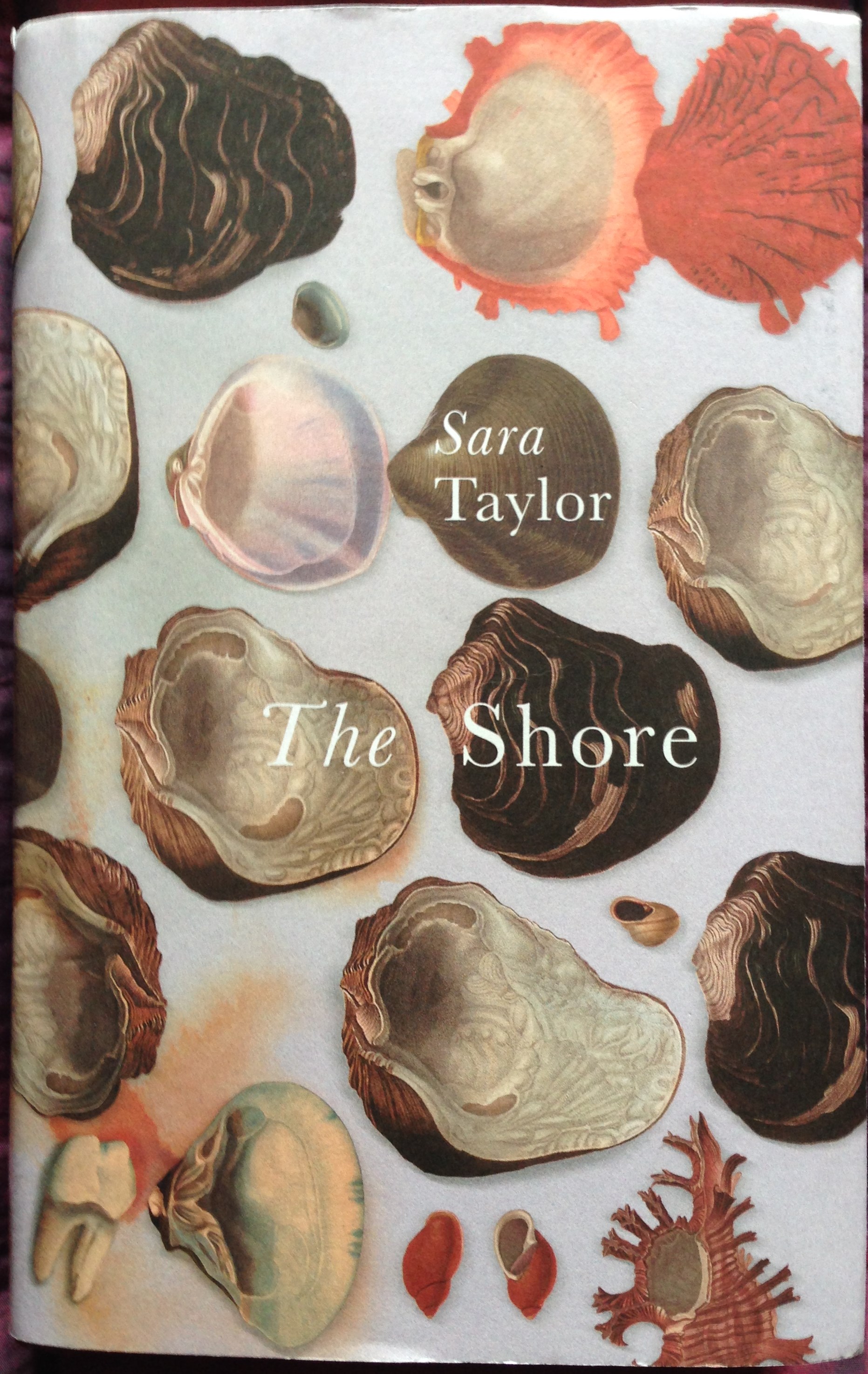
Secondly, and in direct contrast to the cosy Cornish amateur detecting, The Shore by Sara Taylor. I can’t claim this as a relaxing vacation read, despite the beautiful cover:
The Shore tells the lives of islanders off the coast of Virginia. The chapters are told from the viewpoints of different characters and move back and forth across time from the nineteenth century to the twenty-second, showing how people, bloodlines, events and actions are all interwoven. Taylor’s writing is breathtakingly beautiful but her gaze is unflinching:
“The Shore is flat as a fried egg; on a clear day from our upstairs porch it feels like you can see into tomorrow…We take the force out of hurricanes, grow so much food that a lot of it rots on the vine because there’s too much to pick or eat, but people say the government doesn’t remember we’re here, that we get left off when they draw the maps.”
Life on The Shore is not easy – the people are brutal and brutalised, violent and destructive – particularly towards women. At times the unrelenting harshness of the lives depicted made this a tough read, but Taylor’s writing is so original, so tight and accomplished, that I felt myself drawn onwards, like one of her characters unable to stop themselves:
“[I] have been easing back into the landscape like putting on a favourite coat. I hate this place and I love this place and I don’t know if I want to go as far away as possible or ever leave.”
The Shore is its own place, with its own rules. There are ‘witches’ – women bearing the scars of domestic violence who medicate those in need with traditional remedies from the land – and storm bringers, young girls with gifts inherited from their grandfathers:
“She finds a breeze, gives it a twist, and pulls the particles across the bay like teasing knots out of her sister Lilly’s hair. It is a gradual process, and her pace slows as she waits. The ambient moisture begins to bead and grow heavy , a million pregnant bellies. Then, she brings it down.”
The Shore is truly astonishing. It’s definitely one to read only when you’re feeling robust enough to take it, but I wholeheartedly recommend it.
“The stars are smeared across the sky, not the pretty scatter that most people imagine, but a crush of millions in the beautiful, pure darkness”
For me, this sentence sums up The Shore. It is striking, unsettling, the imagery is unexpected and there is a hint of violence – all from the point of view of an individual who knows how powerless they are but still carries hope.
To end, the obvious choice of Madge (who appeared in Desperately Seeking Susan, as did Steven Wright who started the post – this was, of course, complete coincidence brilliant planning on my part) in a video where the budget appears to have been maxed-out on matching bangles for all concerned…these were simpler times, people. All together now: “Holidaaay! Celebraaaate!” :
Richard III is being buried today in Leicester Cathedral after his remains were discovered in the rather unlikely surroundings of a car park in the county in August 2012. Controversial to the end, the reinternment of his remains has been delayed by legal wrangling between Leicester and York as to who should have the bones. Richard III is one of history’s villains, often believed to have killed the sons of Edward IV to secure his own claim on the throne of England (significant crowds attended his funeral procession on Sunday, so maybe he’s been given the benefit of the doubt). This image is due in no small part to the enduring influence of Shakespeare’s portrayal in The Life and Death of Richard III (1591ish), helped along by Laurence Olivier’s 1955 film.
In the interests of balance I thought I would look at this play alongside a novel that seeks to rescue Richard’s reputation.
Richard is an unusual villain in Shakespeare, in that he is the only eponymous character to start his own play (I think…feel free to correct me in the comments!) as he comes on stage to proclaim:
“Now is the winter of our discontent
Made glorious summer by this sun of York”
He is also unusual in that he starts with a trochee – bear with me, I’m not going to get too technical & give you flashbacks to the horrors of Shakespeare at school. But I think this is worth pointing out; most characters speak in iambic pentameter (dee-DUM, dee-DUM etc). Richard comes out and seizes the stage with “NOW is…” (DUM-dee): he is in charge from the off.
What follows is the story of a consummate politician doing whatever he deems necessary to seize the crown. Although he tries to persuade us that his disability (a curved spine, possibly a slightly weaker arm one side) means that through medieval ableism he is marked for villainy (the title quote I’ve used is a pun – he is determined in will and determined by fate) really no-one is less disabled that Richard, as the powerful opening shows us. He manages to bend everyone to his will; he seduces Lady Anne within one scene, despite the fact that he killed her husband:
“Was ever woman in this humour woo’d?
Was ever woman in this humour won?
I’ll have her; but I will not keep her long.”
This is the bleak humour of Richard III – he plots to kill his fiancée even as he seduces her. Often the play is described as a tragedy, but it’s really one of Shakespeare’s history plays and the tone is ambiguous: the last production I saw, with Mark Rylance in the lead, played it as a comedy as far as possible.
Richard’s machinations eventually catch up with him and he is defeated by Richmond (Henry VII) at the Battle of Bosworth, desperately crying out “A horse! A horse! My kingdom for a horse!” A villain indeed, but the audience, like Lady Anne, is seduced by him against our will and the stage is a poorer space when he’s not in it.
Secondly, Daughter of Time by Josephine Tey (1951). It was Emmie’s review of another Josephine Tey novel that introduced to me to this author, and although I don’t normally read series’ out of order, I made an exception for Daughter of Time, as the Crime Writers’ Association voted it the greatest mystery novel of all time.
Inspector Alan Grant has broken his leg and is bored to abstraction away from his job at Scotland Yard. His glamorous friend Marta suggests he try and solve a historical mystery to keep from going stir crazy. Captivated by a portrait of Richard III, he decides to investigate the mystery of the Princes in the Tower.
Grant’s team is not comprised of his usual fellow policeman, and they all have varying theories:
“Nurse Ingham thinks he’s a dreary. Nurse Darroll thinks he’s a horror. My surgeon thinks he’s a polio victim. Sergeant Williams thinks he’s a born judge. Matron thinks he’s a soul in torment.”
As he becomes more involved in the mystery, Grant repeatedly finds himself in opposition to the legend of Richard III:
“’Always a snake in the grass, if you ask me. Smooth, that’s what he was: smooth. Biding his time.’
Biding his time for what? He wondered… He could not have known his brother Edward would die unexpectedly at the age of forty […]It was surely unlikely that a man busy with the administration of the North of England, or campaigning (with dazzling success) against the Scots, would have much interest in being ‘smooth’. What then had changed him so fundamentally in so short a time?”
Grant needs an ally, and it arrives in the form of American academic Brent Carradine:
“He was a tall boy, hatless, with soft fair curls crowning a high forehead and a much too big tweed coat hanging round him in negligent folds…He brought over the chair, planted himself on it with the coat spread around him like some royal robe and looked at Grant with kind brown eyes whose luminous charm not even the horn-rims could dim”
Between the two of them, they start to piece together what they think happened as various powerful medieval families jostled for the crown. The more research they do, the less likely Richard-as-murderer seems to be:
“One could go through the catalogue of his acknowledged virtues, and find each of them, individually, made his part in the murder unlikely in the extreme. Taken together they amounted to a wall of impossibility that towered into fantasy.”
Tey does an excellent job of balancing academic arguments and historical fact with keeping the plot moving (the novel is only 222 pages). Grant concludes his investigation on the day of his discharge home from hospital, convinced he has his man. Let’s just say Shakespeare could never have dramatised the conclusion he comes to.
To end, I can’t help thinking that if Richard III had a chance to set the record straight, he’d choose to do so through the medium of song:









 madame bibi lophile recommends
