Novella a Day in May 2025: No.21

Western Lane – Chetna Maroo (2023) 161 pages

I am not interested in sport of any kind. I’m not anti-sport either, it just completely passes me by. So a novel about squash is not one I’d leap on. But of course Western Lane isn’t about squash; I don’t really know any more about the game than I did before reading the novella. What it explores, against the background of 11 year-old Gopi’s squash playing, is grief, family relationships, and tentative healing.

“It was with a feeling of having been rescued that I raised my racket and served.”

Gopi lives with her widowed father and her two older sisters, beautiful Kush and angry Mona, whose rage is palpable as she tries to keep the home running after the death of their mother.

Their father takes them to the titular sports centre, seemingly at a loss as to how to provide support for his daughters when he is in so much pain himself. Of the three, it is Gopi who throws herself into the game.

“I began dreaming of Western Lane. I saw the white walls and the blossom outside. At night I got out of bed and went over to the windows where there was a bit of light coming through the curtains. I sat on the floor with my racket, my back against the radiator. It was silent now because it was no longer on. I fixed a new grip onto my racket inexpertly, then peeled the tape off and fixed it again.”

The characterisation is so well realised. Her father is distant and quiet, and yet still such a presence on the page. The adult reader understands more of his grieving that Gopi does, and his floundering underscored by deep love and kindness is so moving.

There is a restrained supernatural element which runs through the story. All the family at some times feel a sense of the person who is gone. This is never explained away, nor does it grow into a metaphysical/magic realist type story. Instead it serves to demonstrate how the absence of their mother/wife is a constant presence for them all:

“Maybe, I thought, she would arrive eagerly only to find that things were too solid, and that we – our bodies – were too hard for her. I wondered would our touch bruise her. Would our talk hurt her ears. When we moved would we seem to fly past her, causing her to fall back.”

They all struggle with well-meaning friends and relatives interfering at various points and the pain of this becomes deeper as it threatens Gopi’s friendship with Ged, a white boy, and her father’s friendship with Ged’s mother.

“While Ma was alive, whenever we did something we weren’t supposed to, our relatives would bring Ma’s feelings into it, as if she was easy to hurt. But she wasn’t. It didn’t matter now. Now she was gone, our capacity to hurt her seemed infinite.”

The novella builds towards a climax of a squash tournament, as Gopi tests herself for the first time against unknown players in an unfamiliar setting. But really I didn’t feel it needed this construct. The family relationships, the tensions and strains, and Gopi trying to manage huge feelings provided enough drive to the plot.

Maroo’s writing is beautifully restrained throughout the whole novella and so thankfully, Western Lane doesn’t end on a lifted-onto-shoulders-waving-the-cup moment, but something much more ambiguous and real. This wasn’t unsatisfying and the story felt whole. I was left hoping that things worked out for them all.

“The world seemed big and luminous with some secret that would soon be known to me.”

Novella a Day in May 2022 No.15

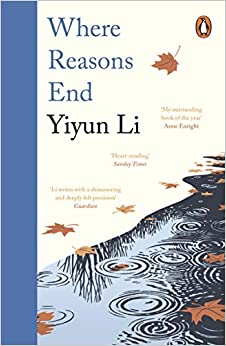
Where Reasons End – Yiyun Li (2019) 170 pages

Trigger warning: mentions suicide

Where Reasons End is a novella without a driving plot. It is written from the point of view of a grieving mother in dialogue with her dead son.

“I was a generic parent grieving a generic child lost to an inexplicable tragedy.”

The mother is a writer and is trying to make sense of what has happened in the only way she knows how.

“It was not a world of gods or spirits. And it was not a world dreamed up by me; even my dreams were mundane and landlocked in reality. It was a world made up by words, and words only. No images, no sounds.”

She does this with the full knowledge that she will never make sense of such an immense tragedy. Her son Nikolai died by suicide aged 16. In the space they occupy together on the page he is just as argumentative and contrary as any other teenager. It’s hard to know if Nikolai’s attitude is the mother/writer trying to convey how her son was in life, or if his harsh judgements are in fact the judgments and anger she feels towards herself.

“Since when have you become an avid consumer of inane analogies and inept metaphors? Nikolai said.”

As the title suggests, Where Reasons End does not aim for facile conclusions. There’s no way to reason out something so horrific that it is beyond all reason. This means that Nikolai is not a fully rounded character. We know certain facts of his life and we get a sense of who he may have been, but Li does not allow us the easy escape of trying to piece together why he would do such a thing. He remains out of reach to the reader in a reflection of how he was and is out of reach to those who love him.

“You cannot demand that everyone be perfect.

I can forgive everyone, he said, for being imperfect.

But not yourself.

I tried, Mommy, I did try.”

if I’ve made Where Reasons End sound a very heavy read I’ve done it an injustice. It concerns an immensely painful subject but there is humour in it too, such as the mother/child arguments between an exhausted parent and a petulant teenager. Nikolai’s unhappy that his mother has bought a real Christmas tree the first festive season after he died:

“Whatever, he said.

Oh, judgemental as ever, I protested in my thought. And unforgiving. And unyielding.

Yieldingly and forgivingly I inquire, he said, Did you decorate it?”

This is not the novella to read when you want a plot-driven story. But it is a sensitive and painfully real exploration of grief. Very sadly, from the in memoriam dedication at the start of the book, I believe that it is also drawn from real life experience.

“There is no good language when it comes to the unspeakable, I thought. There is no precision, no originality, no perfection.”

“Make your mistakes, next year and forever.” (Neil Gaiman)

Happy New Year!  I’ve quoted the lovely Neil Gaiman to start off 2014, and do please check out the full context of the quote here, as I’m sure it will get your year off to a flying start.  Here’s to many more mistakes in 2014!

And now, I’d like to entirely ignore New Year.  This is a blog post for my brother.  His birthday is 1 January, and it’s a crap time to have a birthday.  It gets entirely subsumed in Christmas and New Year, and once you’re no longer a child, everyone you know spends your birthday with a monster hangover.  Rubbish.

Like Neil Gaiman, my brother is a lovely man, who despite reading very little fiction always reads my blog posts and likes them on Facebook.  That’s who we’re dealing with, people.  So what to write about? Well, he likes poetry and I think he has a really good feel for it, an innate understanding.  So this post will look at two poems that I think he’ll appreciate. This is for you, T.  Entirely for you with no thematic link to New Year at all.  Happy Birthday, brother of mine.

Image

(Image from: http://hdwallpaperspictures.com/birthday-cake/)

Firstly, The Door by Miroslav Holub (trans. from Czech by Ian Milner).  You can hear Joseph Fiennes read the whole poem here. This is a hugely clever poem, disguised in simple language.  The poet repeatedly urges the reader to “Go and open the door”, and speculates as to what is on the other side.  The first stanza is:

Go and open the door.

Maybe outside there’s

a tree, or a wood,

a garden,

or a magic city.

This is a poem you can read to a child: the idea and language is so simple, they will quickly relate to the opportunity to let their imagination run riot.  Yet it works on a variety of levels that adults can appreciate, and can be about the search for inspiration; the courage to take new, unexplored paths in life:

Go and open the door,

If there’s a fog

it will clear.

Go and open the door.

Even if there’s only

the darkness ticking,

even if there’s only

the hollow wind,

even if

nothing

is there,

go and open the door.

The images of “darkness ticking” and “hollow wind” are eerie, and add an unsettling quality to the poem.  They bring a sense of form to the formless, effectively creating how the unknown can still be scary. However, this door and what lays beyond is not entirely unknown; I think one of the really clever things about this poem is that the door is a definite article: “the door”, not the indefinite “a door”.  It’s a small thing, but by suggesting the door is specific one, Holub delicately reminds us that this door to new ideas and new ways of living is within reach, already identified, carried within ourselves.  And if nothing else, the final lines remind us:

At least

there’ll be

a draught.

A lovely, humorously deprecating end to an unpretentious poem that can follow you through life.

Secondly, A Glimpse of Starlings by Brendan Kennelly. You can read the full poem here.   This is an astonishing and powerful poem, full of intriguing imagery. It begins:

I expect him any minute now although

He’s dead. I know he has been talking

All night  to his own dead…

It’s not clear who “he” is, or if he is really dead, or only living among the dead.  Googling this poem tells you it is about the poet’s father, struggling to deal with the loss of his wife.   The struggle is beautifully and tenderly evoked through a variety of images:

Sipping a cup of tea, fingering a bit of bread,

Eating a small photograph with his eyes.

The questions bang and rattle in his head


[…]Daylight is as hard to swallow as food

Love is a crumb all of him hungers for.

How gorgeous, and heartbreaking, are those lines?  The frequent use of full-stops keeps the pace of the poem low-key and quiet, creating a sense of the poet’s careful approach towards the grieving man.  The transfer of images between food and the environment “eating a small photograph”, daylight being “hard to swallow”, skilfully shows how the sustenance of a man’s life has disappeared, affecting everything.  The hungering for a crumb of love is a beautiful way of evoking the yearning emptiness of grief that can never be sated.

The image of starlings is created in the last few lines:

…over his shoulder a glimpse of starlings

Suddenly lifted over field, road and river

Like a fist of black dust pitched in the wind.

This is an oblique image so I’ll leave it with you to find your own meaning.  I find this poem extremely powerful and the images truly haunting.

To end, here is a video of the astonishing display of a murmuration of starlings:

I hope you liked them, T. Have a great day one and all!