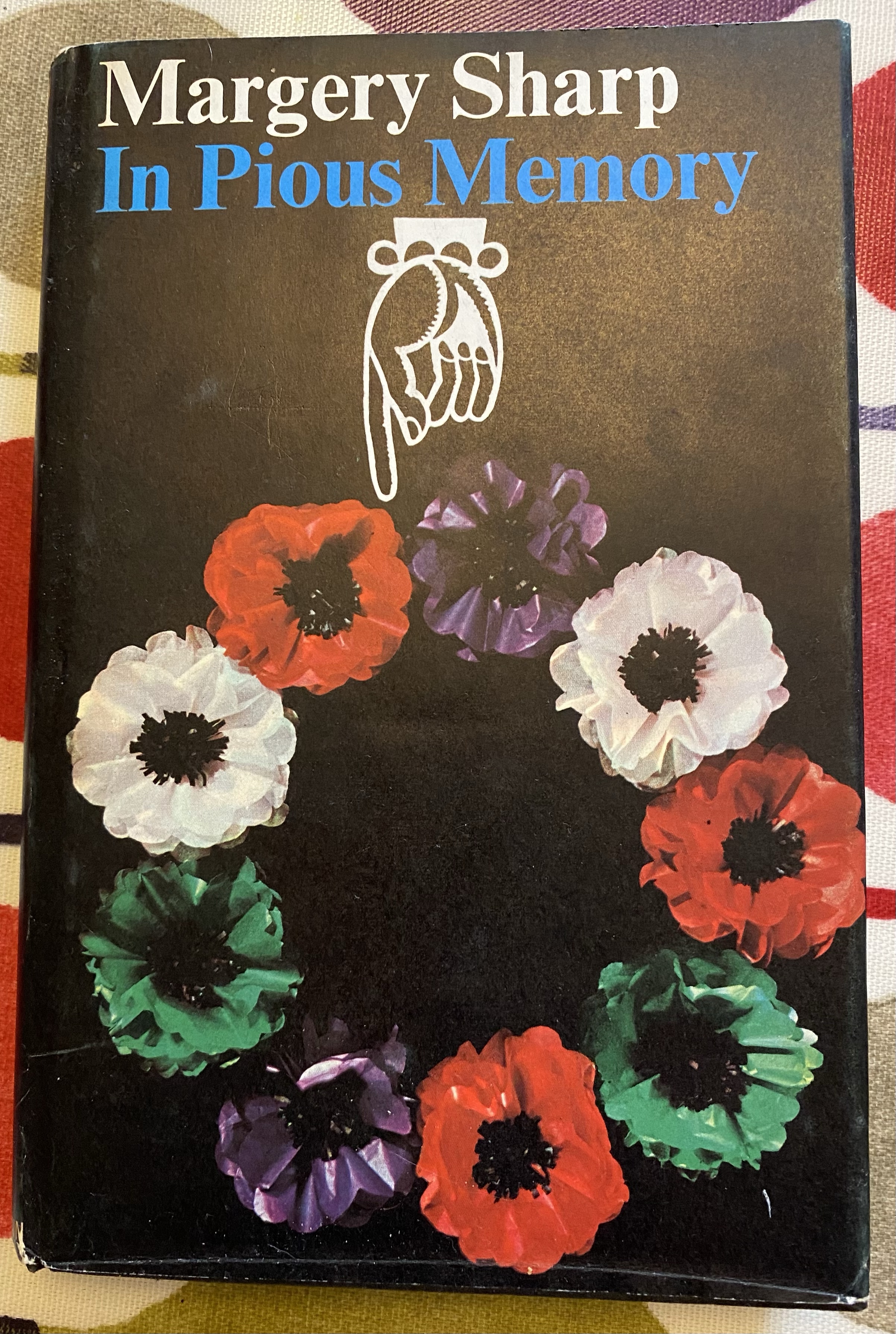
In Pious Memory – Margery Sharp (1967) 160 pages
Today Simon and I are both reviewing In Pious Memory by Margery Sharp, given that Simon had recently acquired a copy, and I’d been meaning to drag mine out of the TBR since Ali’s wonderful review for Novellas in November.
I’m a big fan of Margery Sharp and I enjoyed In Pious Memory a lot. It has her gentle sense of the ridiculous and her fond acceptance of human foibles to the fore, making it a solid comfort read.
It opens with the death of Arthur Prelude, a man who, while inoffensive, seems to have been a monumental bore to all who knew him personally, giving all his energies to his professional life.
“His giant intellect was housed in but an average body – indeed rather below average; average only in the sense of being unremarkable: all the more startling therefore was the effect when on rostrum or at banquet board he suddenly rose to his feet and let his intellect loose like a line from a mouse-trap. Mrs Prelude naturally never witnessed this transformation herself, she was always at home in the hotel bedroom sterilising his inhaling-apparatus with water boiled over a portable methylated-spirit stove; but other wives told her about it.”
His wife was utterly devoted, his adult children a lot more clear-sighted:
“‘Well. of course,’ said Elizabeth. ‘Mother’s of her generation. She behaved quite marvellously, after the crash, and if she’s been crying ever since, it’s only natural.’
‘As it’s natural for us to remain dry eyed?’
‘I suppose so,’ said Elizabeth. ‘After all we didn’t know father very well.’”
Despite Elizabeth and William’s resolution that “‘We must all be very kind to mother, and find her that flat in Hove at once.’”, their younger sister Lydia – determinedly romantic, and set for a career on the stage – decides her father is wandering around the Alps and needs to be found. In this endeavour, she enlists the help of her cousin Toby, and they go biking off across mainland Europe.
Meanwhile, Arthur Prelude is becoming a lot more likable in death than in life, as fictitious memories of his warmth and affection grow and take on a life of their own:
‘We should have lied to mother sooner,’ said Elizabeth.
‘How could we, while father was still alive?’ countered William.
Will Mrs Prelude be able to see past the false memories of her crashing bore husband towards new romantic opportunities? Will Lydia and Toby find Arthur wandering round the mountains in amnesiac shock? Will William get married and will Elizabeth avoid marriage? Absolutely nothing of serious consequence occurs, thank goodness.
In Pious Memory gently ribs questionable veneration of the dead and reminds us all to appreciate the now, imperfect as it may be.
You can read Simon’s thoughts on this novella here.
 madame bibi lophile recommends