This was a really challenging read, and though an astounding work, I was grateful for the novella length as it was tough to take.
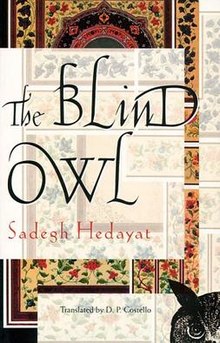
Sadeq Hedayat was an Iranian writer and is considered an innovative titan of Persian literature; he’s a best-selling author in his home country. This novel was initially banned on publication, and according to Wiki there is still censorship of his work (I’ve not linked to the Wiki page because much to my horror there’s a picture of his dead body on it). Sadly, he died by suicide, and The Blind Owl certainly feels authentic in its portrayal of someone losing all sense of reality and suffering mental ill health. I’m giving this post a trigger warning for some pretty disturbing imagery in the third quote, although I’ve not picked the worst in the novella, I wanted to give a true sense of it.
“Will anyone ever penetrate the secret of this disease which transcends ordinary experience, this reverberation of the shadow of the mind, which manifests itself in a state of coma like that between death and resurrection, when one is neither asleep nor awake?”
The unnamed narrator earns his living by painting pen cases. He may or may not have killed someone:
“How could I have resisted it, I, an artist, shut up in a room with a dead body? The thought aroused in me a particular sensation of delight.”
It’s a disorienting narrative. It’s not clear what is true or false: the events described could be entirely in the man’s head and what The Blind Owl describes is him lying on his bed, thinking/hallucinating. It’s a stream of extremely disturbed consciousness. Images and events recur and shift slightly, adding to a sense of disorientation and being witness to someone’s spiralling thoughts.
“A sensation which had long been familiar to me was this: that I was slowly decomposing while I yet lived. My heart had always been at odds not only with my body but with my mind, and there was absolutely no compatibility between them. I had always been in a state of decomposition and gradual disintegration. At time I conceived thought which I myself felt to be inconceivable.”
The narrator has no compassion for humanity and this is what adds to making The Blind Owl such a tough read. He is misanthropic, and so the coldly related details of violence, dead bodies and decomposition are truly horrifying.
I don’t want to put people off reading The Blind Owl because it is truly a brilliant piece of writing, but definitely one for when you’re strong enough to take it, with a comforting escapist read lined up for afterwards.
“Am I a being separate and apart from the rest of creation? I do not know. But when I looked in the mirror a moment ago I did not recognise myself.”
August is Women in Translation month, hosted by Meytal at Biblibio. Do head over to her blog to read more about WITMonth and join in!
Throughout August I’m hoping to post entirely about women in translation, and this week I’m looking at two women who are famous animators as part of their writing.
Firstly, Tove Jansson, who was the creator of the Moomins.
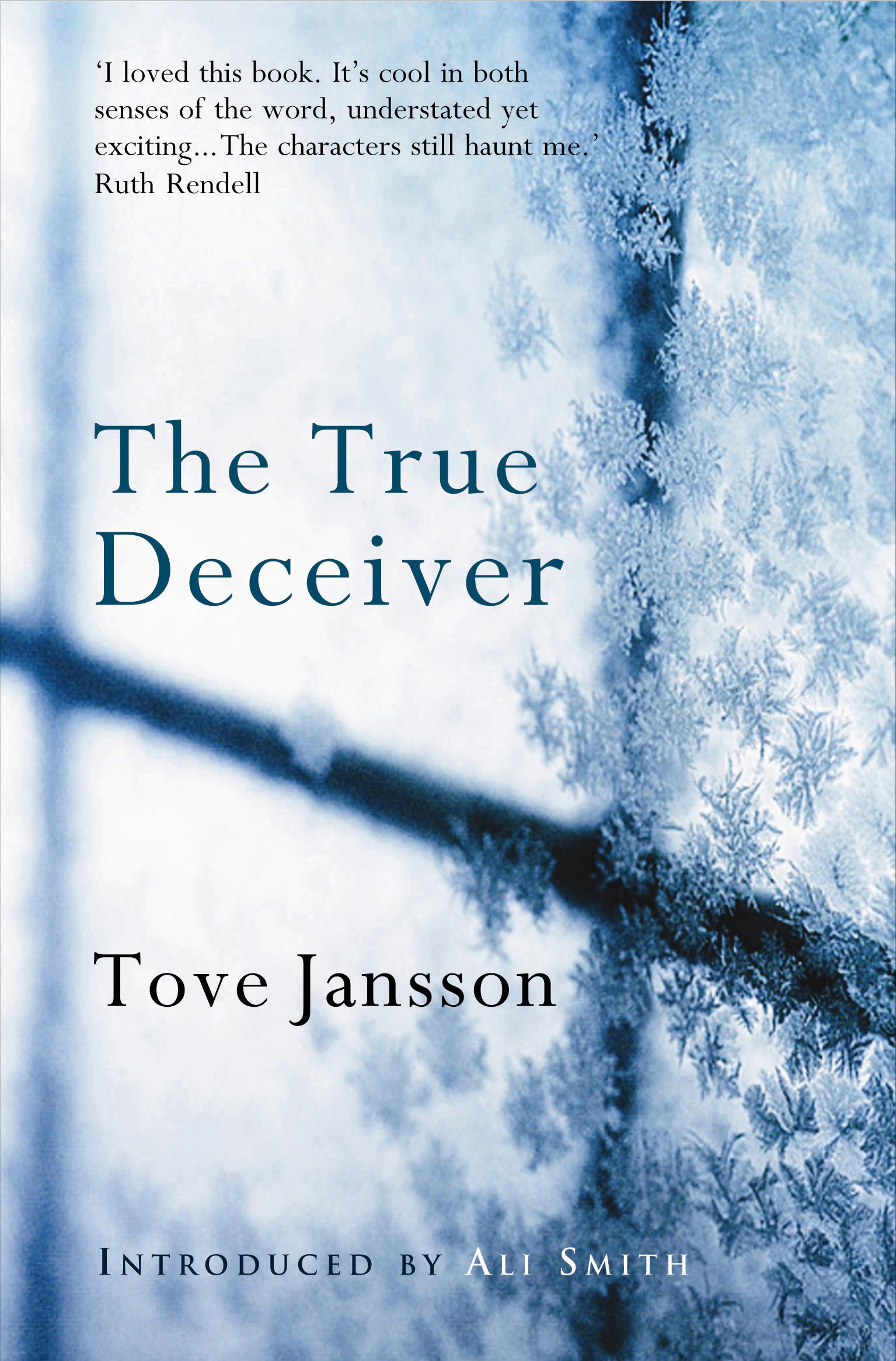
Jansson also wrote novels for adults and Sort Of Books have done a great job making English translations available. The True Deceiver (1982, trans. Thomas Teal 2009) is a simple, unsettling tale set over a winter in a snowbound hamlet in Finland.
Katri Kling is a young woman in her 20s who lives with her brother Mats and her nameless Alsatian dog, keeping herself to herself.
“Every night I hear the snow against the window, the soft whisper of the snow blown in form the sea, and it’s good, I wish the whole village could be covered and erased and finally be clean…Nothing can be as peaceful and endless as a long winter darkness, going on and on, like living in a tunnel where the dark sometimes deepens into night and sometimes eases to twilight, you’re screened from everything, protected, even more alone than usual.”
Meanwhile, Anna Aemelin is an animator who lives on the outskirts of the village. If Katrin seems old beyond her years, Anna has stayed somewhat infantalised despite now being quite old. She eats soft food out of tins, has a cleaner to take care of the huge house she’s lived in her whole life, and has no idea how to manage her money.
“Perhaps the reason people called Anna Aemelin nice was because nothing had ever forced her to exhibit malice, and because she had an uncommon ability to forget unpleasant things. She just shook them off and continued on her own vague but stubborn way. In fact, her spoiled benevolence was frightening, but no-one ever had time to notice.”
Katrin sets her sights on Anna’s house, and so the two women collide:
“That’s where she lives. Mats and I will live there too. But I have to wait. I need to think carefully before I give this Anna Aemelin an important place in my life.”
What follows is a study of the tense, odd relationship that these two women build together. They are both quite damaged in different ways, and they are both loners. Mats has an unspecified learning difficulty and so he operates outside of this dynamic; it is very much about the two women. Mats is Katrin’s motivation though, and they are close without communicating much to one another:
“They owned a silence together that was peaceful and straightforward.”
This is not a story for those who like dramatic events and everything explained. What Jansson does expertly is portray these two women and the development of their relationship. She is entirely unsentimental – neither woman is particularly likeable – but the quiet, suffocating way she builds the story is compulsive.
“Anna walked faster, looking only down at the road. Several neighbours passed by, but she didn’t notice their greetings, just wanted to get home, home to the dreadful Katri, to her own altered world which had grown severe but where nothing was wicked and concealed.”
I really adore Jansson’s writing. It is beautiful but not overdone; pared down to its essence, she takes an incisive look at human relationships and never wastes a word. The True Deceiver is compelling and totally believable.
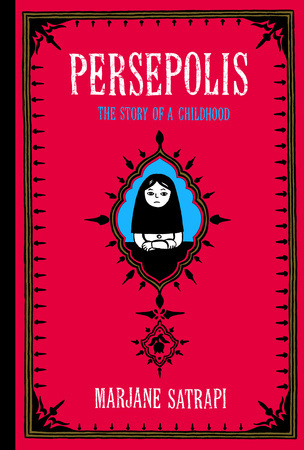
Secondly, Persepolis by Marjane Satrapi (2003, trans. Anjali Singh 2004). This is a graphic novel so please bear with me as I hardly ever read graphic novels and I’ve no idea how to write about it. Set in Iran, this is one more stop on my Around the World in 80 Books Reading Challenge, hosted by Hard Book Habit.
Persepolis was made into a film in 2007 and uses the animation from the novel (it was co-written and co-directed by the author), so this trailer gives a good idea of the artwork:
Satrapi’s drawings are stark and simple in black and white and without excessive detail. As a result her images are incredibly strong and impactful, with nothing to distract from the central message each picture conveys.
The story is a powerful one. Marjane, born in 1970, grows up in tumultuous times in Iran. Her parents are liberal Marxists who allow their daughter a great deal of freedom, but after the Islamic Revolution in 1979 she has to wear a veil and be careful how she behaves in public. Young Marjane is religious and converses with God, but her favourite book is Dialectic Materialism where Marx and Descartes debate the meaning of the material world. “It was funny to see how much Marx and God looked liked each other. Though Marx’ hair was a bit curlier.”
Marjane learns about the history of her country and her family, having descended from Iran’s last emperor. Western culture appeals, while at the same time she knows that Britain conspired with the CIA in 1953 to depose Mossadeq after he nationalised the oil industry, to return the Shah to power (side note: when our previous Prime Minister Tony Blair was busy starting illegal wars in the Middle East, he had to be told who Mossadeq was, because he couldn’t understand Iranian hostility to Britain. I don’t even know where to begin with that.)
Her beloved uncle Anoosh is arrested and asks to Marjane for a final visit before he is executed. The scene where he holds her and calls her “Star of my Life” I found so moving. You can view it on Pintrest here (it’s really hard to write about a graphic novel without images! But I’m worried about copyright infringement ☹)
Persepolis follows Marjane as she leaves Iran for Austria, and her return four years later. We see her growing up, meeting boys, trying drugs, going to parties. She struggles to accept herself, feeling too Persian in Europe and too European in Iran. At times she loses her way, but always returns to her grandmother’s advice:
“There is nothing worse than bitterness and vengeance…always keep your dignity and be true to yourself.”
Persepolis covers absolutely massive themes and is a remarkable achievement. International politics, religion, feminism, identity, social responsibility, extremism, idealism, familial love, are all here. The fact that it’s in graphic novel form mean that it never feels a heavy read and yet Persepolis doesn’t pull its punches or aim to make difficult truths easy for the reader. I’ve not remotely done it justice here.
To end, Marjane loves her hard-won Kim Wilde tape. Here’s the lovely lady herself aged 20, making her TOTP debut:
 madame bibi lophile recommends