“Admit that you deserve forgiveness.” (Niamh Mulvey, The Amendments)

This is my final post for Reading Ireland Month, hosted by Cathy at 746 Books. I’ve really enjoyed my reading for the event with so many strong, memorable voices, and this choice was no exception.

I heard about The Amendments by Niamh Mulvey (2024) through Susan’s review.  It was so appealing I decided it would be my indie bookshop purchase of the month (I need to stop saying I have a resolution to buy one book a month from an indie bookshop or publisher, because it’s never just one 😀 ) and it was a great choice.

There are three main timelines throughout the novel. In London, 2018 Nell’s partner Adrienne is pregnant with their first child and Nell is spiralling with anxiety and ambivalence.

“Adrienne, unfortunately, was not just an object, not just a saviour, not just a happy ending. Adrienne, it turned out, was a person with her own dreams and needs and desires. And those were: more life, more love, which was to say, which is to say – a baby.”

In Ireland, 1982 Nell’s mother Dolores has left home and moved to Dublin, where she becomes involved in a feminist group campaigning for pro-choice reproduction rights (one of the amendments of the title, the other taking place in 2018).

“‘The biggest problem in this country is that people are so scared of asking questions. I don’t know why we’re all so afraid of each other.’

Mary laughed suddenly as if she had only just realised this. She looked at Dolores, as if they were both sharing in this joke, this realisation, together, and Dolores laughed too, though she was uncertain, she felt there was so much she did not yet see.”

In Ireland 2001, studious Nell is struggling with her sexuality and has joined an all-female religious organisation hoping for answers:

“She returned to school that September feeling as if the things she used to count on were all changing in ways she did not at all approve of and this disapproval extended to include her own feelings.”

It is the escalation of events at this time which drive the novel. Nell is so confused, so full of feelings she doesn’t know what to do with, and this builds to a tragedy truly awful and very believable.

Loving Adrienne and recognising that her unresolved feelings from this time threaten her present, Nell agrees to couples therapy. But in order to be entirely honest with both herself and Adrienne, Nell needs to return home to Dolores.

Dolores has deep regrets from her past too, as well as her contemporary worries about Nell. What Mulvey demonstrates so clearly is how much can go unsaid even in relationships grounded in a deep love, and how damaging this can be.

“Dolores wakes up every day of her life with a feeling of worry around Nell, the pain is like a muscle that aches with overuse.”

In exploring the characters’ past and moving them towards a more hopeful future, Mulvey juggles the timelines and the themes with great subtlety. Multiple timelines are always tricky but these were finely balanced throughout and each enhanced the understanding of the other.

The healing that occurs felt hopeful without being sentimental. Nell achieves self-acceptance, if not quite self-forgiveness; resolution if not redemption.

I thought The Amendments was hugely accomplished and very readable. The various female characters were all well-realised and the plotting tight. Mulvey treats her characters with such humane compassion and I was rooting for them to be able to do the same.

“She looks at herself in the mirror and she reflects that all living things want to survive. And it is such a relief to include herself in that humble category of all living things.”

To end, an interesting interview with the author expanding on the societal context of The Amendments:

“One of the luckiest things that can happen to you in life is, I think, to have a happy childhood.” (Agatha Christie)

My Name is Leon by Kit de Waal was published to great acclaim in 2016, and it was one of those books I kept meaning to read but putting off. I thought the story of a boy in the 1980s care system, trying to be reunited with his baby brother who has been adopted, would be unbearably sad.

Kit de Waal grew up in Birmingham with an Irish mother and father from St Kitts, and she holds dual Irish/British citizenship. So I decided that this year’s Reading Ireland 2024 aka the Begorrathon, hosted by Cathy at 746 Books was the time to finally get to it, and I’m so glad I did!

At the start of the novel Leon is almost nine years old and living with his mum Carol, with his father absent in prison. Carol’s just had a baby, Jake, who has blonde hair and blue eyes, unlike Leon who is mixed race. Leon is devoted to his younger sibling, and tries to take care of him as best he can.

“After a few weeks, Carol says Leon can’t go to school because it’s too wet and rainy. That means Leon can play all day and put the television on and make toast if he’s hungry. Carol leaves him in charge when she goes to the phone box and when she comes back she’s out of breath and asks him if the baby’s alright. Leon would never let anything happen to the baby so she worries for nothing.”

A child’s point of view is hard to get right but I thought de Waal created a really authentic voice for Leon (if you look at her Wiki page you’ll see her lifetime of experience that led to her writing this novel.) Leon is old beyond his years, but there is still so much he doesn’t understand.

“He hopes that Jake won’t grow up to be like his dad and say dangerous things in a quiet voice. Leon only smiled because it was polite. If the man comes back, Leon won’t smile a second time. He will be on his guard and he’ll protect Carol and Jake and then he won’t get shouted out.”

Carol has a complete breakdown, and so Leon and his brother are put into foster care, a situation Leon is familiar with.

“Social workers have two pretend faces, Pretend Happy and Pretend Sad. They’re not supposed to get angry so they make angry into sad. This time, they’re pretending to care about him and Jake and his mum.”

Maureen is the experienced carer who takes them both in and I thought she was a wonderful creation. Loving and caring, tough and optimistic. She’s flawed but she gets the important things – authentic, deep care for a child – right.

“He’s heard Maureen swearing loads of times, like when she called Margaret Thatcher a bloody cow because of the miners. And once she said Margaret Thatcher could kiss her arse and Leon laughed and got caught earwigging. Maureen says that if he keeps listening to people’s private conversations his ears will shrivel into prunes and drop off. Leon always checks his ears at night just in case.”

When a couple adopt Jake, we witness Leon’s heart shattering. Maureen objects to the siblings being split up, but the decision by social services is that it is better to have one child adopted – the blonde-haired, blue-eyed baby – than none at all. And in case this seems like a period piece, just a few years ago, a social worker told someone I know that children aged over seven and in care were ‘on the scrap heap’ because the majority only want to adopt babies.

“Maureen wipes Leon’s face with the corner of her dressing gown but because it’s made of the same silky stuff as the cushions his face is still wet and begins to itch.

‘You will be alright, Leon. You will be alright.’

Leon uses the tea towel again because it’s better for tears.”

The rest of the novel sees Leon plotting to reunite his family. This involves stealing money and stockpiling supplies. He’s confused, troubled, and furious. He’s intelligent, kind and vulnerable.

At the same time, he has many adults who care for him. Maureen and her purple-haired sister Sylvia; The Zebra his social worker “but out of all the social workers he’s ever had, she looks at him the most. And when he looks away, she stops speaking until he turns round.” When he discovers the local allotments, he makes friends with further adults. Tufty provides a black male role model, and there is also Mr Devlin, an Irish man whose traumatic past the reader picks up more quickly than Leon.

de Waal balances this story perfectly. The urban setting (which some readers on goodreads have assumed is London but I definitely thought was Birmingham, including the Handsworth riots), is evoked with authentic 1980s details including Curly Wurlys and BMXs. The realities of Leon’s life, racism, and police brutality are not shied away from, but they are shown to sit alongside kindness, compassion and selflessness.

“Leon eats his toast sitting on the carpet by the patio doors. It’s supposed to be summertime but the sky is the same colour as the garden slabs, dull and grey, like the road to school, the cut-through to the precinct or the dirty lane between the tower blocks and maisonettes.”

All the adults in Leon’s young life are flawed, but none are judged harshly. Carol is shown to be extremely unwell. The social workers take damaging decisions but it’s not through disregard of the children. Those who care for Leon make mistakes and struggle to take care of themselves at times, while providing love and respite for a young person with the odds stacked against him.

My Name is Leon is a story of someone learning how to mend a broken heart at an age when you really wish they had no idea of such pain. It’s a story of resilience and all that human beings can give one another, despite our myriad imperfections. I shoudn’t have left it lingering in the TBR for so long.

To end, the trailer for the BBC adaptation of My Name is Leon, which I’ll try and find to watch now. The cast looks stellar – Lenny Henry (who narrated the audiobook and bought the rights), Christopher Eccleston and the peerless Monica Dolan alongside Cole Martin in his first acting role as Leon:

“I must love a loathed enemy.” (Romeo and Juliet, Act 1 Scene V)

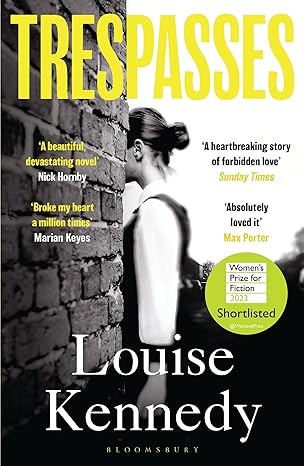
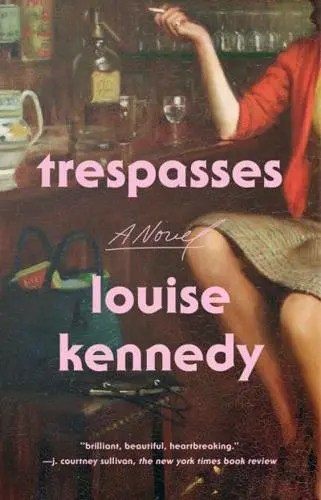
I’m not sure there’s much I can add to the cacophony of praise that Trespasses by Louise Kennedy (2022) has garnered. In fact I did consider not writing a post at all. But in the end because it moved me so much I thought I’d jot a few thoughts down as part of Reading Ireland 2024 aka the Begorrathon, hosted by Cathy at 746 Books. It’s also a stop on my Around the World in 80 Books reading challenge.

A summary of the plot doesn’t do this finely-crafted tale justice.

Cushla Lavery is a Catholic teacher, twenty-four years old and working at a school in a garrison town in 1970s Northern Ireland. She also helps out at her family’s pub, which is where she meets Michael Agnew – around twice her age, Protestant, and married. The attraction is instant and mutual.

“Countless times she had replayed the evening in her head, searching for the word or gesture or pronunciation that had repelled him, that had shown she was too young, too unsophisticated, too Catholic. It seemed piteous now that she had opened her college Irish books at Penny’s messy, elegant table, desperate to impress him. Perhaps she had been too obviously besotted with him.”

They know they have to keep their relationship secret. At the height of the Troubles, they are different religions and Michael already attracts attention through his work as a barrister defending those accused of killing members of the Royal Ulster Constabulary (RUC).

This is a time when politics and violence are woven through the daily lives of people in an immediate way. Cushla has to tread carefully around British soldiers in the pub, the threat of their brutality insidious and palpable. On the way to a party with her colleague and friend Gerry, they are stopped at an army checkpoint. At the flat where Cushla and Michael meet, she tells him not to sit with the lights on and curtains open, and her trepidation is not only due to their forbidden relationship…

Meanwhile, other aspects of life don’t stop. Her grieving mother Gina is self-medicating with gin. A boy in Cushla’s class, Davy McGeown, is bullied because he is from a mixed-marriage family and he ‘smells’ – his mother can’t hang the washing out because the neighbours throw dog dirt at it. His vulnerability is noticed by the priest Father Slattery, who everyone knows shouldn’t be left alone with children.

“Michael said there were all kinds of families. Cushla’s was an unhappy one. What was his like?”

The strain of daily life, living under the misuse of power both political and religious, is brilliantly realised. The narrative is incredibly tense, and the 1970s details are vivid.

The contrast of these tensions with the tender love between Cushla and Michael is subtly portrayed and never jars. Their relationship is believable, and while Michael is known to be “Fond of the women, by all accounts. Sure he’d charm the knickers off you.” he never seems creepy. Cushla is young but not naïve. They know what they have is unlikely to end well and yet they cling to it, the human need for love asserting itself over all that would seek to subdue it.

“She was overcome with a feeling of utter defeat. She wanted to lie on her bed and sleep, but had been unable to say no to him. It wasn’t because he had been kind to her. It was because each time she saw him she was afraid it would be the last time.”

It was the resilience Kennedy portrays which ultimately I found so moving. Not only with Cushla and Michael but in those that surround them, and particularly with Davy McGeown, a bright child caught up in a situation he barely comprehends.

“Booby trap. Incendiary device. Gelignite. Nitroglycerine. Petrol bomb. Rubber bullets. Saracen. Internment. The Special Powers Act. Vanguard. The vocabulary of a seven-year-old child now.”

Kennedy is not remotely sentimental but she is compassionate. She doesn’t judge people or the situation. Through creating recognisable, fully realised characters struggling to live the best way they can, Trespasses is a stunning exploration of the endurance of human spirit.

“For the umpteenth time Cushla wished her parents had called her Anne or Margaret or Rose – not Mary, with its connotations of Marian shrines and rosaries – any name that didn’t mark her out as so obviously a Catholic. She felt guilty for the thought which, she realised, also marked her as a Catholic.”