“People were capable of being many things at once.” (Sarah Gilmartin, Service)

I was a bit wary approaching Service by Sarah Gilmartin (2023) as I’d not long finished an issue-driven novel which I thought never quite managed to create characters who existed believably beyond the issue itself. Service has been described as a #MeToo novel, looking as it does at sexual assault and the structures that enable predators to not only get away with it, but thrive. However, when I saw it in my much-beloved charity bookshop during Cathy’s Reading Ireland Month it seemed perfect timing, and I also remembered that Susan had rated it.
The story is told from the point of view of three characters in alternating chapters.

Hannah, now in her thirties and selling her home as she and her husband divorce, looking back on time when she was a student and a waitress at T, a swanky restaurant reaping the rewards of boomtime Dublin;

“And there was Daniel, of course, we all loved Daniel. The skill, the swagger, the hair, even the naff red bandana that he sometimes wore during prep. We were in awe of him, of the fact that he didn’t seem to care about anything except the food. Serious cooking and good times, that was the dream we sold at T, over and over again.”

Daniel, the celebrity chef who oversaw T, now accused on Facebook of rape by an employee and facing criminal trial;

“Tomorrow the farce begins in earnest. Tomorrow I’ll see that ungrateful wench in person for the first time since she sat at her computer and pressed destroy.”

And his wife Julie, there throughout it all and trying to keep a home running for their teenage sons.

“I knew that you were not the kind of man who would come in the door of an evening and ask about your family. You were too full of your own stories, your voice set to megaphone inside your head, while the rest of us whispered asides. I knew this and I still said yes.”

This isn’t a he said/she said thriller – the way the stories and voices are presented it’s clear that Daniel did it. I thought this was a clever decision, as it frees Gilmartin instead to really focus on the characters’ lives within the various systems of enablement surrounding Daniel. He doesn’t see himself as a predator: why would he, when he is venerated – his toxic, controlling behaviour lauded?

“In that long, hot room that was fuelled by aggression and banter and occasional lines of speed, everything was sexualized.”

Daniel’s narrative is unreliable of course, and Gilmartin cleverly presents it in a way that the reader isn’t sure if he believes it himself. Is he consciously lying, or does he not recognise his actions as rape? He’s deluded enough to think all women want him really, and whether they say ‘no’ to him is a matter of indifference – like everything else they say. In a misogynistic culture where women are commodified and discardable the minute they reach thirty, their careers in front-of-house dependent not on skills or talent but on the approval of the straight-male gaze, where his own wife refers to ‘sluts’, he probably sees what he does as his entitlement.

I’ve seen some readers saying they vacillated with regard to the characters, but this wasn’t my experience with Hannah or Daniel. Where I did change somewhat was with Julie. I found her internalised misogyny infuriating, along with her astounding naivete that somehow a man who has plenty of women willing to sleep with him would therefore not assault anyone.

“How did I not know my husband was a predator? Somehow, I have no answer, beyond some ferocious thought, that all these years have meant nothing, marriage to mirage.”

“How do you weigh up the infinite exhibits of a decades-long marriage?”

But ultimately I saw her as a victim in the situation too, and it is Julie who pinpoints a fundamental societal attitude, so long ingrained, which silences women:

“I always had that ability, learned at such a young age – not to make a scene, not to dramatise, not to look for attention. Only the wrong kind of girls looked for attention.”

There is real tension in Hannah’s narrative as you know what is going to happen while desperately wishing it wouldn’t, and I thought the scene was handled sensitively and entirely non-gratuitously. The immediate fallout and enduring trauma are both believably portrayed.

When I initially read Service, I wondered if a limitation was the voices not being overly distinct from one another, but now, a few days on, I find Daniel’s voice has really stayed with me, the insidious toad (except I quite like toads). So unfortunately through not being able to shake him off I’ve realised my mini-criticism was mistaken!

The ending offered some hope while not being entirely unrealistic which I appreciated, not needing unrelenting bleak narratives right now. In an Author’s Note, Gilmartin explains that the barriers in the current legal system mean that the trial in the book would be unlikely to even occur in real life.

A girl like you.

It could be said in many different ways.”

“We cannot know from whose mouths the echoes of our lives will chime.” (Doireann Ní Ghríofa, A Ghost in the Throat)

I felt quite intimidated approaching A Ghost in the Throat by Doireann Ní Ghríofa (2020) for Cathy’s Reading Ireland Month. A piece of auto-fiction woven around a 18th century Irish-language lament, it sounded quite a challenge. Well, I picked it up and absolutely whizzed through it, finding it so compelling and intensely readable.

“When we first met, I was a child, and she had been dead for centuries.”

At the start of the book, Doireann Ní Ghríofa has three small children and is in the relentless, hazy, exhausting world of trying to keep a home for her family. She captures brilliantly the physical and emotional demands – particularly on women and on women’s bodies – of parenting. I’ve never had children and her visceral (but not shocking or gratuitous) portrait felt very real and immersive.

She loves motherhood and she finds pleasures in the domestic day to day, despite the pressures and demands of both:

“I coax many small joys from my world: clean sheets snapping on the line, laughing myself breathless in the arms of my husband, a garden slide bought for a song from the classifieds, a picnic on the beach, three small heads of hair washed to a shine, shopping list after  completed shopping list – tick tick tick – all my miniscule victories.”

But we are in no doubt that Ní Ghríofa’s life is not easy. She needs support, female support, and she finds it with eighteenth-century poet Eibhlín Dubh Ní Chonaill and her lament for husband – Caoineadh Airt Uí Laoghaire (The Keen for Art Ó Laoghaire) – who was killed by the British.

As Doireann Ní Ghríofa reads and re-reads the poem she has loved since childhood, she despairs at the limited translations and lack of information about the author:

How swiftly the academic gaze places her in a masculine shadow.”

As an Irish-language poet herself, Ní Ghríofa has translated her own poems and so she begins to translate the lament. It becomes something of an obsession, or at least a preoccupation, haunting her sleep-deprived life:

“between the twin forces of milk and text, weeks that soon pour into months, and then into years.”

She also juggles the demands of her own writing:

“I watched poems hurrying towards me through the dark. The city had lit something in me, something that pulsed, vulnerable as a fontanelle, something that trembled, as I did, between bliss and exhaustion.”

Ní Ghríofa brilliantly weaves in aspects of the lament alongside her own life. We learn of the difficulties she experienced in the past, as well as the challenges of her life now. There is a repeated refrain “this is a female text” as she explores how women’s lives have been obscured and disregarded throughout the centuries, and particularly women’s narratives:

“literature composed by women was not stored in books but in female bodies, living repositories of poetry and song.”

One of my favourite examples was this one:

“A family calendar scrawled with biro and pencil marks, each in the same hand – this is a female text.”

Ní Ghríofa writes about her family while keeping them obscured, respecting their privacy. This echoes her attempts to piece together Eibhlín Dubh Ní Chonaill’s life, existing as it did in spaces between the records of the men in her family. Eibhlín Dubh Ní Chonaill remains obscure and Ní Ghríofa has to use her imagination to fill in the considerable gaps.

Another echo is that Ní Ghríofa clearly adores her husband and children, and at one point rues the fact that she can’t write poetry for her husband the way Eibhlín Dubh Ní Chonaill does for hers. But actually I thought these very simply expressed sentences were a lovely tribute to him:

“With him, at last, I began to laugh. He entered my life with neither fanfare nor glamour. There was no elopement. He simply fell into step by my side, with his easy smile, his old t-shirts, his worn jeans, and his steady footfall.”

Although time is never specified, there is a sense of Ní Ghríofa’s family growing older and her work on the translation nearing an end, despite the frustrations:

“Such dedication, if nothing else, has permitted me to grow in slow intimacy with the poet herself, to discover the particular swerve of her thoughts and the pulse of her language.”

The translation is given at the end of the book.

I thought A Ghost in the Throat was incredibly accomplished. It manages to simultaneously convey the horrors witnessed by Eibhlín Dubh Ní Chonaill for English-speaking readers; the challenges of twenty-first century motherhood and female artistry; and the broader themes of women’s voices, lives and creativity being marginalised, with such a light touch. The writing is poetic but never overwritten and Ní Ghríofa’s voice so warm, honest and engaging.

“I have held her and held her, only to find that she holds me too, close as ink on paper and steady as a pulse.”

To end, the author reading from her work while sat in her car:

“People are better inside your head.” (Donal Ryan, The Thing About December)

I never take enough books away with me. So having finished The Garden of Evening Mists during my New Forest weekend, I ducked into the Oxfam Bookshop in Lymington and was gratified to find a copy of The Queen of Dirt Island by Donal Ryan (2022). Ryan is one of my favourite contemporary authors and I was yet to read his most recent novel.

Characters from his previous novel Strange Flowers make a reappearance here, but they are not the main focus. The story belongs to Saoirse Aylward, her mother Eileen, and her paternal grandmother Nana who all live together in Nenagh, County Tipperary.

We follow Saoirse from her 1980s childhood to her thirties, with the tensions and strains, and unwavering warmth and love that the women create within their family home.

Saoirse’s father died a few days after she was born and she sometimes feels guilty for not feeling his loss.

“Every other house in the small estate that had children in it also had a father, a living one.

None of them looked like they were of much use except for cutting grass with the same shared lawnmower, taking turns to cut the verges in the small green area at the front of the estate and the smaller green at the back.”

The Aylward women are an enclosed, loving unit, viewed as somewhat eccentric by the rest of the town. Eileen is uninterested in men for the most part, her heart lying with her dead husband. She is sweary and gruff and no-one understands why she and her mother-in-law are living together.

“She realised that she and her mother rarely spoke properly at all. That most of mother’s speech was indirect, utterances flung around like fistfuls of confetti, vaguely aimed and scattering randomly. But she supposed this to be the way of all parents and child relationships. Her mother told her every single night that she loved her.”

Nana might be less sweary, but in her own way she is just as direct, such as when speaking to Saoirse about her Uncle Chris:

“Whatever he was at inside me he made a pure hames of my pipework. He started as he meant to go on, anyway, that’s for sure.”

His brother Paudie has a dramatic and mysterious life, helping on the farm until he is suddenly arrested and sent to prison.

“They never looked comfortable down here in the angular lowlands of the estate. They were shaped to the contours of hills and hedgerows, their feet only sure on giving ground.”

Yet it is Saoirse’s teenage years that bring the most disruption to the house. Ryan is excellent at capturing this time, such as this description of Saoirse’s first boyfriend:

“His miasma of Lynx and sweat and stolen cigarettes, his uncertain swagger, his damp hand in hers.”

But Saoirse is learning about the darker sides of life too, which have previously not infiltrated her safe home: self-harm, domestic abuse, suicide, sexual assault. Her mother and Nana can’t protect her from everything.

And within her family, there is a threatening presence: her uncle Richard. He is her mother’s brother, and while Eileen is estranged from her family, her father has left her the titular land. Richard wants it back, and this tension bubbles in the background through the years.

The tone of The Queen of Dirt Island felt very well-balanced, not shying away from trauma but not unrelentingly bleak either. Nana in particular provided humorous moments. The women all felt fully realised and believable, their voices beautifully evoked.

This is not a novel to read for positive portrayals of men, however. Nana advises young Saoirse:

“You only get one life, and no woman should spend any part of it being friends with men. That’s not what men are for.”

The Queen of Dirt Island is a warm-hearted book, compassionate to its flawed characters, which was a joy to read. I could have spent another 200 pages at least with the Aylward women.

Ryan writes with a poetic restraint, and the story is told through a series of vignettes. Each section is 500 words including a title, and at just 242 pages it’s a really quick read. Thankfully I’d also found a collection of Dorthe Nors short stories in the Oxfam bookshop so I managed to keep myself going on the return journey home 😉

“She was glad of mother’s unwavering impolitic nature, her peculiar loving manner, and she knew that Nana loved mother with the same gruff constancy.”

To end, the author reading one of the vignettes, which I read in an interview was based on a childhood experience with his mother:

“I finished Ulysses, & think it is a mis-fire. Genius it has I think; but of the inferior water.” (Virginia Woolf) 

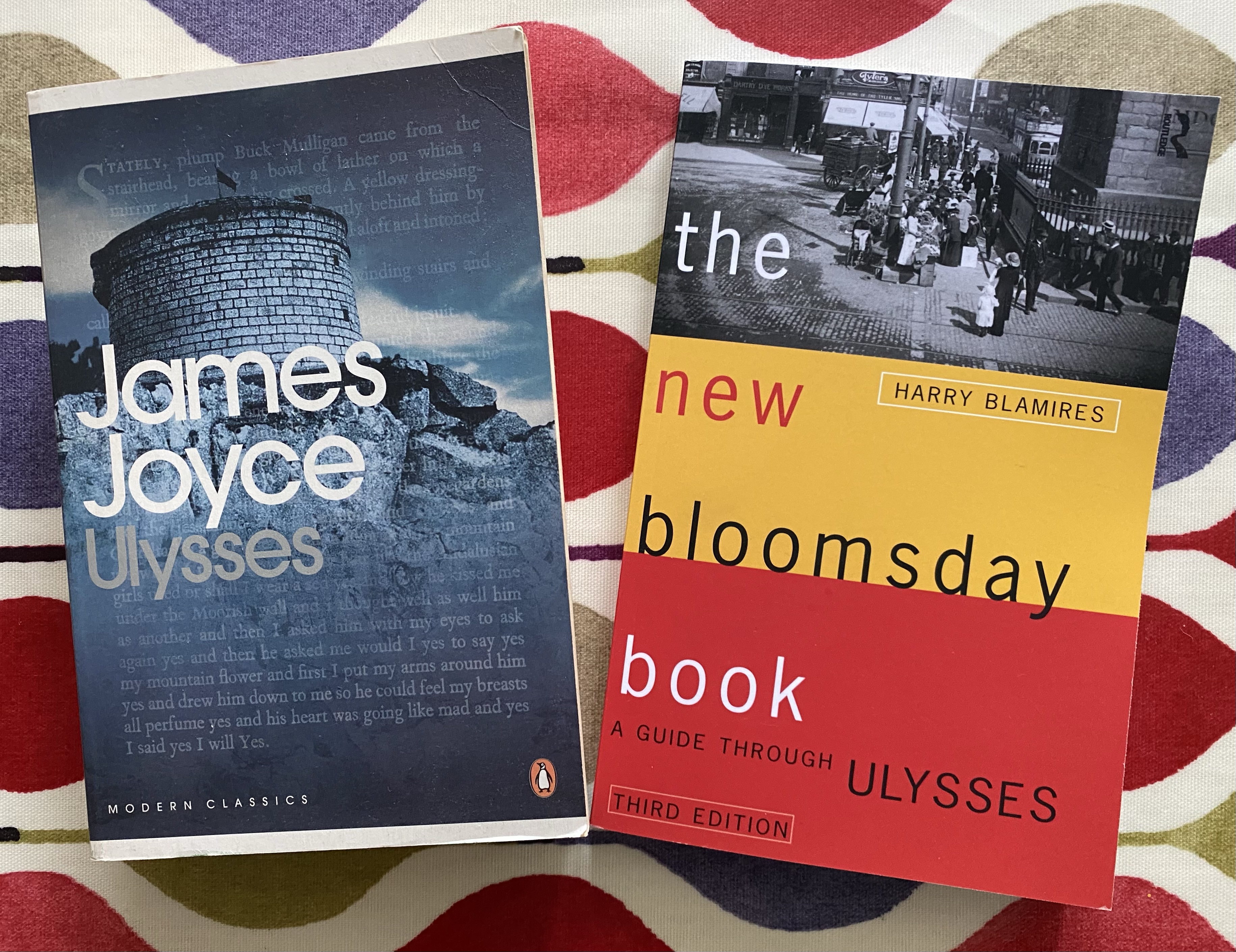
Today is Bloomsday, and the centenary of the publication of James Joyce’s Ulysses. I decided this meant I couldn’t put it off any longer and 2022 would be the year I finally cracked the spine on this tome (metaphorically of course – I don’t crack spines, I’m not an animal.)

When I read War and Peace back in 2017, I opted out of a review-type book post, intimidated at the thought of trying to say anything remotely coherent or interesting about such a revered novel. Instead I opted for a reading diary. Now here I am with a similarly revered, equally intimidating cornerstone of literature. There’s no way I can say anything useful about Ulysses, especially in its centenary year with all the celebratory events happening.

And so I present my Ulysses reading diary, neither coherent nor interesting! In fact, to manage any expectation of intellectual engagement with the genius of Joyce in this post, I should confess that the first hurdle I had to overcome in approaching the text was to get the Ulysses 31 theme tune out of my head (it’s probably unnecessary to explain here that I am a child of the 80s…)

Day 1

“Ulysses, Ulysseeeeees, soaring through all the galaxieeeeees….” Pesky earworm.

Normally if I’m told a book is difficult, I arrogantly assume I can do it. But Ulysses is genuinely intimidating. What I need to remind myself is:

  1. I really love James Joyce. Genuinely, Dubliners is one of my favourite-ever books. So I might even enjoy Ulysses.
  2. Other people have done it. I’ve even met some of them. Lovely bloggers left encouraging comments on my previous post where I explained what I planned to do.  It’s definitely do-able.
  3. I am not going in unarmed. I have The New Bloomsday Book: A Guide Through Ulysses by Harry Blamires (3rd ed. 1996) at my side. I’m almost certain I read on twitter that this was a good thing, and surely twitter is never wrong??

I’ve read the 80+ page introduction to my edition and now wonder if I should gain degrees in Classical Civilisation/Modernism/European History/Religious Studies before even attempting this novel.

I’ll start tomorrow.

Pages read: None. Pages remaining: 933

Day 2

OK, possibly I overreacted. I think maybe I knew too much in advance. In the end, I was amazed I could make it to the end of a single sentence. But so far Ulysses is beautiful yet also sordid, and very readable. I’m glad I’ve got the reading companion though, as there was complex word play around the word ‘melon’ that I definitely wouldn’t have picked up on my own.

Pages read: 140 Pages remaining: 793

Day 3

For such a learned, intellectual novel, Ulysses also manages to be emotionally affecting. Now I’m just under a quarter of the way through I’m finding Leopold Bloom very moving. There’s something pathetic about him, and isolated and sad, even among the crowds of Dublin.

“I was happier then. Or was that I? Or am I now I? Twentyeight I was. She twentythree. When we left Lombard street west something changed. Could never like it again after Rudy. Can’t bring back time. Like holding water in your hand. Would you go back to then? Just beginning then. Would you? Are you not happy in your home you poor little naughty boy? Wants to sew on buttons for me. I must answer. Write it in the library.

Grafton street gay with housed awnings lured his senses. Muslin prints, silkdames and dowagers, jingle of harnesses, hoofthuds lowringing in the baking causeway. Thick feet that woman has in the white stockings. Hope the rain mucks them up on her.”

Pages read: 218 Pages remaining: 715

Day 4

Fair to say my pace has slackened off today. I woke up with the book on my face, which upon removal revealed two hungry cats giving me the death stare.

Pages read: 250 Pages remaining: 683

Days 5, 6, 7

I’m sure a more attentive reader would get a lot more out of Ulysses, but as an inattentive reader I’m still really enjoying it. I especially like the section which the companion tells me corresponds with The Wandering Rocks in Homer. It’s 19 sections where, by following many characters for a short time, Joyce creates the hustle and bustle of the afternoon of 16 June 1904 in Dublin. He does this as much through the inner lives of his characters and their interactions with one another, as with description. Having said that, here are some descriptions which caught me:

“Two carfuls of tourists passed slowly, their women sitting fore, gripping the handrests. Palefaces. Men’s arms frankly round their stunted forms. They looked from Trinity to the blind columned porch of the bank of Ireland where pigeons roocoocooed.”

“Stephen Dedalus watched through the webbed window the lapidary’s fingers prove a timedulled chain. Dust webbed the window and the showtrays. Dust darkened the toiling fingers with their vulture nails. Dust slept on dull coils of bronze and silver, lozenges of cinnabar, on rubies, leprous and winedark stones.

Born all in the dark wormy earth, cold specks of fire, evil, lights shining in the darkness. Where fallen archangels flung the stars of their brows. Muddy swinesnouts, hands, root and root, gripe and wrest them.”

“Moored under the trees of Charleville Mall Father Conmee saw a turfbarge, a towhorse with pendent head, a bargeman with a hat of dirty straw seated amidships, smoking and staring at a branch of poplar above him. It was idyllic: and Father Conmee reflected on the providence of the Creator who had made turf to be in bogs whence men might dig it out and bring it to town and hamlet to make fires in the houses of poor people.”

I’m very grateful for the companion guide. I’m reading part of Ulysses then the corresponding section in the guide, and this isn’t nearly as tedious as I anticipated. It reassures me that I’m picking up a lot, and it’s highlighting the things I didn’t have hope of recognising.

Among all this learning, my most significant take away is: I’m going to start using the phrase “I beg your parsnips.”

Pages read: 403 Pages remaining: 530

Day 8, 9, 10

More than 100 pages of very unpleasant scenes, filled with boorish, racist, drunk men. An effective contrast to Bloom’s sober gentleness and moderation, (although also some questionable voyeurism from him) but I was very glad to leave it behind.

I wasn’t keen on the following section set out like a play either, and Bloom and Stephen’s hallucinations weren’t the most pleasant reading.

It’s hot, my hayfever is terrible, I’m sleep deprived and grumpy so not the best reader right now. Don’t listen to me.

Pages read: 704 Pages remaining: 229

Days 11, 12

Thank goodness – back on a much more straightforward narrative (or as near to one as you get with Joyce) and I’m enjoying Ulysses again. (I don’t normally mind experimental narratives so I’m blaming my hayfever brain.) Lovely scenes between Bloom and Dedalus.

“Literally astounded at this piece of intelligence Bloom reflected. Though they didn’t see eye to eye in everything a certain analogy there somehow was as if both their minds were travelling, so to speak, in the one train of thought.”

Which is then followed by 50-odd pages of (surprisingly explicit, even by today’s standards) almost punctuation-free stream of consciousness – a brave choice to end and a masterstroke.

“…I dont like books with a Molly in them like that one he brought me about the one from Flanders a whore always shoplifting anything she could cloth and stuff and yards of it O this blanket is too heavy on me thats better I havent even one decent nightdress this thing gets all rolled under me…” 

Pages read: 933 Pages remaining: zero!

So that’s me all done! And one of the Big Scary Tomes ticked off my Le Monde’s 100 Books of the Century Reading Challenge. While it doesn’t yet occupy a special place in my heart like Dubliners, I still got so much from Ulysses. It’s such an achievement to be simultaneously so epic and so determinedly everyday. I would definitely read it again, and I’d love to go to the Bloomsday events in Dublin, which I’m sure would mean I’d enjoy a re-read even more.

To end, an opportunity to indulge myself with one of the loves of my life, because here Kate Bush is singing Molly Bloom’s soliloquy:

P.S Virginia Woolf did modify her view of Ulysses at a later date: “very much more impressive than I judged. Still I think there is virtue & some lasting truth in first impressions; so I don’t cancell mine. I must read some of the chapters again. Probably the final beauty of writing is never felt by contemporaries”

Novella a Day in May 2022 No.31

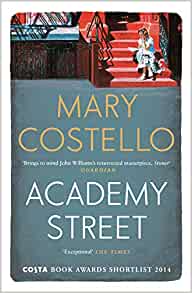
Academy StreetMary Costello (2014) 179 pages

My final novella of Novella a Day in May 2022! Each time I’ve done this project I’ve been uncertain I would finish and this year more than ever looked shaky, as my post-covid brain hasn’t recovered to quite the extent I thought. Still, I’m really glad to have made it and discovered some wonderful novellas along the way. It’s been especially great this year to have Simon at Stuck in a Book doing the project too, and adding many more novellas to my TBR 😊

My final choice is a novella that I remember getting a lot of love in the blogosphere when it was published in 2014. Academy Street by Mary Costello follows Tess Lohan from her childhood in Ireland to adulthood in the US, raising her son on the titular New York street in the 1960s.

Do you know, dear reader, I started writing this post in my usual style but I’ve just deleted it all. I’ve decided instead to pull my favourite passage from Academy Street, and simply say that if you like this, I think you’ll like the novella. The scene is adult Tess, cutting her taciturn father’s hair. He is a grieving man in a great deal of pain over many years, and this has made him distant from his children.

“He turns his head towards her, and she waits to be denounced. He looks at her, baffled, stunned, as if he has suddenly found himself somewhere else. His chin begins to quiver, and he looks down. She is flooded with tender feelings for him. She sees for the first time all he has endured. Holding things together, holding himself together, poised, always, to defend against a new catastrophe. She gets up and lays a towel on his shoulders and begins to cut his hair. Neither of them says a word. She is moved by his silent acquiescence. Gently she takes each strand and cuts, the sound of the scissors in the air between them, the hair falling to the floor. And his sorrow, for all that is lost, lying silent within him.”

I really loved Academy Street. A beautifully observed novella of a quiet, ordinary life and of the distances and touchpoints between people.

So that’s it! Another NADIM come to end. Despite flagging at times I’ve really enjoyed it. And now I plan to go from one extreme to the other. From 31 books under 200 pages, to a single tome of 933 pages. I’m setting myself the goal of getting it read by 16 June. Those of you who recognise the date as Bloomsday will be way ahead of me here. It was published 100 years ago, and so for the centenary I’m finally going in…

Novella a Day in May 2020 #2

From a Low and Quiet Sea  – Donal Ryan (2018) 181 pages

Last year I read The Spinning Heart by Donal Ryan for NADIM and was so impressed by his writing. From a Low and Quiet Sea has absolutely confirmed this view. He is such an understated, sensitive and evocative writer, he’s fast becoming a real favourite.

The story begins with Farouk, and his decision to take his family and leave his homeland after the political situation becomes intolerable.

“He’d measured the weights of his conflicting duties carefully, he’d told his friend in the letter, and he’d measured and measured again, and he’d mourned the time when such duties weren’t in conflict one against the other but were all part of a good life and all given to the same end, but this was now how the world was, and he was left with no choice to get his daughter and his wife to safety.”

Unfortunately Farouk’s story plays out in a way that we would expect from watching the news. Ryan shows the devastation of political violence for this family without ever being mawkish or sentimental. It is unquestionably a tragedy, and it is insane that such tragedy has become predictable. Farouk’s PTSD is captured with tenderness and compassion:

“And late one evening he walked from the camp to the water’s edge and he stood beneath the smirking moon and looked out across the sea, and he wondered at the stillness of it, as though its breath were held, as though it were too ashamed to reveal anything of itself to him, to admit the violence latent in it, to the things it held”

The narrative then shifts perspective to that of Lampy, a young man living with his mother and grandfather. He is nursing a broken heart after the love of his life goes off to Dublin to study at Trinity:

“Twenty-three years old, in the name of God, and still being babied. His mother would be twisting a tea-towel in her hands, back and forth, as though trying to wring some peace from it, some way of settling herself.”

Lampy is somewhat lost. He never knew his father and doesn’t quite fit in with his family at home. His mother and grandfather adore him but are cut from very different cloth:

“His grandfather was wicked; when he was in form his tongue could slice the world in two.”

Lampy’s story is ordinary, but in his own way he is quite desperate, and this is the power of his story. Ryan demonstrates the deep pain that can lie behind the people we meet every day, leading routine lives.

Finally, John is reflecting on his past: his family’s grief for a brother who died suddenly, the bullying of his younger brother, and his life of violence and disappointment.

“My little brother Henry, who came along behind us as an afterthought, a tiny, soundless incarnation of a short renaissance in my parents’ feelings for one another. He was always scared, his smallness and his way of slinking about unseen, inhabiting the background like a soft hiss of white noise behind the ceaseless hum and hubbub of life.”

John is not likable, and nor is he meant to be. It is his story, of a man that causes disruption and disintegration wherever he goes, that brings all three men together.

Its extraordinary that in a short novel split into the three parts, the characterisation of Farouk, Lampy and John is so well developed and fully realised. The way the strands tie together is believable and not at all clunky.

From a Low and Quiet Sea is a stunning novella, perfectly crafted and intelligently written. Unflinching yet beautiful.

Novella a Day in May 2019 #14

The Spinning Heart – Donal Ryan (2012, 156 pages)

I was first made aware of Donal Ryan on Cathy’s blog when she reviewed his short story collection, A Slanting of the Sun and the writing sounded wonderful. The Spinning Heart is Ryan’s first novel and was longlisted for the Man Booker and Guardian First Book Award, winning won Book of the Year at the Irish Book Awards. It reminded me of Jon McGregor’s Reservoir 13, in that it builds a picture of a community in quiet crisis through a variety of viewpoints. However, whereas McGregor uses omniscient narration, Ryan has each of the 21 chapters narrated by a different person. He manages this brilliantly, keeping the story flowing but still managing to convey different voices without jarring.

The story begins with Bobby Mahon:

“My father still lives back on the road past the weir in the cottage I was reared in. I go there every day to see is he dead and every day he lets me down. He hasn’t yet missed a day of letting me down. He smiles at me; that terrible smile. He knows I’m coming to check is he dead.”

This opening paragraph introduces many themes in the novel: families, abuse, inheritance (financial and psychological), uncomfortable but inescapable feelings. Each person in the story is linked to the others either directly or indirectly, and through their individual stories we get a rich portrait of a town, the people in it, and their shared lives.

It is a resolutely contemporary story. The collapse of the Celtic Tiger has had a devastating effect, and everyone is reeling. Bobby was foreman for Pokey Burke, the local building contractor who has fled leaving unpaid builders, unregistered for government help, destitute. There is a ghost town of a new estate with only two residents in it.

Young Brian is thinking of trying Australia for work. He has a good mind but sees no future in study, nor in Ireland itself, especially since breaking up with his girlfriend.

“On an intellectual level, I couldn’t give a shite about her. It’s a strange dichotomy, so it is; feeling and knowing; the feeling feels truer than the knowing of its falseness. Jaysus, I should write this shite down and send it Pawsy before I go.”

Ryan never deals in stereotypes despite many recognisable characters. There is Brian’s postmodern musings, and Lily, the  town’s aging sex worker’s poetic and tender feelings for her children.

“I love all my children the same way a swallow loves the blue sky; I have no choice in the matter. Like the men that came to my door, nature overpowers me.”

The character studies are individual and collective, like the town. So we learn more about how highly Bobby is thought of in the community, despite him introducing himself to the reader in that first chapter as damaged and failing. The builders respect him, women find him attractive, he’s a sporting hero and his wife is devoted. Long-time resident Bridie sums it up:

“There’s something in that boy, the way he looks at you while he’s talking, sort of embarrassed so that you want to hug him, and with a distance in his eyes even when he’s looking straight at you, that makes you think there’s a fierce sadness and a kind of rare goodness in him.”

It is what happens to Bobby that forms the plot of the novella.

The Spinning Heart ends on a note of hope but you still know things could go badly wrong. Ryan manages to convey the toughness of contemporary lives in dire straits caused by family histories and contemporary political mismanagement, without ever being didactic or depressing. It’s unflinching but hugely compassionate.

“the dead stillness I’d assume, the way I’d almost hold my breath while he spoke, it was the very same as when I’d be trying not to startle a wild animal”

And now I really must get to A Slanting of the Sun which I’ve been meaning to read ever since Cathy’s post…

Novella a Day in May 2019 #12

Two More Pints – Roddy Doyle (2014, 115 pages)

Last year as part of NADIM I looked at Two Pints by Roddy Doyle, so I thought this year I’d look the sequel. Like its predecessor, it is written entirely as dialogue between two friends meeting for the titular drinks, and set on specific dates, this time between September 2012 and June 2014. Once again, a warning for swearing – well, it is Roddy Doyle after all 😀

The issues in this period, lest we forget, include the financial crisis, horsemeat in burgers, elections of the new Pope and the deaths of various celebrities. All this occurs alongside family events and disagreements over football.

 – Fiscal cliff.

– He’s shite.

– Wha?!

– He’s just copying the other fella.

– Wha’ the fuck are yeh talkin’ about?

– The rapper.

– Wha’ rapper?

– Fiscal Cliff.

The humour doesn’t detract from the realities though.

– My young one is in trouble. An’ her fella.

– Ah, no.

– The mortgage, yeh know.

– They can’t handle it?

– They’re fucked, God love them. They’ve been into the bank an’ tha’, to try an’ sort somethin’. But –

– No joy?

– It’s fuckin’ madness.

I was disappointed not to hear more about Damien, the grandson from Two Pints who was fracking in the back garden with a magimix, but I think at such a turbulent time, Doyle chose to focus very much on current affairs. The dialogue still felt entirely authentic though, and never heavy-handed.

The conversation is wide-ranging, and even poetry gets a mention, despite the short shrift it was given in Two Pints:

– See Seamus Heaney died.

– Saw tha’. Sad.

– Did yeh ever meet him?

– Don’t be fuckin’ thick. Where would I have met Seamus Heaney?

– That’s the thing, but. He looked like someone yeh’d know.

– I know wha’ yeh mean – the eyebrows an’ tha’.

– He always looked like he liked laughin’.

– One o’ the lads.

– Except for the fuckin’ poetry.

– Wha’ would possess a man like tha’ to throw his life away on poetry?

– Although fair enough – he won the Nobel Prize for it.

– He’d probably have won it annyway.

– For wha’ – for fuck sake.

– I don’t know. Football, plumbin’ – annythin’. Tha’ was what was special about him.

Another affectionate portrait of the people of Dublin, and Ireland at a particular moment in time.

Novella a Day in May 2019 #7

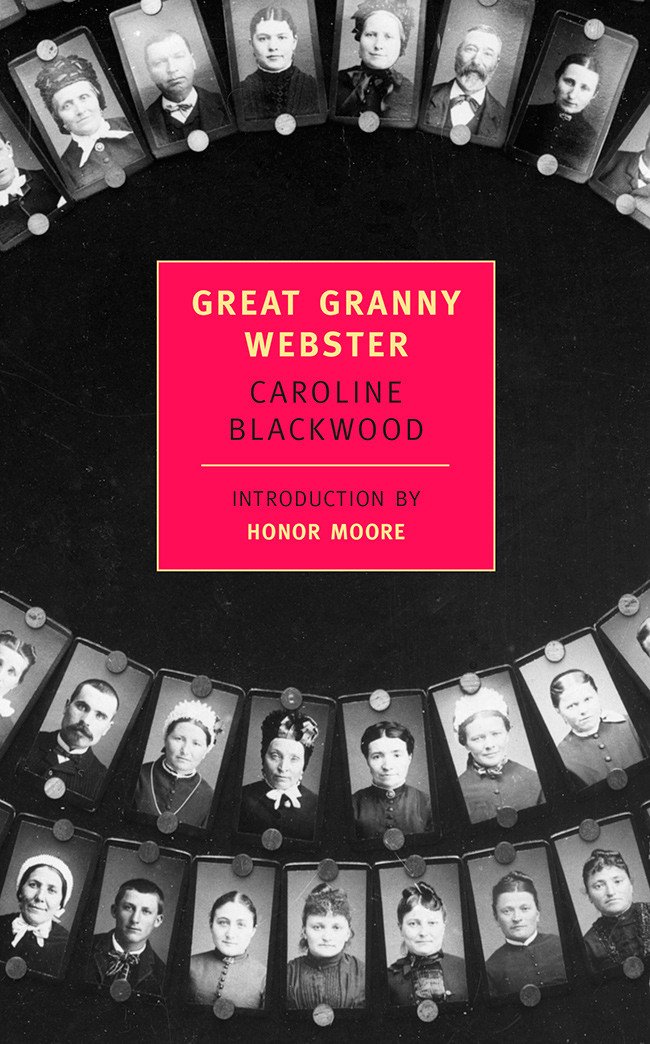
Great Granny Webster – Caroline Blackwood (1977, 96 pages)

My blogging slump meant I completely failed to take part in Cathy and Niall’s Reading Ireland 2019 (#Begorrathon) in March, and so I’m including a few Irish novellas this month. The first of these is by an author I’ve never heard of, which seems extraordinary given her quite astonishing life story.

The titular matriarch of this novel is a wonderfully Gothic creation:

“She had arranged her hair in two grey tufts that lay on her forehead like a couple of curly horns, so that what with the exaggerated narrowness of her elongated face, and her uniquely over-long upper lip, she often reminded me of a melancholy and aged ram.”

The narrator is sent to Hove to recuperate with her great-grandmother in 1947 when she is 14, as it’s thought the sea air will help her recuperate from an operation.  It’s totally bizarre that her family would think this a good idea, as Great Granny Webster lives in severe austerity in a damp and gloomy house, alone except for her aged and devoted retainer, Richards.

“All she wanted from each new day that broke was the knowledge that she was still defiantly there – that against all odds she had still managed to survive in the lonely, loveless vacuum she had created for herself.”

Unsurprisingly, this is not a warm and affectionate portrait of the generations of a family. It is however, witty, astute, sad, and incisive. Great Granny Webster is entirely uncompromising:

 “ ‘There really is nothing more unattractive than the sight of a young woman displaying a repulsive amount of arm. I am not going to mention this subject again.’

Great Granny Webster always told the truth. She never once referred to my sleeves or my arms again.”

We later learn that her daughter (the narrator’s grandmother) completely lost all sense of reality, trapped in the family castle at Dunmartin. The echoes of previous generations are heard down the years. As an adult, the narrator is contacted by her fragile, enchanting Aunt Lavinia who is having similar problems:

“One day Aunt Lavinia rang me up to say it was too maddening, she was in prison. When I sounded astonished she admitted that it wasn’t exactly a prison, but it was just as bad, for she was being detained in a hospital where she had been put by the police.”

What Blackwood captures brilliantly is how in families, people can be superficially polar opposites but underneath it all, so very alike, much to their own alarm:

“Aunt Lavinia’s house was very warm. She liked to have log-fires burning and her central heating turned on even in the summer. Although her bedroom was rather like a hot-house and fragrant with the smell of her lillies, I had exactly the same feeling of chill I had experienced in the bleak, cold, flowerless drawing room of Great-Granny Webster when that old lady had predicted that eventually I would be very like her.”

In such a short space, Blackwood achieves fully-rounded portraits of three generations of women in an idiosyncratic noble family. Great Granny Webster is, like its anti-heroine, bleak, funny and unique.

I read this in an old Picador edition, but I’m delighted to say the wonderful NYRB Classics have re-issued it.

Novella a Day in May #23

Two Pints – Roddy Doyle (2012, 89 pages)

Two Pints is a series of conversations between two men who meet in a pub. Doyle has an excellent ear for dialogue and his first novel, The Commitments, was very dialogue-heavy. This is even more so, with no description at all. It’s set on specific dates and documents the characters’ reactions to events in 2011 and 2012.

Before some examples, a trigger warning for language. Roddy Doyle presents authentic voices, and those voices are sweary. Something he is quite renowned for (I’ve included this clip before, but g’wan, you will!):

There is an ongoing conversation as to the whereabouts of Colonel Gaddafi:

“…An’ anyway, that’s when I see him.

– Who?

– Gaddafi.

– From the chipper?

– No the other one. From Libya.

– In Dublin Airport?

– Terminal 2.

– Fuck off.

– Swear to God. That’s where he’s hidin’.

[…]

– You’re sure it was him?

– Course I am. I winked at him.

– Wha’ did he do?

– He winked back.”

There are also discussions of cultural issues, both high and low:

“- D’yeh ever read poetry?

– Wha’?!

– D’you ever –

– I heard yeh. I just can’t fuckin’ believe I heard yeh.

-Well look it –

– G’wan upstairs to the lounge if yeh want to talk abou’ poetry.”


“- Wha’ does ‘thinkin’ outside the box’ mean?

– You were watchin’ The Apprentice last night, weren’t yeh?”

By the end I really felt as if I’d been in a pub overhearing two old friends talking. The simplicity of Two Pints doesn’t mean it’s prosaic though: the stories regarding a young member of the family, Damien, become increasingly surreal, with an escalating collection of exotic animals and his fracking in the back garden using a magimix. You’re never quite sure what will happen next.

“ – See the Queen’s goin’ to mention Ireland in her Christmas speech.

– Ah, great. I might mention her in mine.

-It’s a big deal.

– Not really. I just say a few words to the family.”

Warm, witty and wonderful.