“I think of a writer as a river: you reflect what passes before you.” (Natalia Ginzburg)

A desperate scrabbling attempt to get a final post written for Women in Translation Month!

Daunt Books are such an interesting publisher and I was keen to read Natalia Ginzburg having heard wonderful things in the blogosphere, so I swooped on All Our Yesterdays (1952, transl. Angus Davidson 1956) when it turned up in my local charity bookshop. I think I’d read somewhere that this wasn’t the best place to start with this author, but I absolutely loved it.
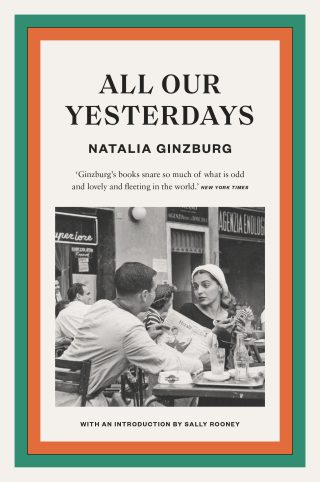
The novel follows two families living in a northern Italian town from the 1930s, through the war years to peacetime. Although the blurb on the French flaps of my edition suggests Anna, the daughter of the poorer family, is the protagonist, really Ginzburg follows them all to a greater or lesser extent, with no overarching plot other than the sequence of years.

Although this approach sounds like a shortcoming, it works so well. It’s not a documentary novel but it gestures towards this with an omniscient neutral(ish) viewpoint and only reported speech. This felt unusual to read, but is so clever in capturing the everyday experiences of those living through extraordinary circumstances.

Anna’s siblings are Concettina, Ippolito, and Giustino. Concettina is popular with boys but struggles to find a purpose in life; Ippolito channels his energies into anti-Fascist activities with his friend from the richer family across the road:

“Emanuele and Ippolito did not even know Italy, they had never seen anything except their own little town, and they imagined the whole of Italy to be like their own little town, an Italy of teachers and accountants with a few workmen thrown in, but even the workmen and the accountants became rather like teachers in their imagination.”

Their lives are equally dictated by world events and by commonplace ones. Anna falls pregnant by her boyfriend and marries an eccentric older man, Cenzo Rena, moving with him to the southern village of Borgo San Costanzo. Her affair with her self-involved, callow boyfriend was no great passion, and while her marriage to Cenzo Rena attracts approbation, he is a warmer, more generous man than the one her own age.

“She was alone with Giuma’s face that gave her a stab of pain in her heart, and every day she would be going back with Giuma amongst the bushes on the river bank, every day she would see again that face with the rumpled forelock and the tightly closed eyelids, that face that had lost all trace both of words and of thoughts of her.”

These are people destined to be on the outskirts of war. Cenzo Rena holds a lot of sway in his local area and does help Jewish people fleeing the Nazi occupation, but on the whole the story of All Our Yesterdays is not one involving soldiers or revolutionaries. It is about ordinary people and for them the conflicts of war are reported facts not lived experience. The latter for them includes a lot of mundanity:

“And the bread in town was rationed and was a kind of soft, grey dough that you couldn’t ever digest, the bread was like the soap and the soap was like the bread, both washing and eating had become very difficult.”

Yet this doesn’t mean the story isn’t affecting, or that the characters avoid tragedy. There are some truly tragic events that are hugely affecting. Ginzburg manages to be even-handed in her treatment of her characters but not detached. Her writing is warm but unsentimental as she demonstrates that flawed people are as worthy of love and mourning as idealised ones.

In case I’ve made it sound unremittingly serious, I should mention that there humour in All Our Yesterdays too. There are romantic entanglements that are treated with a degree of levity, and eccentric housekeepers/family retainers with various foibles. All life is here.

I can’t think of another writer who approaches Ginzburg’s style, and looking back on it I can’t explain how she does what she does. This was a story that snuck up on me, the deceptively simple storytelling drawing me in more than I realised until I was totally immersed. An extraordinary novel.

“Fanfares of trumpets usually announced only small, futile things, it was away fate had of teasing people. You felt a great exultation and heard a loud fanfare of trumpets in the sky. But the serious things of life, on the contrary, took you by surprise, they spurted up all of a sudden like water.”

To end, of course there’s a very famous song I could post on the theme of Yesterday, but instead, to continue the mix of despair alongside levity: have you seen a parrot singing Creep by Radiohead?

Novella a Day in May 2022 No.12

Sweet Days of Discipline – Fleur Jaeggy (1989, trans. Tim Parks, 1991) 101 pages

Sweet Days of Discipline is told in a straightforward, clear style, as is evident from its opening line:

“At fourteen I was a boarder at a school in the Appenzell.”

The narrator is a loner at her 1950’s boarding school, full of the confusing, contradictory desires of someone on the brink of adulthood.

“I ate an apple and walked. I was looking for solitude, and perhaps the absolute. But I envied the world.”

She has to sleep in the part of the school for younger girls as there isn’t room for her. Her mother is in Brazil, her father is disinterested. She gets up at 5am every day to take long solitary walks. Then Frédérique, a banker’s daughter, arrives into this isolated and lonely life. Frédérique has a remote, unknowable quality. She is a nihilist and the narrator vows to dominate her: 

“I still thought that to get something you had to go straight for your goal, whereas it’s only distractions, uncertainty, distance that bring us closer to our targets, and then it is the target that strikes us.”

The story isn’t overtly sexual and the sado-masochism is burgeoning, implicit rather than explicit. The narrator is scarcely aware of the sexual drives that surround her “passione” for Frédérique. It’s a psychologically complex and unarticulated morass of feeling, and it stays that way as she looks back from adulthood.

“Even now, I can’t bring myself to say I was in love with Frédérique, it’s such an easy thing to say.”

Frédérique remains mysterious and unknowable. She has a quality which sets her apart from her peers, which is both compelling and disturbing.

“She already knew everything, from the generations that came before her. She had something the others didn’t have; all I could do was justify her talent as a gift passed on from the dead.”

Although the narrator is looking back, Sweet Days of Discipline is not remotely sentimental. It has a brittle clarity which means that although very little happens, reading it is an immersive experience.

“And perhaps they were the best years, I thought. Those years of discipline. There was a kind of elation, faint but constant throughout all those years of discipline, the sweet days of discipline.”

Novella a Day in May 2019 #29

Pinocchio – Carlo Collodi (1883, trans. Geoffrey Beck 2009) 160 pages

Pinocchio, like a lot of classic children’s literature, is deeply weird and dark. I didn’t read it at all as a child, despite seeing the Disney cartoon which is very different. I picked it up as an adult because its published by the ever reliable NYRB Classics, and it turned out to be an intriguing read.

The basic premise I think everyone knows: a wooden puppet comes to life, wants to be a real boy, misbehaves and every lie he tells has a very obvious effect on his physiognomy.

“ ‘Lies, my boy, are immediately recognizable, for there are two kinds: lies that have short legs and lies that have long noses. Yours happen to be the long-nosed variety.’

Pinocchio, wanting to hide his face in shame, tried to run from the room – but he couldn’t. His nose was so long that it wouldn’t fit through the doorway.”

Pinocchio isn’t very likeable. He’s totally idle and only interested in himself.

“ ‘Of all the trades in the world, there’s only one that really suits me.’

‘And what trade would that be?’

‘That of eating, drinking, sleeping, playing, and wandering wherever I like from sunup to sundown.’

‘For your information,’ said the Talking Cricket, with his usual calm, ‘everyone who plies that trade ends up either in a poorhouse or a prison.’

‘Watch out, you doom-and-gloom Cricket! If I snap, you’ll be sorry!’”

Pinocchio does snap, and kills the Cricket stone dead. A short-lived relationship with an insect, who is nothing like the top hat and frock coat wearing, enduring friend of the cartoon.

The story is episodic, with Pinocchio going on several adventures, invariably taking the wrong decision, and failing to learn from his mistakes. It has the feel of folk tales rather than fairy tales, being grounded in an earthy reality of poverty and banditry, even when the bandits are a fox and cat double act. Pinocchio is always appealing even though he is selfish and unheeding, but there is never any sentimentality in the tale.

However, there is the strong didactic element associated with fairy tales, and Pinocchio is constantly lectured, by the cricket, by adults, and by the fairy with sky blue hair who crops up in various guises.

“ ‘Dear boy,’ said the Fairy, ‘people who talk that way almost always end up either in a prison or a poorhouse. For your information, everyone, whether they’re born rich or poor, is obliged to do something – to keep busy, to work. Woe to anyone who yields to idleness! Idleness is a dreadful disease and must be treated at once, starting in childhood. If not, it will be too late by the time we grow up.’”

Pinocchio does eventually learn and does become a real boy, but there’s something irrepressible about him. The feeling at the end is not of conservative integration where all is right with the world, but rather that the subversive elements that have been present all along are still there, waiting to spill out at any minute.

It’s a tale that can be enjoyed by children and adults. My edition included contributions from intellectual heavyweights to say the least: an Introduction by Umberto Eco, an Afterword by Rebecca West and a quote on the back by Italo Calvino. This shows how Pinocchio has been so widely recognised and why it endures; deceptively simple, hiding its complexities in an engaging children’s tale, it can be read differently each time.

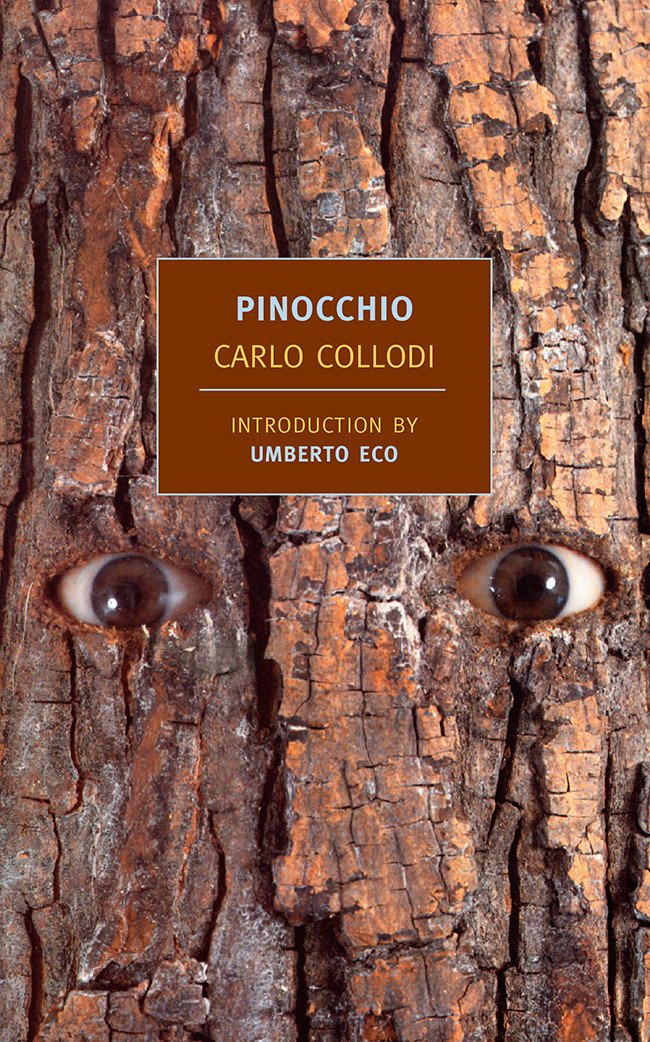
I really didn’t like the cover of the NYRB Classics edition, finding it creepy, but it captures the unsettling quality of the tale of an animated puppet perfectly: