Novella a Day in May 2025: No.16

Tokyo Express – Seichō Matsumoto (1958 transl. Jesse Kirkwood 2022) 149 pages

Tokyo Express is very much a howdunit and whydunit, as the whodunnit is seemingly fairly obvious from the start. This was my first time reading crime master Seichō Matsumoto and I was hugely impressed.

A young couple are found dead on Kashii beach near a shrine, having drunk cyanide. The local Fukuoka police are quick to decide a double suicide. There is nothing to suggest otherwise, but one of the team, Torigai Jūtarō, a long-standing and rather dishevelled detective, isn’t so sure.

“His overcoat was as battered as the clothes beneath it, his face unshaven, and his tie twisted and worn.”

Reminiscent of Lieutenant Columbo (whom he predates), Torigai is sharp-minded and unegotistical too. He starts trying to unravel how the couple came to be on the beach at that time. The young woman called Toki is dressed in a kimono and was a waitress at a restaurant in Akasaka; the man in Western clothes was Kenichi Sayama, an employee at Ministry X, currently under investigation for corruption. They were witnessed getting on the titular train by two of Toki’s colleagues, and it seems pretty clear that their bearing witness was engineered by a businessman called Tatsuo Yasuda.

Quicky Torigai establishes that a lot rests on that train journey and the timings of what happened when. He’s also baffled by a receipt from the buffet car found on Sayama’s body which recorded a food order for just one person.

“A scene formed in Torigai’s mind: the dark silhouette of a man, silently and briskly leading a woman to the beach, and the woman saying: What a lonely place.”

When Kiichi Mihara turns up from Tokyo, an outwardly very different detective takes over. The case is attracting attention due to the corruption in the Ministry, and Mihara works for the Second Division which investigates white collar crime.

“There was something in his cordial tone that reminded Torigai of an insurance salesman.”

The two investigators agree that the deaths are suspicious, and they also realise Yasuda is likely involved. However, trying to crack his alibi about where he was and when proves extremely difficult.

“Yasuda was always consulting the railway timetable. Did that perhaps mean he knew it secrets? In any case, his familiarity with the train times had to signify something. What if Yasuda’s entire alibi was built on it?”

This is one of the most procedural of police procedurals I’ve ever read. Everything hinges on the tight timing of trains, ferries and planes (a premise that would not remotely work in the UK as it depends on all the transport running to time, which as Magnus Mills pointed in out in my earlier read this month, will never occur). Torigai fades into the background, as Mihara tries to pick it all apart but keeps hitting brick walls.

“That crack in the wall had been nothing but a mirage. Mihara felt crushed. He held his head in his hands and, for a moment, could only stare at the piece of paper in front of him.”

I knew a bit about Tokyo Express before reading it, including that all the timings are based on the actual timetables of the time in the novel, and I wondered if it would be impossible to follow/bogged down in the logistics. But Seichō Matsumoto does a great job of carrying the reader along and there’s even a few surprises in store. The relationship between the two detectives is warm and endearing. I don’t know if they appeared in his subsequent novels, but even if not, I’d be keen to read more by this author.

“Mihara liked to ride the trams of Tokyo. Often, he would board without a specific destination in mind. Odd as it might seem, whenever he was at a loss for ideas, he would simply sit on the tram and allow his thoughts to roam. The tram’s steady trundle, its gentle swaying, induced in him an almost euphoric state of contemplation.”

“The cat is, above all things, a dramatist.” (Margaret Benson)

This is my contribution to Reading the Meow hosted by Mallika at Literary Potpourri, a fantastic week-long celebration of literature inspired by our feline friends!

A Cat, A Man and Two Women by Junichiro Tanizaki (1936, transl. Paul McCarthy 2015) is published by the ever-wonderful Daunt Books and I really liked the simple cover:

There seems to have been a flurry in recent years of slightly whimsical stories about cats and I thought ACAMATW would be one of these, I’m not sure why. The prospect was fine with me, I don’t mind whimsy if I’m in the right mood and I adore cats. But in fact this wasn’t whimsical at all. It was a psychological study – albeit a gentle one – of three people and the catalyst (no pun intended but I’m happy its there 😀 ) of their shared pet.

I would just like to pause (paws?) here to let you know that my typing is being severely hampered by my calico cat sitting on my lap, demanding attention – and my tuxedo cat (her brother) has just arrived and there’s a bit of a turf war ensuing…

The titular cat of this novella is Lily, adored companion of Shozo. The story opens with his ex-wife Shinako appealing to his new wife Fukuko to let her have Lily. Her letter emphasises Shozo’s adoration of Lily and Shinako deliberately sets a cat among the pigeons (ha! I’m only a little bit sorry for this 😀 ) of the new marriage,

Even Shozo, feckless in the extreme, notices the change.  

“Could Fukuko be jealous of Lily? He considered this possibility for a moment but then dismissed it as making no sense. After all, Fukuko herself was basically fond of cats. When Shozo was living with his former wife, Shinako, he had sometimes mentioned her occasional jealousy of the cat to Fukuko who had always made rather scornful fun of this silliness.”

Shozo requests his wife cook meals she doesn’t enjoy, so he can share them with Lily. I’m not surprised Fukuko is annoyed:

“Fukuko had been prepared to sacrifice her own taste for her husband’s sake, while in fact it was for the cat that she cooked; she had become a companion to the cat.”

(Update: turf war won by the tuxedo. Calico has stalked off in disgust. Tuxedo determined to rest on my dominant hand and impede my typing.)

The tensions in the marriage centre around Lily, but really have nothing to do with her. She merely highlights Shozo’s lack of drive and inability to engage fully in relationships, except with his cat.

“When he heard people with no knowledge of a cat’s character saying that cats were not as loving as dogs, that they were cold and selfish, he always thought to himself how impossible it was to understand the charm and lovableness of a cat if one had not, like him spent many years living alone with one.”

Shozo isn’t unsympathetic. His mother is manipulative and choosing Lily seems to be one of the rare independent choices Shozo has made. He has had a longer relationship with Lily than either of his wives and his bond with the cat is meaningful to him.

“It was Lily, with whom he’d lived so long, who was more intimately bound up with many memories of his; who formed, in fact, an important part of Shozo’s past.”

Tanizaki does a great job of portraying Lily as a very believable feline, without attributing human motivations or emotions to her. He leaves this to his three human protagonists, who fail to see she is not a strategist in these adult negotiations.

Shinako gets her wish, and the cat she was indifferent to arrives at her sister’s home, where Shinako now has a room. Gradually, she finds herself discovering new emotional territory, thanks to Lily:

“When she thought of the link that bound them together, her anger faded; and she felt, rather, that both of them were to be pitied.”

“Other people had told her so often that she was hard hearted, she had come to believe it herself. But when she considered how much trouble she had put herself to recently for Lily’s sake, she was surprised, wondering where these warm and gentle feelings had been hiding all this time.”

But will Shozo want his cat back? Will Shozo and Fukuko’s marriage survive without Lily to blame for the irritations and lack of understanding?

Tanizaki has a great understanding of cats and of people which makes this novella really shine. The humour is gentle and the psychological observations astute. The ending is left very open which didn’t wholly work for me but this is a minor quibble in regard to this engaging and insightful novella.

ACAMATW was adapted into the film A Cat, Shozo and Two Women in 1956. The summary on Wikipedia makes me think the filmmakers opted for a less open-ended conclusion to the story. From this clip the cat actor looks a lot more tolerant than my two would be 😀

“Some things I cannot see until I write about them.” (Yuko Tsushima)

I wasn’t planning on joining in Japanese Literature challenge 17 hosted by Meredith at Dolce Bellezza other than enjoying other bloggers wonderful posts. However this enthusiastic post by Marina Sofia on Tsushima Yūko’s Territory of Light meant I immediately started rooting through the TBR to find Child of Fortune (1978, transl. Geraldine Harcourt 1983), which I knew I had buried somewhere…

This is the first of her novels I’ve read and on the strength of this I definitely want to read more. Novella length, it tells the story of Kōko, a 36-year-old single mother to eleven-year-old Kayako. Told in the third person from Kōko’s perspective, it is a compelling examination of one woman’s inner world and her barely articulated resistance to the expectations placed on her.

Early in the novel, Kōko suspects she is pregnant. She is ambivalent about Osada, the father, as she is about most things. But gradually she realises that she wants to keep the child:

“Maybe she was reaching an age when it was senseless to want a fatherless child; but, precisely because of her age, she didn’t want to make a choice that she would regret till the day she died. Lately she was more convinced than ever that there was no point in worrying about what people thought. She would soon be thirty-seven. The only person watching Kōko at thirty-seven was Kōko. When this obvious fact finally came home to her it was still a surprise – what a very lonely fact it was!”

Geraldine Harcourt’s informative introduction explains that pregnancy at that age in Japan around this time could still be viewed as shameful even within marriage, so Kōko’s decision is doubly transgressive.

Kōko is an intriguing character, as she lives an unconventional life which places her in opposition to so many, by barely doing anything. Her lack of decision-making is an act of quiet but determined resistance.

Her sister Shoko is much more conventional and doesn’t approve; Kōko’s daughter Kayako much prefers to spend time with her more affluent, conformist aunt. Kōko tries to explain to Shoko:

“No, that’s not it – don’t think I’ve liked using choosing a different world from other people. I know I’ve been stubborn – but not about Kayako alone. All my life, though I often haven’t known which way to turn, I have managed to make choices of my own. I don’t know if they were right or wrong. I don’t think anyone can say that.”

But really she hasn’t made that many choices. She married because of pregnancy; husband Hatanaka organised the divorce years later, unsurprisingly as Kōko didn’t love him, still holding a candle for her lover Doi. She doesn’t enjoy her job teaching piano, but she also takes no steps to do anything else. She doesn’t take great care of herself and she doesn’t have many friends or interests.

Two driving forces in her life are her love for her brother, who died many years earlier, and sexual desire. The latter has led to her current predicament, the former suggests one reason that may be contributing to her lack of attachments.

“A little over a year ago, Kōko had understood something for the first time: the in the end she had let everything slip away from her, that in reality she hadn’t a single resource. It was an alarming discovery.”

Her lack of attachment includes reality – we are taken into Kōko’s dreams and daydreams, woven in seamlessly but disconcertingly.  As we move back and forth in time, learning about Kōko’s childhood, marriage, griefs and pains, Tsushima builds a picture of a woman who may not be completely likable but who is recognisably human and flawed, and muddling through the best way she knows how.

I was really rooting for Kōko to find a more articulate agency, and the penultimate scene was unbearably tense in this regard. Child of Fortune is never didactic yet absolutely achieves a compelling portrait of a woman fighting for her life, against immense societal pressure.   

“Kōko was shaken by the realisation that even now, more than twenty years later, she still lacked any compelling reason to go on living. And by the fact that the will to live was still there.”

To end, Kōko has fond memories of a visit to Karuizawa, which does look lovely:

PS When I was looking for a title quote for this post, I found this great conversation between Tsushima and Annie Ernaux.

“I often think that the night is more alive and more richly coloured than the day.” (Vincent Van Gogh)

Life has caused me to fall behind on blog writing, so unusually I’m writing this a few weeks after having read the book. Thankfully I found this one really stayed with me and I can get it in just in time for the last week of Women in Translation Month 😊

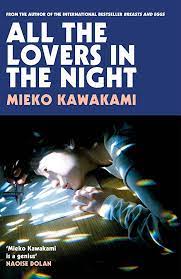
Having really enjoyed Mieko Kawakami’s Miss Ice Sandwich (2013) during my novella reading in May, I was delighted to find a copy of All the Lovers in the Night  (2011, transl. Sam Bett and David Boyd 2022) in my local charity bookshop. It’s very different to my previous read of hers, and while I didn’t enjoy it as immediately as Ms Ice Sandwich,  it did grow on me.

Fuyuko Irie is in her thirties and lives alone. She used to work in an office but her alienation from her colleagues means she prefers working at home. Her colleague/friend Hijiri is supportive of her talents and sends her regular work as a freelance proofreader, this work suiting her precise and solitary nature.

But this means that Fuyuko is even more isolated and achingly lonely. Kawakami is so good at capturing that modern urban alienation for people living surrounded by others but unable to connect, the feelings compounded when in the midst of a crowd.

“As I passed below the haloes of green and red traffic signals, I was taken by this strange view of the evening, the city streets full of people – people waiting, the people they were waiting for, people out to eat together, people going somewhere together, people heading home together. I allowed my thoughts to settle on the brightness filling their hearts and lungs, squinting as I walked along and counted all the players of this game that I would never play.”

It looks like things could change for Fuyuko when she meets Mitsutsuka, a physics teacher. Light is important to Fuyuko – every Christmas Eve (her birthday) she walks the streets at night looking at the illuminations. As Mitsutsuka explains the workings of light to her, they begin a tentative friendship, with brief points of connection offering glimmers of hope:

“‘Um, do you think the light you’re thinking about and the light I’m talking about are, um, the same thing?’

‘Of course they are, Mitsutsuka said with a smile. ‘We’re talking about the same light.’”

In a flashback chapter we learn more about Fuyuko’s background, and why she finds herself in the situation she does. There is an event in the past that Fuyuko describes without naming it in the way that I think most readers would, suggesting she doesn’t fully recognize her trauma or why she is making subsequent self-destructive decisions.

Kawakami subtly demonstrates how Fuyuko could change things for herself, but also how wider society makes this extremely difficult for her. She and Hijiri are women who have made very different choices and present themselves very differently to the world, but both struggle under the expectations placed on women and the fact that these are not an easy fit for either of them. A brief meeting with old school friend Noriko suggests traditional choices are not always happy ones either.

“I’d been on my own for ages, and I was convinced that there was no way I could be any more alone, but now I’d finally realised how alone I truly was. Despite the crowds of people, and all the different places, and a limitless supply of sounds and colours packed together, there was nothing here that I could reach out and touch. Nothing that would call my name. There never had been, and there never would be. And that would never change, no matter where I went in the world.”

All the Lovers in the Night is a slow burn novel, despite being only just longer than novella length. As I mentioned at the start, it was a story that grew on me and I found Fuyuko’s voice more compelling the more I read. A few weeks on and she’s really stayed with me.

Despite the sadness and alienation running through All the Lovers in the Night, I thought it ended with a suggestion of hope. That incrementally things can change, and improve. That imperfect people can make poor decisions but might still be moving towards a brighter time while doing so.

To end, any excuse for the wonderful Patti Smith: