“Everybody is a teenage idol.” (Barry Gibb)

Idol, Burning by Rin Usami (2020 transl. Asa Yoneda 2022) took me into a world I knew nothing about – that of having an oshi. It is a complex culture and there are lots of interesting articles online about it. For the sake of brevity in this post I’ll describe it as where fandom is taken to another level, with devotional idolatry of your oshi, with apologies for huge oversimplification.
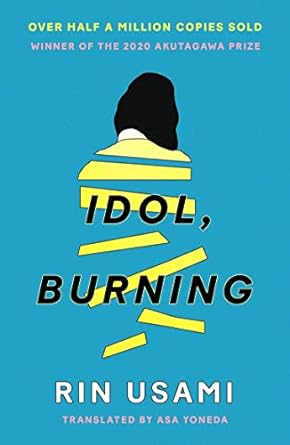
At the start of the novel, sixteen-year-old Akari is waking up to her social media DMs going into overdrive: her oshi, Masaki Ueno, part of boy band Maza Maza, has punched a fan. We follow her through the subsequent days as she struggles with the fallout of his behaviour.

Akari struggles even when things were going well with her oshi. She not academic, she doesn’t like her part-time job but she needs it to pay for all the merchandise associated with her oshi. (Without hammering it home, Usami makes it really clear the financial demands of having an oshi, and how this is exploited by merchandisers.) Her father is away overseas and she’s aware she frustrates her mother and studious sister.

Akari’s mind troubles her with a lack of focus outside her oshi, and her body troubles her too:

“Just being alive took a toll. To talk to someone you had to move the flesh on your face. You bathe to get rid of the grime that built upon your skin and clicked your nails because they kept growing. I exhausted myself trying to achieve the bare minimum, but it had never been enough. My will and my body would always disengage before I got there.”

What helps is her oshi:

“When my eyes met his, they reminded me how to really see. I felt an enormous swell of pure energy, neither positive nor negative, come rising up from my very foundation, and suddenly remembered what it felt like to be alive.”

Akari lives a substantial amount of her life online. Following her oshi’s accounts; blogging about her oshi; chatting with others who share her obsession and understand.

“Narumi sounded the same in person as she did online. I looked at her face, the round eyes and concerned brows overflowing with tragedy, and thought, There’s an emoji like that.

[…] Her facial expressions changed like she was switching out profile pictures.”

What was really clever in this novella (115 pages) and its translation is how Usami changed Akari’s tone and language depending on the medium she was using. The reader could see clearly how the person she created online through her blog and social media interactions wasn’t entirely authentic. It wasn’t entirely inauthentic either, and some of her closest relationships are with those she speaks to online – who of course, may not be entirely authentic either.

“When I pictured a world without Masaki, I thought about saying goodbye to the people here, too. It was our oshi that brought us together, and without him, we’d all go our separate ways. Some people moved over into different genres like Narumi had, but I knew I could never find another oshi. Masaki would always be my one and only. He alone moved me, spoke to me, accepted me.”

It’s a lonely world and there are hints Akari has been diagnosed with depression.

Through her devotion to Masaki we see all that Akari can do: she can be focussed, she can be insightful and she can be sensitive. It’s just that nothing other than her oshi prompts these behaviours.

We never learn the truth of Masaki’s actions and I was pleased about this. It is not his story, and while demonstrating the fallout of a celebrity flaming, Usami keeps the focus tightly on Akari. There is a Q&A with the author at the back of the novel and I wasn’t surprised to read that she has an oshi herself, because her portrayal of Akari is never patronising or pitying.

What Idol, Burning explores is how we all have to find a way to live, and that when this is focussed on something external and unpredictable – like a person and their constructed celebrity persona – then you can be in an incredibly vulnerable position. The novella ends on a tentatively positive note and I hoped Akari would learn to be the protagonist of her own life, rather than giving that power over so completely to someone else.

To end, I should definitely choose some J-pop, but I know absolutely nothing about it. So it’s back to 80s cheese, which I do know about 😀 Idol by name, Idol by nature…

“Whenever I think of the past, it brings back so many memories.” (Steven Wright)

I’m a month into my new job and the main effect it’s having is that my memory is shot to pieces. Trying to cram #allthefacts about one particular health condition into my head means all other knowledge has dribbled out of my ears. In fairness, my short and long-term memory has always been appalling and I used to claim I operated in a constantly shifting 3 hour window. This is currently down to about 30 minutes. Plus I got lost at Bank the other day, when I’ve lived in London MY WHOLE LIFE. And there’s a bloomin’ great building at Bank (guess which one) to help you orient yourself.

800px-Bank_of_England_Building,_London,_UK_-_Diliff

Where am I again? Oh, yeah…

So to console myself this week I’m looking at novels which explore memory. Its inherently unreliable nature means memory is a gift to novelists who want to consider how we construct reality and decide who we are. (At the moment I’m happy if I manage to construct a sentence, never mind reality and coherent sense of self).

Firstly, The Housekeeper and the Professor by Yoko Ogawa (2003, tr. Stephen Snyder 2008).I’m a huge admirer of Ogawa and her spare, stunning writing. In this short novel she details the relationship between a young housekeeper, her son, and the Professor she works for, who since a car accident in 1975 has a memory which lasts 80 minutes, though his memory from before the accident is intact.

“At the end of my first day, I noticed a new note on the cuff of his jacket. ‘The new housekeeper,’ it said. The words were written in tiny, delicate characters, and above them a sketch of a woman’s face. It looked like the work of a small child…but I knew instantly it was portrait of me. I imagined the Professor hurrying to draw this likeness before the memory had vanished. The note was proof of something, that he had interrupted his thinking for my sake.”

These notes cover the Professor’s suit and give him an eccentric experience which belies his brilliant mind. He is talented mathematician who sees numbers everywhere. His housekeeper became pregnant at 18 and needed to work to support her child; she is intelligent but not highly educated. Gradually though, he is able to convey the magic of numbers to her and her mind relishes the new challenge:

“With my finger I traced the trail of numbers from the ones the Professor had written to the ones I’d added, and they all seemed to flow together, as if we’d been connecting up the constellations in the night sky.”

Meanwhile Ogawa is able to convey the magic of numbers to the reader. There is no-one more resistant to mathematics than me – I won’t even play soduku. Yet the Housekeeper’s response to the discoveries the Professor opens up for her is so creative and joyful that I found myself carried along:

“I wondered why ordinary words seemed so exotic when they were used in relation to numbers. Amicable numbers or twin primes had a precise quality about them, and yet they sounded as though they’d been taken straight out of a poem. In my mind, the twins had matching outfits and stood holding hands as they waited in the number line.”

The titular characters and the Housekeeper’s son – nicknamed Root as his flat head reminds the Professor of the square root sign – form a tender alliance. The Professor cannot remember them from one day to the next, and yet he changes their lives forever, through his love of numbers and how he uses these to reach out to people.  The novel is a love story, but not a romance.  It is about the love of friends, of family, of vocation. It contains tragedy but also endurance beyond such, with Ogawa’s sparse style bringing the story a great delicacy. I adored it.

“I thought of the Professor whenever I saw a prime number – which, as it turned out, was almost everywhere I looked: price tags at the supermarket, house numbers above doors, on bus schedules or the expiration date on a package of ham, Root’s score on a test. On the face of it, these numbers faithfully played their official roles, but in secret they were primes and I knew that was what gave them their true meaning.”

Secondly, The Sea by John Banville, which won the Booker Prize in 2005. I’m still a bit conflicted about how I feel about this one, but it’s given me food for thought and is undoubtedly well-written, so I decided to add it to this blog where I only write about books I like. The Sea is narrated by Max Morden, coming to terms with the recent death of his wife. He returns to the holiday cottage which in his childhood was rented by a family, the Graces’, while Max and his family had a nearby chalet.

“I approached the Cedars circumspectly. How is it in childhood everything new that caught my interest had an aura of the uncanny, since according to all the authorities the uncanny is not some new thing but a thing known, returning in a different form, a revenant?”

The Sea is an effective exploration of memory as Max’s memories of the childhood holiday are jumbled alongside those of his marriage and especially his wife’s final illness. Chloe and Myles Grace are twins who never quite reveal themselves to Max, although he begins a tentative romance with Chloe.

“Her hands. Her eyes. Her bitten fingernails. All this I remember, intensely remember, yet it is all disparate, I cannot assemble it into a unity.”

As Max remembers the events of that summer he is forced to reflect on his wider choices and the man he is, particularly as he is now single again.

“Life, authentic life, is supposed to be all struggle, unflagging action and affirmation, the will butting its blunt head against the world’s wall, suchlike, but when I look back I see the greater part of my energies was always given over to the simple search for shelter, for comfort, for, yes, I admit, it, for cosiness.”

So… my reservations about this novel are weirdly some of its strengths. It is written in considered, careful prose, expertly structured overall to build to a conclusion that reconciles past and present. But for me it almost felt too considered, too artful. Then I wondered if Max, insecure about his social background, was supposed to be a slightly ponderous man out to prove his own cleverness? I’m not sure, I would have to read another of Banville’s novels to know. There are certainly moments of wry humour to lift the narrative at moments:

“these days I must take the world in small and carefully measured doses, it is a sort of homeopathic cure I am undergoing”

I’m undecided about Banville at present but I’ll certainly give him another try. If you’ve read him I’d really appreciate enlightenment as to his style and other novels that would be worth a read? The reason The Sea made it onto this determinedly positive blog was the final line of the novel, the final image. It was so powerful, such a perfect end, so moving and insightful: a moment of pure brilliance.

To end, it had to be either this or Elaine Paige dressed as a giant feline. Ultimately I decided to have my memories misty-water-coloured rather than alone in the moonlight. Take it away, Babs: