Novella a Day in May 2025: No.27

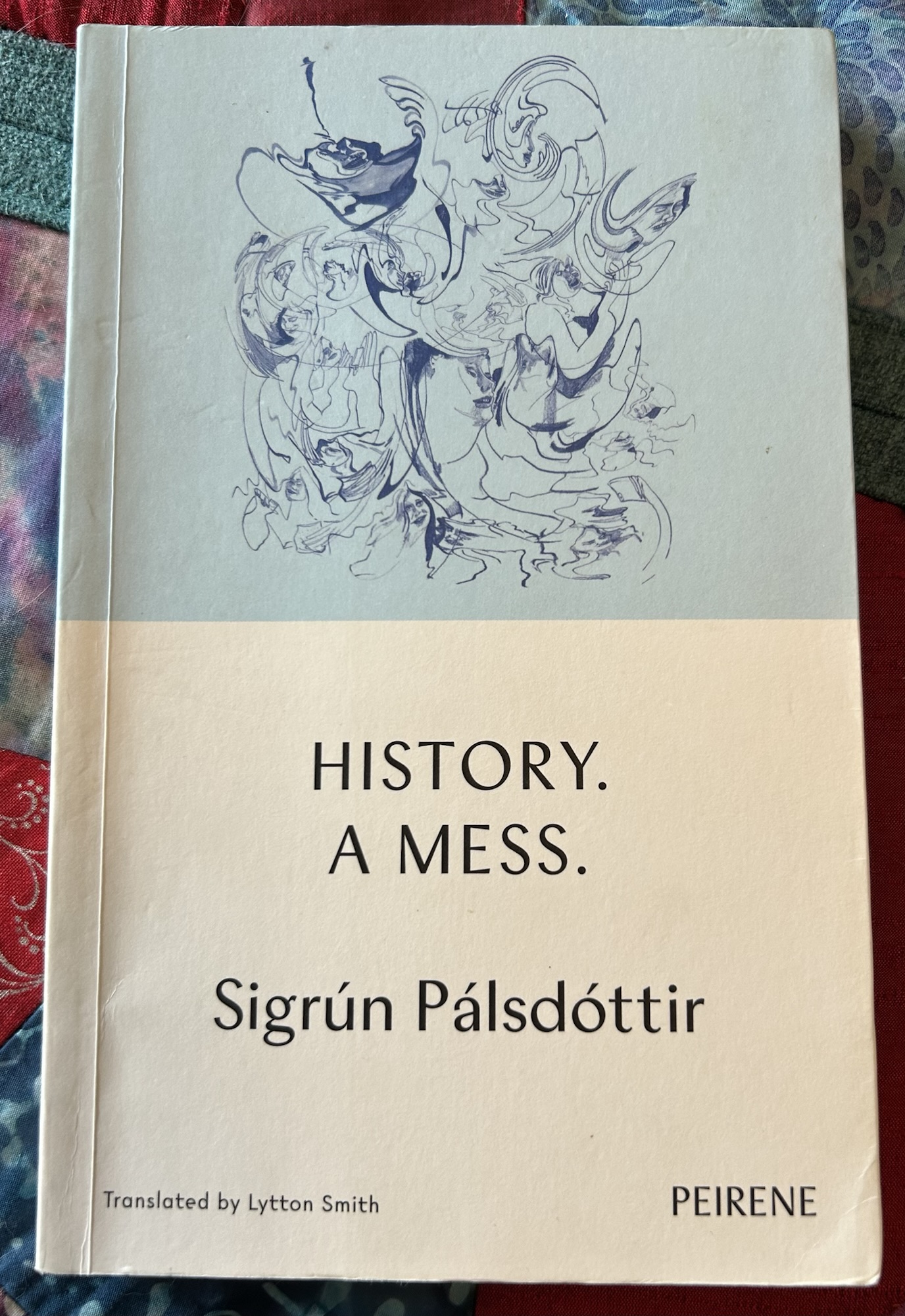
History. A Mess. – Sigrún Palsdóttir (2016 transl. Lytton Smith 2019) 173 pages

History. A Mess. Is narrated by a young unnamed PhD student. As the story opens, she is ecstatic as the research drudge job she had been given by her supervisor, transcribing the journal of a seventeenth-century artist known as SB, seems to have yielded a tremendous discovery: evidence of the first female artist in England.

“Frenzied jubilation thrilled through my body, words burst within me freighted with tremendous power, inside my head sentences and then pages formed one after the other so that by the time I stepped out of the building into the outside courtyard, my introduction was well underway.”

However, we soon learn that something went badly wrong. Five years on, she hasn’t handed in her thesis and she is back in Iceland with her husband Hans, barely leaving her house.

“Even if that person can seem occasionally distant, like Hans, so lost in his world that if you don’t reach out, grasp hold of him, he floats away, as he’s doing now, as I’m letting him do. I’m still trying to figure out what his reaction would be if I reached out for him and laid my cards on the table. Cards on the table. I suspect that his reaction would be sensible. And prudence is no use to me now. My problem calls for a radical solution.”

The fractured, repetitive quality to the sentences are indicative of the narrator’s struggles. The story becomes more hallucinatory and untethered as she seems to unravel further and further.

Some scenes are described that are so florid as to be clearly unreal. Others are grounded in the everyday so we don’t know whether have occurred or not – a skilled positioning of the reader alongside the narrator.

The story can be hard to follow at times, but from the hallucinations we’re able to unpick that she seems to be locking herself in a cupboard in her living room for much of the day. Her parents are around, and her mother is a major figure in her life.

Later in the novel she does leave her home to visit her mother for help in working out what to do about her thesis. Her walk there through the Reykjavik streets collapses reality and hallucination and seems never-ending, like a walk in dream.

“How often can you go over and over a dream in your mind until the scenario begins to crack apart, its images crumbling, their lifetime becoming nothing more than the moment it takes to call them up?”

History. A Mess. Is not an easy read. It is disorienting and confusing, but the writing is taut and so skilled that it never seems to be losing sight of itself. There also remains enough plot to keep pulling the story through, as well as a neat twist at the end.

A repeated refrain in the book is from Andre Breton, and summarises the novella succinctly:

“Everything leads us to believe that there exists a spot in the mind where the real and the imaginary will cease to appear contradictory.”

Novella a Day in May 2025: No.5

Minna Needs Rehearsal Space – Dorthe Nors (2013, transl. Misha Hoekstra 2014) 89 pages

I really enjoyed Dorthe Nors’ Mirror, Shoulder, Signal as the final novella when I first undertook this month-long challenge back in 2018. Since then I’ve read her short story collection Karate Chop, and was delighted to find Minna Needs Rehearsal Space in my beloved charity bookshop. I think it has been published in editions with Karate Chop, but this Pushkin Press edition was standalone.

This is definitely a novella where the style will alienate some readers. It’s written entirely in a series of short sentences.

“Minna walks around in bare feet.

The flat is full of notes.

Bach stands in the window.

Brahms stands on the coffee table.

The flat’s too small for a piano, but

A woman should have room for a flute.”

At first I wasn’t sure I could read a whole novella like this, but then I suddenly clicked with the rhythm and it seemed a lot less jarring.

Minna is a musician living in Copenhagen, trying to write a “paper sonata” and struggling to find a place to work. She is struggling more widely too: with ambivalence towards potential motherhood; with her tightly-wound sister; with her boyfriend who has just dumped her by text.

This spurs Minna to do some dumping of her own, as she unfriends people on social media.

“Minna eats a cracker.

Karin’s missive awaits.

Karin wants to be nasty.

Karin wants to upset her applecart, but

Minna’s cart has no apples.”

She ends up packing Ingmar Bergman’s Billeder as the director becomes almost a Greek chorus/silent interlocutor, when Minna heads for Bornholm and the sea.

The short sentences act as constant present-tense status updates, a commentary on our online living. Yet by piling on the banal observations, gradually a more subtle picture emerges between the sentences. Minna’s frustrations and vulnerabilities shine through.  It’s a brave approach which for me worked well, but I already knew I liked Nors’ observations, characterisation and humour.

Minna Needs Rehearsal Space is a reminder to look beyond what is immediate to a whole picture; one that is always changing in the present and is much more complex than the surface would have us believe.

“Minna’s broken heart dwells in the breast of an optimist.”

“I have looked for life, but I can’t find it.” (Vicki Baum, Grand Hotel)

November is the month of sooooo many reading events, and I’m hoping to take part in Margaret Atwood Reading Month and Novellas in November, but I thought I’d start with German Literature Month XIV, hosted by Caroline at Beauty is a Sleeping Cat and Lizzy Siddal at Lizzy’s Literary Life.

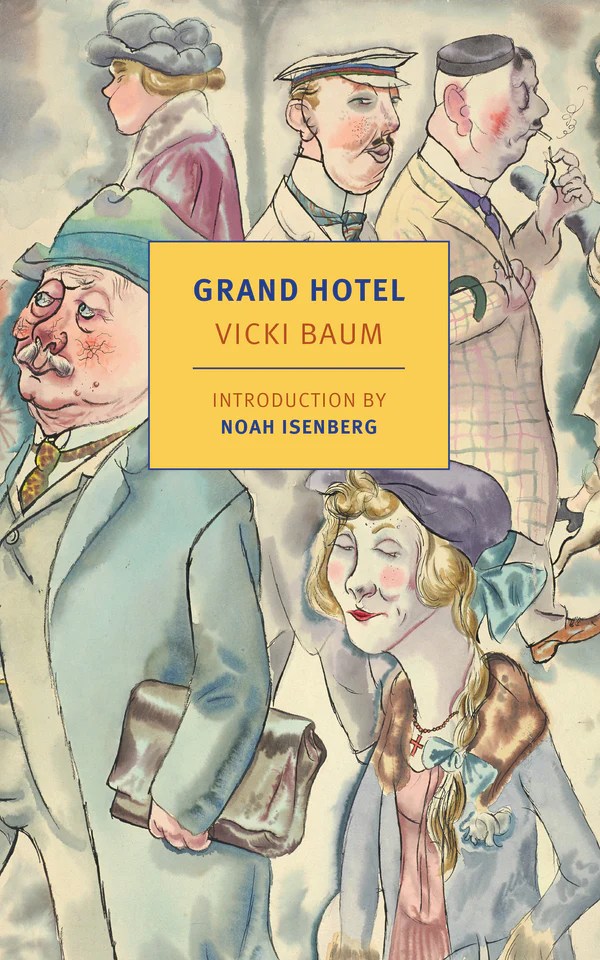
Grand Hotel by Vicki Baum (1929, transl. Basil Creighton 1930-1 revised by Margot Bettauer Dembo 2016) is a novel I’ve been meaning to get to for some time, republished by the wonderful New York Review of Books Classics.

I find a Weimar Republic setting always so enticing, and this novel was a bestseller in it’s day, originally serialised in a magazine. Sometimes with serials you can really see the joins when they are placed in novel form, but the episodic nature of hotel stays by various guests works well and Grand Hotel felt entirely coherent.

The titular building is opulent and glamorous:

“The music of the jazz band from the Tearoom encountered that of the violins from the Winter Garden, and mingled with the thin murmur of the illuminated fountain as it fell into its imitation Venetian basin, the ring of glasses on tables, the creaking of wicker chairs and, lastly, the soft rustle of the furs and silks in which women were moving to and fro.”

As readers we know that momentum for World War Two is building, but for the guests at this time it is the shadow of World War I which still looms large. Doctor Otternschlag’s face has been severely damaged by a shell. Every day he asks if a letter has arrived for him which it never has. We don’t know what this quiet, traumatised man is waiting for.

“Doctor Otternschlag lived in the utmost loneliness – although the earth is full of people like him…”

Glamour is brought by Grusinskaya, a prima ballerina desperately trying to hang on to physical vigour against the forces of aging. She is somewhat ambivalent, feeling driven to be as she has always been, and exhausted by it all:

“Perhaps the world would have loved her as she really was, as she looked now, for example, sitting in her dressing room – a poor, delicate, tired old woman with worn out eyes, and a small careworn human face.”

The most pathos occurs in the guest who doesn’t fit in: Kringelein, a clerk from Fredersdorf, given a terminal prognosis and determined to squeeze the pips from life before it’s too late. He chooses the Grand Hotel as his boss, Herr Preysing, stays there when in Berlin.

“He felt again, here in the bar of Berlin’s most expensive hotel, the same intoxication, a sense of exuberant plenty as well as of anxiety and alarm, the faint threat haunting the wicked joy of wrongdoing, the excitement of an escapade.”

Kringlein’s difficulty is, he is unsure of how to achieve his somewhat nebulous aim. Doctor Otternschlag tries to help but fails, unsurprising given his jaded, damaged view of the world. More successful is gentleman thief Gaigern, a dashing young nobleman who charms everyone:

“I am quite without character an unspeakably inquisitive. I can’t live an orderly life and I’m good for nothing. At home I learned to ride and play the gentleman. At school, to say my prayers and lie. In the war, to shoot and take cover. And beyond that I can do nothing. I am a gypsy, an outsider, an adventurer.”

He kits out Kringelein in fine clothes and takes him for fast drives in cars and up in a plane, but what are his motives? As Kringelein throws his hard-earned but limited money around, what will Gaigern do?

“Human kindness and warmth was so much a part of his nature that his victims always received their due share of them.”

Baum weaves together these disparate lives expertly, as they bump against each other within the Grand Hotel to a greater or lesser extent. There are overarching plots that draw characters together but Baum demonstrates that while hotels are places where change may occur, they do not lend themselves to resolution so easily. Hotels are by nature transitory and lives must be continued, consequences dealt with, once the guests pass through the revolving doors and back into the world.

Perhaps there is no such thing as a whole, completed destiny in the world, but only approximations, beginnings that come to no conclusion or conclusions that have no beginnings.

The tone is so well-balanced, with moments of light humour, almost slapstick, alongside darker elements. I did feel a constant undercurrent of sadness, but this highlighted the resilience of the characters who keep on keeping on during this interwar period, rather than being depressing.

Grand Hotel provides a compelling evocation of the Weimar era too, with glamour, seediness, riches and poverty all bound together in a vibrant, intoxicating, overwhelming Berlin. I’m so pleased to have finally read this novel.

“The room had taken on that utterly strange and enchanted appearance often encountered in hotel bedrooms.”

Grand Hotel was adapted by Hollywood in 1932, which despite my love of Garbo I’ve never seen. Time to remedy the situation!

Shrouded – Sólveig Pálsdóttir (transl. Quentin Bates) blog tour

I’m always a bit trepidatious about agreeing to blog tours, which is why I don’t do many. What if I don’t enjoy the book? I only blog about books I like so what if I have to drop out? Thankfully Corylus Books have never done me wrong, consistently offering excellent crime novels in translation.

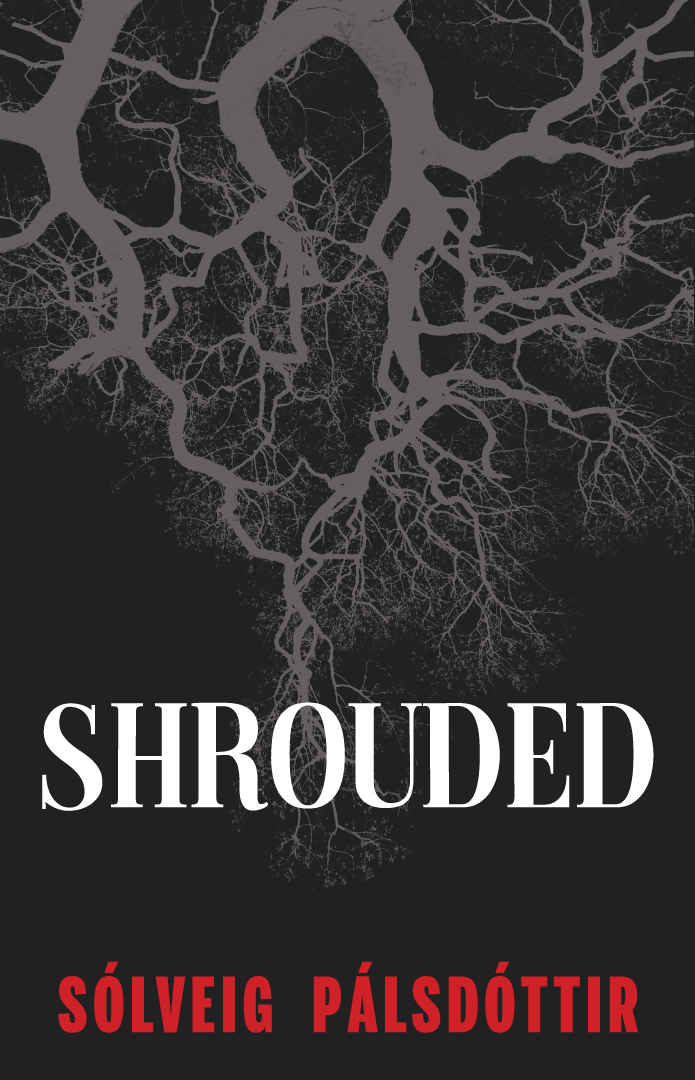
When they suggested Shrouded by Sólveig Pálsdóttir (2023, transl. Quentin Bates 2023), I had two questions: did it matter that I hadn’t read the others in the series? Was it gory (I can’t do gore)? Reassured on both counts, I’m so glad I took the opportunity to join in because I found much to enjoy in this novel.

My allotted date for the tour was 1 August so this is also my first post for Women in Translation Month (#WITMonth), a wonderful and well-established event running for the whole of August.

Here is the blurb from Corylus Books:

“A retired, reclusive woman is found on a bitter winter morning, clubbed to death in Reykjavik’s old graveyard. Detectives Guðgeir and Elsa Guðrún face one of their toughest cases yet, as they try to piece together the details of Arnhildur’s austere life in her Red House in the oldest part of the city.

Why was this solitary, private woman attending séances, and why was she determined to keep her severe financial difficulties so secret? Could the truth be buried deep in her past and a long history of family enmity, or could there be something more? Now a stranger keeps a watchful eye on the graveyard and Arnhildur’s house.

With the detectives running out of leads, could the Medium, blessed and cursed with uncanny abilities, shed any light on Arnhildur’s lonely death?”

The story opens with Arnhildur preparing to go to a séance. We are privy to her thoughts, her frustrations and her little vanities. In a very short space, Pálsdóttir creates a sense of Arnhildur so that when she is murdered, the injustice is fully realised. Although the reader is witness to the murder, it isn’t remotely gory or gratuitous. It’s a responsible and carefully balanced portrait which insists that the murder of an older woman, someone seemingly entirely ordinary, is taken seriously.

Having not read the rest of the series, when police detectives Guðgeir and Elsa Guðrún arrive to investigate I was expecting some clunky exposition to bring readers up to speed. This never happened, and instead we are presented with an established working relationship, respectful and gently teasing, in which we are expected to draw our own conclusions regarding the personalities of the individuals and the dynamic between them.

“‘It’s never this dark in Akureyri,’ Elsa Guðrún assured him, a tie between her teeth as she pulled her brown hair back into a ponytail.

‘Really?’ Guðgeir grinned. This north country pride that some would describe as conceit had always amused him. ‘All the same, it’s a good way further north than Reykjavík.’

Elsa Guðrún wasn’t going to accept Guðgeir’s straightforward geographical point.”

The relationships with the wider team are well drawn, with a sense of professionals rubbing along together as best they can with some tensions and frustrations – in other words, most people’s working lives. There is humour too, and I particularly enjoyed tightly-wound senior officer Særós’ penchant for Insta-type inspiration:

“As always, the week’s aphorism hung on the wall behind her, a print out with black letters on white in a simple IKEA frame. This week it said, Always be the best possible version of yourself.”

Arnhildur was resistant to change and technology, which means no mobiles with sophisticated GPS, laptops or tablets of hers are available to aid the investigation. This made for a police procedural that felt pleasingly traditional while still rooted in the modern world.

One shortcut that might have been available was the presence of Valthór, a medium. I know some readers whose hearts sink at the presence of a psychic in detective stories, but Pálsdóttir never uses the character as an easy way to resolve any plot, despite one of her detectives being open to the possibility of Valthór’s skills:

“Growing up in the west of Iceland, he had been aware that most older people had some belief in an afterlife, and that there were a few people with the ability to converse with the dead. Many of them also believed in premonitions, dreams and prophecies. The people with whom Guðgeir had grown up had fought for their existence, in close touch with the brutal forces of nature that regularly demanded people’s lives. These people had been more down-to-earth than any Guðgeir knew today, and he was still convinced that there was much about the world that could be neither felt nor seen.”

Valthór is a really affecting character, truly suffering in the aftermath of Arnhildur’s death and he enables a continued emotional resonance within the story as Guðgeir and Elsa Guðrún pragmatically and doggedly work to solve the crime.

They discover aspects of Arnhildur’s past that led to her estrangement from her family, and truly disturbing events touching her life before she died. There are a couple of very sinister characters that are deeply unnerving in their believability.

Shrouded is a quick pacy read that I whizzed through on a train journey to Liverpool. Initially I was smugly congratulating myself that I’d guessed certain elements and I was somewhat surprised that a novel which seemed so accomplished had resolved things rather straightforwardly. However, I was far too quick to pat myself on the back 😀 I’d made all the assumptions and deductions Pálsdóttir had guided the reader towards, and I’d missed others entirely, which meant the very end made for a surprising and really satisfying conclusion.

Shrouded is responsible in its treatment of the victim, it’s never sensationalist. It has plenty to say about how people who don’t easily fit in are treated. It demonstrates the complexities of relationships between flawed people (ie all of us) without having characters behave in ridiculous ways.

I realise I’m making it sound dull when it really isn’t! It makes important points without losing sight of the story. I really enjoyed Shrouded and now I need to read the preceding novels in the series; my TBR is never going down, is it…?

Here are the rest of the stops on the blog tour so do check out how other readers found Shrouded:

“The story of our lives still isn’t finished, and it never will be.” (Beatriz Bracher, Antonio)

Trigger warning: mentions mental illness and infant death.

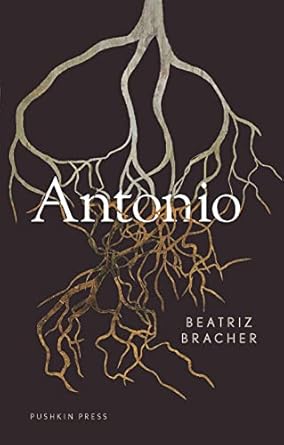
Stu over at WinstonsDad’s blog is hosting Spanish Portuguese Lit Month for the whole of July and so this was the perfect opportunity to get to a novella by Brazilian author Beatriz Bracher which had been languishing in the TBR: Antonio (2007, transl. Adam Morris 2021) published by the wonderful Pushkin Press.

I want to start with the disclaimer that I don’t think I’ve really got to grips with Antonio, so this post is just some initial impressions. Although only 187 pages long it is incredibly densely written and it took me a week to read. Admittedly work has been really demanding lately, but usually it still wouldn’t take me that long to read a book of that length.

Also looking online, there are many effusive reviews praising the socio-political commentary of Antonio, which I’m sure I didn’t fully comprehend. I did pick up some, but I’m certain I need to re-read Antonio at some point.

The novella is told through the alternating viewpoints of three people: Raul, Isabel and Haroldo. Their silent interlocutor is Benjamim, who is awaiting the birth of his first child, the titular Antonio. The imminent arrival of his son has prompted Benjamim to probe into his family history in more depth.

“I’d like to think your mother was also a free person, and maybe you can hold onto that thought, instead of clinging to fear and rage.”

Benjamim knows that his father was Teodoro and that his mother was  Elenir.  Elenir had a son with Benjamim’s grandfather Xavier first, who they also called Benjamim and who died very young. The second Benjamim was raised by his father after his mother died in childbirth.  

Raul is his father’s friend, Isabel is his paternal grandmother, and Haroldo was Benjamim’s grandfather’s friend. They all provide histories of Benjamim’s family that echo and contradict each other, and none seem any more reliable or authoritative than any other. Each has their own truth.

The family is well-off and privileged in São Paulo, but their history is a troubled one. Both Xavier and Teodoro had periods of intense mental illness.

For Xavier, this occurred after the death of Benjamim. As Haroldo recalls:

“[Elenir] looked like a bent piece of wood. She didn’t cry. She received each condolence with correct politeness. Xavier was the total opposite: he was in pieces […] I managed to gain entry to that hell three times. The last time, I brought a team of nurses, to drag my friend out of there and take him to a sanatorium.”

Later, Xavier meets and marries Isabel and they raise a family. They are the generation that came of age in the 1950s and 1960s, idealistic and, in Isabel’s case, driven:

“In a family we’re always a me or and I who’s scattered and complex. It’s only at work, especially work that has to do with ideas, but it’s possible to feel ourselves out and let the contours assume the shape.”

Their youngest son Teo rejects the urban privilege he is born into and goes to live in rural Minas. He throws himself into village life but ultimately becomes rudderless and unwell. Isabel reminds Benjamim of his early childhood:

“You’re from this family, so you are this family. Your father wanted to be rid of all that, and shed himself along with it. The history that he crafted for himself in Minas was a non-history. He went too deep. By the time I brought him back, there was nothing left to hold onto, no handle I could use to hoist him back out: only damaged pieces.”

This is one of central themes of Antonio: how to live an authentic and conscious life, but not be overwhelmed by the search for meaning. How to truly find who you are, alongside the demands of daily life. Isabel believes the answer is hard work, but only Big Work. Haroldo points out:

“She raised a bunch of irresponsible ingrates who are incapable of the most basic displays of solidarity, like visiting their dying mother. Isabel cultivated a true horror of responsibility in them, and at the same time overloaded them with the responsibility to be nothing but the best.”

Isabel recognises that privilege brings responsibility, but she also remains an elitist. When she observes: “I never understood any language that wasn’t well spoken Portuguese.” she is being both literal and metaphorical. The family’s wealth isn’t what it once was and she is unhappy at her children’s middle-class existence.

To me Isabel was the strongest of the three narrators and I got a real sense of her. But Raul, living an ordinary life and baffled by what happened to his childhood friend, and the somewhat reprehensible, colourful Haroldo were also distinct characters if not entirely differing voices, and Bracher balances the three viewpoints well.

I’ve focused on some of the ideas rather than the events of Antonio and that is partly because the novella has some graphic scenes in it – of extensive mental breakdown, one of pig-killing and one of caring for a dead body by someone who doesn’t know what they are doing. None of these are gratuitous but they mean Antonio can be very difficult to read in places.

Bracher avoids conclusions about the causes of Xavier and Teo’s ill health and whether there is a genetic component or whether it is the demands of society on the individual. She vividly, sometimes viscerally, evokes the pressures of family and the search for self in late twentieth-century Brazil.

“To live long and stay well, stay away from your relatives.”

“The cat is, above all things, a dramatist.” (Margaret Benson)

This is my contribution to Reading the Meow hosted by Mallika at Literary Potpourri, a fantastic week-long celebration of literature inspired by our feline friends!

A Cat, A Man and Two Women by Junichiro Tanizaki (1936, transl. Paul McCarthy 2015) is published by the ever-wonderful Daunt Books and I really liked the simple cover:

There seems to have been a flurry in recent years of slightly whimsical stories about cats and I thought ACAMATW would be one of these, I’m not sure why. The prospect was fine with me, I don’t mind whimsy if I’m in the right mood and I adore cats. But in fact this wasn’t whimsical at all. It was a psychological study – albeit a gentle one – of three people and the catalyst (no pun intended but I’m happy its there 😀 ) of their shared pet.

I would just like to pause (paws?) here to let you know that my typing is being severely hampered by my calico cat sitting on my lap, demanding attention – and my tuxedo cat (her brother) has just arrived and there’s a bit of a turf war ensuing…

The titular cat of this novella is Lily, adored companion of Shozo. The story opens with his ex-wife Shinako appealing to his new wife Fukuko to let her have Lily. Her letter emphasises Shozo’s adoration of Lily and Shinako deliberately sets a cat among the pigeons (ha! I’m only a little bit sorry for this 😀 ) of the new marriage,

Even Shozo, feckless in the extreme, notices the change.  

“Could Fukuko be jealous of Lily? He considered this possibility for a moment but then dismissed it as making no sense. After all, Fukuko herself was basically fond of cats. When Shozo was living with his former wife, Shinako, he had sometimes mentioned her occasional jealousy of the cat to Fukuko who had always made rather scornful fun of this silliness.”

Shozo requests his wife cook meals she doesn’t enjoy, so he can share them with Lily. I’m not surprised Fukuko is annoyed:

“Fukuko had been prepared to sacrifice her own taste for her husband’s sake, while in fact it was for the cat that she cooked; she had become a companion to the cat.”

(Update: turf war won by the tuxedo. Calico has stalked off in disgust. Tuxedo determined to rest on my dominant hand and impede my typing.)

The tensions in the marriage centre around Lily, but really have nothing to do with her. She merely highlights Shozo’s lack of drive and inability to engage fully in relationships, except with his cat.

“When he heard people with no knowledge of a cat’s character saying that cats were not as loving as dogs, that they were cold and selfish, he always thought to himself how impossible it was to understand the charm and lovableness of a cat if one had not, like him spent many years living alone with one.”

Shozo isn’t unsympathetic. His mother is manipulative and choosing Lily seems to be one of the rare independent choices Shozo has made. He has had a longer relationship with Lily than either of his wives and his bond with the cat is meaningful to him.

“It was Lily, with whom he’d lived so long, who was more intimately bound up with many memories of his; who formed, in fact, an important part of Shozo’s past.”

Tanizaki does a great job of portraying Lily as a very believable feline, without attributing human motivations or emotions to her. He leaves this to his three human protagonists, who fail to see she is not a strategist in these adult negotiations.

Shinako gets her wish, and the cat she was indifferent to arrives at her sister’s home, where Shinako now has a room. Gradually, she finds herself discovering new emotional territory, thanks to Lily:

“When she thought of the link that bound them together, her anger faded; and she felt, rather, that both of them were to be pitied.”

“Other people had told her so often that she was hard hearted, she had come to believe it herself. But when she considered how much trouble she had put herself to recently for Lily’s sake, she was surprised, wondering where these warm and gentle feelings had been hiding all this time.”

But will Shozo want his cat back? Will Shozo and Fukuko’s marriage survive without Lily to blame for the irritations and lack of understanding?

Tanizaki has a great understanding of cats and of people which makes this novella really shine. The humour is gentle and the psychological observations astute. The ending is left very open which didn’t wholly work for me but this is a minor quibble in regard to this engaging and insightful novella.

ACAMATW was adapted into the film A Cat, Shozo and Two Women in 1956. The summary on Wikipedia makes me think the filmmakers opted for a less open-ended conclusion to the story. From this clip the cat actor looks a lot more tolerant than my two would be 😀

“The life of every man is a diary in which he means to write one story, and writes another.” (JM Barrie)

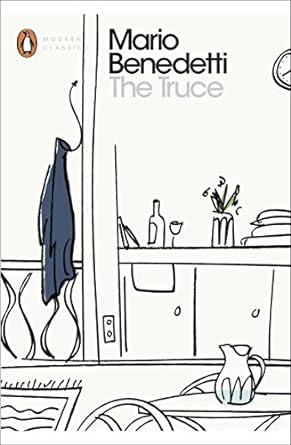
Continuing my endeavour to try and get some momentum back in my Around the World in 80 Books reading challenge, today I’m off to Uruguay, with Mario Benedetti’s The Truce: The Diary of Martín Santomé (1960, transl. Harry Morales 2015) which I was alerted to by Fiction Fan’s glowing review at the start of the year.

As the title suggests, the novella is in diary form, as Martín records his days in the run-up to his retirement, reflecting on how to live out his days. He is a quiet man in an administrative job; things are predictable.

“Today was a happy day; just routine.”

He is a widow of twenty years, and although he still has an eye for women (particularly their legs) he hasn’t had another relationship:

“The entire machinery of my emotions came to a halt twenty years ago when Isabel died. First there was pain, then indifference, then, much later, freedom, and then, finally, tedium. Long, lonely, constant tedium.”

His children Esteban, Jaime and Blanca are essentially unknown to him:

“At least Blanca and I have something in common: she, too, is a sad person with a calling for happiness.”

But although Martín is recording a lot of sadness, it’s not overly depressing. He has an acceptance of his life, and he makes quietly humorous observations, such as an old acquaintance learning of Isabel’s death:

“There is a sort of automatic reflex which makes one talk about death and then immediately look at one’s watch.”

Or his grief when his mother died:

“Only a fervent hatred of God, relatives and fellow man sustained me during that period.”

But things are about to change for Martín in ways he didn’t expect, when he falls in love with Laura Avellaneda, a work colleague half his age. While this would naturally raise questions about power dynamics and appropriateness, I felt it worked in The Truce, as Martín has been established as a gentle man, uninterested in wielding any sort of power or manipulation, and he is very respectful of Laura:

“I’m not going to demand anything. If you, now or tomorrow or whenever, tell me to stop, we won’t discuss the matter anymore and we’ll remain friends.”

In this short novel Benedetti perfectly evokes the gentle, slowly evolving love of Martín and Laura, and of Martín’s grief and acceptance of all he has lost in life alongside all that he still has. It suggests hope is still a realistic thing to hold onto, at any time.

The Truce isn’t sentimental, and although it depicts a romance it’s not rose-tinted. There is one point in particular where Martín behaves badly. He is not a perfect human-being and he causes hurt as well as joy to people.

But it is an empathetic tale, warmly clear-sighted towards ordinary people and all the foibles, weaknesses and strengths that we all carry.

The Truce is realistic, in a way that suggests even the most painful experiences can still be worthwhile. It explores how to not let pain overwhelm, and the importance of compassion for others and for the self:

They suffer from the most horrible variant of solitude: the solitude of someone who doesn’t even have himself.

This was my first experience of Benedetti and I’d be interested to read more by him. Apparently he wrote over ninety books so there’s plenty for me to choose from!

“Everybody is a teenage idol.” (Barry Gibb)

Idol, Burning by Rin Usami (2020 transl. Asa Yoneda 2022) took me into a world I knew nothing about – that of having an oshi. It is a complex culture and there are lots of interesting articles online about it. For the sake of brevity in this post I’ll describe it as where fandom is taken to another level, with devotional idolatry of your oshi, with apologies for huge oversimplification.

At the start of the novel, sixteen-year-old Akari is waking up to her social media DMs going into overdrive: her oshi, Masaki Ueno, part of boy band Maza Maza, has punched a fan. We follow her through the subsequent days as she struggles with the fallout of his behaviour.

Akari struggles even when things were going well with her oshi. She not academic, she doesn’t like her part-time job but she needs it to pay for all the merchandise associated with her oshi. (Without hammering it home, Usami makes it really clear the financial demands of having an oshi, and how this is exploited by merchandisers.) Her father is away overseas and she’s aware she frustrates her mother and studious sister.

Akari’s mind troubles her with a lack of focus outside her oshi, and her body troubles her too:

“Just being alive took a toll. To talk to someone you had to move the flesh on your face. You bathe to get rid of the grime that built upon your skin and clicked your nails because they kept growing. I exhausted myself trying to achieve the bare minimum, but it had never been enough. My will and my body would always disengage before I got there.”

What helps is her oshi:

“When my eyes met his, they reminded me how to really see. I felt an enormous swell of pure energy, neither positive nor negative, come rising up from my very foundation, and suddenly remembered what it felt like to be alive.”

Akari lives a substantial amount of her life online. Following her oshi’s accounts; blogging about her oshi; chatting with others who share her obsession and understand.

“Narumi sounded the same in person as she did online. I looked at her face, the round eyes and concerned brows overflowing with tragedy, and thought, There’s an emoji like that.

[…] Her facial expressions changed like she was switching out profile pictures.”

What was really clever in this novella (115 pages) and its translation is how Usami changed Akari’s tone and language depending on the medium she was using. The reader could see clearly how the person she created online through her blog and social media interactions wasn’t entirely authentic. It wasn’t entirely inauthentic either, and some of her closest relationships are with those she speaks to online – who of course, may not be entirely authentic either.

“When I pictured a world without Masaki, I thought about saying goodbye to the people here, too. It was our oshi that brought us together, and without him, we’d all go our separate ways. Some people moved over into different genres like Narumi had, but I knew I could never find another oshi. Masaki would always be my one and only. He alone moved me, spoke to me, accepted me.”

It’s a lonely world and there are hints Akari has been diagnosed with depression.

Through her devotion to Masaki we see all that Akari can do: she can be focussed, she can be insightful and she can be sensitive. It’s just that nothing other than her oshi prompts these behaviours.

We never learn the truth of Masaki’s actions and I was pleased about this. It is not his story, and while demonstrating the fallout of a celebrity flaming, Usami keeps the focus tightly on Akari. There is a Q&A with the author at the back of the novel and I wasn’t surprised to read that she has an oshi herself, because her portrayal of Akari is never patronising or pitying.

What Idol, Burning explores is how we all have to find a way to live, and that when this is focussed on something external and unpredictable – like a person and their constructed celebrity persona – then you can be in an incredibly vulnerable position. The novella ends on a tentatively positive note and I hoped Akari would learn to be the protagonist of her own life, rather than giving that power over so completely to someone else.

To end, I should definitely choose some J-pop, but I know absolutely nothing about it. So it’s back to 80s cheese, which I do know about 😀 Idol by name, Idol by nature…

“All fiction is about people, unless it’s about rabbits pretending to be people.” (Margaret Atwood)

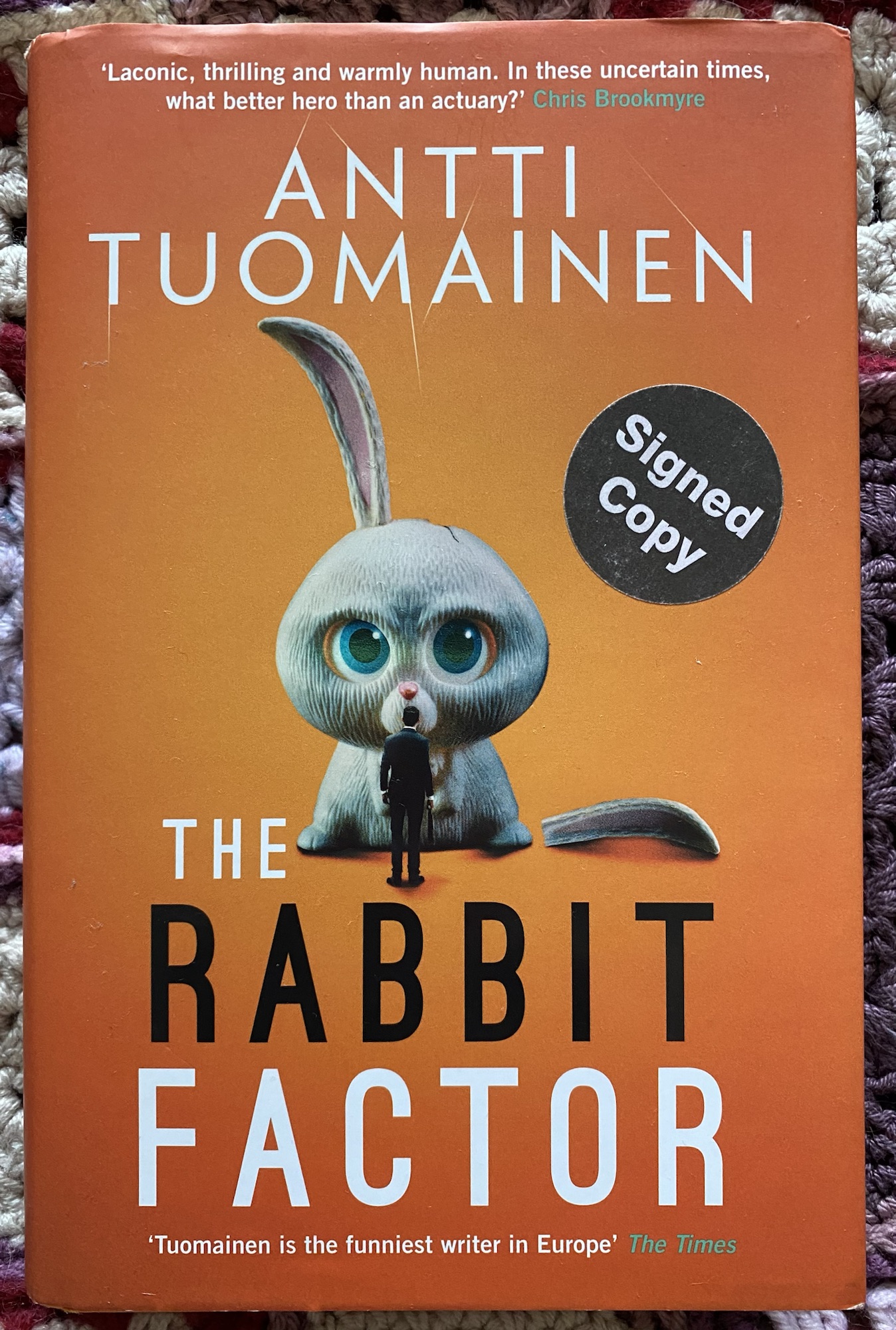
This is my first contribution to Kaggsy and Lizzy’s wonderful #ReadIndies event, running all month. The Rabbit Factor by Antti Tuomainen (2021, transl. David Hackston 2021) is published in the UK by Orenda Books, who describe themselves on their website as: “a small independent publisher based in South London. We publish literary fiction, with a heavy emphasis on crime/thrillers, and roughly half the list is in translation.”

The Rabbit Factor is the first in a trilogy about actuary Henri Koskinen, which had somehow completely passed me by until I read Annabel’s review of the final part, The Beaver Theory. A little while later I saw The Rabbit Theory in my local charity bookshop and took it as A Sign. (As I have mentioned before, I’ll take pretty much anything as A Sign in that shop, and it always results in me buying more books 😀 )

Henri is a man who likes a well ordered, predictable life: “At the age of forty-two I had only one deep-held wish. I wanted everything to be sensible.”

His job as an actuary suits him, using mathematics to predict risk. Unfortunately, what doesn’t suit him is the modern workplace – open plan, noisy and full of corporate-speak about self-actualisation. He is forced into resigning by his boss who hides his bullying behind pseudo-beneficent jargon.

Not long after, Henri is told his brother Juhani has died and he has inherited YouMeFun, an adventure park (not an amusement park) in Vantaa. Unfortunately, before he died his brother inherited their parents’ chaotic approach to life and so Henri finds himself faced with:

“An unbearable lack of organisation, staggering maintenance bills, unproductive use of man hours, economical recklessness, promises nobody could keep, carts that quite literally moved at tortoise speed? I raised my fingers to my throat and checked the position of my tie. It was impeccable.”

Juhani was also in hock to gangsters, two of which – Lizard Man and henchman AK – keep turning up to menace Henri with horrible regularity and conviction. No less threatening, but considerably less violent, is police officer Osmala who similarly seems very interested in YouMeFun and Henri. And so Henri finds himself under enormous pressure and with only his maths skills to fall back on.

“I resigned because I couldn’t stand watching my workplace turn into a playground. Then I inherited one.”

I think maybe this novel passed me by because it can be classified under Nordic-noir, and I don’t read a great deal of that. What I read I enjoy, but I choose carefully because I am a delicate flower and not really in the market for gruesome crimes. Now, there are gruesome deaths in The Rabbit Factor, but I managed these fine. The details aren’t dwelt upon and they are surrounded by such surreal silliness that the focus is more on the ridiculousness of Henri’s situation than violence.

The tone is also not noirish. One of the blurbs in my edition mentions the Coen brothers, and this is a good parallel: while there is darkness to the tale, there is also humour and humanity. Henri’s unlikely colleagues include Esa, the US-marine obsessed security officer; sweet Kristian who is unable to see that his total ineptitude is what prevents him from becoming general manger; Minttu K who seems to know about marketing if she could only stop self-medicating with alcohol; Venla who never arrives for a shift; and quietly efficient Johanna who runs the kitchen and actually seems able to do her job.

There is also Laura Helanto, manager and frustrated artist, who causes feelings to arise in Henri that he doesn’t fully understand. It’s a confusing time for him all round…

“But recent events have taught me that what once seemed likely, as per the laws of probability, is more often than not in the realm of the impossible. And vice versa: what once I would have been able to discount through a simple calculation of probability ratios and risk analysis is now in fact the entirety of my life.”

I really enjoyed The Rabbit Factor. The deadpan narration of Henri is so well-paced that it manages to also be completely engaging. His focus on detail grounds the ridiculousness of his situation so it remains believable, carrying the reader along on Henri’s absurd journey.

“Even as a child I saw mathematics as the key. People betrayed us, numbers did not. I was surrounded by chaos, but numbers represented order.”

The characterisation is equally finely balanced. Henri and his colleagues could so easily be caricatures but instead you end up rooting for these disparate individuals. Tuomainen isn’t remotely sentimental but he is kind to the people he creates. The humour is derived from the situation, never laughing at the people themselves. They change under Henri’s stewardship, and he in return finds himself behaving in ways that surprise him more than anyone:

“I say something I could never have imagined hearing myself say. ‘This doesn’t make any sense. But it has to be done.’”

Last year I decided I would buy one book a month from an independent publisher or bookshop. I think Henri would agree that the probability of my next two purchases in this regard being his adventures in The Moose Paradox and The Beaver Theory are pretty high…

To end, I was so tempted to choose Chas & Dave’s Rabbit, as I absolutely loved that song when I was little (it was released when I was four years old, and I thought they were singing about actual rabbits). But alas, my adult sensibilities prevent me from adding a song about silencing women to the blog 😀 So instead here is a literature-inspired song about drugs rabbits:

“Some things I cannot see until I write about them.” (Yuko Tsushima)

I wasn’t planning on joining in Japanese Literature challenge 17 hosted by Meredith at Dolce Bellezza other than enjoying other bloggers wonderful posts. However this enthusiastic post by Marina Sofia on Tsushima Yūko’s Territory of Light meant I immediately started rooting through the TBR to find Child of Fortune (1978, transl. Geraldine Harcourt 1983), which I knew I had buried somewhere…

This is the first of her novels I’ve read and on the strength of this I definitely want to read more. Novella length, it tells the story of Kōko, a 36-year-old single mother to eleven-year-old Kayako. Told in the third person from Kōko’s perspective, it is a compelling examination of one woman’s inner world and her barely articulated resistance to the expectations placed on her.

Early in the novel, Kōko suspects she is pregnant. She is ambivalent about Osada, the father, as she is about most things. But gradually she realises that she wants to keep the child:

“Maybe she was reaching an age when it was senseless to want a fatherless child; but, precisely because of her age, she didn’t want to make a choice that she would regret till the day she died. Lately she was more convinced than ever that there was no point in worrying about what people thought. She would soon be thirty-seven. The only person watching Kōko at thirty-seven was Kōko. When this obvious fact finally came home to her it was still a surprise – what a very lonely fact it was!”

Geraldine Harcourt’s informative introduction explains that pregnancy at that age in Japan around this time could still be viewed as shameful even within marriage, so Kōko’s decision is doubly transgressive.

Kōko is an intriguing character, as she lives an unconventional life which places her in opposition to so many, by barely doing anything. Her lack of decision-making is an act of quiet but determined resistance.

Her sister Shoko is much more conventional and doesn’t approve; Kōko’s daughter Kayako much prefers to spend time with her more affluent, conformist aunt. Kōko tries to explain to Shoko:

“No, that’s not it – don’t think I’ve liked using choosing a different world from other people. I know I’ve been stubborn – but not about Kayako alone. All my life, though I often haven’t known which way to turn, I have managed to make choices of my own. I don’t know if they were right or wrong. I don’t think anyone can say that.”

But really she hasn’t made that many choices. She married because of pregnancy; husband Hatanaka organised the divorce years later, unsurprisingly as Kōko didn’t love him, still holding a candle for her lover Doi. She doesn’t enjoy her job teaching piano, but she also takes no steps to do anything else. She doesn’t take great care of herself and she doesn’t have many friends or interests.

Two driving forces in her life are her love for her brother, who died many years earlier, and sexual desire. The latter has led to her current predicament, the former suggests one reason that may be contributing to her lack of attachments.

“A little over a year ago, Kōko had understood something for the first time: the in the end she had let everything slip away from her, that in reality she hadn’t a single resource. It was an alarming discovery.”

Her lack of attachment includes reality – we are taken into Kōko’s dreams and daydreams, woven in seamlessly but disconcertingly.  As we move back and forth in time, learning about Kōko’s childhood, marriage, griefs and pains, Tsushima builds a picture of a woman who may not be completely likable but who is recognisably human and flawed, and muddling through the best way she knows how.

I was really rooting for Kōko to find a more articulate agency, and the penultimate scene was unbearably tense in this regard. Child of Fortune is never didactic yet absolutely achieves a compelling portrait of a woman fighting for her life, against immense societal pressure.   

“Kōko was shaken by the realisation that even now, more than twenty years later, she still lacked any compelling reason to go on living. And by the fact that the will to live was still there.”

To end, Kōko has fond memories of a visit to Karuizawa, which does look lovely:

PS When I was looking for a title quote for this post, I found this great conversation between Tsushima and Annie Ernaux.