“Everyone wants to be Cary Grant. Even I want to be Cary Grant.” (Cary Grant)

Happy (belated) Valentine’s Day!  In my post for Valentine’s Day last year (which was also late…) I pointed out that St Valentine is the patron saint for bee keepers, plague, epilepsy and against fainting, as well as for lovers.  Last year I wrote on bee-keeping and plague  but this year I’m going to be more romantic and tell you about the man in my life.  He’s always been there, but these last few weeks it’s like I’m seeing him with new eyes; now I’m obsessed and we spend hours together every day.  The title quote may have given it away: he’s Cary Grant.

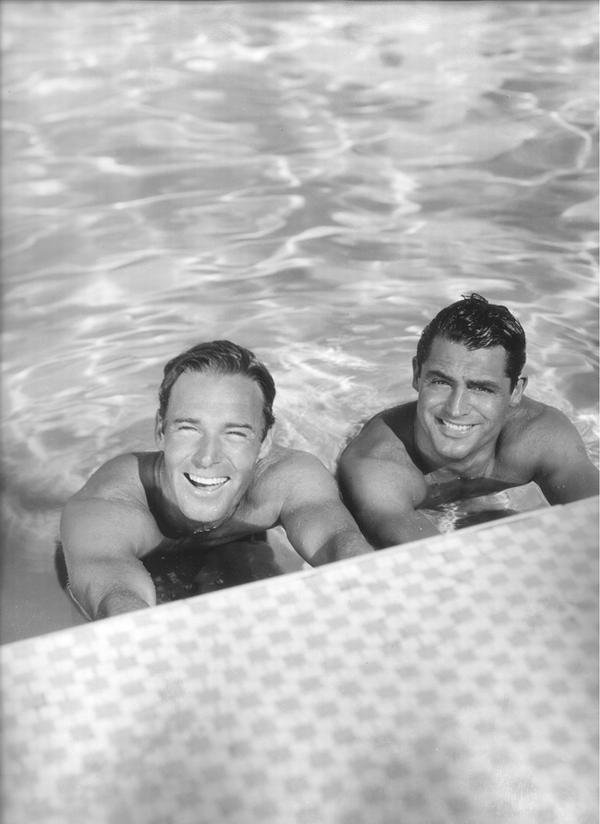
Let me explain.  For my last paper before finals (FINALS!  I’ve just broken out in a cold sweat….) we were given some optional papers to choose from, and I chose Film Criticism.  We’ve been looking at Hollywood Golden Age, a genre Cary Grant sits astride like a tanned, debonair, mid-Atlantic-accented colossus.  Having watched soooooo many of films again (and again, and again) I have a new-found appreciation for this actor with his exquisite comic timing.  It’s not that I didn’t like him before, I just took him for (ahem) granted.  This is how good he is: I had to analyse a scene from a film, and I chose something from Bringing Up Baby.  It was 3 minutes 39 seconds long.  I spent an entire day watching and re-watching the scene.  Think about how many 3 minutes and 39 seconds there are in a day.  That’s how many times I watched it. At the end of  the day I was still laughing at his performance.  The man is a genius.  In the spirit of Valentine’s Day here he is with long-term boyfriend totally-platonic-friend-who-he-just-happened-to-live-with-for-twelve-years, Randolph Scott.
Image

(Image from http://blogs.villagevoice.com/dailymusto/2010/09/cary_grant_and.php)

What a ridiculously good looking pair.  Anyway, I thought for this post I would look at two of his favourite novels.  According to IMDB he was a voracious reader.  Do you think I can find out what he liked to read?  Google, thou hast failed me.  (Probably now I’ll be told that it’s really well-known that he loved Moby Dick or something, but I couldn’t find it). So instead I’ve chosen a James Bond novel as apparently the character was partly modelled on him and he was considered for the role in Dr No, and a short story by a writer who like Archie Leach was famous under a pseudonym.

Firstly, Casino Royale by Ian Fleming (1953).  I’ll be honest, I went into this novel with very low expectations.  Even the most avid Fleming fan will tell you that some of the novels are absolute bilge; apparently the quality of the Bond novels varies widely.  This was the first Bond novel written and the first one I’d read, and I was pleasantly surprised.  OK, Fleming isn’t a grand literary genius, but I doubt he ever proclaimed himself as such.  Casino Royale is a decently written spy story.  It’s quite different to the film, although similarities remain.   I was expecting a flashy, superficial story but it’s a bit more reflective than that.  It opens:

“The scent and smoke and sweat of a casino are nauseating at three in the morning.  Then the soul-erosion produced by high gambling – a compost of greed and fear and nervous tension – becomes unbearable and the senses awake and revolt from it.”

Bond has been sent to Royale-le-Eaux to take down a Russian spy, Le Chiffre, by bankrupting him at gambling.  This being the Cold War, of course the baddies are Russian, and there’s also the rather sinister SMERSH, a Russian covert group whose name means “death to spies” lurking in the background.  That’s the very simple premise of the story.  Along the way there are lingering descriptions of clothes, cars and food (Fleming was clearly something of a gourmand), but the presentation of Bond is more complex than I was expecting.  I don’t think the reader is supposed to wholly like him or trust him:

“His last action was to slip his right hand under the pillow until it rested under the butt of the .38 Colt […] Then he slept, with the warmth and humour of his eyes extinguished, his features relapsed into a taciturn mask, ironical, brutal and cold.”

Bond is more human than in the films (he vomits in the gory aftermath of an explosion). He’s also damaged and flawed, more in keeping with the later filmic representations.  Very much of its time, however, is the misogyny:

“These blithering women who thought they could do a man’s work.  Why the hell couldn’t they stay at home and mind their pots and pans and stick to their frocks and gossip and leave men’s work to the men.”

As well as this general sexism, there’s also a worryingly easy conflation of sex with violence:

“Bond saw luck as a woman, to be softly wooed or brutally ravaged, never pandered to or pursued.”

Truly obnoxious and offensive. But in Fleming’s defence I would say that he seems more emotionally intelligent than his protagonist and we’re not supposed to see Bond as a role model in this sense.  There’s also a good dose of humour in the novel which encourages us not to take Bond entirely as seriously as he takes himself:

 “Englishmen are so odd.  They are like a nest of Chinese boxes.  It takes a very long time to get to the centre of them.  When one gets there the result is unrewarding, but the process is instructive and entertaining.”

So, Casino Royale was better than I expected.  It’s attitudes to women and Eastern Europeans are dated and offensive but as I said, I don’t get the sense the novel fully endorsed the attitude of its protagonist.  It’s a quick, light read (although the descriptions of gambling dragged a bit in places) and for me it was good introduction to the Bond novels.

Secondly, The Celebrated Jumping Frog of Calaveras County (1867) by Mark Twain. What an irresistible title.  Twain was a fairly prolific short story writer, but this was only the second one he wrote.  You can read the full text of it here. It really is a very short tale, and shows how much can be done in so limited a space by an accomplished writer.  It opens:

In compliance with the request of a friend of mine, who wrote me from the East, I called on good-natured, garrulous old Simon Wheeler, and inquired after my friend’s friend, Leonidas W. Smiley, as requested to do, and I hereunto append the result. I have a lurking suspicion that Leonidas W. Smiley is a myth; that my friend never knew such a personage; and that he only conjectured that, if I asked old Wheeler about him, it would remind him of his infamous Jim Smiley, and he would go to work and bore me nearly to death with some infernal reminiscence of him as long and tedious as it should be useless to me. If that was the design, it certainly succeeded.

As you can see, Twain’s humour is at the forefront (if you hadn’t already guessed by the title) and the mix of the ridiculous (“Leonidas W Smiley is a myth”) and the dry (“as long and tedious as it should be useless”) makes the story hugely entertaining.  It’s certainly a confident writer who tells a tale he says will be tedious, and Twain does this not once but twice: “Simon Wheeler backed me into a corner and blockaded me there with his chair, and then sat me down and reeled off the monotonous narrative which follows this paragraph.”  Simon Wheeler’s story of a gambling addict (Jim Smiley) who will bet on anything is directly reported, and he has one of the distinctive Southern voices Twain is so famed for, such as when he’s recounting how Jim trains the titular frog:

“He ketched a frog one day, and took him home, and said he cal’klated to edercate him; and so he never done nothing for three months but set in his back yard and learn that frog to jump. And you bet you he did learn him, too. He’d give him a little punch behind, and the next minute you’d see that frog whirling in the air like a doughnut see him turn one summerset, or may be a couple, if he got a good start, and come down flat-footed and all right, like a cat.”

There are some lovely touches in this story.  I particularly liked the line: “Smiley said all a frog wanted was education” and the fact that the frog is endowed with the decidedly un-froggy full name of “Dan’l Webster”. A quick read that children and adults will enjoy.

To end, here is a clip from The Philadelphia Story, and just possibly the most charming 3 minutes and 46 seconds ever committed to celluloid.  Apparently the bit where Cary Grant says “excuse me” was ad-libbed & that’s why he & James Stewart are trying not to laugh. Enjoy!
“Critics! Appalled I ventured on the name./Those cutthroat bandits in the paths of fame.” (Robert Burns)

Saturday is Burn’s Night, in honour of Scotland’s favourite son, Robert Burns (1759-1796).  I’m posting today however, because tonight I am going to a Burn’s Night supper.  This will consist of Arbroath smokies, followed by haggis, tatties and neeps, followed by clootie dumpling, followed by an argument as to whether I’m going to dance at the ceilidh.   Although I have two left feet I quite enjoy a dance, but my suggestion that we do it before a three course stodge-fest has been met with derision.  Needless to say, I think I’ll be lying down in a corner while the more hardy among my number whizz around in Celtic fashion. To celebrate I’ve chosen a novel written in Scottish vernacular, and a poem by a Scottish writer. I like them both so I hope Burns won’t find me to be one of the “cutthroat bandits” he refers to with such derision. Slainte Mhath!

Firstly, Buddha Da by Anne Donovan (2002).  This was Anne Donovan’s first novel, and it is a confident and accomplished debut.  It tells the story of Jimmy, a Glaswegian painter and decorator, who becomes interested in Buddhism.  His desire to put his newly-discovered beliefs into the practice of his daily life cause strain in his relationships with his wife Liz and daughter Anne-Marie, and all three lend their voices to individual chapters to tell the story.

Jimmy learning to meditate: “It was as if ah’d never felt ma body afore; felt the tightness in ma airms and legs, the openness of ma chest, the wee niggles that ran aboot inside me that usually I never even think aboot. Then as ma breathin slowed doon and ah sterted tae feel mair relaxed he took me through each person in turn.  That was the really hard bit because as each feelin came up he tellt me no tae judge it.  Wi Anne Marie ah just felt ashamed that ah’d let her doon […] Then Liz. That was haurd too cos ah love her – always have – but somehow ah cannae get her tae unnerstaund how this is that important tae me. There’s a gap openin up between us. Ah can feel it and ah’m scared.”

The relationships do start to break down, but Donovan is very even-handed and you don’t apportion blame, you can just see how it’s happening as people grow apart.  The first person narrative from all three characters means you can empathise with them all.  Liz doesn’t always behave in the best way, but I still felt sympathy for her as she struggles to make the life she wants:

“It was five o’clock in the morning but ah didnae want tae go back to sleep in case the dream started again.  It wasnae the most frightenin dream ah’d ever had but it was confusin.  Usually if ah have a dream it’s dead obvious what it means, but this.  Ah leaned back on the pillows, shut ma eyes and the feelin came back tae me; the cauld of the water beneath ma feet, the panic as ah started tae sink and the relief as ah sprung up oot the water, the green castin an eerie light all round the sky and this dark, shadowy figure waitin for me on a rock on the other side.”

And between them both, their daughter Anne Marie.  After she plays her parents a song she’s made with her friend:

“And ah was dead chuffed that they liked it but efterwards, sittin in ma room, ah kept feelin that there was sumpn missin. As if they hadnae really got it. And ah really wanted them, no just tae like it, but tae unnerstaund it.  And ah didnae think they did.”

And that really is the crux of Buddha Da.  It’s about how the people we love may not always be the ones who really understand us.  It’s about the gaps that exist even in our closest relationships.  Donovan writes with real affection for the characters, and so these themes aren’t depressing.  It’s a warm novel about living with imperfections and muddling through together. If you’re interested in Scottish vernacular novels, two famous examples you may want to try are Trainspotting by Irvine Welsh, and How Late It Was, How Late by James Kelman.

Secondly, a poem by the Poet Laureate, Carol Ann Duffy, who was born in Glasgow.    I love Duffy’s writing, and she’s managed the rather astonishing feat of writing decent poems within her remit of commemorating national events. Warming Her Pearls (from Selling Manhattan (1987)) was written long before she took office, and is one of her more famous verses.  However, I still went ahead and chose it rather than something more obscure, as I do think it’s brilliant.  You can read the full poem here.  It is spoken in the voice of a maidservant to a rich society woman:

“Next to my own skin, her pearls. My mistress

bids me wear them, warm them, until evening

when I’ll brush her hair. At six, I place them

round her cool, white throat. All day I think of her”

This to me is a good example of Duffy’s writing: accessible, simple language to convey an unconventional literary voice, in this case, a maid’s erotic love for her mistress.  The power dynamic of the relationship with its “bidding” and the rope of pearls adds a slightly BDSM element, and Duffy plays with the idea of power throughout the poem.  The maid is emboldened by her desire outside of social class, rather than cowed by it.  I love the following image:

“[I] picture her dancing

with tall men, puzzled by my faint, persistent scent

beneath her French perfume, her milky stones.”

The insidious nature of the maid infiltrating her mistress’ life through her body odour is so clever, slyly humorous and evocative; the idea of bodies betraying themselves is carried on in the next stanza: the soft blush seep through her skin/like an indolent sigh.   The tenderness with which the maid approaches her mistress, a reflection of her feelings, is wonderfully evoked through this beautiful language.  Warming Her Pearls is as delicate and subtle as the situation it portrays.

Finally, a little bonus, another poem by Carol Ann Duffy, this is from The World’s Wife, where she imagines the stories of the wives of famous men.  ‘Mrs Darwin’ is one of the shortest, so here it is in its entirety:

7 April 1852.

Went to the Zoo.

I said to Him –

Something about that Chimpanzee over there reminds me of you.

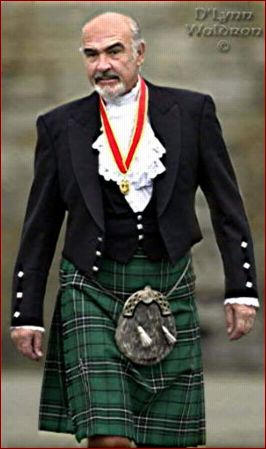
I could end with a picture of the books, but I doubt Burns would approve of such a prosaic choice.  Instead, here’s one of the most Scottish things you’ll ever see:

Image

(Image from http://www.sattlers.org/mickey/culture/clothing/kilts/hallOfFame.html)

“The book is a film that takes place in the mind of the reader.” (Paulo Coelho)

It is a truth universally acknowledged, that the film version of a book is never as good as the original text.  Except I don’t think that’s true.  This week I’m going to look at two books where I think the film was better, but the novels are still worth reading.  Slightly odd tack for a book blog to take, and I may end up regretting this, but let’s crash ever onwards!

Firstly, The Commitments by Roddy Doyle (1987).  Here’s the trailer for the 1991 film, with a brilliant script by the author, in collaboration with the long-term writing partnership of Dick Clement and Ian La Frenais.

The Commitments is Roddy Doyle’s first novel, detailing how a group of white, working class Dubliners set up a soul band together.  I think in this novel Doyle is really learning his craft, and his writing gets progressively stronger as he goes along.  The Commitments is a far from terrible book, but it’s a bit slight, and filled with so much dialogue it reads more like a script than a novel for much of it.  Still, if you’re going to have a novel filled with dialogue it may as well be written by Roddy Doyle, who has a great ear for how people speak and seems to take real joy in capturing it on the page:

“-Grow a pair o’ tits, pal, an’ then yeh can sing with them, said Billy.

– Are you startin’ somethin’?

-Don’t annoy me.

– Here! Said Jimmy. –None o’ tha’.

The time was right for a bit of laying down the law.

-No rows or scraps, righ’.

-Well said, Jim.

– An’ annyway, said Jimmy. –The girls are the best lookin’ part o’ the group.

– Dirty bastard, said Natalie.

-Thanks very much, Jimmy, said Imelda.

-No sweat ‘melda, said Jimmy.

-What’ll we sing? Bernie asked Joey The Lips.

-You know Walking in the Rain?

-Lovely.

– I WANT HIM, Imelda sang.

– It doesn’t exactly have a strong feminist lyric, does it? said James.

– Soul isn’t words, Brother, said Joey The Lips. – Soul is feeling. Soul is getting out of yourself.”

You can see that this is writing really stripped back: minimal punctuation, not always clear who is speaking.  The style suits the tale of a bunch of people with very little creating music with only their voices and few instruments.  It makes The Commitments a quick read, and the characters are evoked with warmth through minimal authorial intervention. By writing in such a sparse way, Doyle allows the characters to speak for themselves. At other times he uses scant detail, rarely embellished with imagery, to portray the lives of the band:

“’Joey The Lips got one of his dress suits dry-cleaned. Dean crawled in under his bed and found the one he’d flung under there. He soaked the jacket till the muck was nearly all gone. Then he brought it down to the cleaners.

Black shoes were polished or bought or borrowed.”

The Commitments is a well-observed story, evocative and humorous. However, a novel about music will always have much to gain from being filmed; hearing the talented cast of the film give their voice to soul classics brings the characters into being in a way that is nearly impossible in print.

Secondly, The Princess Bride by William Goldman (1973).  Here’s the trailer for the 1987 film adaptation, screenplay by the author:

http://www.youtube.com/watch?v=njZBYfNpWoE

One of my favourite films from childhood that I still love to watch today – a definite winner on a rainy Sunday afternoon.  Again, it’s not that the book is bad (the film is scripted by Goldman after all so you wouldn’t expect a great deal of difference) but the film is better.  It takes all the best bits of the book and distils them into a fast-paced, funny narrative; the book can be a bit flabby at times by comparison.  The film also offers some of the best cameos ever: Billy Crystal as Miracle Max, Mel Smith as the torturer, comic genius Peter Cook as the Impressive Clergyman, as well as a perfectly cast set of main characters.  But if you like the film, you’ll like the book.  The same dry, silly humour runs through it, and who wouldn’t love a tale of: “Fencing. Fighting. Torture. Poison. True love. Hate. Revenge. Giants. Hunters. Bad men. Good men. Beautifulest ladies. Snakes. Spiders. Beasts of all natures and descriptions. Pain. Death. Brave men. Coward men. Strongest men. Chases. Escapes. Lies. Truths. Passion. Miracles.”

The tale is one of Princess Buttercup, who falls in love with the stable boy Westley.  He goes off to seek his fortune, and is captured by the Dread Pirate Roberts, who famously leaves no survivors.  Believing her One True Love to be dead, Buttercup agrees to marry the hunting-obsessed Prince Humperdink.  Before they can marry she is kidnapped by a gang comprising the cunning Vizzini (“never start a land war in Asia, [… and] never go against a Sicilian when death is on the line”), the giant Fezzik , and genius-swordsman-with-a-vendetta Montoya (“my name is Inigo Montoya, you killed my father, prepare to die!”) They are followed by the mysterious Man in Black, who seeks to foil their plans… Will goodness triumph? Will true love conquer all? Yes, of course, to both.  This is a lovely escapist fantasy, but at the same time it is a  satire on established rule and its abuses, which gives the story a more serious dimension. Prince Humperdink has arranged the kidnap of Buttercup in order to blame a neighbouring country and start a war.  (Fill in your own contemporary analogy here.)  He tells his henchmen to seek the “villains” in the thieves quarter:

““My men are not always too happy at the thought of entering the Thieves Quarter.  Many of the thieves resist change.”

“Root them out. Form a brute squad.  But get it done.”

“It takes at least a week to get a decent brute squad going,” Yellin said. “But that is time enough.

[…]

The conquest of the Thieves Quarter began immediately.  Yellin worked long and hard each day […] Most of the criminals had been through illegal roundups before, so they offered little resistance.””

Goldman is also able to extend his humour in the novel towards the processes around writing, which he couldn’t do in the film; for example his editor querying his translation of the “original” story by S. Morgenstern:

“this chapter is totally intact. My intrusion here is because of the way Morgenstern uses parentheses.  The copy editor at Harcourt kept filling the margins of the galley proofs with questions: […] “I am going crazy. What am I to make of these parentheses? When does this book take place? I don’t understand anything. Hellllppppp!!!” Denise, the copy editor, has done all my books since Boys and Girls and she had never been as emotional in the margins with me before.”

So there we go: two film recommendations as well as two book recommendations in the same post – call it a late Hogmany present from me to you, dear reader. Enjoy!

Image

“Make your mistakes, next year and forever.” (Neil Gaiman)

Happy New Year!  I’ve quoted the lovely Neil Gaiman to start off 2014, and do please check out the full context of the quote here, as I’m sure it will get your year off to a flying start.  Here’s to many more mistakes in 2014!

And now, I’d like to entirely ignore New Year.  This is a blog post for my brother.  His birthday is 1 January, and it’s a crap time to have a birthday.  It gets entirely subsumed in Christmas and New Year, and once you’re no longer a child, everyone you know spends your birthday with a monster hangover.  Rubbish.

Like Neil Gaiman, my brother is a lovely man, who despite reading very little fiction always reads my blog posts and likes them on Facebook.  That’s who we’re dealing with, people.  So what to write about? Well, he likes poetry and I think he has a really good feel for it, an innate understanding.  So this post will look at two poems that I think he’ll appreciate. This is for you, T.  Entirely for you with no thematic link to New Year at all.  Happy Birthday, brother of mine.

Image

(Image from: http://hdwallpaperspictures.com/birthday-cake/)

Firstly, The Door by Miroslav Holub (trans. from Czech by Ian Milner).  You can hear Joseph Fiennes read the whole poem here. This is a hugely clever poem, disguised in simple language.  The poet repeatedly urges the reader to “Go and open the door”, and speculates as to what is on the other side.  The first stanza is:

Go and open the door.

Maybe outside there’s

a tree, or a wood,

a garden,

or a magic city.

This is a poem you can read to a child: the idea and language is so simple, they will quickly relate to the opportunity to let their imagination run riot.  Yet it works on a variety of levels that adults can appreciate, and can be about the search for inspiration; the courage to take new, unexplored paths in life:

Go and open the door,

If there’s a fog

it will clear.

Go and open the door.

Even if there’s only

the darkness ticking,

even if there’s only

the hollow wind,

even if

nothing

is there,

go and open the door.

The images of “darkness ticking” and “hollow wind” are eerie, and add an unsettling quality to the poem.  They bring a sense of form to the formless, effectively creating how the unknown can still be scary. However, this door and what lays beyond is not entirely unknown; I think one of the really clever things about this poem is that the door is a definite article: “the door”, not the indefinite “a door”.  It’s a small thing, but by suggesting the door is specific one, Holub delicately reminds us that this door to new ideas and new ways of living is within reach, already identified, carried within ourselves.  And if nothing else, the final lines remind us:

At least

there’ll be

a draught.

A lovely, humorously deprecating end to an unpretentious poem that can follow you through life.

Secondly, A Glimpse of Starlings by Brendan Kennelly. You can read the full poem here.   This is an astonishing and powerful poem, full of intriguing imagery. It begins:

I expect him any minute now although

He’s dead. I know he has been talking

All night  to his own dead…

It’s not clear who “he” is, or if he is really dead, or only living among the dead.  Googling this poem tells you it is about the poet’s father, struggling to deal with the loss of his wife.   The struggle is beautifully and tenderly evoked through a variety of images:

Sipping a cup of tea, fingering a bit of bread,

Eating a small photograph with his eyes.

The questions bang and rattle in his head


[…]Daylight is as hard to swallow as food

Love is a crumb all of him hungers for.

How gorgeous, and heartbreaking, are those lines?  The frequent use of full-stops keeps the pace of the poem low-key and quiet, creating a sense of the poet’s careful approach towards the grieving man.  The transfer of images between food and the environment “eating a small photograph”, daylight being “hard to swallow”, skilfully shows how the sustenance of a man’s life has disappeared, affecting everything.  The hungering for a crumb of love is a beautiful way of evoking the yearning emptiness of grief that can never be sated.

The image of starlings is created in the last few lines:

…over his shoulder a glimpse of starlings

Suddenly lifted over field, road and river

Like a fist of black dust pitched in the wind.

This is an oblique image so I’ll leave it with you to find your own meaning.  I find this poem extremely powerful and the images truly haunting.

To end, here is a video of the astonishing display of a murmuration of starlings:

I hope you liked them, T. Have a great day one and all!

Feminist Sundays: The Woman Who Walked into Doors – Roddy Doyle

Feminist Sundays is a meme created by Elena over at Books and Reviews. Here’s what she says about it: “Feminist Sundays is a weekly meme created at Books and Reviews. The aim is simply to have a place and a time to talk about feminism and women’s issues. This is a place of tolerance, creativity, discussion, criticism and praise. Remember to keep in mind that everyone is entitled to their own opinion, although healthy discussion is encouraged.” Do head over to Books and Reviews to read the excellent posts for this meme so far.

This week for Feminist Sundays I thought I’d put a downer on Christmas – if you’re full of festive cheer you may want to stop reading now.  I love Christmas, and I’ve had a great time this week decorating my flat (OK, so I’m a bit behind), wrapping presents and icing Christmas cakes.  I do this in anticipation of the day itself which for me will be fun, silly, relaxed, full of food, and getting slightly tipsy (OK, fairly drunk – when else do you drink alcohol at breakfast?  Why does the birth of Jesus make early morning Bucks Fizz acceptable? Whatever – it’s a fine tradition) in the company of my lovely family. I can confidently state in advance that there will be no weird atmospheres, no aggression, no physical assaults.  But this is not the case for everyone.  Unfortunately, the Christmas period consistently sees a rise in domestic violence compared with the rest of the year.  And although I’m looking at this topic as part of Feminist Sundays, (as the majority of domestic violence cases are male violence towards women) domestic violence can happen to anyone: any gender, any sexuality. It’s a subject Roddy Doyle explored in his 1996 novel, The Woman Who Walked into Doors.

The novel is narrated by Paula Spencer, a woman who is beaten regularly by her violent husband Charlo.  Paula works as a domestic cleaner, and self-medicates with alcohol.  Hers is a voice rarely heard in fiction; Doyle does a brilliant job creating the character and all that surrounds her through a narrative that intertwines the present with reminiscences of the past:

“Where I grew up – and probably everywhere else – you were a slut or a tight bitch, one or the other, if you were a girl – and usually before you were thirteen. You didn’t have to do anything to be a slut. If you were good-looking; if you grew up fast. If you had a sexy walk; if you had clean hair, if you had dirty hair. If you wore platform shoes, and if you didn’t. Anything could get you called a slut. My father called me a slut the first time I put on mascara. I had to go back up to the bathroom and take it off. My tears had ruined it anyway.”

Into this world comes Charlo Spencer, a sexy man who literally takes Paula’s breath away: “I suddenly knew that I had lungs because they were empty and collapsing.”  The romance of their first meeting contains a horrible irony in the soundtrack:

“His timing was perfect.  The Rubettes stopped and Frankie Valli started singing My Eyes Adored You.[…] He’d been drinking.  I could smell it but it didn’t matter.  He wasn’t drunk.  His arms rested on my hips and he brought me round and round.

-But I never laid a hand on you-

My eyes adored you-

I put my head on his shoulder.  He had me.”

This is immediately followed by a description of the aftermath of an assault:

“I knew nothing for a while, where I was, how come I was on the floor.  Then I saw Charlo’s feet, then his legs, making a triangle with the floor.  He seemed way up over me.  […] his face was full of worry and love.  He skipped my eyes. – You fell, he said.”

Charlo’s violence escalates, and Paula gradually comes to realise that he will not change, and that she is not alone in this experience. Doyle achieves the extraordinary balance of writing responsibly about a serious subject and still providing hope:

“For seventeen years.  There wasn’t one minute when I wasn’t afraid, wasn’t waiting. Waiting to go, waiting for him to come.  Waiting for the fist, waiting for the smile.  I was brainwashed and braindead, a zombie for hours, afraid to think, afraid to stop, completely alone. I sat at home and waited. I mopped up my own blood.  I lost all my friends, and most of my teeth.”

Ultimately Paula is a survivor: Doyle returned to her in the sequel Paula Spencer, ten years later.  I haven’t read the sequel (one of many on my TBR pile) but I highly recommend TWWWID. Roddy Doyle is hugely talented at capturing authentic voices in his writing, and TWWWID is no exception.

If you are affected by domestic violence, please, please contact Refuge (UK) or the equivalent service in your country.  They are there to help, not to judge.   Here’s a powerful video make-up artist Lauren Luke made on behalf of Refuge:

“Writing about music is like dancing about architecture.” (Variously attributed)

I was thinking about how this blog is supposed to be themes that relate books to life and how there are gaping holes in what I’ve covered so far.  This week I attempt to redress the balance by picking something that is a huge part of most people’s lives: music.  However, as the title quote shows, I may be digging myself the most enormous hole here, as trying to capture an aural experience through words is nigh on impossible.  Let’s take a breath and have some music so if nothing else this post does make some sort of melodic offering.  One of my favourite bands, and one of my mother’s favourite songs, Frogs Legs and Dragon’s Teeth by Bellowhead:

That was for you Maman!  Right, back to books, and two brave writers who’ve made music a big part of their novels.

Firstly The Courage Consort by Michel Faber (Canongate, 2002).  I’m fan of Michel Faber’s writing – I love his sparse style and unpredictability.  Anything can happen his books, there’s no “typical Faber”.  The Courage Consort is a novella (121 pages in my edition) told from the point of view of Catherine, one of five members of the titular a capella group headed by her husband, Roger.  Catherine is emotionally fragile (we are introduced to her trying to decide whether to jump out of the window) and her husband seemingly oblivious to her pain.  They join three others to rehearse an insanely complex piece called Partitum Mutante in an eighteenth-century chateau in Belgium.  The composer arrives briefly to assist them, a madman who attacked his ex with a stiletto in an airport and tells them to make their singing “more extreme, but more soft also…quiet but loud”.  Working on this seemingly doomed project, the disparate personalities that make up “the seventh most-renowned serious vocal ensemble in the world” start to come into conflict, but not in an entirely predictable way.

Faber creates a believably comic situation and the characters are generally well-observed, if bordering on national stereotypes at times.  The character of Catherine is sympathetic and Faber shows how music carries over into her musings about life in general:

“Other people might think it was terribly exciting when two females singing in thirds made the airwaves buzz weirdly, but Catherine was finding that her nerves were no longer up to it.  Even the way a sustained A flat tended to make an auditorium’s air-conditioning hum gave her the creeps lately.  It was as if her face was being rubbed in the fact that music was all soundwaves and atoms when you stripped the Baroque wrapping-paper off it.   But too much sonic nakedness wasn’t good for the spirit.  At least that was what she was finding lately, since she’d started coming…adrift.”

But things are not necessarily what they seem: Catherine hears screaming in the night and is told a ghost story about the forest that surrounds them.  No-one else hears it, and Catherine goes on to have an experience in the forest which is not told to the reader.  This lack of explication stops The Courage Consort being a straightforwardly comic novel, as an eeriness creeps around the house and its inhabitants.  Things do not go as planned, but ultimately the group comes to fully comprehend just how healing the experience of music can be.

Secondly, Grace Notes by Bernard MacLaverty (Vintage, 1997).  Grace Notes tells the story of another Catherine, this one a composer struggling to manage her art alongside the demands of her life.  These demands include a new baby and ensuing post-natal depression, her father’s death, and conflict with her mother.  Musicality comes naturally to her, and she has an innate understanding form an early age:

“One day, when she was only three or four, she’d slipped away from the kitchen as her mother baked and listened to the radio.  On this particular day the piano lid was open.  Catherine had reached up above her head and pressed the keys as softly as she could.  No sound came from them.  She had to press harder to make the sound come.  It frightened her when it did.  Dar, deep , thundery.  The booming faded away and the noise of the birds outside came back.  She tried further up the piano where the notes were nicer, not so frightening.  She pressed a single note, again and again.  It wasn’t the note which made her feel funny – it was the sound it made as it faded away.  The afterwards.  It made her feel lonely. “

This idea, later defined as “the notes between the notes” – grace notes – is the novel’s theme and main image: what happens in the spaces between events, what is left unsaid, what is defined and what is undefinable.    Catherine gradually comes to terms with her life throughout the course of the novel and moves onwards, creating a new symphony, but the grace notes continue: “it began with a wisp of music, barely there – a whispered five-note phrase on the violins and she was right back on that beach with her baby. […] Like the artist’s hand which moves to begin a drawing but makes no mark”.  Having described Catherine’s life in an interwoven way – memories that come to her interspersed with descriptions of her life in the present – MacLaverty describes her music similiarly, the literal description of the action of instruments interwoven with the images that have inspired Catherine as she writes the symphony.  It’s a highly effective method, and probably the nearest I’ve read to a representation of sound, and the feeling it evokes, written down.

As the novels are about two musical women, here they are pictured with two more musical women: Dusty Springfield and Lily Allen Cooper:

Image

“Raindrops on roses and whiskers on kittens/Bright copper kettles and warm woollen mittens/Brown paper packages tied up with strings/These are a few of my favourite things” (Maria Rainer/Julie Andrews, The Sound of Music)

I write to you from within a fog of lemsip and cough syrup.  Yes, this week I’ve had a grotty cold.  Nothing major by any means, but just enough to make me feel grim and make the days a little greyer.  So I thought for this post I’d cheer myself up and be totally self-indulgent, by choosing two books that are thematically linked only in the fact that they are two of my favourites.

Firstly, If Nobody Speaks of Remarkable Things by Jon McGregor (Bloomsbury, 2002).  This was McGregor’s first novel, longlisted for the Booker, and written when he was only twenty-six.  Choking down my jealousy, I am able to tell you that the accolades are highly deserved.  I think this is such a beautifully written, confident debut.  It tells the story of an ordinary street and its ordinary inhabitants, over the course of a day.

“The short girl with the painted toenails, next door, she says oh but did you see that guy on the balcony, he was nice, no he was special and she savours the word like a strawberry, you know she says, the one on the balcony, the one who was speeding and kept leaning right over, and they all know exactly who she means, he’s in the same place most weeks, pounding out the rhythm like a panelbeater, fists crashing down into the air, sweat splashing from his polished head.”

“In his kitchen, the old man measures out the tea-leaves, drops them into the pot, fills it with boiling water.  He sets out a tray, two cups, two saucers, a small jug of milk, a small pot of sugar, two teaspoons.  He breathes heavily as his hands struggle up to the high cupboards, fluttering like the wings of a caged bird.”

“She opens her front door, just a little, just enough, and she hops down her front steps, the young girl from number nineteen, glad to be out of the house and away from the noise of her brothers.  The television was boring and strange anyway, it was all people talking and she didn’t understand.  She taps her feet on the pavement, listening to the sound her shiny black shoes make against the stone…”

I hope these three examples give a good idea of why I love this novel so much.  McGregor is so skilled at finding the poetry in ordinary lives and how the self is expressed through seemingly innocuous actions.  Gradually the inhabitants of the street emerge as fully realised characters from the details of this one day.  This narrative is intertwined with a first person narrative, and you begin to realise that something significant, and tragic, took place on this ordinary day.  If Nobody Speaks of Remarkable Things is a novel of startling sensitivity and lyricism.

If this has whetted your appetite for McGregor’s novels, I discuss his second novel, So Many Ways to Begin here.

Secondly, Death and the Penguin by Andrey Kurkov trans. George Bird (1996, English translation 2001, Harvill Press).  How to describe this novel?  It’s frankly a bit bonkers and one of those I think I understand, but maybe it’s about something else entirely.  It’s a great read though.  It tells the story of Viktor, an aspiring writer who gets a job writing obituaries, and his pet penguin Misha, who he took on when Kiev zoo gave all its animals away: “he had been feeling lonely. But Misha brought his own kind of loneliness, and the result was now two complimentary lonelinesses, creating an impression more of interdependence than amity.”

The character of this depressed penguin is as vividly realised as any of the human characters, and you really start to feel for this bird who symbolises the existential crisis of his owner and others caught up in a post-Soviet world that they do not understand: “Sleeping lightly that night, Viktor heard an insomniac Misha roaming the flat, leaving doors open, occasionally stopping and heaving a deep sigh, like an old man weary of both life and himself.”

The fragile relationship between Viktor and Misha is tested to its limit by a series of surreal events.  Viktor’s friend Misha-Non-Penguin leaves his daughter Sonya with Viktor, and so he drifts into a family unit with this self-contained little girl and her nanny.  But meanwhile, someone is using his obituaries as a hit-list, and he is being followed by a mysterious stranger known only as the fat man…

“The Chief considered him through narrowed eyes.

“Your interest lies in not asking questions,” he said quietly.  But bear in mind this: the minute you’re told what the point of your work is, you’re dead. […] He smiled a sad smile.  “Still, I do, in fact, wish you well.  Believe me.””

Death and the Penguin is a surreal adventure story, a post-Soviet satire, an examination of the individual spirit up against forces that seek to control.  It’s funny and it’s sad, it has something to say, and it says it in a truly unique and engaging way.

Here are the novels with another of my favourite things, my psychotic cat (he looks calm in this photo, but trust me, he is hell-bent on world domination):

Image

“Never in the field of human conflict was so much owed by so many to so few.” (Winston Churchill)

10 November was Remembrance Sunday, and so for this post I thought I would look at two novels dealing with the theme of war.

Firstly, Regeneration by Pat Barker (Penguin, 1991).  This was the first novel Barker wrote in the Regeneration trilogy, the other two being The Eye in the Door and The Ghost Road.  I actually think The Ghost Road is the strongest of the three, but Regeneration is still an expertly crafted novel, and although each novel in the trilogy stands alone, I think it’s preferable to start at the beginning.  Regeneration tells the story of Dr WHR Rivers, a psychiatrist at Craiglockhart hospital during the First World War, and his shell-shocked soldier patients, including the poets Siegfried Sassoon and Wilfred Owen.  Although fiction, the novel is based on true events and Dr Rivers is a real-life character as well as the poets.  Barker said she chose the character of Rivers as, not being a soldier herself, she had to find a voice with some distance from the trenches.  Although this is the case, the way Barker looks at the horrors of war is unflinching.  I’m about to quote something truly atrocious, brace yourselves or scan past it:

“Burns arms were goose-pimpled, though the room was not cold.  The smell of vomit lingered on his breath.  Rivers sat down beside him.  He didn’t know what to say, and thought it better to say nothing.  After a while he felt the bed begin to shake and put his arm round Burns’ shoulders.  “It doesn’t get any better, does it?” […]

Burns. Rivers had become adept at finding bearable aspects to unbearable experiences, but Burns defeated him.  What had happened to him was so vile, so disgusting, that Rivers could find no redeeming feature.  He’d been thrown into the air by the explosion of a shell and had landed, head-first, on a German corpse, whose gas-filled belly and had ruptured on impact.  Before Burns lost consciousness, he’d had time to realise that what filled his nose and mouth was decomposing human flesh.  Now, whenever he tried to eat, that taste and smell recurred.  Nightly he relived the experience, and from every nightmare he awoke vomiting.”

Horrors like this are almost impossible to contemplate, and even more upsetting when you realise things like this actually happened.  Within this context, amongst their traumatised and screaming comrades, Sassoon and Owen try to express their disgust and anger through verse:

““What draft is this?”

“Lost count,” said Owen. “You did tell me to sweat my guts out.”

“Did I really? What an inelegant expression. “What passing-bells for these who die as cattle?” I see we got to the slaughterhouse in the end.” Sassoon read through the poem. When he’d finished, he didn’t immediately comment.

“It’s better isn’t it?”

“Better.  It’s transformed.” […]  He thought for a moment, crossed one word out, substituted another.  “There you are,” he said, handing the page back, smiling. “Anthem for Doomed Youth.””

Regeneration is not a long novel, 249 pages in my edition, but Barker crams so much in and I’ve barely scratched the surface here.  Alongside the issues of war, she considers themes of madness, what society expects from men, and what it expects from women.  How the state can betray its citizens, and what we can give to each other in times of crisis.

Here is a clip from Gilles MacKinnon’s excellent 1995 adaptation of Regeneration (released as Behind the Lines in some countries), including some lines from one of Wilfred Owen’s greatest poems, Dulce et Decorum Est:

Secondly, further back in time to the Crimean War, Master Georgie by Beryl Bainbridge (Abacus, 1998).  This was the novel for which Bainbridge was posthumously awarded a Booker Prize in 2011, with a special prize, the Best of Beryl.  I haven’t read all of Bainbridge’s books, so I can’t vouch for whether it’s her best, but it’s certainly highly accomplished.  It tells the story of George Hardy, a surgeon and photographer who, after a family tragedy, decides to leave Liverpool for the Crimea.  His adoptive sister Myrtle and geologist brother-in-law Dr Potter accompany him, alongside fire-eater and sometime lover of George, Pompey Jones.  These three voices narrate the story, and learning about the eponymous character from others is entirely appropriate, as George is an enigmatic and conflicted man, as obscure as one of his blackened and fading photographic images .  As Myrtle observes:

“There’s a sameness about death that makes the emotions stiffen – which is for the best, else one would be uselessly crying all day long.  It’s why Georgie often seems insensitive to other people’s feelings.  Dealing with the dying, one must either blunt the senses or go mad.”

Amongst the filth and squalor of the Crimean battlefields, all see death more often than not.  Bainbridge presents it in a determinedly low-key way; the Charge of Light Brigade happens outside the story, and Dr Potter’s pragmatic response speaks volumes about the dehumanising effects of war:

“I am in two minds as to whether I should bother to pack my tent, it being in a wretched state, perfectly sodden and much holed.  It would be better for my health if I slept in the hospital tent, though that too is in a deplorable condition.  I am at least better off as far as transport is concerned; three days ago over two hundred cavalry horses of the Light Brigade stampeded into camp, their riders having perished in a charge along the north valley.”

It may not be “Half a league, half a league, half a league onward…” but while Bainbridge shuns Tennyson’s pomp, her use of small detail says more than enough about the futility of the combat and the waste of human lives.  Master Georgie is a haunting novel that stayed with me long after I finished it.

Here are the novels with the symbol of Remembrance Sunday, a poppy:

Image

“For last year’s words belong to last year’s language /And next year’s words await another voice.” (TS Eliot)

Today marks a year since my first blog post.  During the year I’ve got so much more out of blogging than I ever thought possible, and that is due in no small part to my fellow bloggers, you gorgeous bunch.  So I thought it would be apt to commemorate my first year by looking at a piece of writing by another WordPress blogger.

First birthday

(Image from http://www.juicyoccasions.co.uk/2012_02_01_archive.html)

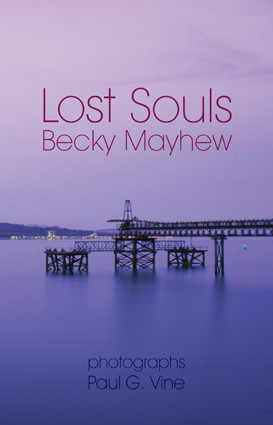
Becky Mayhew blogs at Becky Says Things.  Her blog is funny, insightful and truly original.  Do check it out, I promise you will be better for it as Becky points and laughs at the absurdities of life, and has something interesting to say about it all too. In 2011, Becky had a collection of short stories published by the lovely Treehouse Press, Lost Souls.   It is collection of three stories, “Shelves”, “Ramona” and “Roses”.

“Shelves” is told to us by a librarian, whose sexual encounters are intertwined with her job and the reading matter of her partners.  So she sleeps with the “insipid, vole-like” Geoffrey when he takes on board her suggestion to abandon John Grisham for Jane Austen, and later, after Wuthering Heights:

“I think the dynamic impression of hot-blooded Heathcliff had gone to his head a little, as he had the audacity to suggest we go back to mine. I conceded, and took him round the corner along the twelve houses to my flat, almost entirely for my own personal interest in what a week of Heathcliff does to a man; as it turned out, less than I hoped.”

As the passage above shows, there’s a wry, dry humour running through the tale, and the librarian’s voice is strong and distinctive.  There are some beautiful images and Becky has an original turn of phrase:

“His eyes slid like oil over titles, one black eyebrow raised; occasionally he paused to finger a book spine or to bend to a lower shelf, and then he moved on, disappearing and reappearing in and out of bookcases like a thief.”

Fellow bibliophiles, didn’t we always know that libraries are hotbeds of sexual tension?

The narrator of “Ramona” is a middle-aged teacher, struggling to assert herself in all aspects of her life.  I know enough teachers to know the description of how “it is depressing trying to teach a class of idiots who are far more interested in their social and sexual status than in how Margaret Atwood develops her characters” rings true.  The narrator’s interest in one of her pupils, Ramona Manson, is slightly baffling to her, as Ramona “is not charming, she is not beautiful, she is not even particularly threatening”, and yet, she goes through life with an ease the narrator cannot achieve, and with a sense of authority that continually evades the older woman.  The plot of “Ramona” is a simple one, and yet through this largely unremarkable time the fracture lines in the teacher’s life become fully exposed.  The story is an artfully constructed portrait of an ordinary life teetering on the edge.

I loved the first line of the final story, “Roses”: “There he is, inside a flaming scarlet halo.” It’s a perfect example of what is to come – a beautifully written, unnerving, and insidiously violent tale. Unlike the other two stories, “Roses” is told in the third person, from the point of view of Elizabeth, a florist and fantasist, for whom the flowers are people:

“The bamboo chuckles raspingly under its breath.  The lilies poke out their tongues; the sunflowers nod on their aching necks, shoulders shaking with weary laughter…”

Elizabeth spends her day obsessed with a man who uses the coffee shop opposite her florists:

“Sometimes she can feel him, in the long stretches when she is alone with her flowers; she can feel a presence, a warmth about her, as though he is sitting right there beside her, breathing her perfumed air.  Their worlds beautifully interlaced like the coiling infinity of an open rose.”

That last sentence is such perfectly balanced writing: an image of originality and meaning without any pretension or heavy-handedness. I don’t want to say too much more about “Roses” as it would give the plot away, but the final page of this book, containing the last four short paragraphs of this story, was breathtakingly well-written.  The images are startling and evocative, and I absolutely loved this story.  Becky has blogged in the past about her tendency to procrastinate.  I can only hope she is more successful than me at beating this behaviour, because I want to read more of her work very soon…

On their website, Treehouse Press say “we want our books to be unique and beautiful objects, a thing you’d want to hold in your hand, and also for the writing and the artwork to engage you”.   Hopefully I’ve convinced you of the engaging quality of Becky’s writing.  In the book the stories are alongside the haunting images of Paul G. Vine’s photographs, certainly making it a lovely object. You can buy Lost Souls direct from the publisher at http://www.treehousepress.co.uk/products/lost-souls , so if you’d like to get Becky’s book can I enter a plea that you buy it there and not from a certain tax-avoiding multi-national company?

Image

(Image from http://www.treehousepress.co.uk/products/lost-souls )

Thanks to everyone who’s looked at the blog/followed/commented/re-blogged etc and made the last year such a joy!

“When I was a teenager, I read a lot of Poe.” (Dario Argento)

It’s Hallowe’en!  OK, it was Hallowe’en.  I delayed this post slightly to make it a joint one for my friend D’s birthday, as she is a massive fan of Gothic. Happy Birthday D!

While the cooler kids are no doubt watching films by Dario Argento last Thursday, (who I’ve quoted above) there are some for whom nothing says horror like Hammer.  Hammer Films are a British production company whose classic output you can see clips from here:

http://www.youtube.com/watch?v=MyltXEDiXKM

Some insight into my upbringing there: as a teenager my mother fell in love with Christopher Lee in those roles; it’s a wonder I’m so normal (I always brush my fangs every night before bed).  Also, one of my long-standing girl crushes, Valerie Leon, makes an appearance in the Blood From the Mummy’s Tomb.  She’s the one the narrator describes as “smoking hot”, and indeed she is.  Oh Valerie, how I wish I looked like you, even a little bit would do…  If you think To the Devil a Daughter looks amusing, well, you are probably right.  I’ve never seen it, but a few years back I took my mother to a talk by Richard Widmark.  Christopher Lee made an impromptu appearance in the audience (my mother is still recovering, as am I, to be honest) and the two of them reminiscing about that film was the funniest part of the night.  Definitely worth a look, I’d say.

But this is supposed to be about books, right?  Well, I’m getting there.  Hammer have produced some pretty high-profile films in recent years, including The Woman in Black.  As part of their raised profile, they’ve gone into partnership with Arrow books, and asked contemporary authors (Helen Dunmore, Julie Myerson, Sophie Hannah, Melvin Burgess) to write some creepy stories.  I thought it was the perfect marriage for a Hallowe’en book blog post, so my first choice is The Daylight Gate by Jeanette Winterson (Arrow Books in association with Hammer, 2012). The novel tells the story of the Lancashire Witch trials of 1612.   Winterson has taken this real-life story and woven it with her own fiction to brilliantly evoke a nation caught up in paranoia around the power of women, of ritual, and of a new Protestant faith trying hard to establish itself over the old Catholic one.  Lancashire was a Catholic stronghold, and it’s where the conspirators of the 1605 Gunpowder Plot sought refuge:

“The north of England is untamed.  It can be subdued but it cannot be tamed.  Lancashire is the wild part of the untamed.  The Forest of Pendle used to be a hunting ground, but some say that the hill is the hunter – alive in its black-and-green coat cropped like an animal pelt.”

Alice Nutter is a rich woman who lives alone, rides astride, engages in falconry, and rescues witches from a ducking.  Given these unwomanly ways, she naturally raises suspicions.  She studied under the occultist John Dee, and invented a deep magenta dye “like looking into a mirror made of mercury” which made her fortune. Alice struggles to remain apart from the society she is surrounded by, and eventually gets drawn into the town politics that have seen several women arrested on witchcraft.  The Daylight Gate is a short novel and I don’t want to give too much away, but what I will say is that amongst the witchcraft (severed heads talking with other people’s blackened tongues, people transforming into hares, familiars, elixirs of youth and the like) what is truly shocking is the state-sanctioned capture and torture, based entirely in reality.  Brace yourselves:

“In the cell was a rack, a winch, a furnace, a set of branding irons, a pot for melting wax, nails of different lengths.  A thumbscrew, a pair of flesh tongs, heavy tweezers, a set of surgical instruments, a series of small metal trays, ropes, wire, preparations of quicklime, a hood and a blindfold […] They made a small neat cut in his side and drained a quart of blood to weaken him.  Then they forced him to drink a pint of salt water.  They did not break his fingers joint by joint or pull out his teeth one by one.  They were relaxed. They drew pictures on his chest with delicate knives…they pinned back his eyelids with metal clips and dropped hot wax into his eyeballs. When he screamed they debated whether or not to take out his tongue.  But they wanted his tongue for confession.”

Eek.  I’m not a big fan of horror, but I imagine part of the appeal is that it’s a safe way to scare yourself, secure in the knowledge that Freddy Kruger et al are entirely removed from your life.  In The Daylight Gate, Winterson shows us the horrors that really aren’t so far removed, and as such offers very little comfort.  A truly chilling read for Hallowe’en.

Secondly, The Monk by Matthew Lewis (1796, my copy Oxford University Press 1995).  The Monk was written by Lewis in 10 weeks, shortly before he turned 20.  I decided to read it as at least 3 people, including my friend D, told me it was the most barking mad novel they’d ever come across.  How could I resist?  They were so right, I had no idea how right they were.  The Monk is so insane, to try and review it is near impossible.  Its plot is so convoluted, I can’t give you a summary in a single blog post. Instead, let’s make a list of typical Gothic tropes:

  • Virginal, beautiful young maidens who struggle to remain so
  • Old crones, often in caretaking capacity to the young maiden
  • People with obscure origins inc. family members pretending to be other than they are, to get close to family who for some reason have spurned them
  • Large buildings, many rooms/corridors/secret passageways
  • Large building probably also crumbling
  • Large building has garden where weather ably reflects psychological states of characters
  • Curses – which are ignored at peril also, oaths of vengence
  • Transgressions – religious/sexual (forbidden desires)/moral/societal (leading to or caused by isolation from society)
  • Supernatural – ghosts/spontaneous bleeding inc. signs in blood/resurrections
  • Magic – inc. witches/objects that provide user with all they desire/potions
  • Death and feigned death, murders
  • Dungeons
  • Torture
  • And, of course – Satan

Yep, The Monk has them all.  I can’t believe Lewis forgot to include vampires.  Maybe he thought that was going too far…

Here is a trailer for the most recent adaptation of the novel; the makers should be commended for even attempting it.  No-one does insanity-induced eye-rolls like Vincent Cassell:

http://www.youtube.com/watch?v=WJ5lDIOV_pI