“Everyone talks about the weather, but no one does anything about it.” (Mark Twain)

Being a Brit, I love talking about the weather.  Seriously.  I love the fact that it’s the usual conversation opener for the stranger next to you in the queue (another great British past time). I never tire of it.  There’s always something to say.  At the moment, that thing is: “Will this never end?  I’m melting. I’m honestly melting.  Look, my feet are fusing with the tarmac.  Look.” Yes, we are having a heat wave.  And my usual refrain in hot weather of “At least it’s not as bad as 2006” won’t work, because it is as bad as 2006. It’s too hot.  I live in London.  Over 30C is fine by the coast, but in a city that is ill-equipped to deal with it (there’s not exactly an abundance of air-conditioning; the Tube is like some sort of medieval torture oven masquerading as public transport; the shops are selling out of water, and people are leaving huge chunks of their own scorched skin in their wake) it’s truly revolting.  We had respite of one blissfully grey day and then that blistering ball of fire was back in the sky.  So I’m afraid there was only one choice for a theme for this week’s post, and it has to reflect my current obsession with all things meteorological (I’m checking the BBC weather pages every few hours in the delusional hope the forecast changes to gale-force winds and squally showers.  Not that I know what squally showers are but I’m pretty sure I’d welcome them right now. Although last night there was a thunderstorm & all that’s done is make the humidity worse.) I’ve chosen two novels that use stifling hot weather to further the oppression felt by their protagonists. For those of you suffering a heat wave, I hope it helps in the way CS Lewis identified: “We read to know we are not alone.”  For those of you in colder climes, I hope you feel a reflected warmth from the stories, you lucky, chilly people.

Firstly, A Crime in the Neighbourhood by Suzanne Berne (Penguin,1997).  This was Suzanne Berne’s first book and was pretty well-hyped, winning the Orange Prize and being compared to To Kill a Mockingbird. I’m sure the comparisons were well-intentioned, but who can live up to that?  To Kill a Mockingbird is about as perfect a piece of writing as you’ll come across.  It’s hardly a major criticism if I say this isn’t as good; few books are.  But A Crime in the Neighbourhood is still a well-written, atmospheric and insightful novel with plenty to say.

Set in 1972 with the Watergate scandal playing out in the background, 10-year-old Marsha tells the story of her suburban neighbourhood, where the  body of a 12-year-old boy has been found, raped and strangled.  Marsha has broken her ankle and so is somewhat confined, and her father has left the family for his wife’s sister.  As both her family and the wider community try to deal with the acts of violence that have been perpetrated, Marsha watches and tries to make sense of it all.

“It had been wet in March and early April, then suddenly it got very hot.  In just a few days, our big front yard went from a brown mat to a seething tangle of colour […] Blooming saturated the air, seeping in through open windows and under doors and into the sofa’s upholstery […] A kind of lawlessness infected everything.  Next door, eight-year-old Luann Lauder decorated herself with toothpaste one Sunday morning and ran across the lawn in only her underpants.  Boyd Ellison appeared on the playground one afternoon with a ten-speed bicycle he said was a birthday present but which looked just like our neighbour David Bridgeman’s bicycle, which had recently been stolen.  Blue jays screamed all day long. Even the grass looked unearthly green, as it does right before an electrical storm, when the air starts to hum and your hair stands on end.  And yet our neighbourhood was anything but lawless.”

The atmosphere in the neighbourhood becomes stifling both physically and psychologically.  Berne creates a sense of things quietly building towards a denouement, but not an outcome that can be trusted to bring resolution (we know from the start that the boy’s killer is never found).  When Marsha’s mother says “I sometimes think the suburbs are a distortion.” she picks up on the way human beings can warp what they see when emotions are heightened, and how dangerous this can be when it happens as a group.  Within this atmosphere, Marsha builds her notebook of Evidence:

“Among the details I overheard from my post on the porch, all of which I printed in my notebook with Julie’s Bic pen, are the following: Boyd Ellison was alive and had told the police everything. A man on a motorcycle had attacked him. A man with a beard attacked him. It was a bearded man with a foreign accent, maybe Dutch or Turkish. It was a hippie on drugs. Boyd was in a coma. Boyd had called out his mother’s name. He didn’t know who his parents were.  He was dead. He was alive. He was alive but just barely. He was dead.”

Marsha’s distortions will have a cataclysmic effect when she decides to voice them.  Although taking a single crime in the neighbourhood as its starting point, the novel actually concerns itself with many types of violence human beings can enact on each other, almost with indifference. However, the tone is realistic rather than downbeat, and so the novel is thought-provoking without being depressing.

A very different tale takes place within the sultry weather of The Mango Season by Amulya Malladi.  Now, this is a slight departure for me because generally I’ll only write about books I really rate, whereas I think The Mango Season is…OK.  It’s not a terrible book by any stretch, but it’s quite pedestrian in its language and the story is somewhat slight. However, I decided I would write about it as generally “summer reads” are usually something light by definition, nothing too taxing while you’re roasting your body by the pool.  And as a summer read The Mango Season fits the bill fine. Priya is living in the US, engaged to an American.  She returns home to India to meet her family for the first time in seven years, to try and deal with the fact that they want to arrange a marriage for her.  She returns in mango season, the hottest time of year:

“It was overpowering, the smell of mangoes – some fresh, some old, some rotten.  With a large empty coconut straw basket, I followed my mother as she stopped at every stall in the massive mango bazaar.  They had to taste a certain way; they had to be sour and they had to be mangoes that would not turn sweet when ripened. The mangoes that went into making mango pickle were special mangoes. It was important to use your senses to pick the right batch.”

The story plays out as you’d expect – Priya struggles to adjust to being back at home and the differences between America and India, and between her and her family. This is a light book and the dramas play out comfortably, The Mango Season is a comforting read. Malladi writes about India evocatively and with affection:

“Yellow and black auto rickshaws drove noisily on the thin, broken, asphalt road as I walked on the dirty roadside, sidestepping around rotten banana peels and other unidentified trash.  […] I stopped in front of a small paan and bidi shop where they sold soda, cigarettes, bidis, paan, chewing gum and black market porn magazines, the covers of which you could only see through shiny plastic wrappers. They were hidden, but not completely; you could once in a while catch a naked thigh or dark nipple thrusting against the plastic wrap. A man sat in a hole in the wall and looked at me questioningly.

Goli soda hai?” I asked.”

The Mango Season is a pleasant read, and when it’s this hot, that’s enough.

Here are the books basking:

Image

“If you think you are too small to be effective, you have never been in bed with a mosquito.” (Betty Reese)

My mother was telling me this week that she has had a lot of ideas for short stories come to her, and was asking me for collections of short stories to read to update herself with the form.  It was a coincidence as I’d just finished reading Miranda July’s No-one Belongs Here More than You (Canongate, 2007) which is a highly readable collection of odd, unsettling stories that were both challenging and compassionate.  So there’s my first recommendation.  I’ve talked about short story collections in other posts: James Joyce’s Dubliners, Jeremy Dyson’s Never Trust a Rabbit, but I thought I’d write a post specifically around this type of fiction, as according to Truman Capote, the short story is “the most difficult and disciplining form of prose writing”. Good luck Maman!

Firstly, Sea Monster Tattoo and Other Stories by Ruth Thomas (1997, Polygon).  This was Ruth Thomas’ debut, and it is a confident and varied collection of stories, some of which are only a few pages.  “In Love” is one such story, an entire love affair described over 2 and half sides.  Thomas is such an accomplished writer than the brevity doesn’t result in a lack of depth.  Rather, she is able to create a sense of things distilled to their essence, but lightly, looking at the meaning of everyday occurrences.  Sometimes her imagery is startling:

“In February her flatmate said, “I can’t stand the strain,” and moved out. Everything had ice on it, even eyelashes.”

This almost seems like a non-sequitur, then the meaning hits you, all the more forcefully for allowing the reader to connect the dots.  Some of the stories read like that as a whole; Thomas takes snapshots of lives and then leaves you to find the meaning in the picture.  The title story tells the tale of a group of girls travelling in southern Europe.  Rather than a time of youthful exuberance, it’s an experience of dreary surroundings and small niggles.  As the narrator feels distanced from her companions, we are brought alongside her thoughts:

“I’m thinking of the last time I was on a ferry, in Scotland.  It was cold then too, at a strange time in the morning; I had got off some coach, woken up from some strange dream, and I think there were also sheep in a lorry.  But I was much younger, travelling with my family.  When we got on board there was a fruit machine and decks of cards sticky with beer.  The crossing took over four hours.  My mother tried to get me to sleep on an orange plastic sofa in the lounge but I just sat and stared out of the window at the sea , which was dark and wide and smooth as chocolate.”

The stories in Sea Monster Tattoo are full of such small observances, both of surroundings and of people.  Through these details, Thomas shows great empathy and understanding, and just how much a short narrative can express.

Secondly, Here’s Your Hat What’s Your Hurry by Elizabeth McCracken (1993, Turtle Bay Books).  Again, this was a writer’s debut, but I confess I read it after I’d read her first novel, The Giant’s House, because I’d loved it so much.  I wasn’t disappointed.  The things I’d loved about the novel: inventiveness, compassion, quirkiness, are all present in McCracken’s short fiction.  In “It’s Bad Luck to Die”, a woman tells of her love for her tattoo artist husband.  She’s six feet tall:

“Years later he told me how he was bowled over by all those square inches of skin, how I was so big and still not fat.  “I fell for you right away,” he said.

[…] but he didn’t give me my first tattoo till a year later, the day after we were married: a little butterfly pooled in the small of my back.  Five years later, he began referring to it as his “early work,” even though he’d been tattooing for twenty-five years before he met me.  That didn’’t rankle me as much as you might think – I liked being his early body of work, work-in-progress, future.  That little butterfly sat by itself for a while, but in five years time Tiny flooded it with other designs: carnations, an apple, a bomber plane, his initials.”

The tattoos are a living part of her, she almost expects to prick herself on a rose etched on her body.  In the course of 22 pages McCracken portrays this couple and their method of communication that no-one around them understands with such delicate sensitivity that I was really moved by the story; I found the final line brought tears to my eyes. Proof that in the right writer’s hands, you don’t need a whole novel.

In the title story, McCracken’s offbeat humour is at the fore, with a tale of Aunt Helen Beck, who claims to be peoples’ aunt even though they don’t know her, and in this way travels around the country taking advantage of their hospitality. She is a forceful presence:

They went around back and walked into a bright kitchen, full of the sorts of long skinny plants Aunt Helen Beck had always distrusted: they looked like they wanted to ruffle your hair or sample your cooking.  The boy followed them into the house…

“So,” she said. “what’s your name?”

“Mercury,” he said.

“I beg your pardon?”

Ford shrugged. “His mother likes planets.”

“I like vegetables,” said Aunt Helen Beck, “but I wouldn’t name my child Rutabaga.”

Aunt Helen Beck isn’t quite as morally upright and conservative as she likes to convey, and she and Mercury bond in what is a truly touching, unlikely friendship. I think this is McCracken’s great strength: her characters are always unusual but not self-consciously quirky, and her writing reminds us of all the ways human beings can reach out to each other across seeming differences.

Both these collections contain lots of little gems, great stories by accomplished writers with distinctive voices.

Here are the books with a pea, and any princess who’s had a sleepless night can attest to how powerful this small thing can be:

Image

“L’anglais n’est que du français mal prononcé”/“English is little more than badly pronounced French” (D’Artagnan in Vingt ans après / Twenty Years After – Alexandre Dumas)

Sunday was Bastille Day (La Fête Nationale /Le Quatorze Juillet in France) and so in honour of my friends across La Manche I thought this week I would look at two novels by French writers.  Unfortunately, being a typical Brit, I’m useless at other languages – even one with a 60% overlap with English – and so je regrette, I will be discussing the novels in their English translations. Both are novels, classics of French literature, and both concern adolescents, but other than that they are very different. J’espère que vous apprécierez!

Firstly Le Grand Meaulnes by Alain-Fournier (1913, my copy Penguin 1987).  Alain-Fournier was the pen name of Henri Alban who died in 1914, fighting in World War I.  He was only 27 when he wrote Le Grand Meaulnes, and I think this is a case where it’s very hard not to read the novel biographically with regard to the author’s own life story.  Le Grand Meaulnes has an elegiac quality, a mourning for a lost France, a golden time which has passed.  It is a story of young adulthood and sexual awakening being told by a narrator looking back on events, and as such it has a nostalgic, idealised tone.  Knowing the author died so quickly after writing it adds to this atmosphere of loss.

The novel is narrated by fifteen year old Francois, who attends the school where his parents are teachers.  He is lonely, and when seventeen year old Augustin Meaulnes arrives at the school, Francois finds a hero (hence le grand…).  Not long after his arrival, Meaulnes finds fireworks left over from Le Quatorze Juillet celebrations (apt for this post):

“He was showing me the two fuses with paper wicks which the flames had bitten into, seared, and then abandoned.  He stuck the nave of the wheels into the gravel, produced a box of matches – this to my astonishment for we were not allowed matches – and stooping carefully held a flame to the wicks.  Then, taking my hand, he pulled me quickly back.

Coming out of doors with Madame Meaulnes…my mother saw to great bouquets of red and white stars soar up from the ground with a hiss.  And for the space of a second she could see me standing in a magical glow, holding the tall newcomer by the hand, and not flinching…

Once again, she had nothing to say.

And that evening a silent companion sat eating at the family table, his head bent over his plate, paying no heed to three pairs of eyes that saw nothing but him.”

A little while after this, Meaulnes disappears for three days.  He returns without explanation, wearing the waistcoat of a Marquis.  Eventually he tells Francois what happened in those missing days, and the adventure is somewhere between reality and a dream.  He lost his way on a journey to the village, and ends up in the grounds of a large estate.  The house has the feeling of being abandoned, and he discovers a box of old clothes, rich costumes, which he dresses in.  He follows a “young dandy”, also dressed in clothes of a bygone era, into the “farm, chateau, abbey, whatever it might be” and finds himself in the middle of a fete where everyone is dressed oddly, feasting and dancing.   In the garden, he sees a young woman, and follows her onto a boat:

“And now on shore, everything fell into place as in a dream.  While children ran about shouting and laughing, and their elders broke up into groups and moved away through the woods, Meaulnes kept to the path where the girl was walking only a few steps ahead. He came up with her before he had given himself time to reflect and said simply:

“You are beautiful.””

And so le grand Meaulnes becomes the romantic hero, as he returns to school and he and Francois attempt to find the chateau, and the young woman, Yvonne, again.  As Meaulnes searches for her in Paris, Francois discovers where the chateau is. Meaulnes and Yvonne are reunited and marry, but not before Meaulnes has had a crisis over the fact that things can never be as they once were:

“Once she laid a hand on his arm gently, in a gesture of trust and helplessness.  Why was le grand Meaulnes at that moment like a stranger, like a man who has failed to find what he sought and for whom nothing else held any interest?  Three years before such a gesture would have overjoyed him to the point of terror, perhaps even madness.  Why then this present emptiness, this aloofness, this inability to be happy?”

And therein lies the rub of this novel – le grand Meaulnes can behave like a bit of an idiot.  He is the eternal romantic, but life cannot be all romance.  As he tries to live out his fantasies, he actually behaves quite badly toward the women in his life.  The women in this novel are not fully drawn, they exist as vessels for le grand Meaulnes’ romanticism, and as such this novel can be a frustrating experience for 21st century readers. But as a portrayal of the time when childhood has been left behind but adulthood is still to be realised, and of a time when a person has an all-consuming romantic sensibility before it becomes tempered by experience, Le Grand Meaulnes is brilliantly evocative.

Secondly, and with a protagonist very different to Meaulnes, Zazie in the Metro/Zazie dans le Metro by Raymond Queneau (1959, my copy Penguin, 2000). Zazie lives in the country, but when her mother wants to have a few days alone with her lover, Zazie arrives in Paris to spend time with her uncle Gabriel, a female impersonator.  Zazie is excited to ride the Metro, but there is a strike on. Undeterred, she explores Paris and has adventures.  And that’s about it, really.  But despite an outwardly simple plot, Zazie is a hugely enjoyable and compelling read.  Zazie is worldly wise and foul-mouthed, and has a great time rocketing around Paris on her own.  Here she is chatting to a police constable about her missing uncle:

“He added with a nostalgic air:

“Words don’t have the same meaning as they did.”

And he sighed as he looked at the extremity of his beetle-crushers.

“None of this gives me back my unkoo,” said Zazie.  “they’ll start saying I got a phobia again and it won’t be true.”

“Don’t worry my child,” said the widow.  “I shall be there to bear witness to your good will and to your innocence.”

“When people are really innocent, that is,” said the constable, “they don’t need anybody.”

“The bastard,” said Zazie, “I can see him coming a mile off. They’re all the same.”

“You know them well as that, then, my poor child?”

“Don’t talk to me about ‘em, my poor lady,” replies Zazie, simpering. “Just fancy, my mamma, she split open my papa’s skull with a chopper. So after that, cops, talk about getting to know them, my dear.”

“Well I never,” said the constable.

“Cops though, they’re just nothing,” said Zazie. “But judges. Well now, that lot…”

“All swine,” said the constable impartially.

“Anyhow, the cops and the judges too,” said Zazie, “I fooled ‘em.  Like that (gesture).””

This scene shows a lot about Zazie: the heroine is no idealised infant, but a manipulative, savvy, funny, independent being who seeks to please no-one.  The novel has a lot of dialogue and as such a lot of slang, like unkoo, or the opening word “Howcanaystinksotho” (how can they stink so?) which according to Wikipedia, in the French original was “Doukipudonktan”  to represent “D’où qu’ils puent donc tant” (“Why do they stink so much?”).  This gives the novel a unique voice and a real feel of stepping into a pre-teenager’s world (although we’re never told exactly how old Zazie is).  It almost reads like a script, particularly when it uses devices like “(gesture)”, and in fact it was made into a film by Louis Malle just a year after publication. But there are times when Queneau takes on a stronger authorial role, and the voice has a light comic tone that is wholly in keeping with his heroine’s dialogue:

“Perceiving her uncle a prey to the victualing mob, she bawled out: Come on, unkoo! And grabbing hold of a carafe full of water, threw it at random into the fray.  So strong is the martial spirit among the daughters of France.  Following this example, the widow Mouaque disseminated ashtrays all around her. So powerful is the spirit of imitation which can cause even the least gifted to act. Then was heard a considerable fracas: Gabriel had just collapsed into the crockery, carrying with him into the debris seven waiters who were completely out of control, five customers who had been taking part and one epileptic.

Rising to their feet with simultaneous impulse, Zazie and the widow Mouaque approached the human magma which was struggling in the sawdust and crockery.  A few judiciously applied blows with a syphon eliminated from the competition several persons endowed with fragile skulls.  Thanks to which Gabriel was able to pick himself up…”

Zazie isn’t necessarily likeable, she’s a self-serving brat, but I love her.  I urge you to spend three days with Zazie as she gets to know the great city of Paris and some of its more idiosyncratic inhabitants.

Here are the books with one of France’s greatest products, fromage bleu.  Ah, Roquefort, je t’aime, je t’aime beaucoup….

Image

“The world is governed by very different personages from what is imagined by those who are not behind the scenes.” (Benjamin Disraeli)

This week I’ve been thinking about what goes on behind the scenes of things.  There’s been the Edward Snowden/Stephen Lawrence bugging stories running on in the press, and on a much lighter note I’ve been watching Scandal (about a political fixer), which has replaced a certain epic fantasy drama as my conflicted- inner-monologue programme of choice. My conflicted-inner-monologue goes thusly: “Why am I watching this?  Its fluffy drivel…I’m not watching this…I have to wait how long for the next episode?” ad infinitum until the end of the series, followed by googling to see what happens in the next series & how long I’ll have to wait before its screened.  Anyway, my psychological torments aside, I’ve branched out a bit this week by making a diary one of the choices, rather than sticking purely to fiction.  Jeanette Winterson once said: “There’s no such thing as autobiography, there’s only art and lies” so I think a diary fits into this category and isn’t so out of place in a blog about fiction. Both the diary and the novel are told from the point of view of someone in the background of another’s fame, bound up in their domestic life and the intimacy that necessarily entails; behind the scenes of their public life.

Firstly, sister of William Wordsworth, Dorothy Wordsworth’s The Grasmere Journal (my copy Oxford World’s Classics, 2002).  William and Dorothy were separated as children but once reunited as adults they lived together in the Lake District, even after his marriage, until her death.  They were incredibly close (weirdly close, rumours of incest continue to this day) and she is thought to have been his muse.  Coleridge and De Quincey both rated her writing and her intellect.  Certainly Dorothy had a big influence on her brother’s writing; she was his scribe, as Wordsworth became ill in the through the physical act of writing, so it’s not too much of a stretch to assert that if it wasn’t for her we probably wouldn’t have Worsdworth’s poems, either in terms of their inspiration or the words on the page. The diary details the minutiae of their life together, but she writes very little about what she feels, only what she sees.  While at times this can make the writing a bit limited, at other times her powerful observations are beautiful, as this famous passage from “Thursday 15th April 1802” shows:

“When we were in the woods beyond Gowbarrow Park we saw a few daffodils close to the water-side. We fancied that the sea had floated the seeds ashore, and that the little colony had so sprung up. But as we went along there were more and yet more; and at last, under the boughs of the trees, we saw that there was a long belt of them along the shore, about the breadth of a country turnpike road. I never saw daffodils so beautiful. They grew among the mossy stones about and above them; some rested their heads upon these stones, as on a pillow, for weariness; and the rest tossed and reeled and danced, and seemed as if they verily laughed with the wind, that blew upon them over the lake; they looked so gay, ever glancing, ever changing. This wind blew directly over the lake to them. There was here and there a little knot, and a few stragglers higher up; but they were so few as not to disturb the simplicity, unity, and life of that one busy highway.”

Guess which monumentally famous poem that inspired?  Yup, if it wasn’t for Dorothy, Wordsworth would never have “wandered lonely as a cloud”. Some of you may think that’s no bad thing, and I have to confess I would be amongst you – I am really not one for the Romantic poets at all.  But even if you don’t like the poetry, Dorothy’s diary is still worth a look as firstly, it’s not Romantic poetry so it’s very different, and secondly, she’s a brilliant nature writer.  She has great feeling for the Lake District, and if you’ve ever been there you’ll find yourself transported back through her writing.  Here she is writing not about the Lakes, but on a rare trip away (to Calais, to see Wordsworth’s French mistress and his daughter), gazing back towards England:

“We had delightful walks after the heat of the day was passed away – seeing far off in the west the coast of England like a cloud crested with Dover castle, which was but like the summit of the cloud – the evening star and the glory of the sky. The reflections in the water were more beautiful than the sky itself, purple waves brighter than precious stones, for ever melting away upon the sands. The fort, a wooden building, at the entrance of the harbour at Calais, when the evening twilight was coming on, and we could not see anything of the building but its shape, which was far more distinct than in perfect daylight, seemed to be reared upon pillars of ebony, between which pillars the sea was seen in the most beautiful colours that can be conceived. Nothing in romance was ever half so beautiful.”

Finally, she’s worth reading for the small domestic scenes that remind us all that even great poets have to eat.  “I went and sate with W & walked backwards and forwards in the Orchard till dinner time – he read me his poem.  I broiled beefsteaks.”  I love that – the orchard, the declaiming of poetry, all very idyllic and impressive, followed by the mundane detail of what happened next.  Poetry, then beefsteaks.  It’s not just Wordsworth we see in this light.  On “Monday Morning 1 September 1800” Dorothy documents “I broiled Coleridge a mutton chop which he ate in bed.” Another time she has letters from the great poet and mutton chop consumer: “very melancholy letters, he had been very ill in his bowels”.  (I’m not a doctor but I’d suggest being a massive opium addict is not the best for one’s melancholia or one’s bowels).   There’s plenty to Dorothy’s short journals, and while the feeling of getting behind the scenes of Wordsworth and Coleridge’s poetry is enticing, her writing stands on its own as an intriguing observation of the natural world and early nineteenth century domestic life. 

Before I discuss the second book here’s a picture of the Lake District (or at least one lake in the district) to keep you going.  This is a long post, I’m sorry…

Image

Secondly, The Life and Opinions of Maf the Dog and of his Friend Marilyn Monroe by Andrew O’Hagan (Faber & Faber, 2010).  Yes, it’s a well-known and much debated story told from the point of view of a dog.  If that sounds like a premise that would make you want to poke your own eyes out, stay with me.  It’s not a novel I would have read either, except it’s by Andrew O’Hagan, who is a terrific writer, and who dealt with the dark side of fame and its repercussions on the famous so brilliantly in his 2003 novel Personality. If you thought the dog thing sounded like quite a fun and original way of telling the story, well, you were right, and I shouldn’t be so jaded and blinkered. Maf (there’s no way I’m writing that title out in full again)tells the story of Marilyn’s last few years through the eyes of her Bichon Maltese dog, Mafia Honey, given to her by Frank Sinatra.  Except it sort of doesn’t.  Marilyn was placed under intense scrutiny and yet still remained an enigma, and Maf doesn’t seek to change this.  By the end of the novel she is still a mystery, O’Hagan doesn’t have a “Marilyn theory” to put forward.  Instead, through Maf, we take a look at Hollywood, and to wider extent the USA, on the brink of change, as the Golden Age of the 1950s fades and the momentum for immense change in the 1960s builds.

“There was a neon halo over Times Square.  The puddles were lighted pink and the bulbs made a cartoon beauty of Midtown, pulling shadows and poor men out of the alleys…bright commerce took advantage of the dark, the changes in colour feeling like events…in the middle of all those twinkles, you might wonder if people even had a chance of spending their lives wisely.”

It’s a comedy in the main though, and there’s plenty of whimsy which plays with the unusual point of view but never overdoes it:

“We usually hate cats, not for the typical reasons, but because they show an exclusive preference for poetry over prose.  No cat ever spoke for long in the warmth of good prose.  A dog’s biggest talent, though, is for absorbing everything of interest – we absorb the best of what is known to our owners and we retain the thoughts of those we meet.”

This psychic device means Maf is able to speak with knowledge on a wide range topics, particularly philosophy.  Apparently most dogs are socialists, and Maf particularly loves Trotsky.  This I felt was the weakness of the novel; Maf is an engaging and unique voice, but a little pompous.  Generally this doesn’t stop him from being likeable, but at times I felt the philosophising and intellectual name-dropping could have done with a more heavy-handed edit.  Still, the descriptions of Marilyn are sympathetic and delicate:

“She found it hard. Many of the old bids for independence had fallen short.  She was tired.  When she hugged me, her comforter, her guardian, I felt a weight of disappointment about her, as if the stands she had taken in life, and in love, had only revealed her personal shortcomings and the impossibility of respect.”

While Marilyn struggles, Maf is her constant companion and goes everywhere wither, meaning we learn about Sinatra’s temper tantrums, JFK’s shoes, George Cukor’s interior design…  When he accompanies her to Lee Strasberg’s famous actor’s studio to learn about method acting, Maf takes on board all the techniques:

“I reached inwards. All the way in.  I recalled some humiliation I once suffered at the hands of Evelyn Waugh and a croquet ball.  I must have been the merest puppy and was pootling on the lawn […] Evelyn was making a point, a facetious point, naturally, about the ugliness of George Eliot, and when I tried to correct him along Latin principles he knocked a croquet ball across the lawn at vicious speed and it struck me in the centre of my infant forehead…I used it to deepen my performance on the table at the back of Jack’s Bar.”

The great Strasberg takes notice and asks someone to fetch the dog some water.  A method acting dog – brilliant.  Along the way there are other light comic touches – rats with Brooklyn accents, an Old English Sheepdog who speaks like Boris Johnson (only more coherent), the fact that Lady from Lady and the Tramp is the dog of his dreams, and he congratulates himself on seeing beyond her typecasting as the love interest: “If only she had met me things would be different.” Over the years many people seem to have felt that way about tragic Marilyn, but she wasn’t saved, and the book isn’t so funny as to downplay this part of the story.  Marilyn comes across as vulnerable and damaged, and her little dog, like so many others around her, can only watch her self-destruct.  Maf is an original take on a behind the scenes story, one that respectfully leaves the same questions unanswered as to why Marilyn’s life ended the way it did.

Originally I planned to write “the scenes” on a piece of paper and photograph the books behind it (fnar fnar) but I decided against this marvellous visual pun and instead opted to photograph them with a picture of the peerless Sir Humphrey Appleby (Sir Nigel Hawthorne) from Yes Minister/Yes Prime Minister, master manipulator of behind the scenes political power wielding: 

Image

“I’m definitely the best king in England at the moment.” (Charles II)

The theme for this week’s post came upon me quite suddenly this week, and turned out, most unpredictably, to be the English Civil War.  Firstly, a friend told me this was her new obsession, so we discussed books that she was reading.  Then on Friday night Ben Wheatley’s latest film,  A Field in England, premiered simultaneously in cinemas, on TV and on DVD, and so in watching it I ensured the latter half of my week was one concerned with seventeenth century politics. For those of you who haven’t seen it, it’s a hallucinatory, yet somehow simultaneously earthy, tale of deserters during the English Civil War.  It’s original and disturbing, yet also funny, with comedy stalwarts such as Reece Shearsmith and Julian Barratt amongst the cast, the latter of whom gets to deliver one of the best lines of the film: “your privy parts are doomed, homunculus!” The black and white cinematography by Laurie Rose is stunning, all combining to make a truly memorable film.

But back to books.  I’ve chosen two texts (one’s a play) that reflect my ambivalence towards this time in history.  On the one hand, I’m a republican (small “r”, and nothing against our current Royal Family, it’s the institution I object to, not the people) but on the other hand, Cromwell is difficult to side with and I love Charles II.  Known as the Merry Monarch, his court was criticised for its excesses of all kinds, but I think it always sounds like quite a fun place to be (which undoubtedly says more about my lax morals than my politics).  He re-opened the theatres (that’s enough for me), allowed women on the stage for the first time, commissioned Christopher Wren to build some of our most beautiful buildings, and supported the war veterans. He also remembered his favourite mistress on his deathbed (“let not poor Nelly starve”) when he could have easily disregarded her, and endorsed religious tolerance.   Sometimes portrayed as dim, I think he was actually quite witty.  When John Wilmot, Earl of Rochester wrote “We have a pretty witty king,/And whose word no man relies on,/He never said a foolish thing,/And never did a wise one” Charles II apparently responded: “that’s true, for my words are my own, but my actions are those of my ministers”. Far from perfect, I’d still pick him over the Puritan any day.  So to reflect this I’ve chosen a novel that is set during the Civil War, and a play that was written during the reign of Charles II and concerns a libertine follower of the King. All together now: “Oliver’s army’s here to staaaay, Oliver’s army’s on its waaaay…”

Firstly, As Meat Loves Salt by Maria McCann (2001, Flamingo).  This was McCann’s first novel and is written with great confidence, particularly as the narrator and protagonist, Jacob Cullen, is despicable.  But McCann’s writing so vividly evokes the era and the characters that you keep reading, despite being embroiled with a character you cannot sympathise with.  Jacob is a servant in a Royalist household.  The novel opens with a pond being dragged for a body, and the man who Jacob has murdered being pulled from the weeds.  He flees the estate with his new bride and brother, but his violent nature rises to the fore and he attacks his wife, raping her.  He then runs to join Cromwell’s army, where he meets Christopher Ferris, the love of his life:

“”Leave him, Ferris.”

“We cannot leave him like this.” Warm fingers wiped my mouth and chin.  I looked up to see a young man gazing perplexed into the distance, his profile lean and pensive, but full-lipped and long-nosed.  He knelt at my side as if watching for someone, his hand still absently stroking my lips so I breathed its scent of sweat and gunmetal.

I coughed against his palm, and he turned on me a pair of eyes as grey as my own. Pale hair hung thick on his collar; I saw he had shaved some days before. As I met his eyes they darkened, the pupils opening out like drops of black ink fallen into the grey, then he looked away, and his fingers slid from my face.

“Let me drink,” I creaked out.”

Jacob becomes obsessed by his idealistic lover, and follows him as he leaves the army for London, and then to a Diggers commune. Throughout the novel Jacob never becomes likeable, but if you can cope with that, then I really do recommend this book, as it is perfectly paced, visceral and evocative:

“Men were screaming, “For God and Parliament!” I saw the first of ours run up the breach and fling himself on the defenders.  There were flashes, followed by the sound of musket fire, and screams. I struggled to run with my weapon upright and not fall over it. At the front I could see a great mass of men packed and heaving together. A little further forward and we were pressing into the breach, those inside jabbing at us with bills.  Slashing back, I laid a face open. Muskets fired on us from the upper storeys, hand grenades rained down and I saw a man shot to bits in front of me…”

If all that sounds a bit heavy and grim, then may I recommend a Restoration comedy by way of light relief?  The Rover by Aphra Behn (1677) was a hugely popular play in its time, and the protagonist, Willmore, thought to be modelled on either Charles II or John Wilmot.  Aphra Behn was the first woman to make a living as a professional writer, which prompted Virginia Woolf to proclaim “All women together ought to let flowers fall upon the tomb of Aphra Behn, for it was she who earned them the right to speak their minds.”  She’s certainly an interesting woman, who worked as a Royalist spy, but when Charles II refused to pay her expenses (told you he wasn’t perfect) she earned her living through her pen.  The Rover follows a group of Cavaliers who arrive in Naples for carnival, and their romantic embroilments.  There is disguise, women avoiding nunneries, mistaken identities, beautiful courtesans, trapdoors, robberies, cross-dressing… its hugely entertaining and witty.  When Willmore first meets his love interest Hellena, she is disguised as a gypsy (obviously):

Hellena. Sister, there’s your Englishman, and with him a handsom proper Fellow—I’ll to him, and instead of telling him his Fortune, try my own.

Wilmore. Gipsies, on my Life—Sure these will prattle if a Man cross their Hands.[Goes to Hellena] —Dear pretty (and I hope) young Devil, will you tell an amorous Stranger what Luck he’s like to have?

Hell. Have a care how you venture with me, Sir, lest I pick your Pocket, which will more vex your English Humour, than an Italian Fortune will please you.

Will. How the Devil cam’st thou to know my Country and Humour?

Hell. The first I guess by a certain forward Impudence, which does not displease me at this time; and the Loss of your Money will vex you, because I hope you have but very little to lose.

Will. Egad Child, thou’rt i’th’ right; it is so little, I dare not offer it thee for a Kindness—But cannot you divine what other things of more value I have about me, that I would more willingly part with?

Hell. Indeed no, that’s the Business of a Witch, and I am but a Gipsy yet—Yet, without looking in your Hand, I have a parlous Guess, ’tis some foolish Heart you mean, an inconstant English Heart, as little worth stealing as your Purse.

Will. Nay, then thou dost deal with the Devil, that’s certain—Thou hast guess’d as right as if thou hadst been one of that Number it has languisht for—I find you’ll be better acquainted with it; nor can you take it in a better time, for I am come from Sea, Child; and Venus not being propitious to me in her own Element, I have a world of Love in store—Wou’d you would be good-natur’d, and take some on’t off my Hands.

Hell. Why—I could be inclin’d that way—but for a foolish Vow I am going to make—to die a Maid.

Will. Then thou art damn’d without Redemption; and as I am a good Christian, I ought in charity to divert so wicked a design—therefore prithee, dear Creature, let me know quickly when and where I shall begin to set a helping hand to so good a Work.

Hell. If you should prevail with my tender Heart (as I begin to fear you will, for you have horrible loving Eyes) there will be difficulty in’t that you’ll hardly undergo for my sake.

Will. Faith, Child, I have been bred in Dangers, and wear a Sword that has been employ’d in a worse Cause, than for a handsom kind Woman—Name the Danger—let it be any thing but a long Siege, and I’ll undertake it.

Hell. Can you storm?

Will. Oh, most furiously.

Hell. What think you of a Nunnery-wall? for he that wins me, must gain that first.

Will. A Nun! Oh how I love thee for’t! there’s no Sinner like a young Saint—

As the scene above shows, sex is very much at the forefront and the libertinism makes the play saucy but not crude. The play has been noted for its threats of violence and rape against women, but I think the fact that Hellena is as witty a match for Willmore, and (slight SPOILER) that he gives up his roving ways for marriage at the end of play (well, it is a comedy) means that power lies with the women as far as possible in the misogynistic cavalier society, and this means the play can still be enjoyed today. If the excerpt above made you roll your eyes at the sight of seventeenth century language, I’d still recommend you see it performed.  It’s fast-paced, fun, verbally witty, physically ridiculous, dramatic comedy at its very best.

Here are the books with some oranges, in honour of Nell Gwyn, mistress of Charles II, theatre actress and orange seller:

Image

“You can’t die with an unfinished book.” (Terry Pratchett)

This week’s post was prompted by a discussion I had with a friend at the weekend.  We hadn’t seen each other for about six weeks, and last time we met we’d discussed the new BBC cat-and-mouse crime drama we had just begun watching, The Fall. For those of you who haven’t seen it, Gillian Anderson plays a police detective hunting a serial killer in Belfast.  We know who the killer is from the off, the drama came from watching how they closed in on each other.  When we started watching it, we were full of enthusiasm – I love Gillian Anderson as a screen actor, she’s just got one of those incredibly sensitive faces that registers every flicker of emotion.  We thought Model Boy (so called because we only knew him from the smoking hot Calvin Klein ads with Eva Mendes) who I now know is called Jamie Dornan, was doing a great job as a creepy family man/serial killer. This weekend we spent time discussing how fed up we were with the whole thing.  So what happened?  The ending.  Or rather, the ending didn’t happen.  Without giving away too many spoilers, it just…ended.  Then there was a trailer for the next series.  As a viewer I felt they were taking the piss, frankly.  It wasn’t two series, it was one series cut in half.  I’ve seen some claims that it was a cliffhanger ending.  It wasn’t.  I don’t mind a cliffhanger ending, the 1969 version of The Italian Job is one of my favourite rainy-Sunday-afternoon films.  I don’t mind ambiguity – I don’t want to know what Bill Murray whispers to Scarlett Johansson in Lost in Translation.  That night I dreamt about the video for The Prodigy’s Smack My Bitch Up  (viewers of a sensitive nature please approach that hyperlink with caution) I’ve no idea why – because it really wasn’t that sort of night, I assure you – except to remind me that I also don’t mind having my assumptions undermined in the final few frames either.  I think the difference between The Fall and the examples I’ve just given is that the others all felt crafted towards their respective endings, whereas The Fall, which must have also been crafted towards its end, didn’t give that impression.  It just stopped.  And yet sometimes, even when the ending isn’t what the author had in mind, reading an unfinished book can still be worth doing (see? We got to books in the end.  My diatribe is over, almost).  So here are two books that were left incomplete due to the authors’ deaths (do you hear that, producers of The Fall?  They died – a valid reason. OK, now my diatribe is over.) I think it’s good to go in knowing that the stories are unfinished, but these novels are beautifully written and although it’s sad that the endings are lost, it doesn’t diminish the work.

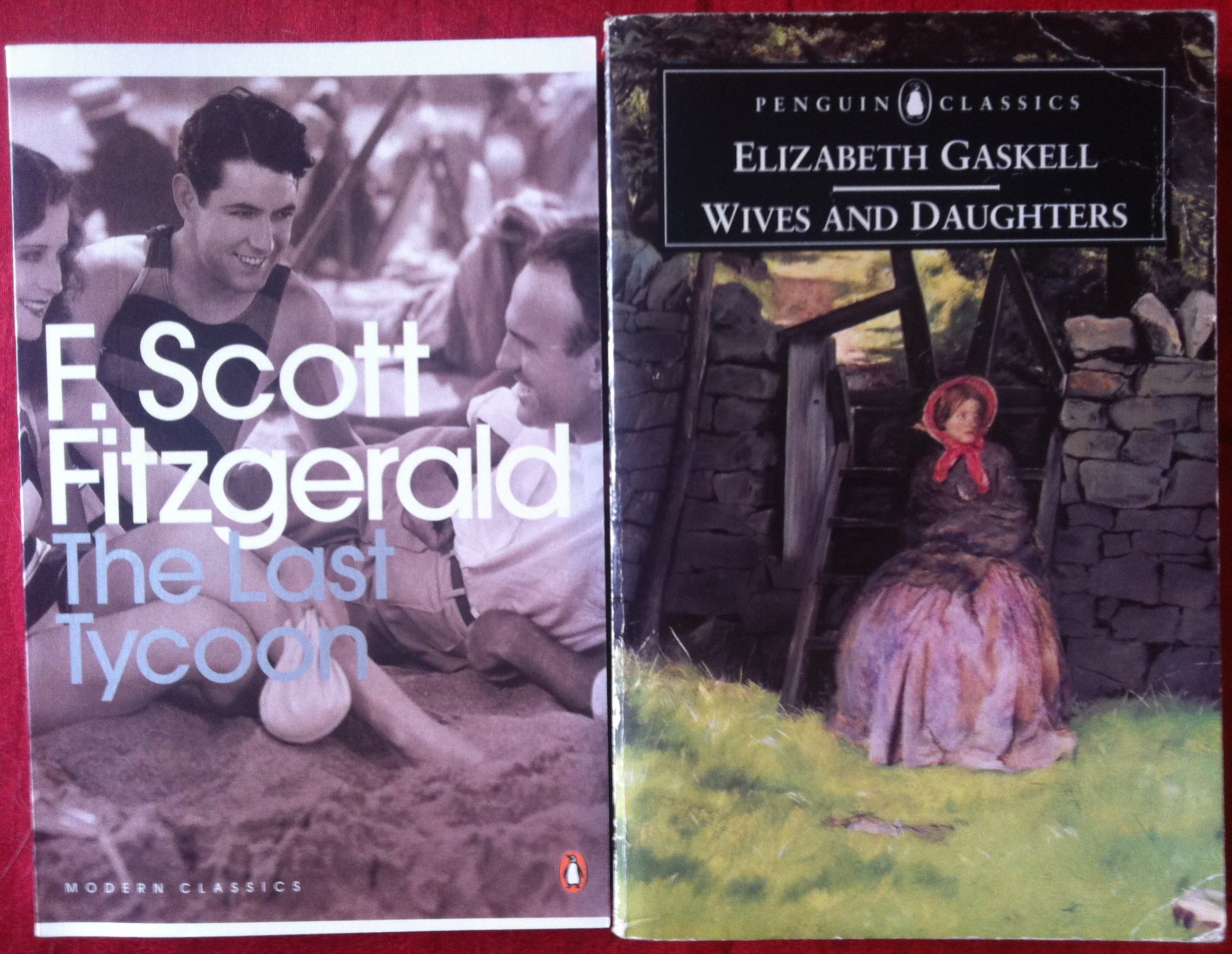
Firstly, The Last Tycoon by F. Scott Fitzgerald.  This is the story of Monroe Stahr, Hollywood producer, told by Cecelia Brady, the daughter of another producer.  The narrative voice isn’t consistent though, and Cecelia often narrates things she couldn’t know.  I felt this worked well, as it highlighted the artifice of storytelling, and was wholly in keeping with a tale of Hollywood.  It’s the topic Fitzgerald was born to write about, and it’s such a shame he didn’t complete it.  He is brilliant at capturing why we acknowledge the artificiality of Hollywood, and yet why it continues to hold our fascination:

“Under the moon the back lot was thirty acres of fairyland – not because the locations really looked like African jungles and French chateaux and schooners at anchor and Broadway at night, but because they looked like the torn picture books of childhood, like fragments of stories dancing in an open fire.”

Hollywood offers audiences a chance to believe in magic, and recapture that feeling often lost in childhood. However, Fitzgerald also exposes the less-than-glamorous reality behind facades, and yet why those façades remain special:

“Stahr stopped beside her chair.  She wore a low gown which displayed the bright eczema of her chest and back.  Before each take, the blemished surface was plastered over with emollient, which was removed immediately after the take.  Her hair was the colour and viscosity of drying blood, but there was a starlight that actually photographed in her eyes.”

The plot concerns Stahr’s affair (the planned title may have been The Love of the Last Tycoon) with a woman who, in movie fashion, he sees across a crowded room, and the machinations of Hollywood tycoons that surround him.  The plot stops short of these being fully played out, and my edition then gives a plot outline based on Fitzgerald’s notes.  The novel is very much a work in progress, but I hope the quotes I’ve used have demonstrated why it’s still worth reading – the beauty of Fitzgerald’s writing shines even before it’s polished.  For all you aspiring writers out there, I’ll  finish this part with some of Cecelia’s cynical observations on the profession:

“Writers aren’t people exactly. Or, if they’re any good, they’re a whole lot of people trying so hard to be one person. It’s like actors, who try so pathetically not to look in mirrors, who lean backward trying – only to see their faces in the reflecting chandeliers.”

“I grew up thinking that writer and secretary were the same, except that a writer usually smelled of cocktails and came more often to meals.”

At almost the opposite end of the spectrum from Hollywood glamour is a tale subtitled “An Every Day Story”, the novel Wives and Daughters by Elizabeth Gaskell. For those of you who don’t like Victorian fiction, or saw the BBC version of Cranford and think Gaskell is all parochial tales of small town personal politics, please stick with me.  W&D is one of my favourite novels and it’s wonderfully written.  Gaskell is not a highly moralising Victorian writer, nor is she blinkered in her view.  She presents the characters and the situations, and then leaves the reader to make up their own mind.  There is no omnipresent narrator (like George Eliot) to instruct you how to react.  Although W&D is a tale of small town life, Gaskell was a writer who concerned herself with big issues – unmarried mothers in Ruth, the destructiveness of industrial life and urban poverty in North and South.

In W&D there is not such an obvious political drive, instead Gaskell uses the small setting to look at society at large, and on the brink of change.  There is much (as the title would suggest) around the role of women, and frequent mentions of the incoming railway, which will revolutionise society.  There is also a strong theme of Darwinism.  The main hero, Roger Hamley, is a highly intelligent, gentle, and serious natural scientist.  Gaskell was related to Darwin through the Wedgwood family and knew him personally.  It’s fascinating to see this revolutionary scientist presented in such an intimate way.  Roger provides the romantic drive of the plot with the heroine Molly Gibson, but there’s much more going on than a straightforward romantic arc.  Molly’s father remarries and his new wife and her daughter come to live with Molly and her father.  His new wife is utterly self-serving and vacuous, but in her daughter, Cynthia, Gaskell takes the pretty coquette of Victorian fiction and gives the character real depth.  As a result, Cynthia and Molly become friends and allies, not enemies.  The Hamleys are a local family with a bloodline that Squire Hamley is snobbishly proud of.  His wife is befriended by Molly, and she becomes involved in the family and the dramas around their two sons, Osborne and Roger, neither of whom are quite what their parents think. The personal relationships are drawn with such insight and sensitivity, to create a novel of human understanding which I found deeply moving.  To be honest, I could go on about this novel forever, so I’m going to reign myself in by quoting just one section at length.  Squire Hamley is sitting by the fire, smoking his pipe.  His wife has died and he is losing his estate piece by piece.  He feels utterly alone and desolate, and then his son Roger arrives in the room.

“The Squire sat and gazed into the embers, still holding his useless pipe-stem. At last he said, in a low voice, as if scarcely aware he had got a listener,—”I used to write to her when she was away in London, and tell her the home news. But no letter will reach her now! Nothing reaches her!”

Roger started up.

“Where’s the tobacco-box, father? Let me fill you another pipe!” and when he had done so, he stooped over his father and stroked his cheek. The Squire shook his head.

“You’ve only just come home, lad. You don’t know me, as I am now-a-days! Ask Robinson—I won’t have you asking Osborne, he ought to keep it to himself—but any of the servants will tell you I’m not like the same man for getting into passions with them. I used to be reckoned a good master, but that’s past now! Osborne was once a little boy, and she was once alive—and I was once a good master—a good master—yes! It’s all past now.”

He took up his pipe, and began to smoke afresh, and Roger, after a silence of some minutes, began a long story about some Cambridge man’s misadventure on the hunting-field, telling it with such humour that the Squire was beguiled into hearty laughing. When they rose to go to bed his father said to Roger,—

“Well, we’ve had a pleasant evening—at least, I have. But perhaps you haven’t; for I’m but poor company now, I know.”

“I don’t know when I’ve passed a happier evening, father,” said Roger. And he spoke truly, though he did not trouble himself to find out the cause of his happiness.”

Someone terribly important thought that this was one of the most perfect scenes in English literature, but I’ve wracked my brains (and google) and I can’t remember who it was.  I think it may have been Henry James.  I hope it gives you a feel for how artfully drawn the characters in Wives and Daughters are, and with what subtlety the relationships are evoked.  The story ends at a point where you can see how everything will play out and you’re just enjoying getting there. Gaskell was extremely close to finishing the novel, and my copy just has a note at the end by the editor of Cornhill Magazine, which was publishing the novel in serial form, to confirm the author’s plans.  W&D is a deserving classic of English literature, even in its unfinished state.

I couldn’t think how to represent “unfinished” in the photo of the books this week, so here they are straight up.  However, in the spirit of this week’s theme I will leave the text of this post unfini….

Image

“She got her looks from her father. He’s a plastic surgeon.” (Groucho Marx)

For the second week running Groucho provides the title of my post – I try not to quote the same person so close together, but it was really hard to find a quote about fathers that had the right air of flippancy that I try to cultivate for this blog. 16 June was Father’s Day in many countries and so both of the books I’ve chosen are around this theme.  However, my search for quotes about fathers showed me it’s a potentially tricky subject for people, so neither of the novels are precisely about fathers, more about the role of fathers and the impact that has.  Also, my own father has always proclaimed that Father’s Day is a commercial scam and instructed his offspring not to engage with it, which means I feel a bit disloyal even mentioning it.  So the theme of this post is Father’s Day, sort of…

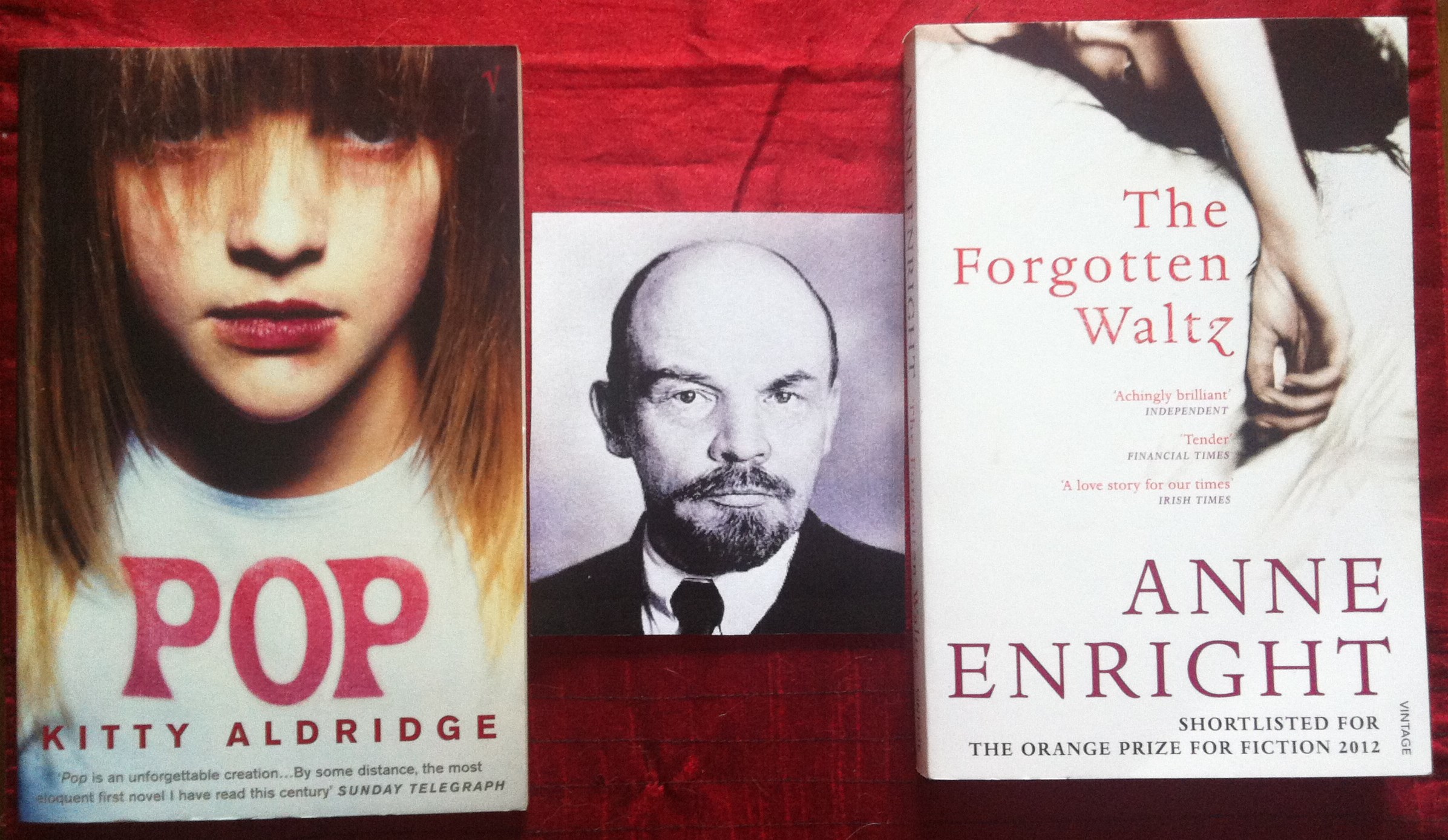
Firstly, The Forgotten Waltz by Anne Enright (2011, Vintage).  Enright has a sparse writing style that I love, and I highly rate her 2007 novel The Gathering, which won the Man Booker Prize.  The Forgotten Waltz explores many of the same themes – families, what damage they do, the lies and intricacies that can make up adult lives.  If that sounds really depressing, well, it’s not exactly a heart-warming read, but it’s not downbeat, just very real.  I chose it for Father’s Day because the narrator identifies her lover’s role as a father as the motivating force in their lives from the opening paragraph:

“If it hadn’t been for the child then none of this might have happened, but the fact that a child was involved made everything that much harder to forgive.  Not that there is anything to forgive of course, but the fact that a child was mixed up in it all made us feel that there was no going back; that it mattered.  The fact that a child was affected meant we had to face ourselves properly, we had to follow through.”

The thing that happens is an extra-marital affair, and the child is Evie, who witnesses the narrator, Gina, kissing her father.  You’ll note Gina believes there was “nothing to forgive”, which is somewhat questionable – when deceit is involved, people get hurt in the fallout.  But I think this one of the strengths of the novel, that there are not easy characters (like the intermittently self-deluding Gina) or situations, no “goodies” or “baddies”.  It’s all shades of grey (by which I mean morally complex, not badly written BDSM tales).

The reality of the situation is also reflected in the structure of the narrative, which although essentially linear, jumps back and forth, as people do when they’re telling you their story.  It accurately reflects the complexities of our lives, the way we restructure our narratives as we try and make sense of things; things that can appear different to us on different days: “This is the real way it happens, isn’t it? I mean in the real world there is no one moment when a relationship changes, no clear cause and effect.” There’s no huge driving plot here, in that sense it is a very simple tale, but Enright’s great skill is to capture small moments and attempt to define their importance:

“When the last small guest was gone and the rubbish bag full of packaging and uneaten lasagne the thought of him – the fact of him – happened in my chest, like a distant disaster.  Something was snapped or broken. And I did not know how bad the damage was.”

The Forgotten Waltz is an acutely insightful novel, that at the same time steps back from offering the answers – honest and thought-provoking.

Secondly, Pop by Kitty Aldridge (2001, Vintage). Pop was Kitty Aldridge’s first novel (she’s an actress who has been friends with fellow thesp-turned-author Esther Freud since their days at drama school, literary fact-fans) and looking on amazon people seem to object to the abundance of imagery in the novel, which I think is understandable in your first attempt.  I like an abundance of imagery so it didn’t bother me at all, and I found the story of Maggie, parentless at thirteen, going to live with her trivia-loving granddad in the Midlands in 1975, a touching and compelling read.   The opening paragraph introduces us to Maggie’s new parental figure:

“She is looking up at a tall man in shambolic clothes.  He is racing-dog thin with a long mischievous face, whiplashed with creases. The railway-station wind lifts his remaining hair.  It is hard to say how old he is; old, seventy perhaps.  But he moves with the quick fluidity of a youth and hangs a lean on one hip like a gunslinger. When he is not squinting he has the openly amazed expression of a child.  His eyes are a shocking shade of blue; they steal almost all the available light.  Maggie follows, up into his eyes like the light.”

The book follows Pop and Maggie as they grow used to each other.  The plot is slight – Pop wants to win the local pub quiz:

“Pop had stayed up half the night with his facts.  He knew every West Indian cricket team for the past five years.  “I’ll wipe the floor with you in a sporting category any day Malcolm Denton!” he hollered as he shaved at dawn.  The statement sprang through the open window and bounced off car roofs into the trees.  The birds stopped singing momentarily, considering the claim.  The three of them trooped in the man-dog-child formation along Tower Road past the Pint Pot and on past Iris’s house.  Iris was Pop’s exquisite, unattainable love and he was going to win her at any cost.  He told himself the gallon of beer and five pounds meant nothing; winning, that was what counted.”

Gradually, the two of them, a cantankerous old man still having nightmares about the war, and a teenage girl who worries her hands are too big & the rest of her too bony, form an unlikely alliance, and a bonded family.  This is what makes Pop a great Father’s Day read:

“Pop wondered about her.  About how it would turn out.  About what he’d said to the woman carrying a file with their names on.  The stuff about family, about blood ties, all that thicker-than-water speech.  The prohibitive wave of his hand to knock the alternatives into a cocked hat.  The rise of blood in his temples as he moved himself to trembling, and the final whispered declaration of love for her, that he didn’t feel then but was saddled with now […] And he felt for her now alright. He laid his chin in the cradle of his free hand and closed his eyes. Buggered it again, you fool.”

Here are the books with a picture of Lenin.  I realise I need to explain this, dear reader.  They are with Lenin because my very own pater is the spitting image of the Bolshevik leader.  So much so that when I showed him (my Dad, I don’t talk to the ghost of Lenin) the image on my phone that flashes up when he calls me, he asked “When was that taken?  I look good.” And I had to break it to him that it was in fact Vladimir Ilych, not himself. Happy Father’s Day, and up the revolution!

Image

“I find television very educating. Every time somebody turns on the set, I go into the other room and read a book.” (Groucho Marx)

Unlike Groucho Marx, I quite like television.  I say this in the full acknowledgement that at least 99% of it is shocking in its lack of aspiration towards anything other than cheaply-made sensationalist drivel.  And (unsurprisingly) it will never be as rewarding to me as reading is.  But some of the programmes of recent years have just been astonishing.  I’m careful how I use TV, which essentially means I never channel surf to sit mindlessly in front of  America’s Next Top Gypsy Teenage Mom Hoarder Bounty Hunter Bride’s Got Talent or whatever else the channels are filling their many hours with repeats of.  I choose what I’m going to watch, and then my addictive personality traits emerge as I stack up hour upon hour to watch in a big binge.

This is why I’ve only just started on Mad Men Season 6. But aside from my unhealthy habits, there was another reason why I stacked up the episodes.  Fear.  I was so worried it wouldn’t live up to itself.  Surely, I thought, they’re due to screw it up?  They’ll take this piece of TV perfection and turn it into yet another series that lost its way and sends fans apoplectic with grief at the betrayal?  I needn’t have worried.  A few minutes in to the first episode, there was a moment so completely perfect I nearly wept with relief at the beauty of it all. (For those of you who haven’t sold your soul to Rupert Murdoch in the name of timely programming, and therefore haven’t seen season 6 yet, don’t worry, this isn’t a spoiler). Here it is, the moment: Don Draper is on the beach in Hawaii reading Dante’s Inferno.  That’s it. Damn, Matthew Weiner is a bona fide genius.  Everything you need to know about a character distilled into one perfect moment.  Don Draper, living the life everyone wants: gorgeous and successful, beautiful loving wife sipping cocktails next to him, relaxing on a beach in luxury, reading about the nine circles of Hell.  I could’ve kissed the screen.  If I wasn’t such an appalling housekeeper & so my TV covered in dust, I would have.

And then this got me thinking about other moments in TV where books are used as a visual clue to as to the reader’s personality.  There’s the time in The Wire where McNulty (police officer) goes to Stringer Bell’s (drug lord’s)apartment, picks up a copy of Adam Smith’s The Wealth of Nations and is so wrong-footed by it he wonders aloud “Who the fuck was I chasing?” But often it’s unspoken, and funny: Marcus, the scarily shark-eyed ten- year- old in Spy, reading The Slap (Christos Tsiolkas) or Machiavelli’s The Prince; Gromit’s many punning titles of great novels (my favourite: Crime and Punishment by Fido Dogstoyevsky).  It’s a great opportunity to flesh out a character (even a plasticine dog) without using any dialogue, in a matter of seconds.  A wordless conversation between the programme makers and the viewer.  So in celebration of such moments, here are two TV characters and the books I’d like to see them read (and proof, if proof were needed, that Matthew Weiner is not lying awake at night worrying that I’m about to emerge as a rival TV-producer-of-substantial-genius)…

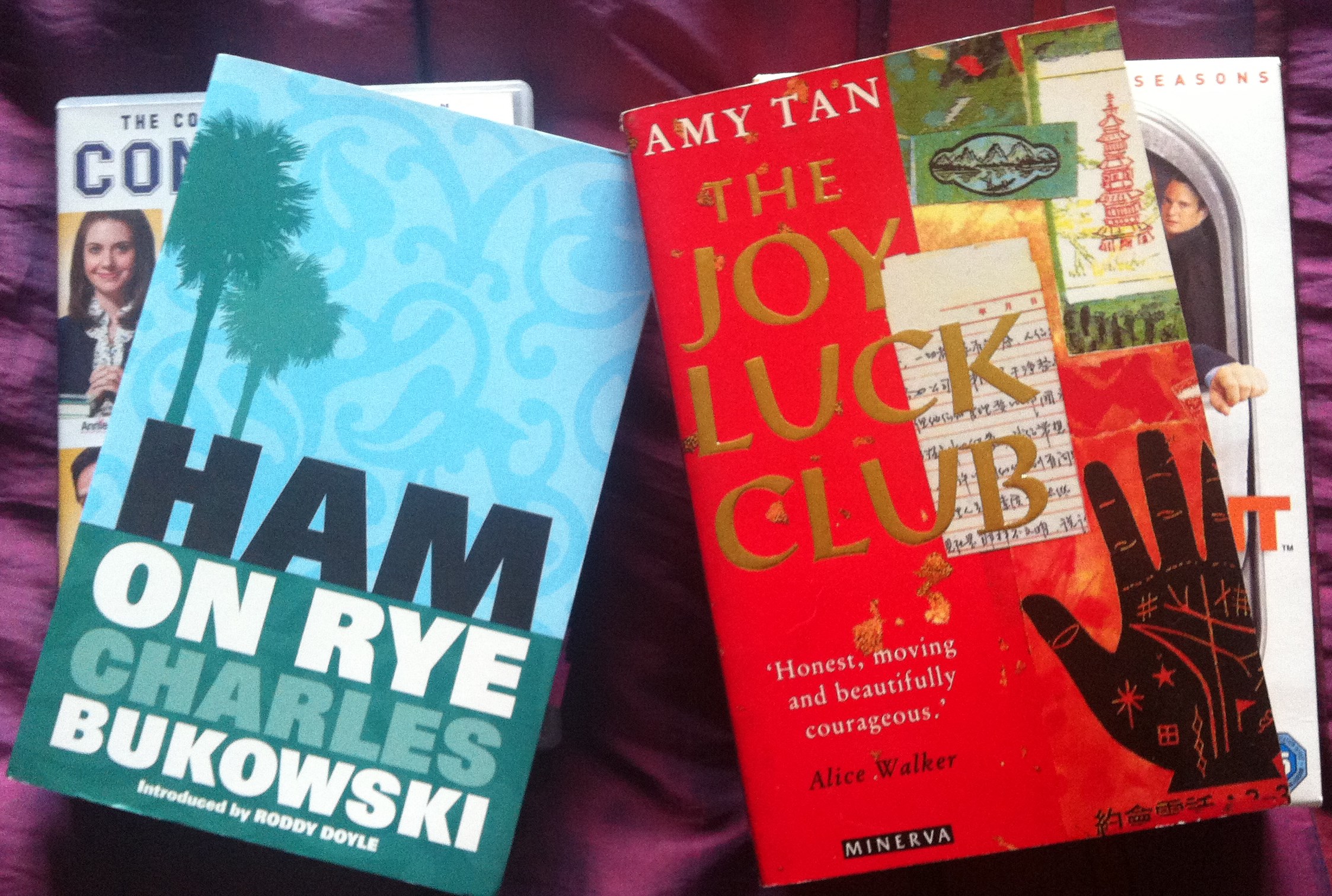
Firstly, in celebration of the series return via Netflix, Gob from Arrested Development, for whom I recommend The Joy Luck Club by Amy Tan (1989, my copy 1996, Minerva).  The uninitiated can view some of Gob’s moments here:

Gob is a lunatic, obsessed with stage magic but woefully inept at its execution, a wannabe alpha male who will never lead the pack, despised by his mother and barely tolerated by the rest of his family.  And he travels everywhere by Segway.  I decided on The Joy Luck Club because I feel Gob could benefit from some positive female energy in his life, and this tale of two generations of mothers and daughters will immerse him in oestrogen-fuelled drama.  It will also show him the power of unconditional love of parents for their children, something entirely lacking in his own life.  The club of the title is a group of Chinese immigrant women who are living in San Francisco, and who get together to play mah jong.  At the start of the novel one of the women, Suyuan, has died, and her daughter, Jing-Mei/June has been asked to take her place.  The novel is divided into four sections as the three remaining mothers and each of the four daughters tells their story.  The tales explore the experience of the women back in China, and their daughters’ experiences as the first generation growing up in San Francisco.  The communication difficulties across the generations are contextualised within an Asian-American experience, but are really universal:

“For all these years I kept my mouth closed so selfish desires would not fall out.  And because I remained quiet for so long now my daughter does not hear me.  She sits by her fancy swimming pool and hears only her Sony Walkman, her cordless phone, her big, important husband asking her why they have charcoal and no lighter fluid….I did not lose myself all at once. I rubbed out my face over the years washing away my pain, the same way carvings on stone are worn down by water.” (Ying-Ying St.Clair)

“During our brief tour of the house, she’s already found the flaws.  She says the slant of the floor makes her feel as if she is “running down”.  She thinks the guest room where she will be staying – which is really a former hayloft shaped by a sloped roof – has “two lopsides”.  She sees spiders in high corners and even fleas  jumping up in the air – pah! pah! pah! – like little spatters of hot oil.  My mother knows, underneath all the fancy details that cost so much, this house is still a barn.  She can see all this.  And it annoys me that all she sees are the bad parts.  But then I look around and everything she said is true.” (Lena St.Clair)

The novel has been accused by some of dealing in racial stereotypes, but I think what limits this is Tan’s ability to create seven strong, original, fully drawn female characters and explore their idiosyncratic relationships.  The voices of the members of The Joy Club Club are memorable and distinctive.

Secondly, Annie from Community, for whom I recommend Ham on Rye by Charles Bukowski (1982, my copy 2000, Canongate). The uninitiated can view some of Annie’s moments here:

http://www.youtube.com/watch?v=JUKDfOWGVQY

Oh, Annie, with your relentlessly perky expression and upbeat attitude, your array of tastefully coloured angora jumpers and perfectly organised stationery.  Every now and again the strain shows and the façade crumbles, and Bukowski will teach you that that is where the interesting stuff happens.  Come join us on the darkside, Annie, you know you want to…… Ham on Rye is Bukowski’s most autobiographical novel, and follows his alter-ego Henry Chinaski through an abusive childhood and into an early adulthood where his main source of support and meaning is found in a bottle.   After his first experience with alcohol, drinking his friend’s father’s wine, Henry sits on a bench and reflects:

“I thought, well, now I have found something.  I have found something that is going to help me, for a long time to come.  The park grass looked greener, the park benches looked better and the flowers were trying harder.”

The only other positive experience Henry has in a childhood filled with violence and deprivation is when a teacher praises his creativity and reads aloud an essay he has written:

“Everybody was listening.  My words filled the room, from blackboard to blackboard, they hit the ceiling and bounced off, they covered Mrs Fretag’s shoes and piled up on the floor… I drank in my words like a thirsty man.  I even began to believe some of them[…]So that’s what they wanted: lies. Beautiful lies. That’s what they needed. People were fools.”

Bukowski is a legend of the beat generation and his reputation for hard-living precedes him.  In some ways this is unfortunate, as it suggests a reputation built on image rather than skill.  But he’s a really beautiful writer who Capote could never accuse of typing, not writing.  For all you fellow bibliophiles out there, here is what happens when Henry discovers the joys of the library:

“It was a joy. Words weren’t dull, words were things that could make your mind hum.  If you read them and let yourself feel the magic, you could live without pain, with hope, no matter what happened to you.”

Gorgeous.  Moments like that shine out like beacons amongst the violence and bleakness of Henry’s existence; Ham on Rye is a fantastic reminder of why we read.

Here are Gob and Annie with their books:

Image

“Why do people say “grow some balls”? Balls are weak and sensitive. If you wanna be tough, grow a vagina. Those things can take a pounding.” (Sheng Wang, probably)

I didn’t plan for the theme for this week’s post to be feminism, but then my weekend consisted of thinking of little else, so I decided feminism it had to be. So, what happened this weekend?  I watched Caitlin Moran being interviewed by India Knight as part of this year’s Hay sessions, Beyonce’s Chime for Change concert was televised, I read an interview with Joss Whedon talking about Buffy as a role model and why he didn’t want her turned into a doll, there was an article about feminist activism in the digital age. Then I switched on Radio 4 for Book Club and the author was discussing his creation of strong female characters (more of that later).  Once I’d decided on the theme for this post, I wondered if this meant branching out from discussing fiction, as I gazed at my bookshelves trying to decide between Germaine Greer, Susie Orbach, Caitlin Moran, Naomi Wolf, Natasha Walter…  but then I realised I was being incredibly short-sighted.  I wanted this blog to be about fiction and there was no reason to change (but I still wanted to name-check a few authors, please check them out if you haven’t already).  Feminism is about the world we live in, and fiction writing and reading is part of that – for some of us, a huge part… So, fiction it is. I’ve chosen one classic of feminist literature and one less obvious choice.  Also, one by a female author and one by a male, because I don’t think feminism is about the exclusion of men (that’s just made me think of another recommendation, Feminist Ryan Gosling by Danielle Henderson, a great gift for the feminist Gosling fan in your life, of which surely there are many). Let’s smash the patriarchy!

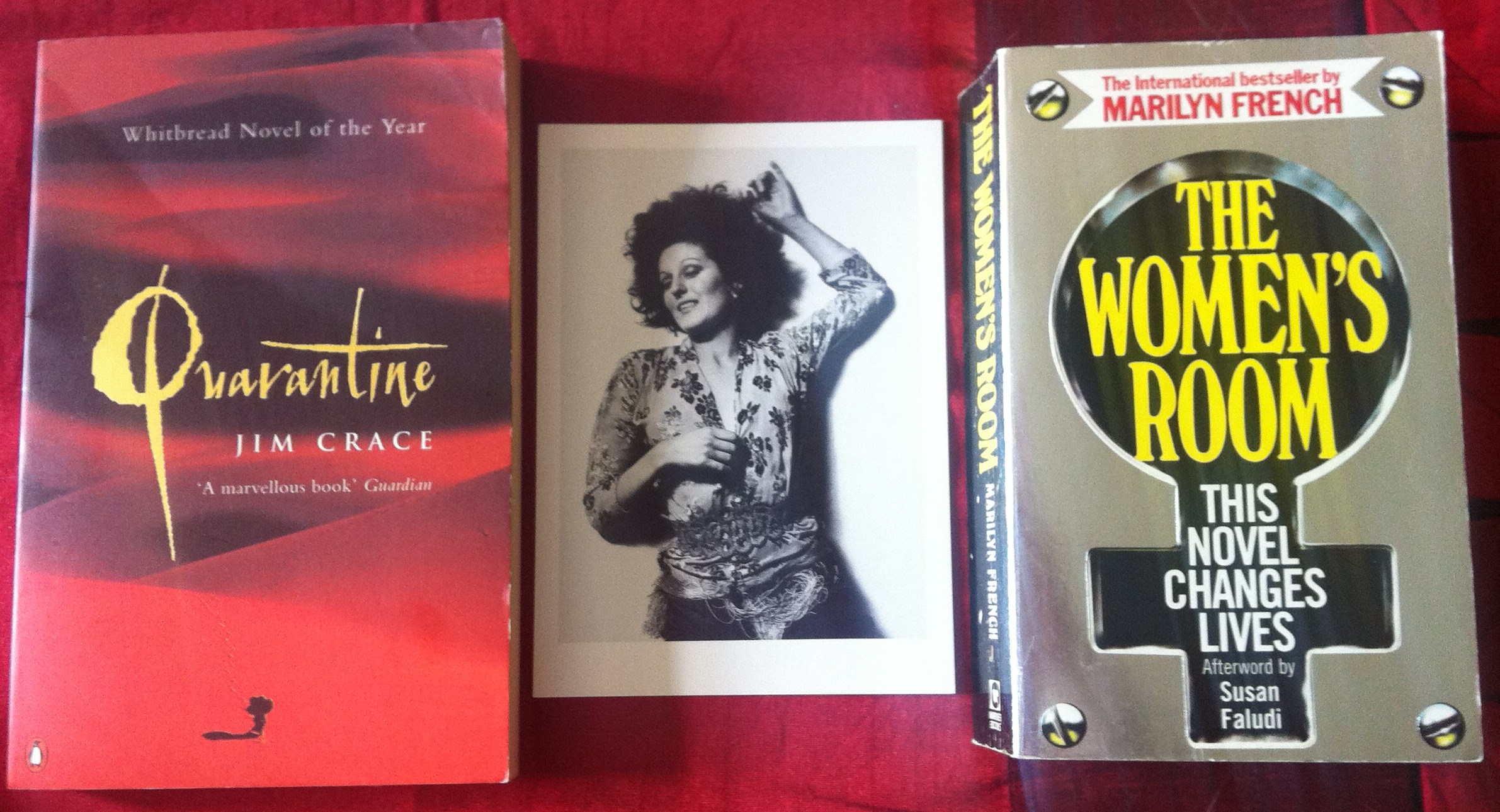
Firstly, The Women’s Room by Marilyn French (1977, my copy Warner Books 1993). Written during the 1970s feminist movement, this was French’s first novel and has become one of feminism’s classic texts.  It’s a huge tome – just shy of 700 pages in my copy, but it has a very readable style and isn’t an arduous “but-I-know-this-is-good-for-me” experience. The central protagonist is Mira, a baby-boomer who grows up to live the domestic idyll, married to a doctor (called Norm, geddit?) and with 2 children who she raises in middle-class suburbia. Her friends are all like her, and discontent and extra-marital affairs abound as they come to terms with the limitations of the lives they’ve wandered into.  After the breakdown of her marriage, Mira attends Harvard and plans to become a teacher.  Here she has her consciousness awakened by Val, a feminist.  It is this character that voices the more extreme views within the book, the most famous probably being “all men are rapists”.  Eek.  Don’t let that put you off though, as the novel generally has a less extreme approach to issues, and as an insight into militant 1970s feminism the character of Val is worth sticking with.  There is a lot of angry polemic, which isn’t necessarily a bad thing, and here there is enough narrative drive to make you feel you’re not being battered over the head with it.  Mira is a character you root for, and she’s not a victim:

“Ever since the divorce, she had grown more and more bitter at that injustice, at the injustice of the way the world treats women, at Norm’s injustice to her.  And all she was doing was getting more bitter, destroying her own life, what was left of it.  There is no justice . there was no way to make up for the past. There was nothing that could make up for the past.  She sat stunned for a while, freed of a burden, feeling her mouth soften, her brow unline. […] There was no justice, there was only life. And life she had.”

In some ways The Women’s Room has dated. Things are different to how they were in 1977.  In other ways it hasn’t dated at all and the things that its angry about are still a source of inequality today; as a novel that looks at how “women’s work” is undervalued, it is entirely current as long as gender pay gaps persist, which they do. The Women’s Room is an approachable way to start to look at feminist issues through narrative.

Secondly, Quarantine by Jim Crace (1997, Penguin).  This may not seem an obvious choice, but it was the novel discussed on Radio 4’s Book Club this week, where Crace identified himself as a feminist:

“I guess it’s a question of being a right-on bloke, that’s lived in through the seventies and eighties […] what I do want to do with the women in my books though, is not have Hollywood type heroines, in which good looks are the gateway to being virtuous and having good luck, and having good fortune, and having long marriages and lots of handsome children. That seems to me to be a very pessimistic view of the world, that only very good-looking women are going to do well in the world. So what I want to do in all of my books, is to present women who are admirable for other reasons. They are strong women, and I like that, and in a way if you’re spending as many hours alone in your house as I do, then you might as well have the company of women that you’ve created who you like.”

So, who are the women of Quarantine?  They are Miri and Marta, living in Judea around 2000 years ago.  Miri is married to Musa, a truly evil man to the point of possibly being the embodiment of Satan.  He is a trader, one who exploits and commodifies all: “He looked each of them in the face as if they were for sale.  He could tell at once what they were worth.”  Miri doesn’t even pretend to like him. Marta enters the desert to fast for fertility:

“Husbands were amusing, too.  At least, they were amusing when they were out of sight.  Their vanities and tempers could be joked about among women friends at the ovens or the well.  Grumbling and laughing at their curdy husbands made the bread rise and the yoghurt set.  But Marta could not find the comedy in Thaniel.  He’d made her and his first wife barren, she was sure, with his dry heart and sparking tongue.  They were like millstones without oil.  But – Marta was an optimist – she still believed everything would be a joy if she could have his child.”

Set 2000 years apart, The Women’s Room and Quarantine both highlight the marriage laws remaining resolutely on the man’s side.  Quarantine however, is resolutely on the women’s side, as they fight to find their way in a society that is not built for them. The women are the strongest characters in the novel, and this may be somewhat surprising when you consider there is another man in the desert too, a young Galilean:

“He was open mouthed.  He looped his tongue from side to side, circling his lips, tasting the atmosphere for smells.  In fact his sense of smell had been so bludgeoned by the heat and by his thirst that he could not detect the sulphur even. He was parched and faint.  His lips were cracked…he was a traveller called Jesus, from the cooler, farming valleys in the north…”

The word quarantine comes from the Italian quarantena, meaning 40 days, and so the title takes on a layered meaning.  The characters are in quarantine from the rest of society for various reasons, including Jesus spending forty days in the desert as part of his spiritual journey. Quarantine is a haunting, beautifully written novel about characters on the outskirts, who are given a space of their own within this story.

Here are the novels, hanging out with Germaine Greer:

Image

“There is no surer foundation for a beautiful friendship than a mutual taste in literature.” (P.G. Wodehouse)

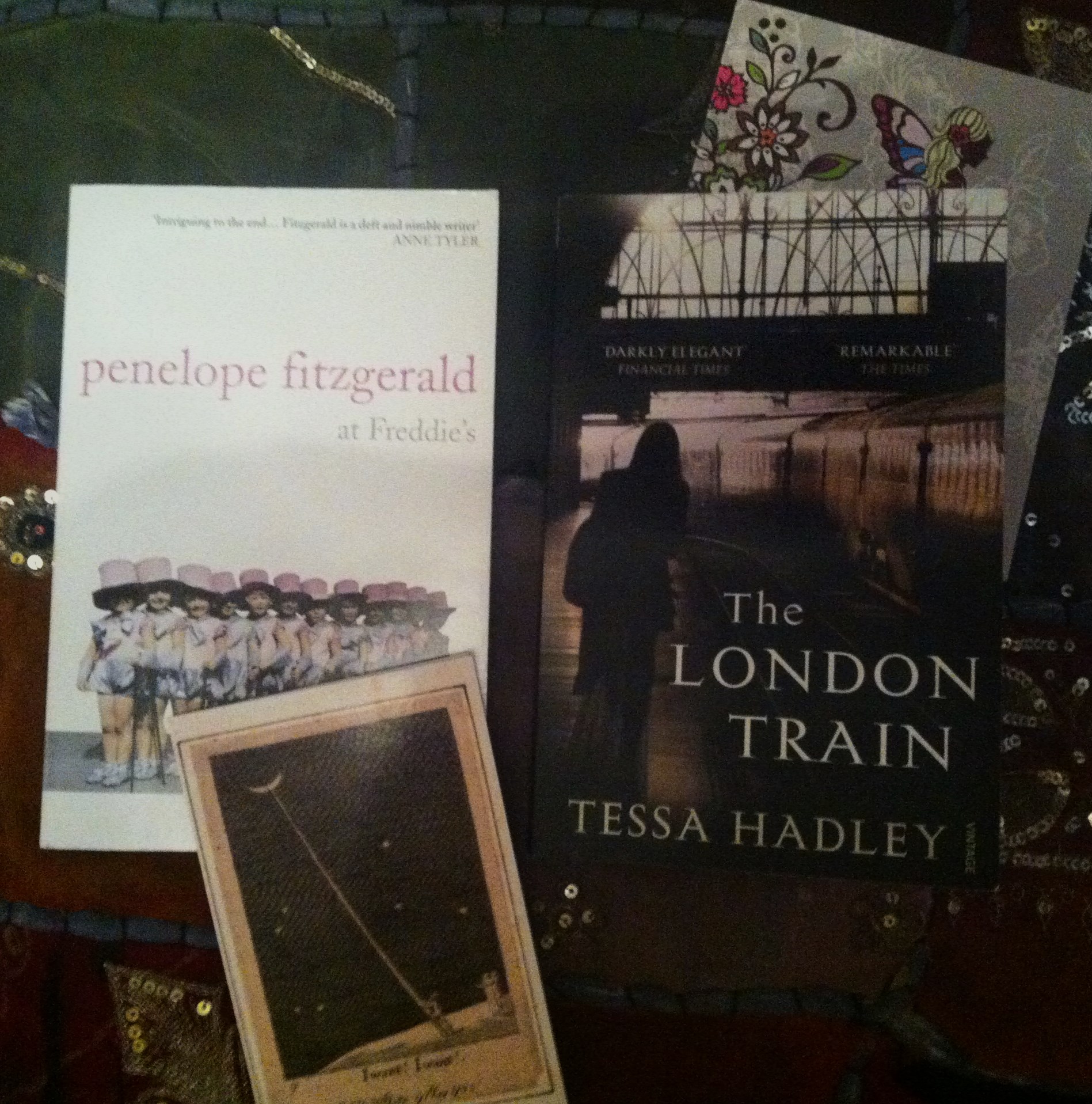
Usually I try and pick books that explore a similar theme in different ways, but this week the choices aren’t linked thematically in any way except how they came into my life.  Both were given to me as gifts recently and I enjoyed them both, but couldn’t think what else to pair them with for a post.  Then I realised that for me they were sort of tied together, and this was a good enough (flimsy, lazy, what you will) reason for them to occupy the same post.  It’s unusual for friends to by me books – I think one sight of my overflowing bookshelves sends them scurrying to the nearest smellies store for presents, in the mistaken belief that any book they buy me I will have already read/somehow owned for years even if it’s just released/view with barely disguised contempt.  I’ve recently put the kibosh on toiletries by developing mad allergies, cause unknown, that make me look like Father Bigley (as my ever-sympathetic brother pointed out, for all you Father Ted fans out there) so this may explain the sudden enthusiasm for printed matter amongst my cohorts.  Either that, or I’ve finally taken control of my body odour, negating the need for bags of stuff from L’Occitane. Whatever the reason, two of my friends did sterling work with these recent offerings.

Firstly, At Freddies by Penelope Fitzgerald(1982, my copy 2003, Flamingo), given to me by my lovely friend C, who is an academic mega-brain, filled with boundless enthusiasm for literature, and despite these gifts and being quite beautiful as well, carries it all with such an unassuming genuine pleasantness as to make her completely likeable.  She can now add gift-giving to her long list of talents.  C chose this for me because firstly, she’d read and enjoyed it, and secondly because it concerns the theatre, which is one of my great loves.  But although it does have a dry, knowing humour about the theatre, At Freddies is much more about being a child in an adults world, about school and those teachers whose main qualification is their force of personality, and about trying to find your place in the world, which is after all, a stage (at least according to one highly regarded writer).  Freddie runs a dilapidated stage school for children in 1960s Covent Garden.  There is no money but somehow she keeps it all hanging together by being someone who everyone knows, and who no-one can refuse.

“Insane directors, perverted columnists cold as a fish, bankrupt promoters, players incapable from drink, have all forgiven each other and been forgiven, and will be, until the last theatre goes dark, because they loved  the profession.  And of Freddie – making a large assumption – they said: her heart is in it.”

There is a lot of humour in this book, the precocious kids who are manipulative and knowing, but still just children, are hilarious.

“You saved me Miss Wentworth…I’d be out of work, I’d never get work again, if you hadn’t spoken to Mr Lightfoot…I owe everything to you…”

Freddie paid no attention whatsoever.

….Mattie, with an expression of deep malignance, departed.

“He’s acting,” said Miss Blewett.

“Worse than that,” said Freddie.  “He’s acting being a child actor.”

Apparently Penelope Fitzgerald did teach at a theatrical school for a time, and some of her portrayals of theatrical professionals are drily presented, such as the director who wants to “underline Shakespeare’s concepts in the way he’d do it himself if he were here” – apparently this means having young boys played by very old men, and everyone on stage except the person going mad acting a breakdown while the character experiencing it remains stock still.  Not sure that’s quite what Shakespeare had in mind…  All this mayhem revolves around Freddie who remains resolute but ultimately enigmatic.  No-one quite knows her background, motivation or purpose, except to keep going.  When one of the teachers finds her collapsed, he reflects “No, she won’t die…She won’t change her habits so easily.” At Freddie’s is a short novel (230 pages my edition), highly readable and very enjoyable, but also unnerving and thought-provoking, as much about what isn’t said as what is.  I highly recommend it.

Secondly, The London Train by Tessa Hadley (2011, Vintage) given to me by my also very lovely friend K, who is as creative as she is kind as she is gorgeous.  I’ve got to stop hanging round with such thoroughly brilliant women, it only highlights my own shortcomings (except when it comes to choosing friends, which I am inordinately talented at). K chose this for me because again, she’d read and enjoyed it, and secondly, because it was set partly in London, another of my great loves.  See what thoughtful friends I have? The London Train is a book of two halves.  In the first half, Paul is looking for his missing daughter, Pia, who he finds living in north London with her slightly controlling boyfriend and his sister.  In the second half, Cora is travelling in the opposite direction, back to Wales, to escape a failing marriage.  I enjoyed Tessa Hadley’s first novel, Accidents in the Home, a great deal but I hadn’t kept up with her writing since, and The London Train made me regret this, as she writes with such sparse beauty:

“He wished he could remember better those passages in The Aeneid where Anchises in the Underworld explains to his son how the dead are gradually cleansed in the afterlife of all the thick filth and encrusting shadows that have accumulated through their mortal involvement, their living; when after aeons they are restored to pure spirit, they long, they eagerly aspire, to return to life and the world and begin again.  Paul thought that there was no contemporary language adequate to describe the blow of his mother’s vanishing. A past in which a language of such dignity as Virgil’s was possible seemed to him itself sometimes only a dream.”

Hadley is also brilliant at capturing small moments, both between people and within individuals:

“Her speech wasn’t slurred, but aggressive, some layer of concealment had been stripped from between them. Where their feet bruised it, the grass sent up its yearning green smell, tugging at his emotions.”

“In the library Cora sometimes felt as if she had fallen to the bottom of a deep well.  It wasn’t an unpleasant feeling.  She hadn’t known there could be a job like this, pressing so weightlessly on the inner self, allowing so much space for daydreaming.”

This great skill, at pinpointing the significance of moments that are barely tangible, make Hadley’s writing both incisive and sympathetic.  The London Train is about the journeys we take both physically and psychologically, and how we construct notions of home, sometimes in the entirely wrong places.  I’ll be seeking out the novels by Hadley that I haven’t read as a matter of urgency.

Here are the books alongside the cards which accompanied them – thanks again, C&K!

Image