“Heterosexuality is not normal, it’s just common.” (Dorothy Parker)

I’m hopelessly late with this post, which was prompted by 17 May being the International Day Against Homophobia, Biphobia and Transphobia. At first when I was looking at what was going on this past week for a theme for this post, I was resistant to choose this, as it seemed I would be attaching the potentially reductive label of “gay writing” to literature.  I’m not sure about this label for the same reason I’m unsure of the label “women’s writing” – while not necessarily inaccurate, it seems to suggest its somehow not “proper” writing, that it can only appeal to ready-designated group and have no meaning outside of that. Well, to quote Maya Angelou, we are all more alike than we are unalike, and so great writing is great writing. Who a writer chooses to sleep with is their own business, and if this informs their writing I don’t see why it should be picked out as “gay writing” unless we have the label “straight writing” which, of course, we don’t. And I guess that’s my main objection.  There’s nothing inherently wrong with literature being labelled as gay, except that because the sexuality is marked out when straight isn’t, it seems to be suggesting a deviation from some sort of norm.  And as Dorothy Parker pointed out….. So why did I decide to go ahead with it?  Because we still need an  International Day Against Homophobia, Biphobia and Transphobia, because the city I live in has seen a rise in homophobic attacks over recent years, because this sickening hate crime still exists, and so I wanted to recognise 17 May as an important day.  I hope one day it is no longer needed.  And now I’ll climb down off my soapbox to talk about books, no more ranting, I promise…

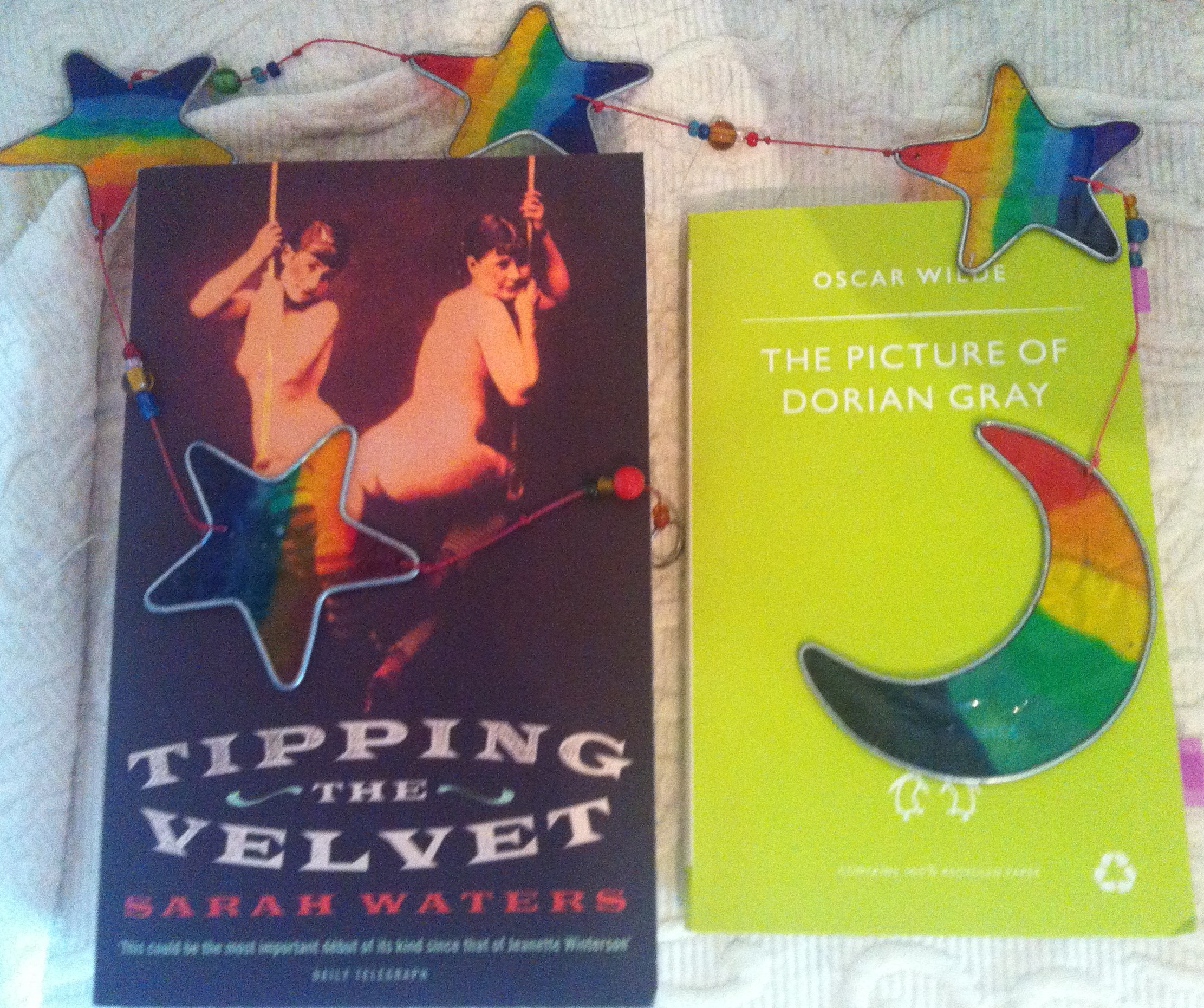
Firstly, Tipping the Velvet by Sarah Waters (who doesn’t mind being labelled a lesbian writer, so maybe I should stop being quite so precious about it) (1998, Virago).  This was Sarah Waters’ first novel and was widely well received; she has gone on to forge a successful literary career with four further novels.  I enjoy her work greatly, because she writes evocatively of the past (in TtV its Victorian London) and is a beautiful writer who also has a great command of plot.  The plot of TtV sees Nan King fall in love with a male impersonator, Kitty, and she leaves her home and family to work with Kitty in the theatres and music halls.  They begin a relationship, but when this disintegrates Nan leaves her and works in London, selling her body as a boy, becoming a rich woman’s plaything, and getting caught up in politics through her friendship with a neighbour.

“The Palace was a small and, I suspect, a rather shabby theatre; but when I see it in my memories I see it still with my oyster-girl’s eyes – I see the mirror-glass which lined the walls, and the  crimson plush upon the seats, the plaster cupids, painted gold, which swooped above the curtain. Like our oyster-house, it had its own particular scent – the scent, I know now, of music halls everywhere – the scent of wood and grease-paint and spilling beer, of gas and of tobacco and of hair-oil, all combined.”

Waters often describes settings through smells, and it is a technique that works well, creating a vivid earthiness that engages with Victorian literary tradition but pushes far beyond it, giving a voice to those largely unheard in the literature of the time:

““You say I know nothing about you; but I have watched you upon the streets, remember.  How coolly you pose and wander and flirt!  Did you think you could play at Ganymede , for ever? Did you think, if you wore a silken cock, it meant you never had a cunt at the seam of your drawers?….You’re like me: you have shown it, you are showing it now! It is your own sex for which you really hunger!””

“Tipping the velvet” is Victorian slang for cunnilingus, something I don’t remember occurring in Dickens…

Secondly, The Picture of Dorian Gray by Oscar Wilde (1891, my copy 1994). I won’t go into this in great detail, because I think it’s one of those novels that everyone knows even if they haven’t read it.  A beautiful boy named Dorian Gray has his portrait painted, capturing his first flush of youth.  Under the influence of the hedonist Lord Henry Wotton, Dorian offers up his soul to stay beautiful forever.  He gets his wish, and the portrait ages in his place, growing more hideous with each passing year as a reflection of Dorian’s corrupted soul.  This was Oscar Wilde’s only novel and was hugely controversial at the time, but as my plot summary has hopefully captured, it’s actually a highly moral work.  It’s also gorgeously written, with Wilde bringing his aesthetic sensibilities to his prose, and full of typically Wildean aphorisms to raise a smile amongst the dark subject matter:

“You have a wonderfully beautiful face, Mr. Gray. Don’t frown. You have. And beauty is a form of genius -is higher, indeed, than genius, as it needs no explanation. It is of the great facts of the world, like sunlight, or spring-time, or the reflection in dark waters of that silver shell we call the moon. It cannot be questioned. It has its divine right of sovereignty. It makes princes of those who have it….. People say sometimes that beauty is only superficial. That may be so, but at least it is not so superficial as thought is. To me, beauty is the wonder of wonders. It is only shallow people who do not judge by appearances.”

TPoDG is a great read, with something for everyone: wit, morality, amorality, the Gothic, adventure, and almost pastoral in places with its detailed descriptions of nature.  It also, like Dorian, hasn’t aged one jot.  In this age of celebrity obsession focussed so much on appearances, the enormity of the cosmetics industry, of plastic surgery and of so much style over so little substance, TPoDG has as much to say about our society today as it did about late Victorian society.  We all have to face our portraits at some time…

Here are the novels wearing a rainbow, symbol of LGBT Pride (and surrounded by cat hair, sorry about that):
Image

“Never love anyone who treats you like you’re ordinary.” (Oscar Wilde)

This week I struggled to find a theme to write about, as absolutely nothing remotely noteworthy happened.  I went to work, I saw friends, I cooked, I shopped (as little as possible, I hate shopping in all forms), I read, I watched DVDs (I’m catching up on Breaking Bad)…you get the utterly banal picture.  So I was completely at a loss until an epiphany – that’s probably overstating it, a realisation – earlier today: in my problem lay my solution.  There’s probably a tenet of some philosophy that tells you that very thing, but I took my time getting there. The theme of this week’s post is novels that take a look at the resolutely everyday, the ordinary events in ordinary lives.

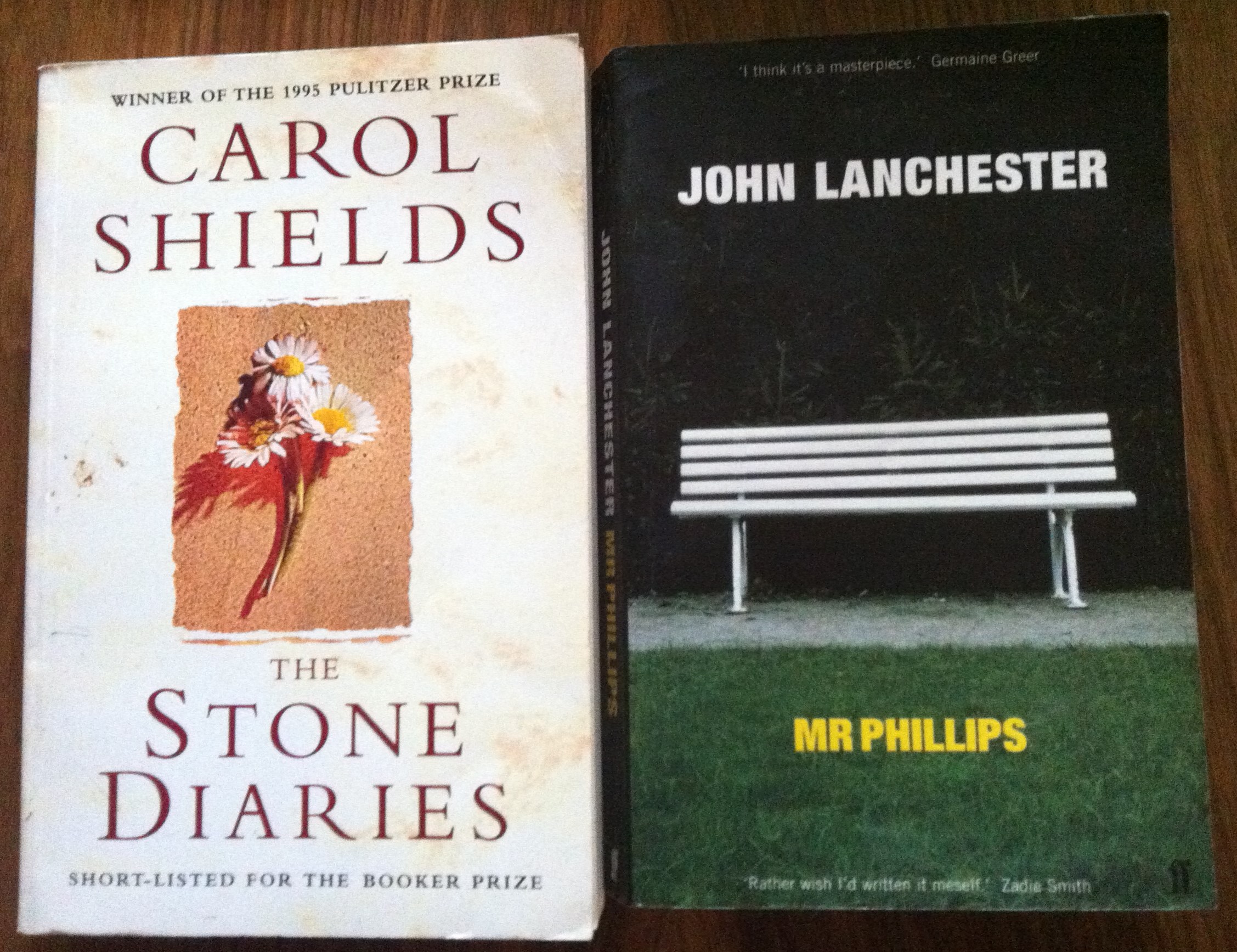
Firstly, The Stone Diaries by Carol Shields (1993, 4th Estate). This novel tells the story of Daisy Goodwill, from birth to death, her life lead along entirely ordinary lines.  The Stone Diaries was showered with awards, and certainly Shields is an author gifted in finding the poetic in the everyday.  Take for example this description of eating to assuage a stomach ache (Daisy’s mother failing to recognise birth contractions):

“Frequently she sprinkles sugar on top of the buttered bread.  The surface winks with brilliance, its crystals working between her teeth, giving her strength.  She imagines the soft dough entering the bin of her stomach, lining that bitter bloated vessel with a cottony warmth that absorbs and neutralises the poisons of her own body.”

This first chapter is narrated in the first person, with Daisy telling the part of her life from before she could speak.  The rest of the novel though, is a mixed narration, including third person, letters, newspaper cuttings. This has the effect of demonstrating the difficulty of biography – how it is a patchwork of sources and viewpoints, and that there can never be a definitive telling of a life.  This distance is reflected in the character of Daisy herself, a woman who never quite becomes the protagonist of her own life.  She never quite engages with the events or people that surround her.  The closest she comes to being fully present is in her garden:

“It is, you might almost say, her dearest child, the most beautiful of her offspring…she understands, perhaps, a quarter of its green secrets, no more.  It in turn perceives nothing of her, not her history, her name, her longings, nothing – which is why she is able to love it as purely as she does, why she has opened her arms to it, taking it as it comes, every leaf, every stem, every root and sign.”

So Daisy is not necessarily the most likeable character, but this is turn adds to the verisimilitude of the story – she is just as flawed and problematic as everyone else, ordinary and yet entirely unique.

Secondly, Mr Phillips by John Lanchester (2000, Faber & Faber), and from a book that encompasses an entire lifespan to one than concerns just a single day. However, this is not an ordinary day in the life the eponymous protagonist (hero is a bit much, Mr Phillips is far from a heroic character).  Mr Phillips has lost his job, but he gets up and leaves for work as he has done for decades.  His wife and family, and his neighbours, do not know he has been made redundant. He spends the day aimlessly wandering around London.  Through the events he experiences and his thoughts and fantasies, Lanchester creates a fully drawn and minutely observed character.  Mr Phillips may not be employed as an accountant any longer, but it is an intrinsic part of his nature.  He cannot enjoy a walk in Battersea Park without drawing up what he sees in double entry style.  For example, the lovely peace pagoda in the park is reduced to “Asset: Golden Buddha, Liability: Upkeep of Buddha, gilt paint, etc.”  It reminded me of Oscar Wilde’s definition of a cynic, a man who knows the price of everything and the value of nothing.  But this cost/benefit analysis does make for some funny passages such as his colleagues discussing the chances of being dead before the next Lottery draw, and therefore when you should buy your ticket to maximise your chances of winning the Lottery and minimising your chances of being dead. “It had lingered in the mind.  Mr Phillips wonders what his relative chances of being dead before this week’s Lottery draw are at this precise moment.  In all probability they have never been better. Or worse, depending on your point of view.”

Poor Mr Phillips, so bound by the quantifiable realities of life.  Watching someone bungee jump he reflects how adrenalin sports hold no appeal: “You would have to see gravity as a joke or as a benign force or at the very least something you could trifle with …whereas all that Mr Phillips  has to do is look downwards, at his sagged and weighted flesh, to feel differently.” Mr Phillips also thinks about sex a lot, but calculates that “even allowing for films, Mr Phillips is still left with an average daily probability of 96.7 per cent against having sex.” It is this dour acceptance of all odds, weighing up of everything, that makes Mr Phillips so ordinary.  He will never truly experience the extraordinary because he’d never embrace the unknown.  Or will he?  On this day unlike any other, Mr Phillips is forced out of the ordinary.

I was tempted to present the books this week on my toilet, as I thought what is more ordinary than that?  You’ll be relieved to know I decided not to do this, and opted for my ordinary, everyday dining table instead:

Image

“I like work: it fascinates me. I can sit and look at it for hours.” (Jerome K. Jerome)

This weekend is the May Day Bank Holiday in UK.  For those of you who don’t have this celebratory tradition, it’s very simple.  A young woman is dressed in diaphanous clothing and flowers and carried through the village.  Traditionally she would have been a virgin.  Yes, in Britain we like celebrate the purity of young girls by parading them as some sort of Springtime woodland sex fairy.  Then we get children to dance with ribbons around a giant phallic symbol – nothing inappropriate there.  Then grown men strap bells to their ankles and don knickerbockers to dance with each other (women are banned from this so inherently masculine of pursuits) and whack each other with well, that would be phallic symbols again.  It’s not as weird as it sounds.  I did the mammoth cock ribbon dance (not its technical name) as a six year old and it didn’t do me any lasting damage – my therapist promises me it’s all reversible.  The traumas of May Day aside, 1st May is also International Workers Day, and so I’ve chosen a play that picks up on themes of May Day, and a novel about workers politics.

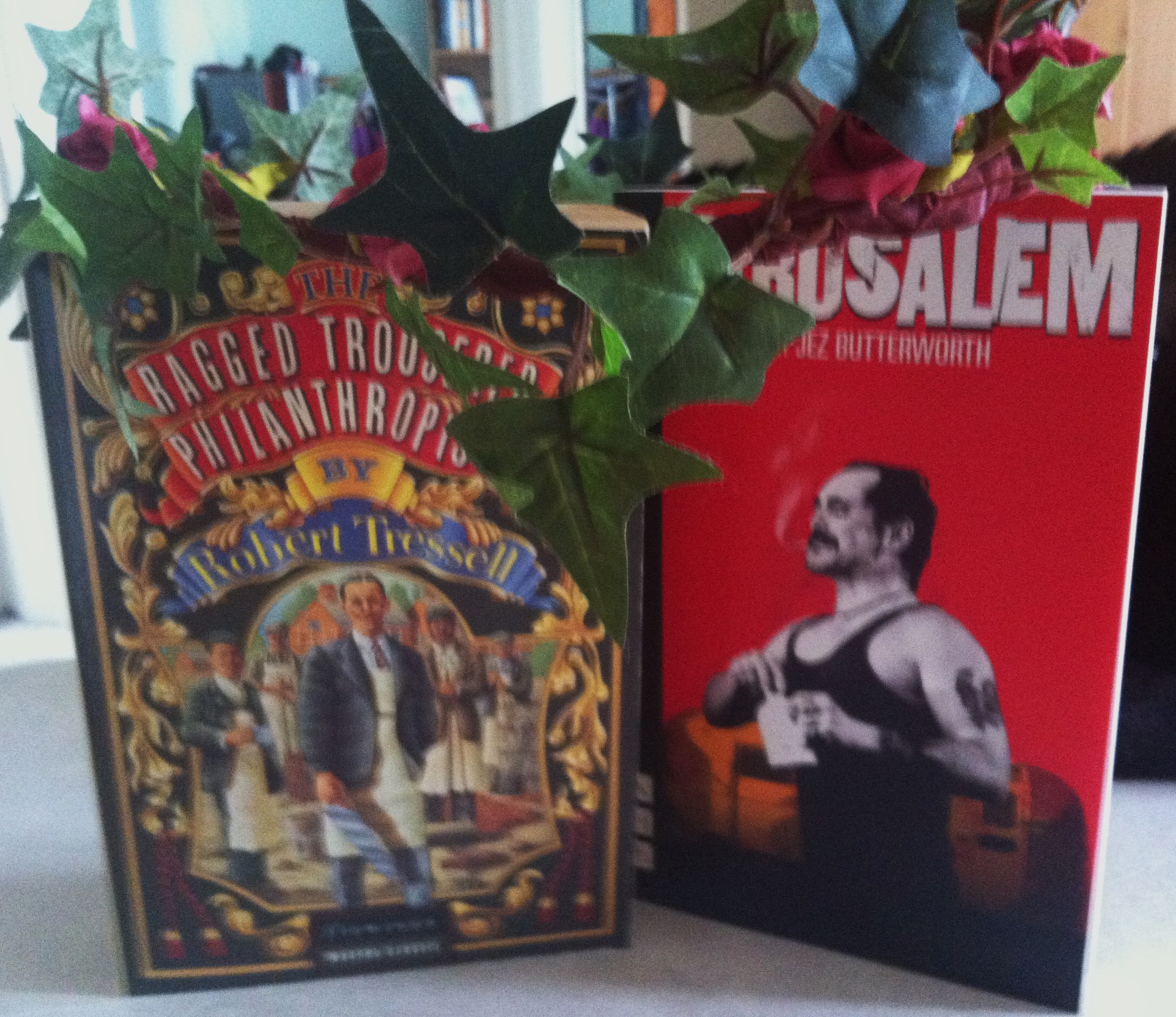
Firstly, a disclaimer. Jerusalem by Jez Butterworth is set on St George’s Day (23 April), not May Day.  But hey, what’s a week? I decided to go ahead with it anyway as it lends itself to May Day – ideas of ritual, tradition, Springtime and revelry run throughout.  Seeing Jerusalem was one of the most extraordinary experiences I’ve ever had in the theatre;  Mark Rylance in the lead role of Johnny ‘Rooster’ Byron put in a performance that was literally breathtaking – and that’s not a misuse of the word literally, at one point I realised I’d forgotten to breathe. I loved it so much that when a friend offered me the chance to interview Mark Rylance I turned it down – I couldn’t bear the thought that I might not like him off-stage and that I’d lose that performance. Even if you didn’t catch Jerusalem, which ran 3 times in London and also on Broadway, I still recommend the playtext.  Jez Butterworth is a highly rated playwright and his original voice and great skill mean it is an enjoyable read.

Rooster Byron lives in a mobile home in a wood.  The local council plan to evict him.  The local teenagers love him (and sort of despise him), as he supplies them with drugs and alcohol.  A local girl (dressed as a fairy) has disappeared and her psychotic step-father believes Rooster is involved, and plans to do him serious damage. Amongst these various pressures, Rooster remains resolutely upbeat and self-aggrandizing, with tall tales such as this one of his conception, whereby his philandering father is shot by his wife:

JOHNNY….The bullet passes clean through his scrotum…where it hits the number 87 tram to Andover. The bullet passes through two inches of rusty metal, clean through an elderly lady’s packed lunch and lodges in my sweet mother’s sixteen year old womb. Eight months, three weeks, six days later. Out pops him. Smiling. With a bullet clenched between his teeth.

GINGER. First of all. Babies don’t have teeth.

JOHNNY. All Byron boys are born with teeth. Thirty two chompers.  And hair on thems chest,…

Hopefully it’s apparent that Jerusalem is very funny.  Traditions surround the characters, such as the local Flintock Fair taking place, but are made resolutely current, such as when a Morris dancer arrives, talking about how his participation is due to a “Swindon-level decision”, and needing drugs to get him through it – hardly a bucolic idyll.  This take on England’s green and pleasant land lends the play a slightly surreal air, as Rooster’s outsider status gives him an askance view of the traditions, both wholly entangled (he was once the main attraction of Flintock Fair, performing daredevil stunts) and yet undermining them also.  The surreal quality exists in fairly straightforward exchanges:

JOHNNY. …Two weeks back, your brother Daffy comes round here, tries to buy three grams of whizz with a tortoise.

LEE. That weren’t his tortoise. That’s my sister’s tortoise.

JOHNNY. Well, now it’s my fucking tortoise. Little bugger pisses everywhere. It pisses pints.  It’s like the TARDIS.

LEE. He’s right. That tortoise pisses like a shirehorse.

But as well as humour, the surreal quality is unnerving, and you feel anything could happen.  When Byron claims he met a ninety foot giant “just off the A14 outside Upavon. About half a mile from the Little Chef. I’d been up for three days and nights playing canasta with these old ladies in a retirement home outside Wootton Bassett.” you don’t entirely disbelieve him.  What is real, what is fable, merge until you are not sure whether you watching a man in a mobile home in a wood in the West Country or a mythic being inextricably bound to the legends of the land. Maybe both. I can’t recommend Jerusalem highly enough.

Secondly, and I’ll make this brief, as my love for Jerusalem means I’ve wittered on too much already, The Ragged-Trousered Philanthropists by Robert Tressell.   Published in 1914, 3 years after the death of its author from tuberculosis, TRTP is a classic of socialist literature.  Frank Owen, described on the back cover of my copy of the novel as a “journeyman-prophet”, joins a group of workers who are renovating a house known as The Cave.  He encourages them to consider their role within a capitalist system and how they engage in their own economic suppression.  It’s a long novel, and highly polemical, but it’s also very readable and engaging.  In one of the most famous sequences in the book, Owen uses a loaf of bread to explain his reasoning. The bread is raw materials, cutlery is machinery, the cut pieces of bread the goods made.

‘You say that you are all in need of employment, and as I am the kind-hearted capitalist class I am going to invest all my money in various industries, so as to give you Plenty of Work. I shall pay each of you one pound per week, and a week’s work is -you must each produce three of these square blocks…..

‘These blocks represent the necessaries of life. You can’t live without some of these things, but as they belong to me, you will have to buy them from me: my price for these blocks is–one pound each.’

As the working classes were in need of the necessaries of life and as they could not eat, drink or wear the useless money, they were compelled to agree to the kind Capitalist’s terms. They each bought back and at once consumed one-third of the produce of their labour. The capitalist class also devoured two of the square blocks, and so the net result of the week’s work was that the kind capitalist had consumed two pounds worth of the things produced by the labour of the others, and reckoning the squares at their market value of one pound each, he had more than doubled his capital,…as for the working classes,… they were again in precisely the same condition as when they started work-they had nothing.”

This occurs in a chapter called ‘The Reign of Terror. The Great Money Trick’. As you may have guessed, TRTP is quite a bleak novel. Nothing changes and the workers are so indoctrinated in the system that Owen fails to raise their consciousness, turning his attention instead to George Barrington, a middle-class socialist who plans to overturn the system through elected representatives in the House of Commons (argue amongst yourselves as to how that’s working out). The Philanthropists of the title are the workers, doing so much for so little their labour must surely be an act of philanthropy towards their capitalist employers. This bitter irony captures the attitude of the novel towards the complicity of all society in a capitalist system, but although it is an angry book, TRTP doesn’t lose sight of its story amongst the politics.

Here are the books garlanded in May Day fashion:

Image

“I’m not married, I don’t have any kids, and I’d blow your head off if someone paid me enough.” Or “I killed the president of Paraguay with a fork. How’ve you been?” (both Martin Blank (John Cusack) Grosse Pointe Blank)

This week I went to a reunion, which wasn’t nearly as traumatic an experience for me as it is for Martin in Grosse Pointe Blank, partly because I gave up contract killing years ago, but mainly given that we meet regularly every six months, but we call it a reunion to make it a slightly bigger deal to try and ensure all six of us make an effort to be there. In trying to decide which books to discuss, I found those treating the subject of reunions a bit sparse. As a result, I’ve picked two that share a lot of similarities; both are written by British male authors, both consider the subtleties of male friendship, and both won the Booker prize. So there may not be as much contrast this week as I normally aim for in my book choices, but I hope you enjoy them. I will also claim that together they represent the characters’ relationships in both books as they are united yet disparate, sharing a common ground but a very different language. While this is true, I’m not clever enough to have made this my reasoning at the time. The reason was they were all I could come up with. I hope you enjoy!

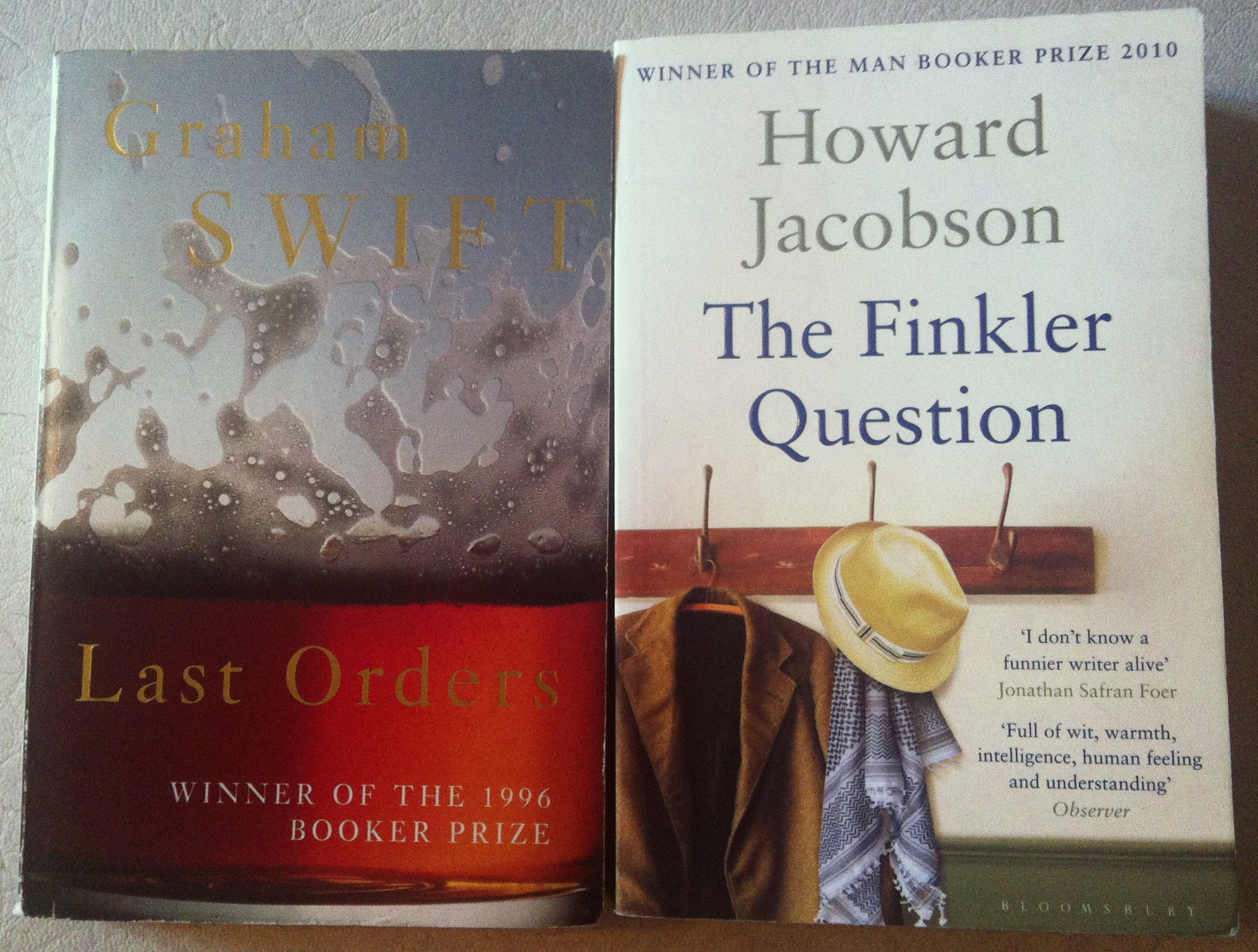
Firstly The Finkler Question by Howard Jacobson. This was the first book by Jacobson that I’d ever read, and I think on the basis of this I will hunt down more of his work. I found The Finkler Question funny, intelligent and thought-provoking, not an easy balance to achieve. After a reunion with his schoolfriend Sam Finkler and their teacher Libor, Julian Treslove walks home and is mugged by a woman who he believes says “You Jew” to him, despite the fact that he’s not Jewish (both Sam and Libor are). Following this incident Treslove begins to explore Jewish culture and identity further, struggling to work out his place amongst it. Meanwhile, both Finkler and Libor are grieving widows, searching for ways to stop themselves drifting rudderless with grief.

All three characters are fully drawn, but it is Treslove who provides the main point of view, and he is an incredible creation, because frankly, he is a monumental prick, and yet Jacobson manages to make you not despise him. He would claim he loves women, but really only sees them as a vehicle for his over-developed sense of sentimentality, continuously picturing them on their deathbed, himself wracked with grief, living out the operas he adores. When Libor, who actually is wracked with grief for a woman he genuinely loved, mentions trying to cope with the pathos of life: “Treslove couldn’t bear the thought. Why did anyone want a defence against pathos?” Alongside this sentimentality he is fixated with Judaism, but doesn’t think of himself as an anti-semite, despite the fact of referring to all Jewish people by the name of his Jewish friend, to construct thoughts such as: “if you were a Finkler you just found it in your genes, along with other Finkler attributes it was not polite to talk about.” He is so self-deluding that: “For a moment he wondered if that was the reason he had fared so badly at the BBC himself –anti-semitism.”

Oh boy. What an arsehole. An yet the humour of the novel lends it such a lightness of touch that you end up seeing the pathos of Treslove, not the one he wants whereby he can rend his garments, but a more ordinary pathetic quality, of someone trying desperately hard to understand the life they are living, and failing. Even at the small level, things are baffling: “At a certain age men began to shrink, and yet it was at precisely that age that their trousers became too short for them. Explain that.” So Treslove’s attempt to understand Middle East politics is bound to fail. It’s here that the book becomes more complex, as Jacobson uses the lives of these characters to explore wider notions of identity, history and politics, particularly regarding Jewish culture. At this point I felt I wasn’t clever enough for this story, as Jacobson is so adept at painting the various shades of grey that I felt my understanding wasn’t subtle enough. One of the characters realises “What she might be wrong about today she will be right about tomorrow.” That’s what I took away from this novel, that there are no easy answers, no one story to be told, either on a personal level or a worldwide stage. But it is better to laugh than cry: “He did something with his shoulders which he hoped she would interpret as emotional pain, but not too much.”

Secondly, Last Orders by Graham Swift. The reunion in this novel is defined by who doesn’t attend: the friends of Jack Dodds meet in south London (Bermondsey) to travel to Margate (a seaside town in Kent) to scatter his ashes at sea. The characters take it turns to tell the story of that day and the history that binds them. His son Vince, Ray the lucky gambler, Lenny, whose daughter had a baby with Vince, and Vic, the undertaker. Jack’s wife Amy stays behind but also narrates (as does Jack and Vince’s wife Mandy at points). It is determinedly ordinary: although an unusual day nothing extraordinary occurs, there is no great drama. As they tell their stories you begin to understand what binds these men together, and what the great moments and great disappointments of their daily lives have been. Some of the chapter headings take their names not from the narrator, but geographical locations along the way. I’ve decided to quote from “Canterbury” because it reminded me (deliberately, I’m sure) of Chaucer’s pilgrims, who also travel from south London (Southwark) to Kent. The men in this group aren’t Knights and Squires, they aren’t captured in epic poetry, but Swift shows us the grandeur of daily life:

“I sit there, keeping an eye out, but I don’t see them anywhere, so I get up and find the way out, and then I spot them, standing on the paved area, looking out for me. I think, Friends. The sky’s dark and threatening, and the wind’s cold but they don’t look like they’re getting peeved. They look like they’re glad to be here together, like all’s forgiven. I think, maybe….I can feel the cathedral behind me, looking at me.”

This quote also highlights the main drawback of the book. Swift has attempted to capture vernacular south London speech (of which I am a native speaker), but he doesn’t quite manage it. I think with this sort of thing you’ve either got to go all out (like Trainspotting) or ignore it completely. What Swift ends up with is a mixture of the two and as such the voices don’t sound authentic. What is authentic however, is the characters’ experience, feelings and reactions, and this is the story’s great strength. Not a flawless novel, but still a moving one.

Here are the books, reunited (I know, totally uninventive photo, but how to portray a reunion?):

Image

“If you want to get laid, go to college. If you want an education, go to the library.” (Frank Zappa)

This week I went to visit friends in Oxford, an incredibly beautiful city: the dreaming spires, the May morning choirs, the seasons of mists and mellow fruitfulness… er, where was I?  Oxford has a mythology about it as Britain’s oldest university which inspires both fear and rapture, but I don’t think that’s necessarily limited to Oxford or Cambridge.  Going to university can be an exhilarating, terrifying, wonderful time no matter where you are.  And it can also be a massive let-down, when actually nothing major happens and it’s just another step of many on your path. So this week I thought I’d look at two novels that try and capture this time, one set in Oxford, and one at the fictional Drama Arts school in London. Both novels consider the gap between our aspirations and dreams, what we wish were true, and the reality we have to navigate around these hopes.

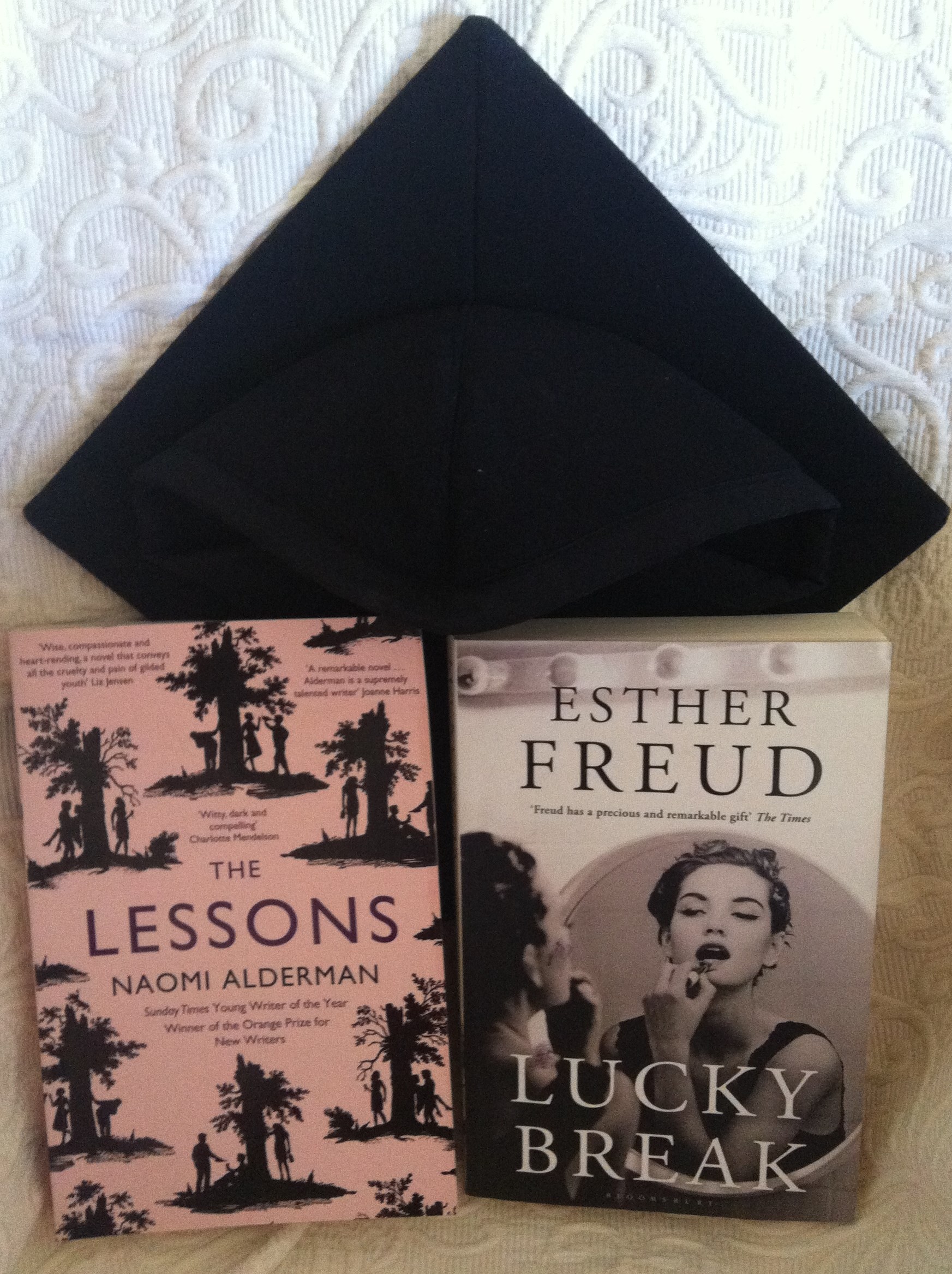
Firstly The Lessons by Naomi Alderman (Penguin, 2010).  Alderman studied at Oxford herself, and so there is a sense of authenticity in her descriptions of Oxford both in terms of the geographical surroundings but also in the psychology of the university: “This is Oxford: it need not be all or nothing, but it lends itself to that way of thinking.”  The lack of romanticism means there is a limit to which The Lessons adds to the mythology of the place which was somewhat refreshing.  However, there is more than a whiff of Brideshead in the tale: a naïve young man arrives at Oxford, is befriended by a rich man from a Catholic family, who introduces him to his glamorous circle, but all is not as it seems…sound familiar? But The Lessons still manages to tell its own tale.  The main protagonist, James Stieff, is miserable at Oxford until the pretty and talented Jess introduces him to Mark, an erratic and charismatic student whose enormous wealth means he owns a crumbling Georgian mansion where he and the rest of the group (bookish Franny, glamorous Emmanuella, and Simon who I felt was quite undeveloped, preventing me from reducing him to a single adjective easily), all live.  During their time at Oxford they bond over student parties and intrigues, but after university they drift apart as so easily happens.  However, James and Mark are bonded by an event at university which means they are not so easily split:

“I thought he needed to be saved and that it was for me to do.  In that moment I was lost.”

Mark is mentally unstable and although previous mental illness is alluded to it’s never properly explained.  When James reflects, fairly early on:

“For this is the heart of the matter: disasters occur where accidents meet character.”

It is a foreshadowing of where the tale will take us.  The character of Mark is both compelling and flawed, and this fatal combination is ultimately destructive to all who get too close.

The Lessons in many ways is a straightforward book with a simple plot and the resolution is low-key.  However, to an extent I thought this was its strength: few of us live life on a determinedly grand scale and the events and realisations we experience can seem outwardly small, however great the significance to us as individuals. Although James believes:

“It is ridiculous to think we can learn anything from so arbitrary experience as life.  It forms no kind of curriculum and its gifts and punishments are bestowed too arbitrarily to constitute a mark scheme.”

He does in fact learn lessons, but they’re just not as clearly delineated as when they are bestowed from within an academic structure:

“No wonder we spend our adult lives feeling we’re simply pretending to know what we’re doing.  After sixteen years spent doing exams , where the lessons we’ve received perfectly fit the challenges we’re faced with, our preparations for the unpredictable events of normal life will always seem shoddy and haphazard.”

I thought Disobedience, Naomi Alderman’s first novel was far stronger than The Lessons, (especially in terms of characterisation, only Mark and James were fully drawn), but this novel still had something to say about how we come to terms with what we learn, inside and outside the classroom, and how we carry that into our lives with meaning.

Secondly, Lucky Break by Esther Freud (Bloomsbury, 2011).  Before she turned to writing, Freud trained at Drama Centre London, and although the Drama Arts of Lucky Break is fictional, it certainly seems authentically drawn (the temptation to wonder if any characters in the novel are based on specific actors is hard to resist).  A group of students start at Drama Arts, a training school with the ethos of: “Break them down to build them up.”  They all embrace the opportunity to be broken, despite Nell worrying that being overweight will mean she always plays maids and wenches, Charlie being a stunning beauty who is utterly selfish, and Dan becoming something of a teacher’s pet.

“There would be actors, acting, and then them, inhabiting their actual characters, an entire psychological life, both physical and mental, all mapped out.”

However, once in the world of jobbing actors rather than in the classroom, they find their idealism quickly fades.  Nell’s friend Sita constantly plays girls despairing at an arranged marriage, as the industry is unable to cast an Asian woman as anything else, there are limited roles for women, and only 8% employment.  The casting couch remains and any signs of physical imperfection result in a career crisis.

Freud’s fluid writing and subtle characterisation creates flawed, believable characters in a highly readable style that whips the reader along.  Although acting is a profession surrounded by glamour that most of us will never experience, Lucky Break shows the reality of the industry and all its inherent frustrations, while at the same time making it understandable as to why people persevere against the odds.  The allure of that lucky break exists not only for actors, and can be a driving force, even when it seems entirely ethereal and beyond reach. Lucky Break is ultimately more optimistic than The Lessons about holding onto idealism once you leave the sheltering confines of further education and head out into the world, but both show the value of realising that the lessons, and therefore learning, never quite end.

Here are the books donning (get it? donning.  Oh wow, I apologise.  That was truly bad.) a mortar board.  I know it just looks like a big black square but I promise it is a mortar board, I just couldn’t get it to balance properly (as with the books, so it is with my head. Is the impossibility of wearing academic dress part of the elitism? In which case I’m screwed.)

Image

“Adults are just obsolete children and the hell with them.” (Dr. Seuss)

The theme for the post this week was prompted by spending time with friends’ children.  Although I don’t have kids myself, I enjoy their company and the fact that most of my friends have now reproduced works superbly in my favour:  I can spend time with them, then trot off to [insert any number of frivolous time-wasting activities here]. So, my lack of maternal instinct aside, one of the brilliant things about kids is when they start to discover language and approach it with such fresh eyes and ears, making you reconsider the words you use to explain and understand the world.  This got me thinking about novels written from the point of view of children.  It’s a hugely tricky premise to pull off effectively, but done well it can help the author voice something essential about our experiences in the world, that we perhaps lose sight of as we grow into adults.  To Kill a Mockingbird is a perfect example of this – an incredibly well-written, powerful and incisive novel that so many people adore and find profound meaning in.  I decided not to discuss To Kill a Mockingbird as I found it too daunting a task (for the reasons just given), so instead I’ve chosen two fairly recent novels that both employ a child narrator (a five year old boy and an nine year old boy respectively) to explore tragic circumstances through voices that are not typically heard in literature.

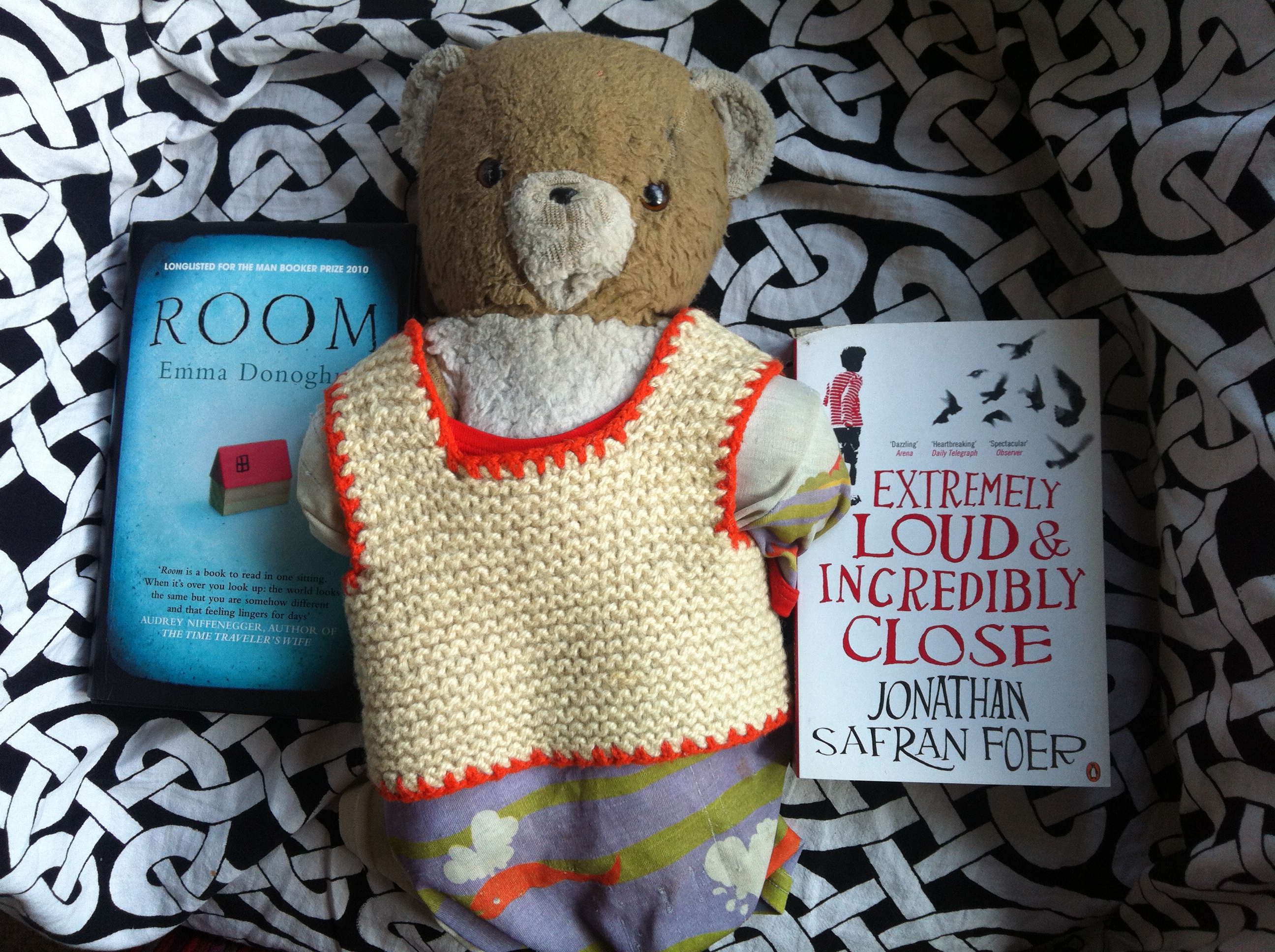
Firstly Room by Emma Donoghue.  A few years ago I was doing an evening class with a journalist who was given a proof copy of this novel to read, and she absolutely raved about it.  I was reluctant to read it at the time as I knew it was inspired by the Josef Fritzl case, and I wasn’t sure of the role in literature in fictionalising such recent events.  My only defence is that I’m an idiot, as Room is a wonderful novel which treats its subject matter with great sensitivity.  It tells the story of Jack who has lived all his five years with Ma in Room, an 11×11 foot space.  Within this limited environment, Jack creates richness and stimulus for himself, personifying the objects that surround him to create his friends:

“I count one hundred cereal and waterfall the milk that’s nearly the same white as the bowls, no splashing, we thank Baby Jesus.  I choose Meltedy Spoon with the white all blobby on his handle when he leaned on the pan of boiling pasta by accident.  Ma doesn’t like Meltedy Spoon but he’s my favourite because he’s not the same.  I stroke Table’s scratches to make them better”

Jack is happy in his world (aside from when their captor, “Old Nick” visits), but how much he is shielded from its sinister side becomes apparent when he describes among the games he and Ma play one called Scream, where it’s clear they spend a portion of each day yelling for help.  They have a TV, and for me this really brought home the shock of what they were enduring: the mention of celebrities like Rihanna, Lady Gaga, and Kanye West grounded it very much in the here and now and narrowed the distance between their extreme experience and the contemporary reader.

Jack is remarkably accomplished verbally and numerically for a five year old, and while the cynical side of me thinks this is convenient for Donoghue as she can make a five year old say much more than they would otherwise, I actually think it works.  Ma is college educated and in trying to provide games to keep Jack occupied, she inevitably ends up accelerating his learning in some areas that children with more balanced experiences wouldn’t undertake.  At one point he even paraphrases 1 Corinthians 13:11: “When I was a kid I thought like a little kid, but now I’m five I know everything”.

Jack’s voice is so distinctive and unique, I found myself being completely drawn into his world.  The story is never depressing because although Ma has been through the most horrific ordeal, her love for Jack ensures that while he is scared and often overwhelmed, he is never without an ally.  At one point, considering whether she sees her captor and rapist in Jack, she says: “He reminds me of nothing but himself”.  This is Donoghue’s great achievement as an author; she has created a protagonist who is wholly unique.

Secondly, Extremely Loud and Incredibly Close by Jonathan Safran Foer.  To start I just want to get my one negative point out the way: I found the voice of the narrator, Oskar, entirely unconvincing as a nine year old, even a precocious, highly intelligent, autistic nine year old.  Having said that, Oskar is an engaging, likeable and sympathetic character who easily carries you along on his journey around New York and towards an understanding of what life means following the death of his father.  After his father dies in the events of 9/11, Oskar finds a key labelled “Black” in a vase in his father’s closet.  Oskar decides to unravel the mystery by visiting every New Yorker with the surname Black in New York.  For part of the way he is accompanied by his elderly neighbour, Mr Black (you can probably guess how they meet).  The narrative is interspersed with stories from his grandparents, who witnessed the Dresden bombings, broadening the narrative to consider human trauma across the generations of a family.

The book is inventive in its structure both in narrative terms and physically – there are blank pages, those with only a few words, words crossed out, photographs.  This alongside Oskar’s unique understanding of the world, even in small domestic matters (“I woke up once in the middle of the night and Buckminster’s paws were on my eyelids.  He must have been feeling my nightmares.”) makes for a reading experience unlike any other.  There are ways in which I felt the book wasn’t entirely successful, and certainly not on par with Everything is Illuminated, Safran Foer’s previous novel which I think is one of the best pieces of literature of recent years.  However, I don’t want to dwell on the shortcomings in particular, because I felt the novel succeeded in capturing the most important thing, the grief of a child for his father.

“I loved having a dad who was smarter than the New York Times, and I loved how my cheek could feel the hairs on his chest through his T-shirt, and how he always smelled like shaving, even at the end of the day.  Being with him made my brain quiet.  I didn’t have to invent a thing.”

Extremely Loud and Incredibly Close is as inventive as its main protagonist, and I found it a highly readable and moving novel from an author who strives to create truly original pieces of writing.

Here are the books with a remnant of my own childhood, Ted (unlike Oskar, I clearly wasn’t an inventive child, at least when it came to naming my toys):

Image

“Definition of a classic: a book everyone is assumed to have read and often thinks they have.” (Alan Bennett)

Before I start this post proper, I just wanted to mention the sad news that Iain Banks announced this week that he has terminal cancer.  In almost 30 years Iain Banks has produced an impressive volume of work, including science fiction under the name Iain M. Banks, and aged only 59, it was reasonable to assume he would continue to do so for a great many years. Instead, he has confirmed that his latest novel, The Quarry, will be his last. I discuss my favourite of his novels, The Crow Road, in my post of 25 February.  I really don’t know what else to say about this that won’t sound trite or clichéd, but I would urge you once more to check out the work of this highly readable writer whose talent will be sorely missed by his many fans worldwide.

***

The prompt for this post came from a friend who emailed this week asking me for recommendations of classics to read.  She had just bought a Kindle and discovered the joy of copyright-free books being free to download.  (All hail Project Gutenberg).  So I thought lots of people could be in a similar position, and it would make a good post… how wrong I was.  It wasn’t long into my deliberations (which I’d love to claim involves a complicated algorithm I’ve compiled to ensure the most riveting blog possible, but the reality is me staring mindlessly at my bookshelves and shaking my head whilst eating too much chocolate) that I ran into the truth of Alan Bennett’s definition.  For so many of the books charged as classics I found myself asking – who needs me to recommend them?  Everyone’s heard of them, knows what they’re about, has an idea of whether it’s something they’re interested in.  OK, I don’t pick the world’s most obscure books the rest of the time, but classics don’t exactly need the PR.  Then I decided to just chill out and pick a book each from the 18th, 19th and 20th centuries that are classics but maybe not the most well-known ones.  You’ll be relieved to know I scrapped that idea as I realised this would mean the post would go on forever, and like so many Modernists before me, I decided to abandon all thoughts of the nineteenth century. So here are two books, both of which you’ve probably heard of, one from the century that saw the birth of the novel, one from the twentieth century (unfortunately only the first one is free to download on Project Gutenberg).  If you haven’t read them, I hope this post is helpful in adding to the belief that you have!

Firstly, The History of Tom Jones, A Foundling, by Henry Fielding (1749, my copy Penguin 1999).  Written at the time when the novel as a form was just beginning, you can sense Fielding having a great time playing around with the lack of established rules – there a lots of direct addresses to the readers, often at tangents to the plot, including précis to each chapter such as “Chapter XII: containing what the Reader, may, perhaps, expect to find in it” and “Chapter I: containing little or nothing”. The book is a huge one: 346,747 words, according to Wikipedia, so I won’t attempt anything other than the very basic outline of the plot: Tom Jones is found abandoned in Squire Allworthy’s bed as a baby.  The Squire raises him as a son, and Tom falls in love with his neighbour, the beautiful and virtuous (of course) Sophia.  He has a nemesis, Bilfil (nephew to Squire Allworthy), whose machinations lead to Tom being banished from the house.  He takes to the road, and Sophia, who loves him, runs away to find him.  Adventures, trials and tribulations abound…

The Victorians reacted against the libertinism of the eighteenth century, but I think this liberal morality means the novels of the time are great fun.  Tom Jones is picaresque, and as such Tom doesn’t always behave well, but it’s always believable and funny, and what makes it so endearing is that he really tries to be the hero of this novel. For example, when he hears the screams of a woman in a wood, he runs to her rescue.  Except he half slides down a hill in a not-very-heroic manner, beats the man attacking her, and then rather than cover over the exposed woman, enjoys gazing at her breasts. The lady recovers sufficiently to flirt with him, and declines his offer of a coat:

“Thus our Heroe and the redeemed Lady walked in the same Manner as Orpheus and Eurydice marched heretofore.  But tho’ I cannot believe that Jones was designedly tempted by his Fair One to look behind him, yet as she frequently wanted his Assistance to help her over Stiles, and had besides many Trips and other Accidents, he was often obliged to turn about.”

Needless to say, this being the eighteenth century, they end up acting on their inclinations…

Tom Jones is a classic that perhaps isn’t as well read as some of the novels that followed, their way opened by Fielding’s inventive work.  I think that’s a shame.  It’s funny, it has plenty to say, and although it’s satirical it’s not overly moral, so if you’ve been put off the classics by the heavily moral tone of the Victorians (or Fielding’s contemporary, Samuel Richardson) then Fielding could be the author for you.  And although Tom Jones is long, it’s not nearly as long & impenetrable as other eighteenth century classics like Tristram Shandy and Clarissa. As a free download, you won’t even have to wrestle with an unwieldy paper tome, so there’s no reason to be anything other than content: “a blessing greater than riches; and he to whom that is given need ask no more.”

My second choice, Scoop by Evelyn Waugh, runs to a modest 222 pages in my edition (Penguin, 1938; my copy much later but no date given) so if you can’t face the girth of Tom Jones, maybe this will appeal more. Scoop is Waugh’s satire on the newspaper business, and the integrity (or lack thereof) of an industry looking for a story at any cost is thoroughly lampooned.

William Boot writes countryside columns for the Daily Beast.  The newspaper’s owner, Lord Copper, mistakes him for the novelist John Boot, who wants to leave the country, and so sends him to be a war correspondent in Ishmaelia, a (fictional) country on the verge of civil war.  The whole experience is disastrous for Boot, but he does manage a scoop, and so is proclaimed a wild success.  The novel is full of Waugh’s witty turns of phrase (Boot is served at one point by a page “with a face of ageless evil”)and eccentric characters, who ask questions like: “Why should I go to Viola Chasm’s Distressed Area; did she come to my Model Madhouse?” If you enjoyed Vile Bodies, this style will be familiar to you, but here the humour is employed to expose the faults inherent in the Press rather than the Bright Young Things of the interwar years. Waugh is scathing about the process of news journalism as a whole: “News is what a chap who doesn’t care much about anything wants to read.  And its only news until he’s read it.  After that it’s dead.” The facts of the war are unimportant to the journalists, as Boot is instructed at one point: “From your point of view it will be quite simple.  Lord Copper only wants Patriot victories and both sides call themselves patriots, and of course both sides will claim all the victories.”

I don’t know a lot about journalism today but I suspect Scoop hasn’t dated too badly, and therefore the satire stands up as well today as it ever did.  One thing which doesn’t stand up & which I found shocking is the horrifically racist language used through the book.  It’s not in abundance, but there’s enough of it there for me to feel the need to warn you.  Ishmaelia is set in Africa, and the language used by the white journalists to describe the country’s inhabitants is derogatory and hugely offensive – it is probably also, I fear, an accurate portrayal of attitudes at the time.  I would still recommend Scoop as a novel, but I wish I’d known about this facet of the story before I went in, as I would have felt better prepared to manage it.

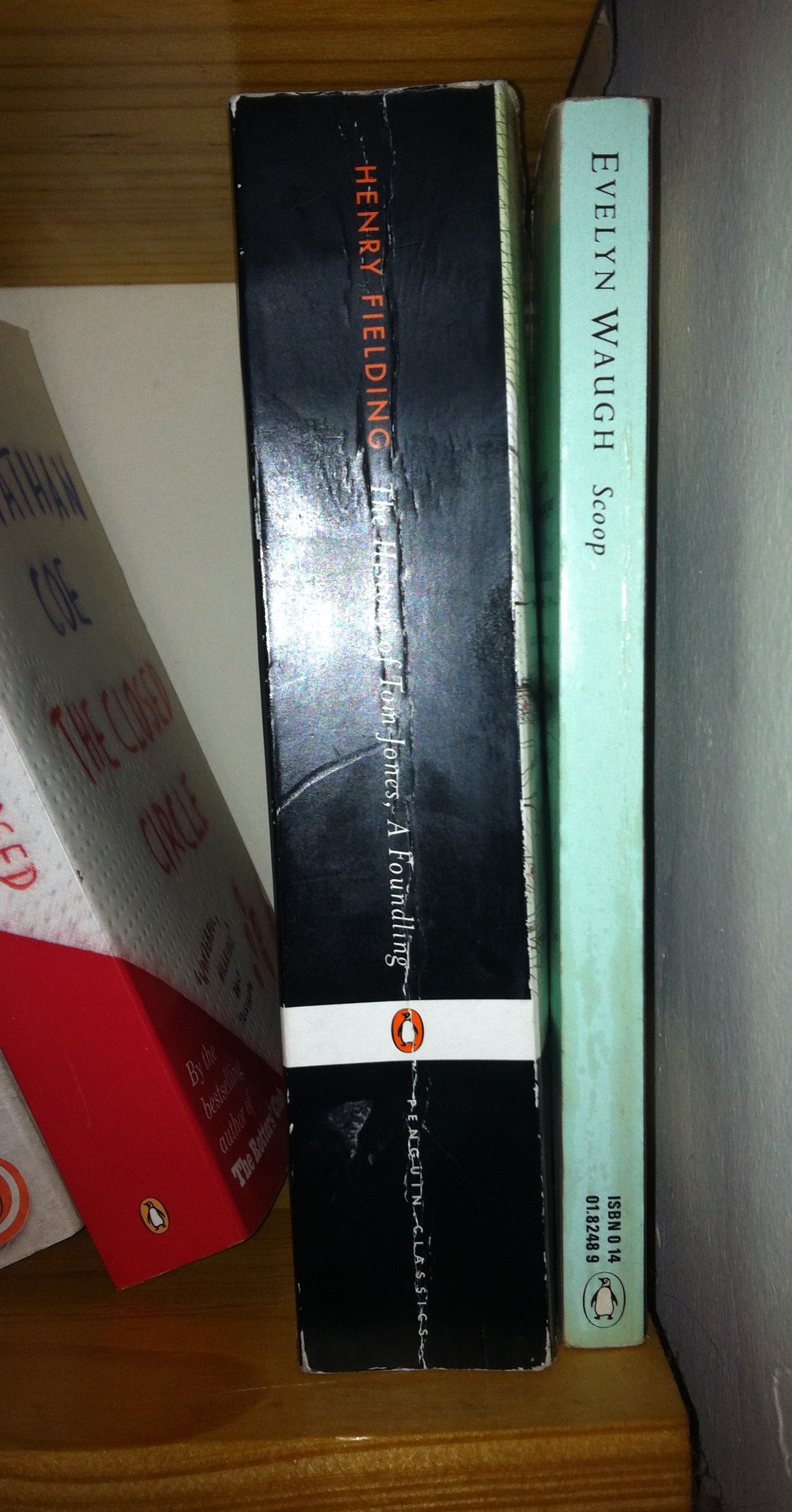
Here are the books presented in classical style, on a bookshelf!

Image

“I’m frightened of eggs” (Alfred Hitchcock)

This weekend has been the long Easter weekend in the UK.  I appreciate not everyone’s Christian (myself included) or that even if you are you might not necessarily celebrate Easter now but in May instead, or not at all.  So I don’t want to bang on about the festival itself at any great length, but I did use it as a starting point for this week’s choices.  I chose a book with references to bunnies in the title, and one about life & death, seeing as how its Easter and springtime, season of renewal.  Two ways to celebrate Easter with no associated risk of adult-onset diabetes (unless of course you tuck into chocolate eggs & simnel cake while reading them, behaviour which I couldn’t possibly endorse…)

Firstly, Never Trust a Rabbit by Jeremy Dyson (Duck editions, 2000).  Dyson is one of the comedy quartet The League of Gentlemen.  I’m not sure how much success they had outside of the UK, so do forgive me if I’m about to tell you what you already know.  The League made three TV series set in the fictional village of Royston Vasey, where three of the four writers played various bizarre residents of the village (Dyson doesn’t enjoy appearing on screen).  They also made a feature film (The League of Gentlemen’s Apocalypse), in which they played themselves, and Michael Sheen played the role of Dyson.  The reason I mention the TV series is that is if you’re familiar with it, you’ll already have an idea of what to expect: the village production of The Sound of Music as directed by Dario Argento.  The book contains twelve short stories which present familiar situations but unnerve the reader as it gradually emerges that the reality we are dealing with is not exactly what we think we know.  My favourite was probably City Deep, set on the London Underground. It’s an environment I have to deal with regularly but that I try to avoid wherever possible, as I hate the idea of being trapped in a crowd in a tunnel underground.  Dyson perfectly captured the stifling, detached reality that the Tube offers and took it a step further, with a ghoulish, terrifying denouement that to a reluctant tube-user like myself seemed at once outrageous and entirely believable (the dark, hidden truth that I suspected was always there). But the stories aren’t resolutely parochial.  The longest story, The Engine of Desire, takes in several locations worldwide, as the sinister Jack Sleighmaker travels the globe to track down whatever item his extremely wealthy clients desire, by any means necessary.  Sleighmaker is an utterly reprehensible human being and his client is the equally despicable Prince Bandar, but Dyson’s writing is so well-paced and compelling that you find yourself reading on despite not rooting for any of the characters. I read this story in bed and found it so creepy I had to watch clips of kittens falling off things on YouTube before I could go to sleep.  The twelve stories in the collection are all equally strong, there are no weak links; they are also varied enough from one another to keep you entertained while still working together as a collection. (As a P.S to this, another member of The League is Mark Gatiss, whose novels about the gentleman spy Lucifer Box I discuss in the post “Having your book turned into a movie is like seeing your oxen turned into bouillon cubes” on 14 November 2012).

Secondly, The Death of Vishnu by Manil Suri. This novel tells the story of Vishnu, an odd-job man in a residential block, who sleeps on the landing, and now lies dying the same place.  An author’s note at the start of the novel tells you this is based on a true story: while the characters that surround Vishnu are fictional, Vishnu’s name, occupation, and the manner of his death are all true.  I’m still not sure how I feel about this: whether it seems cruel and uncaring, or whether as a Westerner I’m too used to seeing death made taboo, institutionalised and tucked away out of sight so we don’t have to deal with it or our own mortality, and to let a man die where he chooses, the place where he has always lived in full sight, is an acceptance of the process we all face.  The novel doesn’t offer easy answers, it instead presents things as they are and encourages us to recognise a common humanity, in its many guises.  Take the opening line: “Not wanting to arouse Vishnu in case he hadn’t died yet, Mrs Asrani tiptoed down to the third step above the landing on which he lived, teakettle in hand.” On the one hand this shows consideration, on the other, Mrs Asrani doesn’t want to wake Vishnu up because she doesn’t want to deal with him.  Things are not clearly defined in the novel, the characters are all flawed (Vishnu is an alcoholic who is bribed into doing his work by the residents) but they are fully drawn and entirely believable.  We learn about the residents of the block and their various intrigues, and about Vishnu himself as the ordinary events of the day mingle with his reminiscences about his life.  It seems apt to include his memory of Holi, as last week was Holi week:

“The light shines through the landing window. It plays on Vishnu’s face. It passes through his closed eyelids and whispers to him in red.  The red is everywhere, blanketing the ground, coloring the breeze.  It must be the red of Holi. He is nine, hiding behind a tree, fistfuls of red powder in each hand.”

The Death of Vishnu is beautifully written but in a simple style that allows the characters to breathe and readers to find their own way amongst them.

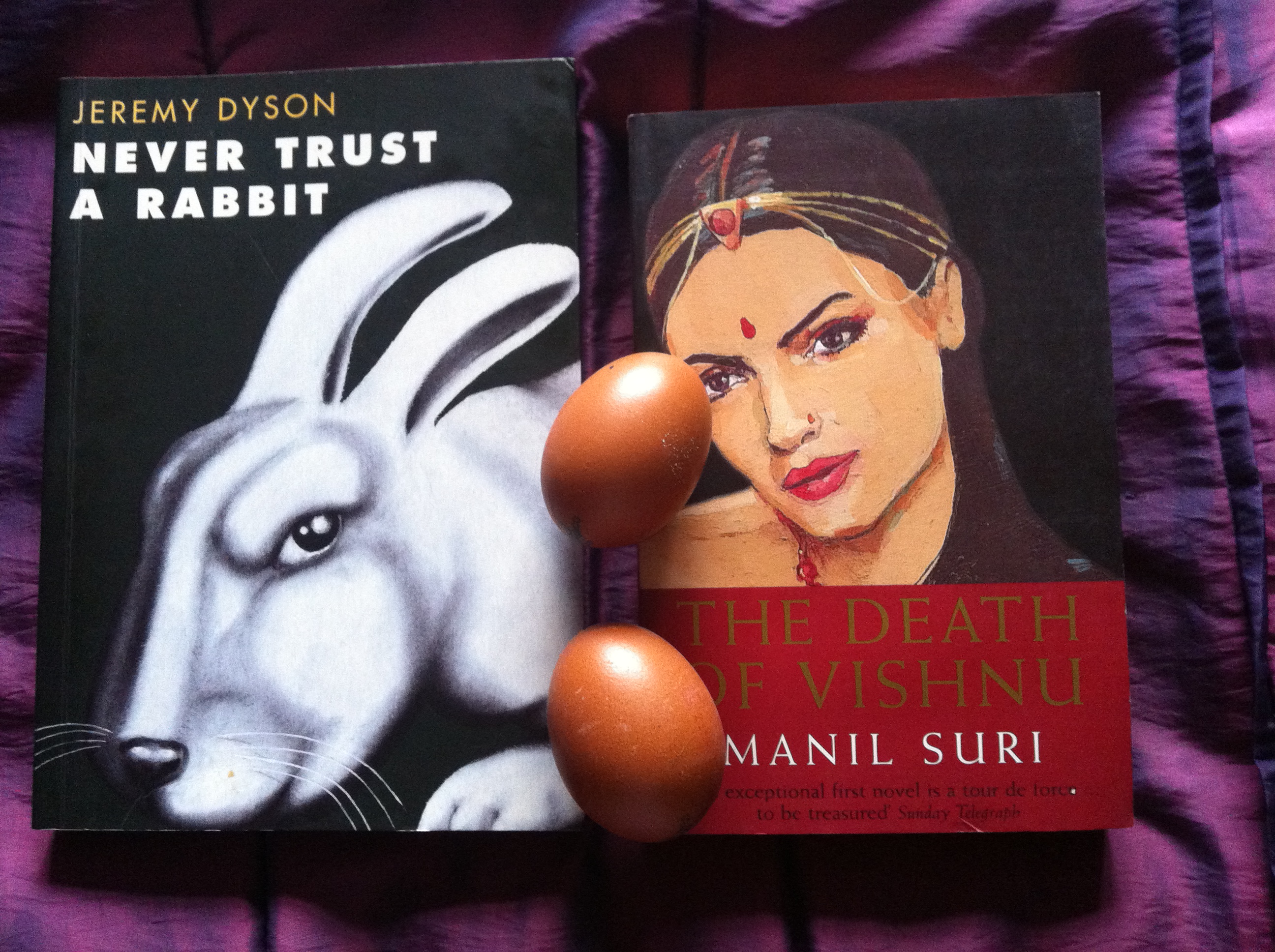
Here are the books with some non-chocolate eggs, so if you share Hitchcock’s phobia look away now:

Image

“It’s always funny until someone gets hurt. Then it’s just hilarious.” (Bill Hicks)

I try to post once a week, and failed totally to do so last week.  This means the post I planned on funny books, to coincide with Comic Relief , was oh-so-topical last week but now is about as current as Christmas.  What the hell, I won’t let my ineptitude deter me from my course.  I’ve written in a previous post about my friend H insisting on lending me light reads, this week I’m going to look at two more books H hopes will encourage me to relinquish my default solemnity and embrace the sunny side of life (particularly difficult here in the UK at the moment as Spring refuses to be sprung and it’s snowing. There’s even talk of a white Easter, which is so unnecessary). I’m concerned this post is self-defeating, because humour is so personal that whether or not I found something funny is really irrelevant as to whether anyone else finds it funny, but let’s crash onwards, and hopefully I’ll be able to give you an idea of whether you want to read the novels or not.  Probably I should stop thinking about it all so seriously!

Firstly Small World by David Lodge (1984, Penguin).  H lent this to me because I am one of those nerds unable to function in the real world so I keep holing up in universities, refusing to leave until I develop book-fanciers lung (which is a disease I think I’ve just invented) from hanging out in libraries the entire time. Well, everyone needs a life plan….  So, Small World is set amongst academia, and mainly derives its humour from its portrayal of vain, self-serving academics competing with each other for a Chair of literary criticism post that only exists virtually – they don’t have to do any work for it, deliver lectures, or even use an office.  This forms the background to series of conferences where the cast of characters intermingle, bitch, gossip and have sex with one another. The nearest character to a hero is Persse McGarrigle, a ridiculously idealistic post-graduate who has spent too much time in books and too little in the real world (I obviously have no idea what that’s like). His thesis is on Shakespeare’s influence on Eliot, then on a whim he tells his fellow academics that its actually about Eliot’s influence on Shakespeare, a preposterous notion which rather than ridiculing, they all get terribly excited about. And so the foibles of contemporary academia are astutely satirised.  I say contemporary because although it was written in 1984, the following sentence convinced me of its relevance:

“How gratifying to encounter, in the dreary desert of contemporary criticism, an exponent of that noble tradition of humane learning, of robust common sense and simple enjoyment of great books.”

Unlike references to long-deceased shop chains like Rumbelows and Sketchleys, and Persse being completely confused as to what a karaoke bar is, this part of the book doesn’t seem to have dated at all.  Much as I enjoy my study (and therefore keep returning to it), many is the time I’ve sat in tutorials wishing I could just state that I liked something, without placing it in its post-modern, post-feminist, post-post-post framework to deconstruct its meaning to the point where you start to doubt your own sanity and whether you even know what a book is.

I have to admit I didn’t love Small World, I thought it was clever rather than funny, and it didn’t really engage me, but if you are involved in any sort of academia I’m sure you will recognise the characters and university politics and derive a few wry smiles of recognition at the very least.

But as I planned for the blog to be celebratory rather critical (and keep getting knocked off this course by the books H lends me, I may have to stop reading them, or at least stop blogging about them) I would like to balance this out by flagging up that David Lodge is an insightful critic as well as a novelist, and I highly recommend his The Art of Fiction. Each chapter takes a topic around creating fiction and uses an example as a discussion point, for example Defamiliarisation in Charlotte Bronte, Intertextuality in Conrad, and so on.  It’s really accessible, readable way of beginning to explore ideas, written in a non-pretentious way that his characters in Small World would be incapable of.

But The Art of Fiction is not fiction itself, and so I return to my second choice of novel, The Eyre Affair by Jasper Fforde (Hodder & Stoughton 2001). This was Fforde’s first novel featuring his heroine detective, Thursday Next.  If you think that’s a bad name pun, here are a few more: Millon De Floss; Jack Schitt; Landen Parke-Laine (a British monopoly pun “land on Park Lane” which perhaps doesn’t translate as well as the others) and many more.  As the pun Millon De Floss shows, this is a silly, fun book for literature lovers.  The Eyre of the title is Jane, and in an alternative 1985, Thursday has to defeat the evil Acheron Hades (great name) who is taking first editions of books and removing characters from them, causing all subsequent copies of the story to change.  Thursday pursues him into Jane Eyre (literally, she enters the story), where she has to stop him wiping out the heroine of one of her favourite novels without changing the story herself.  Things don’t go exactly to plan, but then Jane Eyre in Thursday’s world doesn’t have the ending we know and love….

The story is great fun, and if you love literature there are plenty of jokes to enjoy.  Thursday works as a literary detective, and this is a world where literature is taken very seriously. Teenagers swop Fielding cards:

““I’ll swop you one Sophia for an Amelia.”

“Piss off!” replied his friend indignantly.  “If you want Sophia you’re going to have to give me an Allworthy plus a Tom Jones, as well as the Amelia!”

His friend, realising the rarity of a Sophia, reluctantly agreed.”

The literary dedication of the populace continues into adulthood, such as when the Baconians, a group concerned with proving Shakespeare didn’t write Shakespeare, have their meeting fire-bombed by the radical splinter group, the New Marlovians.

The idea of characters being kidnapped from fiction works really well, as Fforde is able to use examples of characters that are abandoned by their authors to support the premise.  For example, Christopher Sly, the drunkard from the start of The Taming of the Shrew, has been found “wandering in a confused state just outside Warwick”.  He did disappear from the play, so maybe he was kidnapped in this world also?!

There is a feel of The Hitchhikers Guide to the Galaxy about The Eyre Affair and if you enjoy Douglas Adams I think you’ll enjoy this. It’s very clever but it’s not out to prove its own cleverness, and while it could have done with a slightly more heavy-handed editor in places, The Eyre Affair is a pacey, joyous tale about what happens when characters really come alive. And if H is reading this: success!  It made me laugh, my friend.

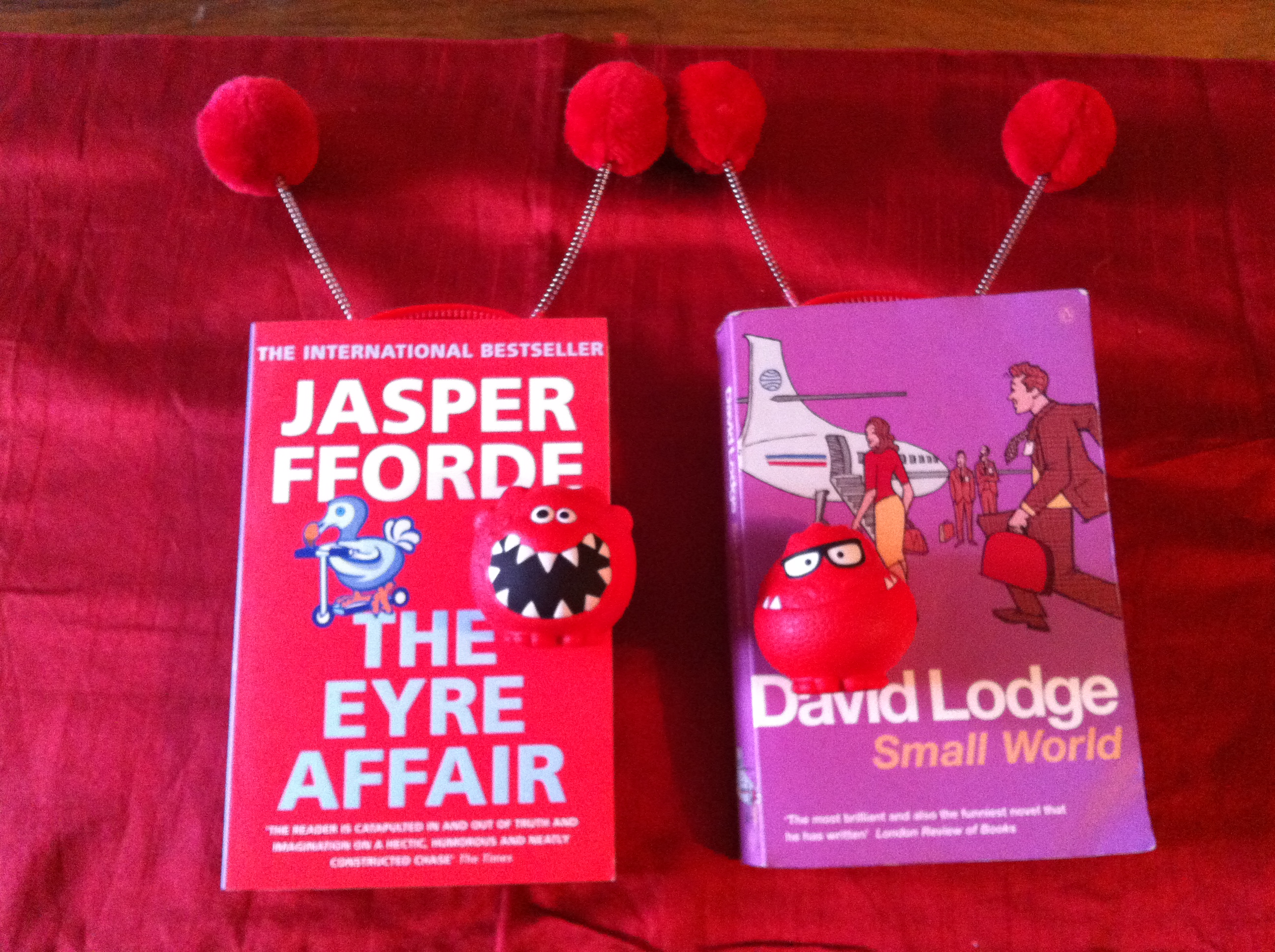
Here are the books doing their bit for Comic Relief by donning this year’s deelyboppers and red noses:

Image

“All women become like their mothers. That is their tragedy. No man does. That’s his.” (Oscar Wilde)

I inherited all the great loves of my life from my mother: literature, the theatre, film, Islay single malt whisky, and cheese that will blow out your nasal passages from 50 metres. We don’t agree on everything: Kris Kristofferson remains an enduring source of contention (me: total  1970s love god, have you seen A Star is Born? She: eyes are too small. Neither of us is willing to back down.) These enormous differences aside, we get on pretty well, and so Mother’s Day is a source of celebration in my family.  In the UK Mother’s Day is 10 March (for once I’ve managed to post on time, in fact a day early as tomorrow will be spent cooking up a feast for the family), so to any of you who aren’t from the UK, Ireland or Nigeria (ie where Mother’s Day is the 4th Sunday in Lent), I apologise and ask that you view this as a postponed/pre-emptive post depending on when Mother’s Day occurs for you. I’ve chosen one book written about a mother from the point of view of a child, and one written from a mother to her child.  Both merge fiction with biography and contain significant sadness, but both are about the triumph of the human spirit. Well, mother-child relationships can be among the most complex…

Firstly, a novel that my English teacher at school thought was very nearly perfectly written: Oranges Are Not the Only Fruit by Jeanette Winterson (1985, my copy Vintage, 1991).  Oranges tells the story of Jeanette, who grows up in an evangelical household in the north of England.  Her mother is a strong, dominant and domineering woman who initially believes Jeanette will help her in her idiosyncratic crusade against sin.  As Jeanette gets older, she realises she is attracted to women, and acts on this.  Her refusal to subdue who she is to the will of her mother leads to a failed religious intervention (almost exorcism) and eventually a breakdown in their relationship.  If this sounds utterly heavy and depressing, let me assure you it’s not.  Humour runs throughout the whole of Oranges, a gentle prodding at the absurdity of life:

““You can always tell a good woman by her sandwiches,” declared Pastor Finch.

My mother blushed.

Then he turned to me and said, “How old are you, little girl?”

“Seven.” I replied.

“Ah, seven,” he muttered. “How blessed, the seven days of creation, the seven branched candlestick, the seven seals.”

(Seven seals? I had not yet reached the Revelation in my directed reading, and I thought he meant some Old Testament amphibians I had overlooked….)

…”Yes,” he went on, “how blessed,” then his brow clouded. “But how cursed.” At this word his fist hit the table and catapulted a cheese sandwich into the collection bag;”

The narrative is interspersed with a fairytale that echoes the main narrative. This serves to broaden the perspective away from its immediate setting, and emphasise that while it is a unique story that is being told, it is also something familiar to us all, a fable.  We may not all be northern English, evangelical Christian and gay, but, in the words of the author:

“Everyone, at some time in their life, must choose whether to stay with a ready-made world that may be safe but is also limiting, or to push forward, often past the frontiers of commonsense, into a personal place, unknown and untried.”

Oranges is fantastically well written (when the author was just 24) and succeeds in being challenging and complex, but also easy to read and reassuring.  The language is poetic and exacting but never overblown:

“We lived in a town stolen from the valleys, a huddled place full of chimneys and little shops and back-to-back houses with no gardens. The hills surrounded us, and our own swept out into the Pennines, broken now and again with a farm or a relic from the war. There used to be a lot of old tanks but the council took them away.”

Oranges is one of my favourite books by one of my favourite authors and so of course, I highly recommend it.  The author was asked if it was autobiographical.  Her answer: “No not at all and yes of course.”  For those of you who enjoy it, I also recommend Why Be Happy when you Could Be Normal?,  Jeanette Winterson’s autobiography, (the title taken from a question her mother asked her when she came out) which shows the story behind Oranges, and also beyond it.

Secondly, Paula by Isabel Allende (1994, my copy Flamingo, 1995 trans. Margaret Sayers Peden). Tragically, in 1991, Isabel Allende’s 28 year old daughter Paula fell into a coma caused by porphyria, and died in 1992 having never recovered. Paula is the story Allende writes for her daughter as she waits for her in the hospital, bringing her novelist’s sensibilities to the story of her family’s life:

“Listen, Paula. I am going to tell you a story, so that when you wake up you will not feel so lost. The legend of our family begins at the end of the last century, when a robust Basque sailor disembarked on the coast of Chile with his mother’s reliquary strung around his neck and his head swimming with plans for greatness.”

Those of you who enjoy Allende’s fiction will find the same style here, and some very recognisable characters from The House of the Spirits. Allende writes vividly and with love of and for her family past and present.

“[Your grandmother] was drinking cheap pisco, and hiding the bottles in strategic places.  You Paula, who loved her with infinite compassion, discovered the hiding places one by one and without a word carried off the empty bottles and buried them amongst the dahlias in the garden.”

“Celia and Nicolas have asked me to come home to California for the arrival of their baby in May. They want me to take part in the birth of my granddaughter; they say after so many months of being exposed to death, pain, farewells, and tears, it will be a celebration to welcome this infant as her head thrusts into life. If the visions I had in dreams come true, as they have in other times, she will be a dark-haired, likeable little girl , with a will of her own. You must get better soon, Paula, so you can go home with me and be Andrea’s godmother.”

Time is not linear or earthbound in Paula, as the family’s past, present and spirits all exist in a mother’s story, evoked in a hospital room. The final third of the book sees Allende stop talking to Paula and instead speak to the reader, as she loses hope that her daughter will recover.   However, the death of her daughter is not an irretrievable loss for Allende who has an acute awareness of the afterlife and sees her family around her whether they are alive or dead.

“She died in my arms, surrounded by her family, the thoughts of those absent, and the spirits of her ancestors who had come to her aid. She died with the same perfect grace that characterised all the acts of her life.”

Paula is a hugely affecting narrative of one of the hardest experiences a mother can live through, but ultimately the enormity of the familial love that surrounds Paula is the strongest force, and this makes it a great Mother’s Day read.

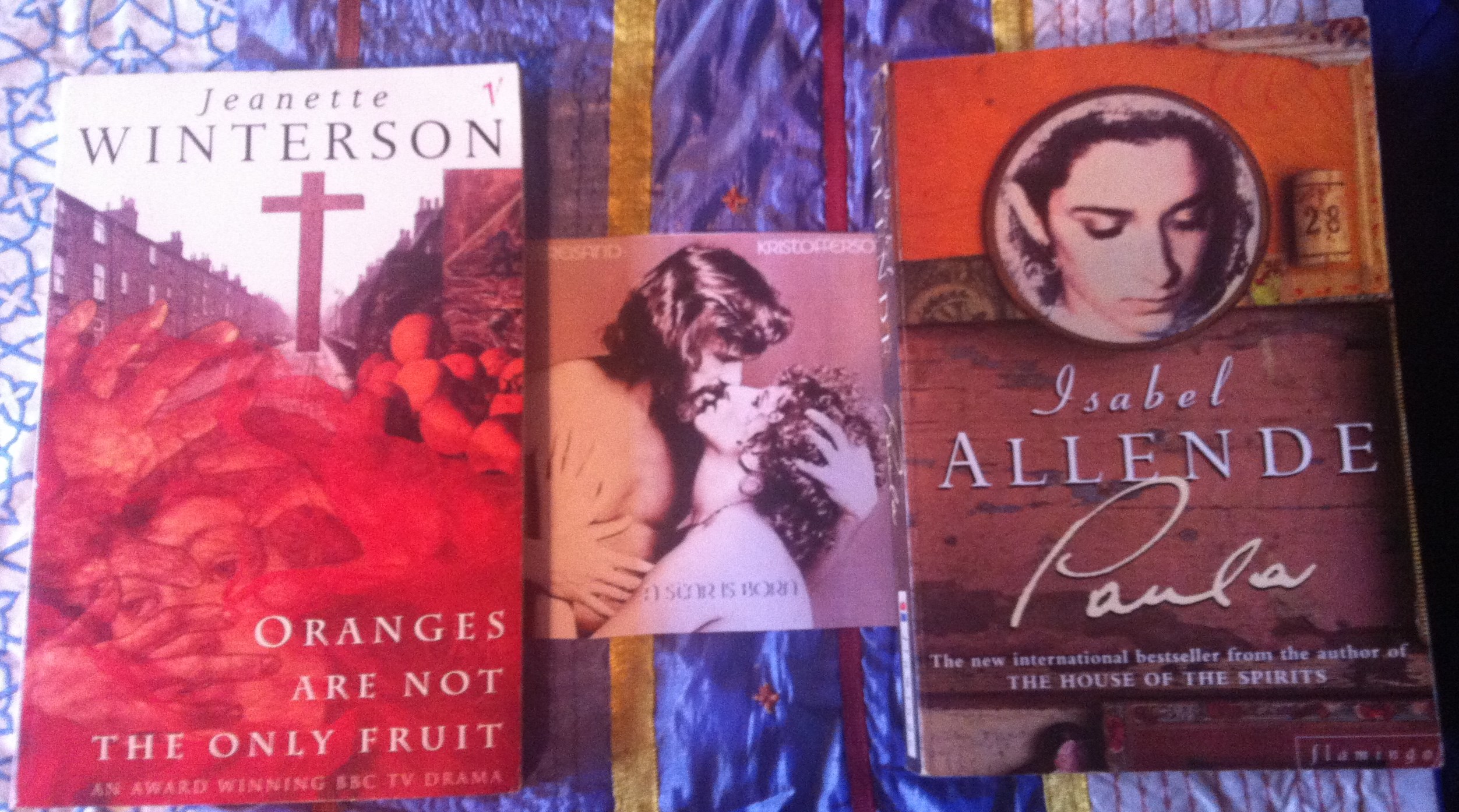
Here are the books alongside the gorgeous Kris.  To my mother I say, Happy Mother’s Day, Maman, and I hope titling this post with a quote from your beloved Oscar compensates for my insistence on presence of Mr Kristofferson.  And yes, I am planning a substantial cheese plate for the meal tomorrow, don’t worry….

Image