I really enjoy poetry, from ancient to contemporary, but I often neglect to pick it up. So MARM was a perfect opportunity to get back to reading it, as I had a copy of Atwood’s volume Dearly (2020), with its striking cover of iridescent feathers, in the TBR.
Dearly was written between 2008-2019 and includes a lot of Atwood’s enduring concerns: the natural world; the destruction of the planet; power structures that are imposed on others. There is also consideration of aging and death, and the volume is dedicated in absentia to her partner of many decades, Graeme Gibson, who died in 2019.
Atwood’s poetry is so accessible. She is an acute observer which suits poetry, and she conveys this without impenetrable allusion or obscure metaphor. In Salt she layers a series of images in evoking the past:
“Once in a while there was a pear or plum
or a cup with something in it,
or a white curtain rippling, or else a hand.
Also the mellow lamplight
in that antique tent,
falling on beauty, fullness,
bodies entwined and cherishing,
then flareup, and then gone.”
It was her consideration of aging and loss which appealed to me most in this volume, and there are some beautifully tender poems, full of love without sentimentality. In Blizzard:
“My mother, sleeping.
Curled up like a spring fern
although she’s almost a century.
I speak into her topmost ear,
the one thrust up like a wrinkled stone
above the hills of the pillows:”
And of course her titular poem, about shifts in language entwined with personal loss, which if you click the last link in this post you can hear her read. Her deep love for her life partner resonates throughout this volume, written before he died but filled with the anticipatory grief his dementia diagnosis gave rise to. Mr Lionheart in particular I found so moving, weighing what is being lost and what remains, for both the person with dementia and those who care for them:
“There’s birdsong, however,
from birds whose names have vanished.”
Before she concludes:
“Lions don’t know they are lions.
They don’t know how brave they are.”
What I haven’t captured here is Atwood’s characteristic wit and warmth, but rest assured it is here! There are poems that conclude with pithy lines, making me smile more than once. She is clever and funny and entertaining. Published just before she turned 81, in Dearly she is as engaged with the modern world and engaging as ever.
I found this essay about writing Dearly which includes Margaret Atwood reading the titular poem, so I highly recommend heading there for a read and listen.
I really wanted to get this posted in time, but those of you who read my previous post will know I’m currently getting over labyrinthitis. So the same disclaimer applies: please bear with me and apologies in advance for inadequacy/incoherence!
Old Babes in the Wood (2023) is a collection of short stories split into three sections. Tig & Nell contains three stories about the titular couple, My Evil Mother contains eight stories and the final section returns to Nell & Tig with four stories.
I find it hard enough to write about short stories even when my ears aren’t making life extremely trying, so I’m just going to focus on the final section for this post. The Nell & Tig stories explore what it means to be part of a long-established, now elderly couple and the challenges of aging, illness and bereavement.
These issues form a large part of my working life, and I thought Atwood nailed it with her characteristic insight, wit, compassion, and lack of sentimentality. I’m not one for biographical readings generally, but it is worth noting that Graeme Gibson, Atwood’s partner of 45 years, died in 2019 and Old Babes in the Wood is dedicated to him.
In A Dusty Lunch, Nell is sorting through Tig’s father’s belongings. The Jolly Old Brigadier – JOB – fought in the war and covered his PTSD with relentless joviality which didn’t quite fool anyone.
“The Brig had been shunted off to peacetime babysitting, a headquarters here, a headquarters there, a defence attaché in Washington decorating cocktail parties, but for what? Soldiers in peacetime are superfluous: celebrated once a year for something they once were, avoided in the here and now for what they have become.”
As Nell sorts through his belongings she realises the myriad stories that make up a life, and how many remain unspoken and therefore unrealised by even those closest to the person. She has no idea what to do with the deeply meaningful accoutrements of a life that hold no meaning for her, including the ghosts that haunted the Brig.
“What about the silent people, some alive, some dead, who sit in armchairs but aren’t really there, […] Because they’re part of it too.”
This will resonate with anyone who has had to sort through the material contents of another’s life. By placing it with the war generation, further emphasis is given to silent enduring traumas and the cost of choices made for domestic life in peacetime.
Widows is an epistolary episode, capturing the inadequacy of responses to the bereaved as Nell writes to her friend Stevie:
“You were always a well-meaning busy body. I don’t fault you for it – you have a kind heart, you are filled to the brim with good intentions, but I don’t want any casseroles or oblique, probing questions, or visits from professionals, or nieces talking me into buying an assisted-care condo. And no, I do not wish to go on a cruise.”
And really, responses can only ever be inadequate in the swirling disorientation of immense grief:
“Time has ceased to be linear, with life events and memories in a chronological row, like beads on a string. It’s the strangest feeling, or experience, or rearrangement. I’m not sure I can explain it to you.”
In Wooden Box, Nell is working out how to manage the demands of the everyday, when her whole life has been entirely disrupted by Tig’s death:
“It’s like being a student again: the same disorganisation and fecklessness and sudden bursts of intention, the same formless anxiety, the same bare bones meals. How easily she has slipped back sixty years, give or take: grazing, dubious leftovers, no ceremony.”
The titular box is one Tig made in school, with a few bits and pieces in it, which evade Nell as to their meaning. She is baffled and overwhelmed as to what to do with them, the box symbolic of her entire widowhood.
The final story which gives its name to the collection, Nell and her sister Lizzie are sorting through their childhood summer cabin, layers of memories alongside layers of dust and ancient belongings. In line with the fairytale title, Nell recognises her magical thinking, whereby Tig is both absent and ever-present.
“It’s an optical illusion, the retreating figure dwindling, growing smaller and smaller and then disappearing in the distance. Those retreating stay the same size. They aren’t really diminished, they aren’t really gone. It’s just that you can’t see them.”
Old Babes in the Wood is as accomplished as you’d expect. The collection overall is a varied one, including elements of sci-fi, fairytale and even whimsy (in The Dead Interview Atwood communes with George Orwell via Mrs Verity, a medium.) Atwood completely understands the form of whatever she turns her hand to. She always has something interesting to say and she does so with humane understanding.
To end, Margaret Atwood reading one of the earlier Tig & Nell stories, Morte de Smudgie:
This is the first of what I’m hoping will be two posts for Margaret Atwood Reading Month 2024 (#MARM2024) hosted by Marcie at Buried in Print, as I aim to read the two short story collections I have in the TBR.
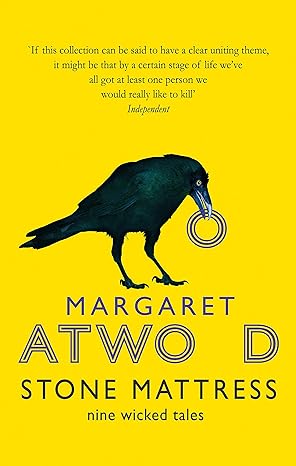
Stone Mattress: Nine Wicked Tales (2014) turned out to be perfect autumn reading with its edge of darkness, verging on Gothic at times.
The first three tales are connected. Alphinland sees fantasy writer Constance negotiate heavy snow after the death of her husband; in Revenant, the poet she loved in her youth, Gavin, tries to manage the frustrations and isolations of older age; in Dark Lady one of his lovers with whom he cheated on Constance is back living with her twin brother.
All of these are grounded in reality, but Atwood weaves through touches of unreality to destabilise any certainty the reader has about what is being portrayed. Constance’s fantasy world is entirely real to her, and there are hints that it is an effective means of controlling people. But is this psychological or metaphysical?
“How did he manage to work his way out of the metaphor she’s kept him bottled up in for all these years?”
Atwood’s portrayal of Constance and Gavin allows for some light satire as to the vagaries of literary trends, and the uses writers make of their art. Gavin enjoyed the male privilege of 1960s bohemianism and is disappointed that the world has moved on alongside his aging body:
“His regret is that he isn’t a lecherous old man, but he wishes he were. He wishes he still could be. How to describe the deliciousness of ice cream when you can no longer taste it?”
Dark Lady portrays the life of an aging muse, using the Shakespeare reference to make Jorrie a slightly ghoulish presence. As her brother Tin reflects on her appearance:
“at least he’s been able to stop her from dyeing [her hair] jet black: way too Undead with her present day skin tone, which is lacking in glow despite the tan-coloured foundation and the sparkly bronze mineral-elements powder she so assiduously applies, the poor deluded wretch.”
“He has to keep reminding her not to halt the sparkly bronze procedure halfway down her neck: otherwise her head will look sewed on.”
Gavin’s nostalgia for the sexual politics of the 1960s is given further short shrift in the titular tale. I was delighted to learn that the idea came about on an Artic cruise, where Atwood’s late husband started to work out how to murder someone on a ship and get away with it. Atwood decided to finish the tale and the logistical details are closely observed.
All the tales are memorable, and the collection finishes on one that feels truly terrifying as an external threat builds towards vulnerable people in a nursing home. Like the tales that have preceded it, Torching the Dusties is touched with the fantastical while staying rooted in the recognisable. Wilma has Charles Bonnet syndrome, hallucinating due to her failing eyesight:
“she locates the phone in her peripheral vision, ignores the ten or twelve little people who are skating on the kitchen counter in long fur-bordered velvet cloaks and silver muffs, and picks it up.”
Atwood relentlessly builds the tension in the tale, ending it on a jovial note that is brilliantly inappropriate.
There’s so much here for Atwood fans to enjoy: the sharp observations (particularly on ageing), the wry societal commentary; the mischievous humour, and of course the fierce intellect. She’s clearly having fun here and encouraging her readers to have fun too. I’m looking forward to the other collection I have to read, Old Babes in the Wood (2023).
For a few years now, despite my best intentions, I have entirely failed to take part in Margaret Atwood Reading Month (MARM) hosted by Buried in Print. This year I was determined to do better and I’m delighted it meant that I finally plucked Hag-Seed (2016) from the TBR.
Hag-Seed is Margaret Atwood’s retelling of The Tempest as part of the Hogarth Shakespeare Project. It’s my favourite of Shakespeare’s plays and I can be a bit precious about such endeavours, but I thought if anyone is up to the task it would be Margaret Atwood. The Tempest is such a complex play, and really quite horrible in many ways, but with fairies and magic occurring too. It’s quite a balancing act.
I realise this is probably the least controversial position I could take, but here it is: Margaret Atwood is absolutely and completely brilliant at what she does. From the start of Hag-Seed I was drawn in because she knows how to tell a compelling story, and write it with such skill. In Hag-Seed, she never loses sight of her source and there are enough references to keep Shakespeare nerds like me happy; but at the same time you could read it not knowing The Tempest at all and the novel would stand entirely on its own.
Felix Phillips is the artistic director of the Makeshiweg Theatre festival. He runs it with the help of Tony:
“Finding the money had been Tony’s thing. A lesser thing: the money was only a means to an end, the end being transcendence: that had been understood by both of them. Felix the cloud-riding enchanter, Tony the earth-based factotum and gold-grubber. It had seemed an appropriate division of functions, considering their respective talents. As Tony himself would put it, each of them should do what he was good at.
Idiot, Felix berates himself.”
Felix is alone in the world, his wife having died in childbirth and his beloved daughter Miranda following her aged three. When Tony conspires to oust Felix, no-one stands in his way, least of all the Minister of Heritage, Sal O’Nally:
“The Sound of Music, said Sal. Cats. Crazy for You. Tap dancing. Things the ordinary person could understand. But the ordinary person could understand Felix’s approach perfectly well! What was so difficult about Macbeth done with chainsaws? Topical. Direct.”
Atwood has a lot of fun with references to Felix’s outlandish productions, both those past and The Tempest he was planning to stage before Tony’s takeover. As someone who has sat through many … interesting … theatrical choices over the years I really enjoyed these brief asides.
Felix disappears to a rurally isolated shack to lick his wounds and prepare his revenge, with only the ghost of his daughter for company:
“She never asked him how they came to be there together, living in the shanty, apart from everyone else. He never told her. It would have been a shock to her, to learn that she did not exist. Or not in the usual way.”
His ‘most auspicious star’ arrives in the shape of Estelle – lover of sparkly earrings and someone who wields enough power to help Felix direct his fate. She gets him a job under the pseudonym of Mr Duke, putting on productions with a cast from Fletcher County Correctional Institute, using actors with stage names like 8Handz, WonderBoy, and Shiv. After a few years, Felix is ready to enact his revenge.
“We’re doing The Tempest, he said.
‘Oh,’ said Estelle, dismayed. He knew what she was thinking: way too gay.”
Like Prospero in The Tempest, Felix remains a problematic protagonist. He drives the action by using people, consumed by his own vision of revenge. The prisoners are not fully realised characters and I think this is deliberate. Although Hag-Seed is narrated in the third person, it’s all from Felix’s point of view and for him the prisoners are, in the main, a means to an end.
One aspect Atwood didn’t explore is the role of Caliban and post-colonial readings of The Tempest. Caliban can really dominate productions alongside Prospero, but in Hag-Seed his character – or equivalent character – is not a focus. Ideas often explored in productions now around colonisation and slavery were not present. There is some racism from Felix in his casting notes, but the fact that the prisoners are a much more diverse group than the theatre world and politicians is pretty much left alone. Perhaps she felt there wasn’t space, and for the sake of a tight narrative she had to pick a focus.
Atwood brilliantly builds towards Felix’s vengeful denouement and I found it tense and perfectly executed. The ending of the novel follows that of the play by containing almost as many questions as it resolves, yet it was ultimately satisfying.
“Fear can be very motivating. Sea-changing, you might say.”
Hag-Seed isn’t just a clever reworking of scenes and structure though, or word play and puns, as enjoyable as those are. I thought it captured the deep-rooted sadness in the play and the themes around the emptiness of revenge, the loneliness of humans, and the endurance of grief. It demonstrated how people can imprison themselves, and was truly moving to the final line.
There’s an interesting article by Margaret Atwood on writing Hag-Seedhere.
“It’s the words that should concern you, he thinks at them. That’s the real danger. Words don’t show up on scanners.”
To end, Prospero’s Act IV speech that I never make it through dry-eyed:
This is my contribution to Margaret Atwood Reading Month, hosted by Naomi at Consumed by Ink and Marcie at Buried in Print. Do join in with #MARM!
As a teenager I fell in love with Atwood and read all her novels and short stories, most of her poetry and a collection of interviews. Then I’m not sure what happened, the MaddAddam trilogy didn’t appeal to me as much and I probably hadn’t read any Atwood since The Blind Assassin in 2000. In this year of my book-buying ban, I found I had two Atwoods in the TBR, so here they are.
Firstly, The Heart Goes Last (2015), my first Atwood in about 18 years, and from the first page I realised I needed her back in my life. She is such an accomplished writer that you know you’re in safe hands. She knows what she’s doing: the characters will be believable, the plot will carry you through, she has something important to say. What more could you want? This being Atwood, the story is terrifying, funny, and horribly believable.
Charmaine and Stan are living in their car. Time and place are unspecified, but there’s every reason to assume it’s now, in the United States. The recession has bitten and they have lost their jobs and their homes, along with many others. Poverty and deprivation have led to rising crime and they are at risk of violent attack. Unsurprisingly, their marriage is under strain:
“Charmaine says why don’t they go jogging? They used to do that when they had their house: get up early, jog before breakfast, then a shower. It made you feel so full of energy, so clean. But Stan looks at her like she’s out of her mind, and she sees that yes, it would be silly, leaving the car unattended with everything in it…and putting themselves at risk because who knows what might be hiding in the bushes? Anyway where would they jog? Along the streets with the boarded-up houses?”
Then one day, when Charmaine is working in a bar, she sees aa television advert for Positron. Positron offers a place to live and full employment.
“She can feel the griminess of her body, she can smell the stale odour coming from her clothes, from her hair, from the rancid fat smell of the chicken-wings place next door. All of that can be shed, it can peel off her like an onion skin, and she can step out of that skin and be a different person.”
Living in Positron means alternating one month in the town, one month in the prison called Consilience. Stan is from a tough background and his brother Con is a criminal. This means Stan is far from naïve, but he is also desperate:
“They’re like the early pioneers, blazing a trail, clearing a way to the future: a future that will be more secure, more prosperous, and just all-round better because of them! Posterity will revere them. That’s the spiel. Stan has never heard so much bullshit in his life. On the other hand, he sort of wants to believe it.”
Charmaine and Stan sign away their lives to the project – there’s no leaving once you’re in – and settle into their new lives. The aesthetic is an idealised 1950s Doris Day film, with surveillance. Gradually they both, in very different ways, begin to understand the dark side of the Positron project, and of each other.
“He hadn’t recognised it when they’d been living together – he’d underestimated her shadow side, which was mistake number one, because everyone has a shadow side, even fluffpots like her.”
The plot that develops is darkly comic, and deeply sinister. Needless to say, the uses of technology in Positron are not ethical, and the question is, where do you draw the line? The answers to this question become more and more murky as the novel progresses.
Charmaine and Stan are not always sympathetic but they are believable, including why they would sign their lives away. The rise of the far right in today’s politics can seem bewildering at best and terrifying most of time, but Atwood has Stan address the reason people support their freewill being circumscribed, in no uncertain terms:
“Not that he gives much of a flying fuck about freedom and democracy, since they haven’t performed that well for him personally.”
There’s also a great deal about gender politics in The Heart Goes Last. I can’t say too much about it for fear of plot spoilers, but I greatly enjoyed this pithy observation by Charmaine when she’s taken out for dinner by a powerful man who wants to seduce her:
“She blots the corner of her eye, folding the trace of black mascara up in the serviette. Men don’t like to think about makeup, they like to think everything about you is genuine. Unless of course they want to think you’re a slut and everything about you is fake.”
The ending is perfect: a twist that shows in miniature the broader themes of the novel, ending with an unresolved question for a character and the reader. It doesn’t allow a comfortable feeling of being in a better, wiser position than the characters but instead asks: when faced with a moral dilemma, do you really know what you would do?
Secondly, The Penelopiad (2005), a novella (hooray!) in which Atwood retells the story of Penelope, faithful wife of Odysseus (part of Canongate’s Myth Series). Penelope narrates the story from Hades. She was the faithful wife of Homer’s myth, but also had her eyes wide open with regard to her warrior husband:
“Of course I had inklings, about his slipperiness, his wiliness, his foxiness, his – how can I put this? – his unscrupulousness, but I turned a blind eye. I kept my mouth shut; or, if I opened it, I sang his praises. I didn’t contradict, I didn’t ask awkward questions, I didn’t dig deep. I wanted happy endings in those days, and happy endings are best achieved by keeping the right doors locked and going to sleep during the rampages.”
This captures much of the themes of The Penelopiad, that is, that Penelope’s feelings for her warrior husband are not straightforward, and also, that the story of events depends on who is doing the telling, what they leave in and what they miss out. The Odyssey is a cornerstone of Western civilisation, but it is not the only version. Penelope’s Odysseus is a wily cheat, far from heroic. Helen is a vain bitch:
“Of course, she was very beautiful. It was claimed she’d come out of an egg, being the daughter of Zeus who’d raped her mother in the form of a swan. She was quite stuck up about it, was Helen.”
When Odysseus is away fighting the Trojan War, Penelope runs his estates extremely well and keeps her suitors at bay. Her son Telemachus is a brat and Penelope feels more kinship with her 12 maids, many of whom she has known since they were babies. The maids form a Greek chorus throughout the story, speaking in verse between chapters. We know that Telemachus will kill them all on his father’s return, and Atwood is intrigued as to why these powerless (poor, female) people are treated so brutally:
“Let them dangle, let them strangle –
Blame it on the slaves!”
Penelope is shown as having to carefully navigate a position that sees her wealthy but powerless, having to pick her way through a minefield of social constraints that could see her branded a whore in her husband’s absence. Her faithfulness is not out of loyalty to Odysseus but self-preservation in a patriarchal society.
There are massive themes in this novella and they are as relevant as ever when the most powerful man in the world has a constant refrain of ‘fake news!’. By the end of The Penelopiad Penelope is shown to possibly not be a reliable narrator, but then, is anyone? Don’t we all have our own versions? Atwood reminds us that for each story told, it is worth considering what gain is to be made. And she does so with irreverent glee:
“Who is to say that the prayers have any effect? On the other hand, who is to say they don’t? I picture the gods, diddling around on Olympus, wallowing in the nectar and ambrosia and the aroma of burning bones and fat, mischievous as a pack of ten-year-olds with a sick cat to play with and a lot of time on their hands.”
Taking part in #MARM has made me check Atwood’s bibliography to see what I’ve missed: I’ve still got her three most recent short story collections, Hag-Seed and the MaddAddam trilogy to catch up on. I’m really grateful to #MARM for reminding me just how much I love her writing and giving me my Atwood impetus back again!


 madame bibi lophile recommends
