I really enjoy Margery Sharp’s comic eye, and there’s a perfect example early in this novel in a description of the family’s Sealyham:
“His shaggy eyebrows and meditative gaze gave him an old-gentleman look; he sat there like a retired Colonel, newspaper laid aside, contemplating Socialism.”
The terrier’s family are hodgepodge: widowed fifty-five year old Isabel Brocken, “sentimental, affectionate, uncritical,” and her priggish brother-in-law Simon:
“Mr Brocken was not conceited enough to perceive in himself any compensating charms. To be loved without reason did not flatter him. He put up with Isabel’s affection, as he put up with Isabel, because he had to.”
As well as two younger people staying at the house: Isabel’s nephew Humphrey and her companion Jacqueline, both recovering from the recent war.
This unlikely group live a life of very little strife, ensconced in Isabel’s old family home of Chipping Lodge, sat in a suburb of London which escaped the bombs. (Unlike Simon’s house which is why he finds himself having to tolerate other people, while it is rebuilt.)
Keeping them in domestic order are the self-contained housekeeper Mrs Poole and her teenage daughter Greta.
Their domestic peace is shattered when Isabel invites her old school friend Tilly Cuff to stay indefinitely. The motivation stems from a perceived injustice she did to Tilly years ago, and a plan to make amends. For Tilly does not seem to have thrived:
“No-one ever fell in love with Tilly, not even curates.”
Simon, Humphrey and Jacqueline are horrified. Firstly by Isabel’s plan to leave Tilly all her money, and secondly by Tilly herself:
“Is she to be allowed to beggar herself for the sake of a peculiarly offensive incubus?”
Sharp is always good at villains without caricature, and Tilly is a perfect example. She is manipulative and mendacious, particularly towards Greta Poole. It is Greta and her mother that provide the greatest emotional engagement in the novel: Tilly’s treatment of them shows her to be a real threat, and Simon’s attitude towards them shows him not to be irredeemably hard-hearted.
Yet Tilly is also shown to be vulnerable, lonely and defensive. Although she is powerful in her ability to completely destabilise the entire household, really she has less resources, personal and financial, to draw on than anyone else.
I found The Foolish Gentlewoman to be a surprising page-turner, as I wanted to see how the household would escape Tilly! And yet, things didn’t quite pan out as I expected. Sharp has fun with confounding reader’s expectations:
“To set one’s foot on a tragic stage, and find that the part thrust into one’s hand belonged to a domestic comedy: to read on, and perceive in prospect a crisis after all potentially tragic: to turn the last page upon anticlimax. How inartistic, and yet how life like!”
Yes, anti-climatic in a sense, but wholly satisfying and enjoyable. I particularly liked the happy ending arranged for Simon:
“With no less than five persons had Mr Brocken narrowly escaped, if not intimacy, a degree of acquaintance that would have allowed any one of them to become a nuisance to him.”
A gentle joy made readily available thanks to the excellent Dean Street Press and Furrowed Middlebrow.
So my plan is to post on one book a day as this wonderful event is running all week. However, various bloggers suggestions of what to read in the meantime made me realise I’d missed some, so my best laid plans may well change! The start of the week is sorted, but the end of week could well be subject to alteration 😀
Today I’m starting with Margery Sharp, whom I adore, so I’m delighted that the 1937 Club has prompted me to pick up The Nutmeg Tree.
Sharp’s insightful but gentle, humane comedic tone is perfectly realised in Julia, a woman we meet taking a bath for as long as it takes the bailiffs to leave. Once they do, she hurriedly heads off to France at the behest of her daughter Susan, whom she hasn’t seen since she was a toddler.
“Those nineteen months of being young Mrs Packett had exhausted her supply of maternal affection; and she was also aware that for a young child the life at Barton was far more suitable than the life she herself looked forward to, in Town. She hadn’t yet any definite plans about it, but she hoped and trusted that it would be very unsuitable indeed.”
Susan has been raised by her paternal grandparents after her father died in World War I. She is a Proper Young Lady, while Julia has led a ramshackle life, entirely of her choosing. Now Susan wants to get married, her grandmother doesn’t approve, and Susan has called in Julia for reinforcements.
She arrives in France having become semi-engaged to an attractive trapeze artist on the way there. Julia is completely delightful and while she doesn’t always behave honourably, she does behave warmly. She understands and enjoys people. Her daughter is almost the polar opposite:
“Julia, who could get intimate with a trapeze artist after five minutes conversation – who was intimate with the salesman after buying a pair of shoes – had talked for an hour to her own daughter, about the girl’s own father and lover, without the least intimacy at all.”
As with The Stone of Chastity, I was struck by Sharp’s liberal attitude towards sex. As far as I know she wasn’t a controversial author, so maybe attitudes like this were more prevalent in the 1930s than I’ve allowed for:
“If she took lovers more freely than most women it was largely because she could not bear to see men sad when it was so easy to make them happy. Her sensuousness was half compassion”
However, safe to say Susan would not share that view. She is, her mother realises, “a prig”. “Strong on logic, weak on human nature.” Susan is entirely inflexible. It becomes apparent that no-one particularly likes her, though she is loved and admired. Sharp is too subtle to demonise Susan though, or make her a villain. She is a not an unpleasant person, but just someone who is better suited to ideas and projects than to the realities of human society and all its complexities.
“‘It takes all sorts to make a world,’ thought Julia. But it was no use saying that to Susan.”
Meanwhile, Susan’s lover Bryan is, Julia realises, more like Julia herself. Convinced he will make Susan very unhappy, she wonders how on earth to maintain her fragile reconciliation with her daughter while not encouraging the match. As if this weren’t enough to contend with, another love interest arrives for Julia…
Sharp has all this play out with great comic pacing. I enjoyed the broader running jokes, whereby her mother-in-law Mrs Packett is convinced Julia owns a cake-shop despite absolutely no evidence of this, and proceeds with organising an entire business plan; and Julia’s continued attempts to impress people and pretend she is other than she is, by reading The Forsythe Saga – no-one is fooled and no-one cares.
The older Mrs Packett is only a secondary character, but I thought she was wonderful and wished Sharp had given her a novel to herself:
“It seemed to her more likely that her mother-in-law was of the type, not rare among Englishwomen, in whom full individuality blossoms only with age: one of those who, at sixty-one, suddenly startle their relatives by going up in aeroplanes or by marrying their chauffeurs.”
The Nutmeg Tree is not a fluffy read though. There’s a strong theme around choices – or lack thereof – for single women without money. Julia has moments of real despair, Bryan reveals a really quite vicious side to himself, and I was very struck by this paragraph about dating soldiers home on leave from the war:
“You could be dining out with a man, having a perfectly lovely time, and suddenly across the room he would catch another man’s eye, or a man would pause by your table, and all at once they were somewhere else and you were left behind. It had seemed as if war were a sort of fourth dimension, into which they slipped back without even noticing, even out of your arms… so you never really knew them”
The Nutmeg Tree is a wonderful character study set within a well-paced comedy. In Julia, Sharp has created a well-rounded, wholly believable chancer, who the reader roots for because she is entirely without malice. Margery Sharp really is a joy.
To end, The Nutmeg Tree was adapted as Julia Misbehaves in 1948. Has anyone seen it? From the trailer it looks like it could be fun:
I had such a book hangover after Bleak House. I couldn’t settle to anything. A friend of mine who loves a certain 80s singer has a phrase when she hears other warblers: “He’s alright, but he’s not George Michael.” Well, I kept picking up books that were alright, but they weren’t Bleak House. So few books are, I find…
Then I remembered that when Simon did his books of the year round up last year, I’d recognised two were on my TBR pile. Surely books good enough to make the final cut would see me right? Of course they did 😊 Hooray for bloggers and their brilliant recommendations!
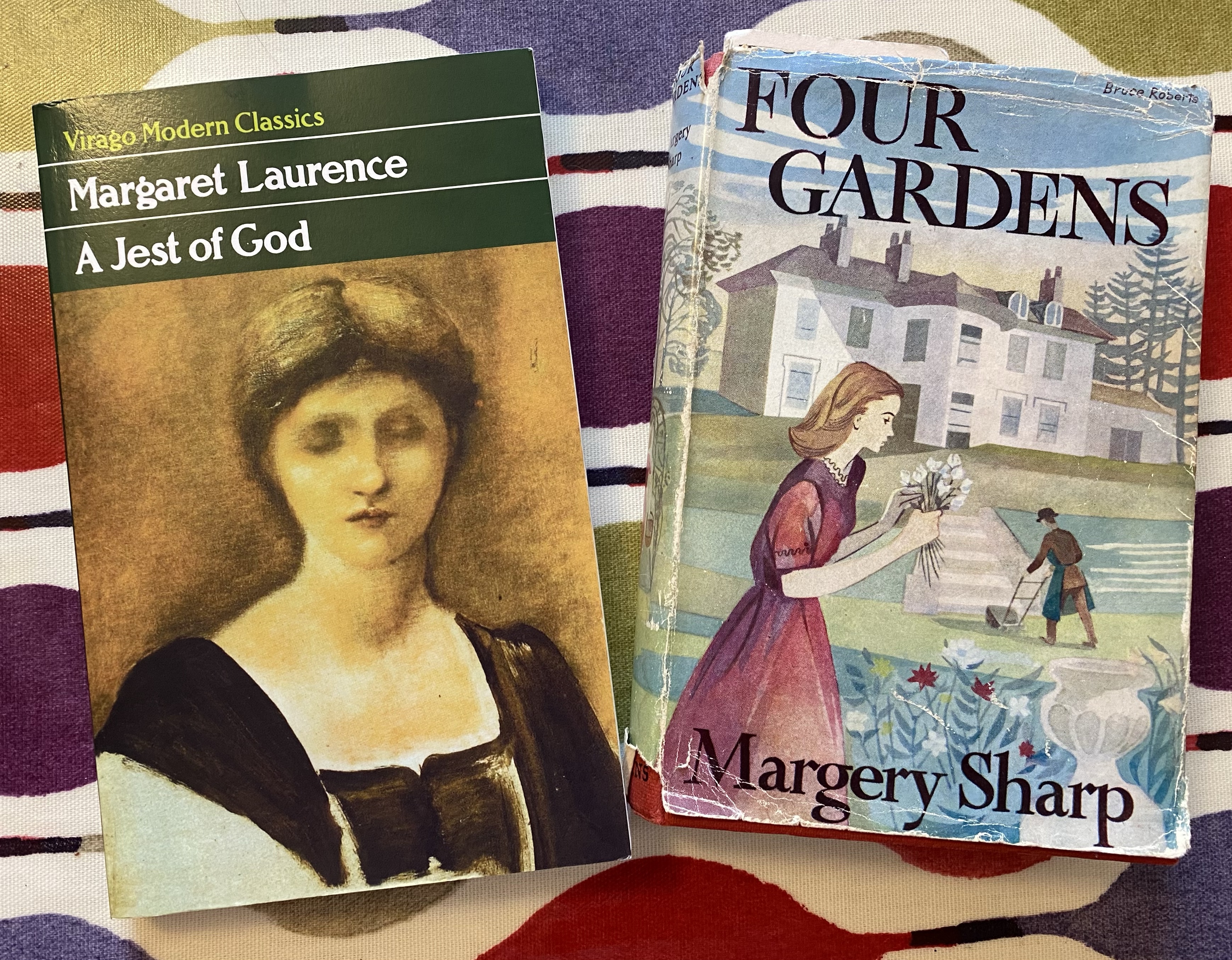
Firstly, the novella which made the top of Simon’s list, A Jest of God by Margaret Laurence (1966). This was the second in Laurence’s Manawaka sequence, but thankfully they can all be read as standalones as I’d not read anything by her before. On the strength of this, I’ll definitely be seeking out her writing again.
A Jest of God is an intimate character study of Rachel Cameron, a thirty-four-year-old teacher who lives with her emotionally manipulative mother above the Manitoba funeral business her father ran until he died.
The novel is narrated in the first-person, and Rachel’s mind is an oppressive and tense place to be. She is highly anxious and self-censoring:
“There. I’m doing it again. This must stop. It isn’t good for me. Whenever I find myself thinking in a brooding way, I must simply turn it off and think of something else. God forbid that I should turn into an eccentric. This isn’t just imagination. I’ve seen it happen. Not only teachers, of course, and not only women who haven’t married. Widows can become extremely odd as well, but at least they have the excuse of grief.”
This anxiety and second-guessing is not helped by her mother’s behaviour, which is self-pitying, judgemental and highly manipulative. Rachel recognises this, but is at a loss as to how to extricate herself:
“Her weapons are invisible, and she would never admit even to carrying them, much less putting them to use.”
“All such words cling to the mind like burrs to hair, and I can never seem to brush them away, as I know I should do.”
Rachel’s mother is not an out-and-out baddie though, and Laurence expertly demonstrates the vulnerability and fear that underlies her machinations. Similarly, Rachel does not always behave well. In one particular scene early in the book, she actually behaves despicably and doesn’t make amends despite her instant remorse. She is a complex, contradictory character, wholly believable. Laurence treats her tenderly but unflinchingly; without judgement but also without sentiment.
Rachel could so easily be a stereotype: a lonely single woman, living with her mother. But Laurence side-steps clumsy characterisation, or easy dismissal of Rachel, by delicately exploring the true meaning of the adjective so often attached to unmarried women approaching middle-age: she is desperate. She is absolutely desperate and despairing. She is lonely, and feels trapped in the life she has always known, with no way out. She wants things to be different, but she doesn’t know how. She is deeply, existentially sad.
1966 is a time of societal change, when women like Rachel could feel stifled by convention and also have some sexual freedom. So when Nick, and old schoolfriend appears, there are brief moments of physical connection. But in only seeing things from Rachel’s point view, the reader is able to realise how little intimacy there is. And that is what Rachel needs, more than the sex which Nick offers. Yet she doesn’t know how to achieve this:
“I talk to him, when he is not here, and tell him everything I can think of, everything that has ever happened, and how I feel and for a while it seems to me that I am completely known to him, and then I remember I’ve only talked to him like that when I’m alone. He hasn’t heard and doesn’t know.”
In some of Nick’s reported speech, the reader picks up on things Rachel ignores. She is so bound in her own intense feelings, she can’t really hear the cues Nick gives, over her relentless inner voice.
“He’s thirty-five, not fifteen. His past such gauche public performances. What he worried about Rachel? I’m not worried. I’m perfectly alright. Well, relax, then. I am relaxed. Oh? Shut up. Just shut up.”
A Jest of God is such an accomplished novel that is also so approachable. I found Rachel’s voice got under my skin very quickly and distinctly, and I had to read on. I think it works very well as short novel, longer would have been too oppressive and difficult to sustain I suspect. But at the length it is it remains powerful and impactful, and not as depressing as I’ve made it sound!
Ultimately there is resilience and change for Rachel, even some defiance. And there are brief moments of humour, such as Rachel trying to duck her colleague Calla’s constant invitation to attend Tabernacle with her:
“At least I have postponed it, and perhaps by that time some reasonable excuse will come along, or I’ll be dead.”
A stunning novel: a precise and compassionate character study, clever and humane. I’m so glad to have discovered Margaret Laurence at long last.
“Something must be the matter with my way of viewing things. I have no middle view. Either I fixed on a detail and see it as though it were magnified – a leaf with all its veins perceived, the fine hairs on the back of a man’s hands – or else the world recedes and becomes blurred, artificial, indefinite, an abstract painting of a world.”
Secondly, after being in Rachel’s head, I looked forward to some comic relief from an author I always enjoy: Margery Sharp. Four Gardens (1935) was number ten in Simon’s list. But this wasn’t as comic as some of her other novels; it had a slightly elegiac tone and the relationships included a certain sadness. But it wasn’t a sad novel overall, and I sunk into Four Gardens with pleasure.
Four Gardens follows the life of Caroline Chase from late teens to middle-age and the titular spaces she finds herself in. The device with gardens isn’t remotely heavy-handed and for a significant section of the novel they barely feature. But Caroline is a gardener, given half a chance, and it is instinctive and natural to her:
“Her step, as she now redescended to the rose garden, was therefore a proper gardeners tread – slow, considerate, with long abstracted pauses for survey and meditation. She also, without thinking, removed her hat and gloves.”
This is her first garden, one she trespasses into, and as she meets her first love there, it has a dreamlike quality. Perhaps this is why her love of gardening is so easily disregarded when she leaves behind youthful folly to marry the determinedly sensible Henry:
“For all these things in themselves – love at first sight, undying devotion, and general aloofness – were very exciting indeed; it was only in connection with Henry that they became so curiously prosaic.”
And so for many years Caroline doesn’t garden at all. She runs a house and she raises her son and daughter in the town where she has always lived. She is the creator of a safe space for her children and an unwavering routine for her staid but affectionate husband.
Despite the love she feels for her family and the tranquillity of her home life, I did find an element of melancholy to Caroline’s domestic arrangements. Her family are near and dear, but there seemed to be very little intimacy: she and Henry rarely communicate about anything beyond practical considerations, and she doesn’t really understand her children at all. She also despises her closest friend in the village, Ellen Watts – a monstrous and wholly believable creation. Caroline reflects very little though, and so any concerns are quickly subsumed in the relentless demands of domesticity:
“Thinking – the deliberate exercise of the brain – did not come naturally to her.”
But I wouldn’t want to give the impression that Four Gardens is ponderous or heavy-going in any way. It felt quite a realistic presentation of Edwardian contentment, though not without Sharp’s gentle jibes, such as this discussion of wallpaper where Caroline evokes her husband’s approval to counteract her mother’s reservations:
“Mrs Chase was at once silenced. […] It would have seemed perfectly reasonable to her that Caroline, who was in the house all day, should have suited her surroundings to the taste of a man who was out of it.”
I did want Caroline to exert herself in some way, to stake a claim beyond her roles meeting everyone else’s needs. Finally she does it, when she starts growing runner beans during World War I, and realises how much she is nurtured by time with her plants:
“there was usually a quiet space, between twelve and half-past, when the first work of the house was finished and before the children’s dinner became a pressing consideration; and these thirty minutes Caroline began to guard and cherish as a precious treasure.”
The war years are beautifully evoked by Sharp, with all their worry alongside self-serving censorious behaviour of some in the village. After the war, everything changes. Caroline finds herself mistress of a large house, with a garden she can’t touch unless she wants to incur the wrath of a succession of gardeners:
“The garden was looking well. But it always did look well, and gave her no special pleasure […] It was perfectly designed and perfectly kept, and to Caroline completely uninteresting.”
Meanwhile, her children are vaguely affectionate, patronising strangers. They change the names she loves, Lily becoming Lall and Leonard, Leon. They are academically accomplished and having had money their whole lives, utterly contemptuous of it. These Bright Young Things live by a morality that is absolutely baffling to Caroline, and there is a lovely echo of an earlier scene between Caroline and her mother in a later conversation between Caroline and Lall. The reader can see they are so much more alike than either realises, dramatic irony at its lightest.
I’m not one for biographical readings of novels but something of the tone of Four Gardens – affectionate, gentle, slightly sad – did make me consider the dates. In Caroline, Sharp is writing about her parents’ generation, so maybe that explains it… or maybe it has nothing to do with it at all, who knows?
Caroline’s fourth garden finally sees her able to do as she pleases. I couldn’t help feeling she might really surprise her children, and herself 😊 A warm, engaging story of a woman’s outwardly ordinary adult life during great societal change.
To end, Paul Newman adapted A Jest of God as Rachel, Rachel for his directorial debut. This very odd trailer doesn’t make it seem overly appealing:
This week sees the arrival of the 1940 Club reading event, hosted by Kaggsy and Simon.
I always enjoy the Club weeks and this was no exception, as I’ve used the opportunity to read one of my favourite authors, Margery Sharp, and her comic novel The Stone of Chastity.
This short novel is immensely silly which, it is safe to say, is precisely the point. Professor Pounce has come across mention of the titular object while trying to duck out of a bridge game, and is entirely fixated on locating it and testing it (unchaste women fall off the stone – of course there’s no such test of virtue applied to men.)
He arrives in the village of Gillenham to stay for the summer, with his endlessly patient sister-in-law Mrs Pounce and feckless nephew Nicholas, plus the mysterious and glamorous Carmen, whose role is undefined and therefore treated with suspicion by some of the villagers.
The opinion of the villagers and the potential discord caused by a chastity test is something Nicholas is all too aware, but of which the Professor remains blissfully aware.
“Wobbling down the road next morning, on a borrowed bicycle with the bundle of questionnaires stacked in its carrier, Nicholas Pounce felt himself to be, both literally and figuratively, in a very precarious position.”
Of course Nicholas is right, and while the villagers don’t react in quite the way he expects, react they do.
Mrs Crowner, the vicar’s wife, has concerns: “It is a deliberate attempt to arouse Pagan memories.”, while her husband maintains a benign indifference. The moral indignation is left to fall to Mrs Pye, who unfortunately for the Professor does wield some power:
“He simply could not get his uncle to grasp the unpalatable fact that a scientific investigation into a renascent Norse legend might have a direct effect on the supply of milk and cream and butter and eggs.”
The delightfully named Mrs Thirkettle seizes the opportunity to proclaim possession of the stone and sell it to the Professor. Meanwhile Mr Thirkettle, through convoluted means, manages to get a day out the likes of which he’s never seen, and ongoing free beer at the local pub.
Arthur Cockbrow’s seduction of his maid hits a major bump in the road as she starts to refuse his advances, given that the Professor’s work is something to do with the powers that be (it isn’t):
“He could not understand it at all. His pursuit of Sally had lasted a full two weeks – quite long enough to satisfy her pride – and had never looked in the least hopeless. And now in some mysterious way the Government had stepped in! The Government! It was lunatic!”
Sally is not alone, as other single women in the village start to see the tactical benefit of keeping suitors at arms’ length: “The professor’s questionnaire had done several unexpected things, and one of them was to promote a hitherto impossible female trade unionism.”
There’s no doubt that the portraits of the villagers are a bit yokely and dated. But not nearly as much as I pessimistically anticipated, and Sharp never really suggests that the Pounces are in any way superior. Professor Pounce is ridiculous, Nicholas hopelessly naïve and self-focussed. The villagers are certainly savvy, and there’s also some truly touching scenes between Mr and Mrs Jim who own the pub and are shown to have an affectionate and loving relationship.
Everyone is treated with a light comic touch, and the characters gently ribbed for their human foibles, without any suggestion that the author or reader should consider themselves above such behaviour.
It’s a short novel and there’s some plot around Nicholas’ love life, the entanglements of the villagers, and the move towards the inevitable chastity testing – will anyone volunteer?
“The fateful morning dawned misty, with a promise of heat. By 10 o’clock the mist had melted into thin streamers. By noon the sky was a clear and cloudless dome of blue. It was a perfect day for testing chastity.”
I was really surprised by the attitude to chastity in a book written in 1940. There’s absolute acceptance of sex outside marriage to the extent it seems the norm rather than the exception. Unmarried women who aren’t virgins aren’t remotely judged, except by Mrs Pye and it’s clear she has her own reasons for doing so. Sharp seems to take the view that virginity is a social construct and pokes gentle fun at using it to attach any judgement towards human beings.
So mainly very silly indeed, but still with a point to make, particularly about the roles of women at the time. I found it delightful.
To end, a certain Madonna song would be the obvious choice. But I was in a shop a few days ago which was playing a truly dreadful version of this song, which only reminded me of the brilliance of The Pogues. So in honour of Mr Thirkettle’s legendary night on the tiles…
I’m a big fan of Margery Sharp and I enjoyed In Pious Memory a lot. It has her gentle sense of the ridiculous and her fond acceptance of human foibles to the fore, making it a solid comfort read.
It opens with the death of Arthur Prelude, a man who, while inoffensive, seems to have been a monumental bore to all who knew him personally, giving all his energies to his professional life.
“His giant intellect was housed in but an average body – indeed rather below average; average only in the sense of being unremarkable: all the more startling therefore was the effect when on rostrum or at banquet board he suddenly rose to his feet and let his intellect loose like a line from a mouse-trap. Mrs Prelude naturally never witnessed this transformation herself, she was always at home in the hotel bedroom sterilising his inhaling-apparatus with water boiled over a portable methylated-spirit stove; but other wives told her about it.”
His wife was utterly devoted, his adult children a lot more clear-sighted:
“‘Well. of course,’ said Elizabeth. ‘Mother’s of her generation. She behaved quite marvellously, after the crash, and if she’s been crying ever since, it’s only natural.’
‘As it’s natural for us to remain dry eyed?’
‘I suppose so,’ said Elizabeth. ‘After all we didn’t know father very well.’”
Despite Elizabeth and William’s resolution that “‘We must all be very kind to mother, and find her that flat in Hove at once.’”, their younger sister Lydia – determinedly romantic, and set for a career on the stage – decides her father is wandering around the Alps and needs to be found. In this endeavour, she enlists the help of her cousin Toby, and they go biking off across mainland Europe.
Meanwhile, Arthur Prelude is becoming a lot more likable in death than in life, as fictitious memories of his warmth and affection grow and take on a life of their own:
‘We should have lied to mother sooner,’ said Elizabeth.
‘How could we, while father was still alive?’ countered William.
Will Mrs Prelude be able to see past the false memories of her crashing bore husband towards new romantic opportunities? Will Lydia and Toby find Arthur wandering round the mountains in amnesiac shock? Will William get married and will Elizabeth avoid marriage? Absolutely nothing of serious consequence occurs, thank goodness.
In Pious Memory gently ribs questionable veneration of the dead and reminds us all to appreciate the now, imperfect as it may be.
You can read Simon’s thoughts on this novella here.
The 1954 Club is running all this week, hosted by Simon and Kaggsy. Do take a look at the posts and join in if you can, the Club weeks are always great events 😊
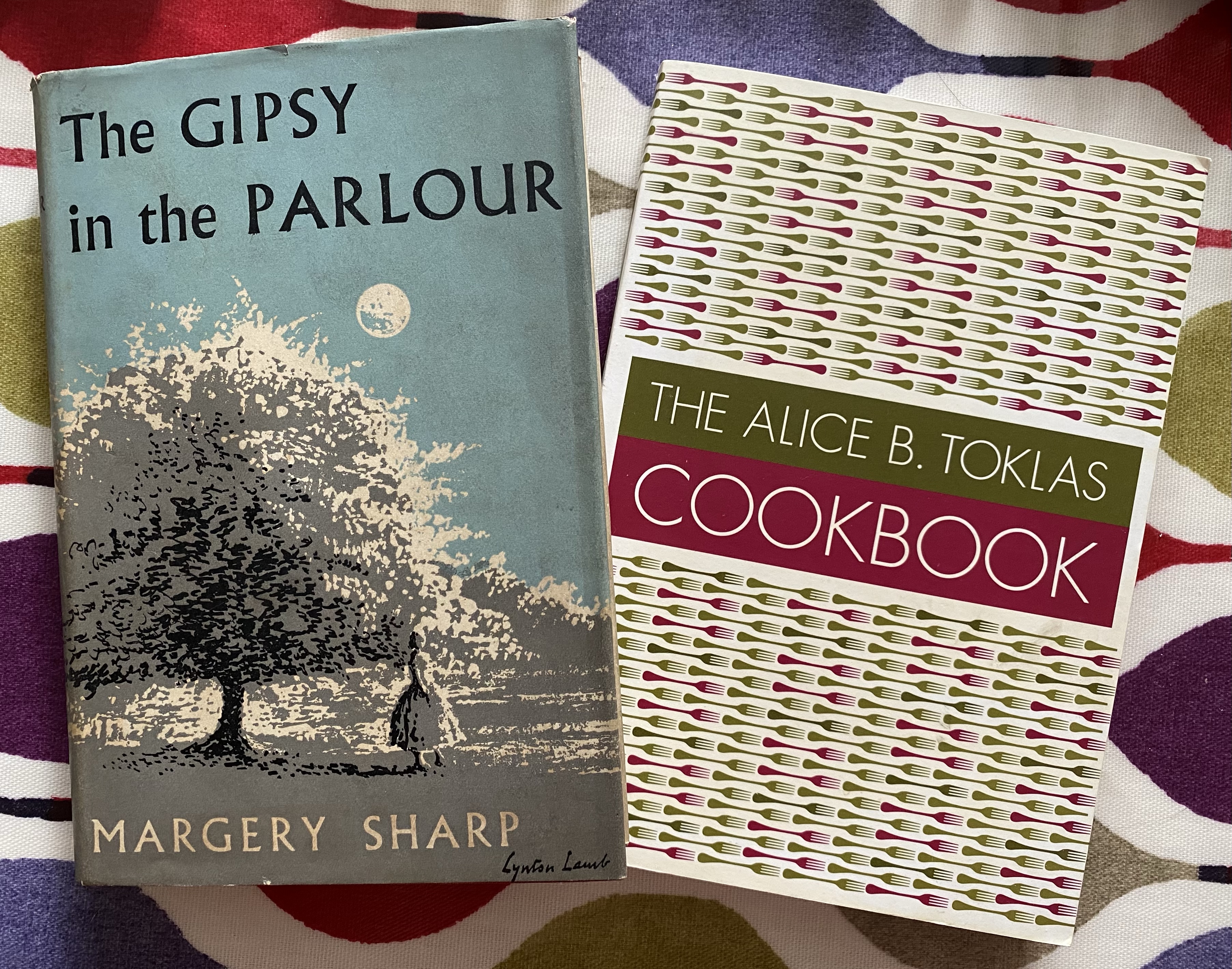
For this contribution, I thought I’d look at two books on a domestic theme. Firstly, The Gipsy in the Parlour by Margery Sharp. Despite the concerning title I can confirm while there is definitely dated language, it’s not prevalent throughout the novel.
The story is set in the 1870s and told from the point of view of an unnamed cousin of the family, looking back on her childhood as an adult now in the 1920s. This means Sharp manages a 11 year-old’s point of view without getting too caught by it, and it works well.
The child loves visiting her family in Devon, leaving behind the fog and grime of London for a West Country summer. She also leaves behind her cold, distant parents for her beloved aunts, Charlotte, Grace and Rachel. They have all married into the Sylvester family and form a capable team who run the domestic affairs of the farm with good-natured hard work.
“Nature had so cheerfully designed them that even wash-day left them fair-tempered: before the high festivity of a marriage their spirits rose, expanded and bloomed to a solar pitch of jollification.”
At the start of the novel they await the arrival of a fourth sister-in-law, who is going to marry Stephen Sylvester, the kindest of the male members of the family (who feature very little in the child’s world, due to their “effortlessly preserved complete inscrutability”). However, when Fanny Davis arrives, she is very different to the rest of the family – thin and pale rather than hale and hearty.
“She seemed to have nothing to say. She had neither opinions nor tastes. She hadn’t even an appetite. The amount she left on her plate would have fed a plough-boy – I believe often did feed a plough-boy”
The family know very little about Fanny “the most that could be discovered was a sort of shadow-novelette” but they welcome her in. However, it isn’t long before trouble strikes. Although Fanny attends a dance with family, whirling around quite happily, it isn’t long before she enters a Decline, and has to spend her days laying in the parlour.
The 11 year-old enlightens us:
“I knew a good deal about declines. A friend of my mother’s had a daughter who had been in one for years. Declines also occurred frequently in cook’s novelettes”
And
“No common person ever went into one. Common persons couldn’t afford to. Also, there needed to be a sofa. No sofa, no decline.”
As the narrator boldly plans to cure Fanny, in the manner of an Angel-Child in a novelette, the reader knows more is going on than the characters realise. Quite what Fanny is up to only gradually emerges, and in the meantime Sharp shows how destructive one person can be for previously happy family. Fanny may be persistently reclined but she is never passive, and she causes a great deal of stress and heartache for the Sylvesters.
Meanwhile, the narrator back in London is making a great friend of Clara Blow, the sort-of landlady to her handsome cousin Charlie. Despite Fanny’s frequent assurances to the young girl that they are “special friends”, it is loyalty to Clara that causes conflict for the narrator and makes her question what is actually happening back in Devon.
Will Fanny’s machinations come to light? Will the Sylvester family find a way back to happiness? Will everything work out in the end? Despite this being not as broadly comic as other Sharp novels I’ve read, I was never in any doubt that all would come right. Which it did 😊
Secondly, a slight departure, as I’m going to review a cookery book. Except it’s not really a review of the recipes in The Alice B Toklas Cookbook. There are plenty of recipes, but the book is a memoir too, which is what makes it all the more interesting. Alice B Toklas was the life-partner of Gertrude Stein, and as she reminisces about growing and eating food, she records their life together and meals taken with the many well-known artists who crossed their path, such as decorating a bass fish to entertain Picasso (we’ve all been there, desperately trying to create piscine entertainment for a Cubist in a Rose Period).
Image from wikimedia commons
She also recalls living through France during the war: “In the beginning, like camels, we lived on our past.” They live through rationing: trading cigarettes with soldiers, and Gertrude Stein acquiring food on the black market through force of personality.
“When in 1916 Gertrude Stein commenced driving Aunt Pauline for the American Fund for the French Wounded, she was a responsible if not an experienced driver. She knew how to do everything but go in reverse.”
Aunt Pauline is their Model T Ford, succeeded by Godiva:
“Even though Godiva was what a friend ironically called a gentleman’s car, she took us into the woods and fields as Auntie had. We gathered the early wildflowers, violets at Versailles, daffodils at Fontainebleau, hyacinths (the bluebells of Scotland) in the forest of Saint Germain. For these excursions there were two picnic lunches I used to prepare.”
But just in case this excursion sounds too idyllic…
“Back in Godiva on the road again it was obvious that somewhere we had made a wrong turning. Was Godiva or Gertrude Stein at fault? In the discussion that followed we came to no conclusion.”
One of my favourite stories was of Alice making raspberry flummery for a friend in the resistance who has a sweet tooth. It leads to a conversation about gelatine, the friend borrowing several sheets. Alice later finds out this is because it is essential for making false papers.
This is not the book to read if you want some easy, quick recipes to cook after work (and of course Alice and Gertrude had domestic staff to help them, several described in the book). There is more than one recipe that calls for 100 frogs legs, but as Maureen Duffy points out in her introduction, is that the legs of 100 frogs, or 100 legs in total? There’s also the detailing of how to prepare a leg of mutton by injecting it with orange juice and brandy for a week.
In case it’s not already apparent, this is also not the book to support a plant-based diet. Toklas acknowledges this, naming Chapter 4 “Murder in the Kitchen”. A vast quantity of eggs seem necessary to many recipes. When I came across a recipe for frangipane tart I thought I’d finally found something I’d enjoy, but it was like no frangipane I’d ever encountered. However, Chapter 5Beautiful Soup, was quite tempting with its descriptions of various ways to make gazpacho.
I didn’t know this before I read the book, but the interwebs tell me that the recipe for haschich fudge is the most famous. Apparently the first publisher didn’t realise what it was and so allowed it to be printed, perhaps misled by Alice’s mischievous suggestion that “it might provide an entertaining refreshment for Ladies Bridge Club or a chapter of the DAR”.
My favourite chapter was 13, “The Vegetable Gardens at Bilignin”. Alice’s passion for the garden shone through:
“For fourteen successive years the gardens at Bilignin were my joy, working in them during the summers and planning and dreaming of them during the winters”
Her descriptions of the gardens and produce were absolutely lovely:
“The day the huge baskets were packed was my proudest in all the year. The cold sun would shine on the orange-coloured carrots, the green, the yellow and white pumpkins and squash, the purple eggplants and a few last red tomatoes. They made for me a more poignant colour than any post-Impressionist picture.”
Again, the love of Alice’s life undercuts the romanticism:
“Gertrude Stein took a more practical attitude. She came out into the denuded wet cold garden and, looking at the number of baskets and crates, asked if they were all being sent to Paris, that if they were the expressage would ruin us.”
There are a million quotable and notable passages in this cookbook. If you’ve any interest in Stein and Toklas, in interwar France, or in generation perdu, I’d urge you to get this. You can just dip into it and there’s always something to entertain, but probably not much to cook…
“From Madame Bourgeois I learned much of what great French cooking was and had been but because she was a genius in her way, I did not learn from her any one single dish. The inspiration of genius is neither learned nor taught.”
To end, Dorothy Dandridge in an Oscar-nominated performance in 1954’s Carmen Jones:
It is a truth universally acknowledged that 2020 has been a big old pile of pants. Initially I felt guilty about seeking some escapism – it seemed to be another facet of privilege that escapism was available to me – but now I think if it keeps you sane, do whatever works to come out the other side (and I need to keep reminding myself that there will be the other side…) So here are two enjoyable, light comic novels that have helped me keep possession of my remaining marbles.
Firstly, Kate reminded me that the Lucia novels by EF Benson are perfect for this sort of read. Having read Queen Lucia back in April for the 1920 Club, I was keen to read the sequel Lucia in London (1927), especially as fans of Mapp and Lucia tell me the novels get better as they progress.
It opens with the death of Lucia’s aunt by marriage, who had been very unwell for many years and lived to a ripe old age. All things considered:
“it had been generally and perhaps reasonably hoped among his friends and those of his wife that the bereavement would not be regarded by either of them as an intolerable tragedy.”
But to do so would deny Lucia a chance at self-dramatisation, so of course she goes all out for grief. Her donning of black and a pained expression is wonderfully satirised by Benson, as are the social niceties of bereavement when no-one genuinely cares for the departed:
“Georgie held her hand a moment longer than was usual, and gave it a little extra pressure for the conveyance of sympathy. Lucia, to acknowledge that, pressed a little more, and Georgie tightened his grip again to show that he understood, until their respective finger-nails grew white with the conveyance and reception of sympathy. It was rather agonising, because a bit of skin on his little finger had got caught between two of the rings on his third finger, and he was glad when they quite understood each other.”
It soon becomes clear that Lucia plans to decamp to London, to the aunt’s very swish home, leaving Riseholme reeling. Georgie understands the impulse but is surprised that Lucia is quite so keen to leave:
“He wanted, ever so much, to have a little flat in London (or a couple of rooms would serve) just for a dip every now and then in the life which Lucia found so vapid. But he knew he wasn’t a strong, serious character like Lucia, whose only frivolities were artistic or Elizabethan.”
As readers we know that Lucia is entirely frivolous of course, and she throws herself into the contemporary London scene with gusto.
“What she wanted was the foam of the wave, the topmost, the most sunlit of the billows that rode the sea. Anything that had proved itself billowish was her game, and anything which showed signs of being a billow, even if it entailed a vegetarian lunch with cocktails and the possible necessity of being painted like the artist’s wife with an eyebrow in one corner of the picture and a substance like desiccated cauliflower in the centre.”
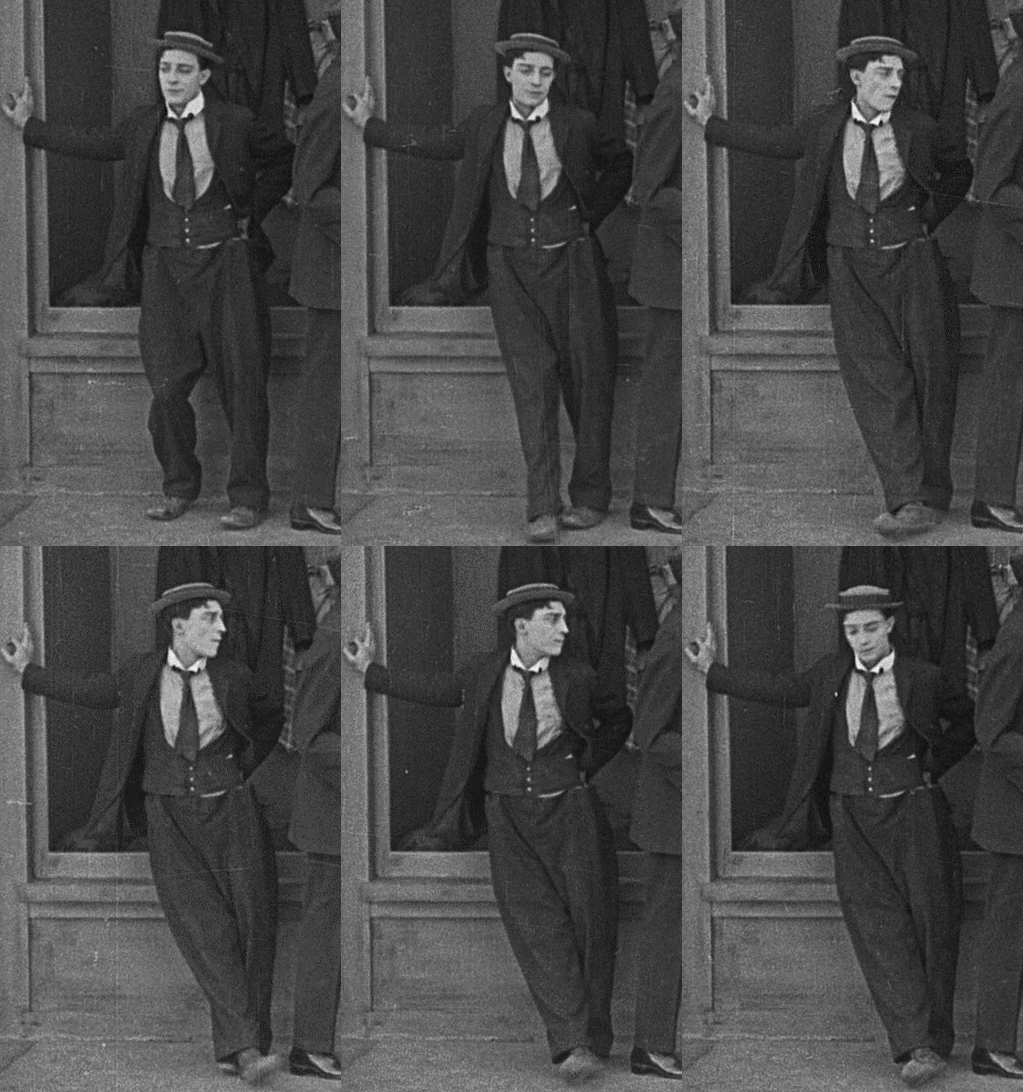
As a Londoner myself it struck me that nothing changes: 93 years on and the silliness of the fashionable London scene is still ripe for satirising. Benson pokes gentle fun, nobody is truly despicable or utterly destroyed. Personally I enjoyed the ongoing saga of Georgie’s Oxford bags, bought during “a moment of reckless sartorial courage”. Not everyone can carry off Oxford bags with the aplomb of Buster Keaton, after all:
Life at Riseholme continues at its usual pace – that is, a snail’s. It is a life they all enjoyed, one filled with enough little dramas and crises to keep them all amused. Now however, something is missing:
“Yet none of these things which, together with plenty of conversation and a little housekeeping and manicuring, had long made life such a busy and strenuous performance, seemed to offer an adequate stimulus. And he knew well enough what rendered them devoid of tonic: it was that Lucia was not here, and however much he told himself he did not want her, he like all the rest of Riseholme was beginning to miss her dreadfully. She aggravated and exasperated them: she was a hypocrite (all that pretence of not having read the Mozart duet, and desolation at Auntie’s death), a poseuse, a sham and a snob, but there was something about her that stirred you into violent though protesting activity, and though she might infuriate you, she prevented your being dull.”
Will Lucia make a splash in London? Will Riseholme find their way without her? Will she ever return? What do you think?
“Aren’t you feeling more Luciaphil? I’m sure you are. You must enjoy her: it shows such a want of humour to be annoyed with her.”
Now a musical interlude, but one of which I’m certain Lucia would not remotely approve. You can’t get more London than Chas and Dave:
Secondly, Ali’s lovely post 10 vintage books of joy reminded me I had Something Light by Margery Sharp (1960) in the TBR, and so I dug it out forthwith. I adore Margery Sharp and her well-observed but gentle humour was just what I needed.
It opens “Louisa Mary Datchett was very fond of men.” Unfortunately for Louisa, this means she keeps running round after various wet blankets, helping them keep on track, buying them yogurt and mopping their brows. She’s getting older and her profession as a dog photographer only just keeps her afloat, so she decides she needs to get married.
“ ‘It’s not the suffragettes who’d be proud of me,’ thought Louisa bitterly, ‘it’s the Salvation Army. I may be the modern woman, the femme sole with all her rights, and I’m very fond of men, but it’s time I looked out for myself. In fact it’s time I looked out for a rich husband, just as though I’d been born in a Victorian novel…’”
It’s a brilliant piece of characterisation that Louisa doesn’t come across as either a doormat or as mercenary. She’s a kind person, a wee bit lost, and trying to take the best decisions she can for a happy life.
We then follow Louisa’s various adventures trying to gain what she thinks she wants. She spends a week trying to secure a rich husband, another seven days rekindling an adolescent devotion and a further week acting as a housekeeper for a man whose ready-made family are appealing.
That’s pretty much it, plot-wise and there are no real surprises. In no way is this a criticism. A comfort read for me has a nice predictability to it and I enjoy watching things play out as I expect in an entertaining way.
What further makes this such an enjoyable read are the fond portraits of the various characters, and the little details. One suitor is frequently likened to a Sealyham terrier; bamboo framed spectacles are given far too much importance; Louisa wears a “rowdy housecoat, zebras on a pink ground”; the milkman is a constant source of sympathetic wisdom as well as dairy products; Louisa has to try and sell ugly beechnut jewellery on behalf of her Bohemian artist neighbour. Everyone is flawed, believably human, gently ribbed by the author. It’s an absolute delight.
“She was constantly being either sent for, like a fire engine, or dispatched, like a lifeboat, to the scene of some masculine disaster”
To end, an 80s pop classic as always, but presented in a lip sync scene of sibling bonding that makes me smile, and we all need things that make us smile right now:
Today is Margery Sharp’s birthday, which I know thanks to Jane from Beyond Eden Rock; I’ve joined in the celebrations with Jane the last few years and I find starting the year with Margery is a sound way to begin if ever there was one 😊
Two years ago I looked at The Eye of Love, which introduced the character of Martha, a strong-willed, self-possessed child. Sharp continues Martha’s story in two sequels, which I thought I’d look at today. These short novels work well individually but also when read together, as I did, the second giving more satisfying conclusion to the story.
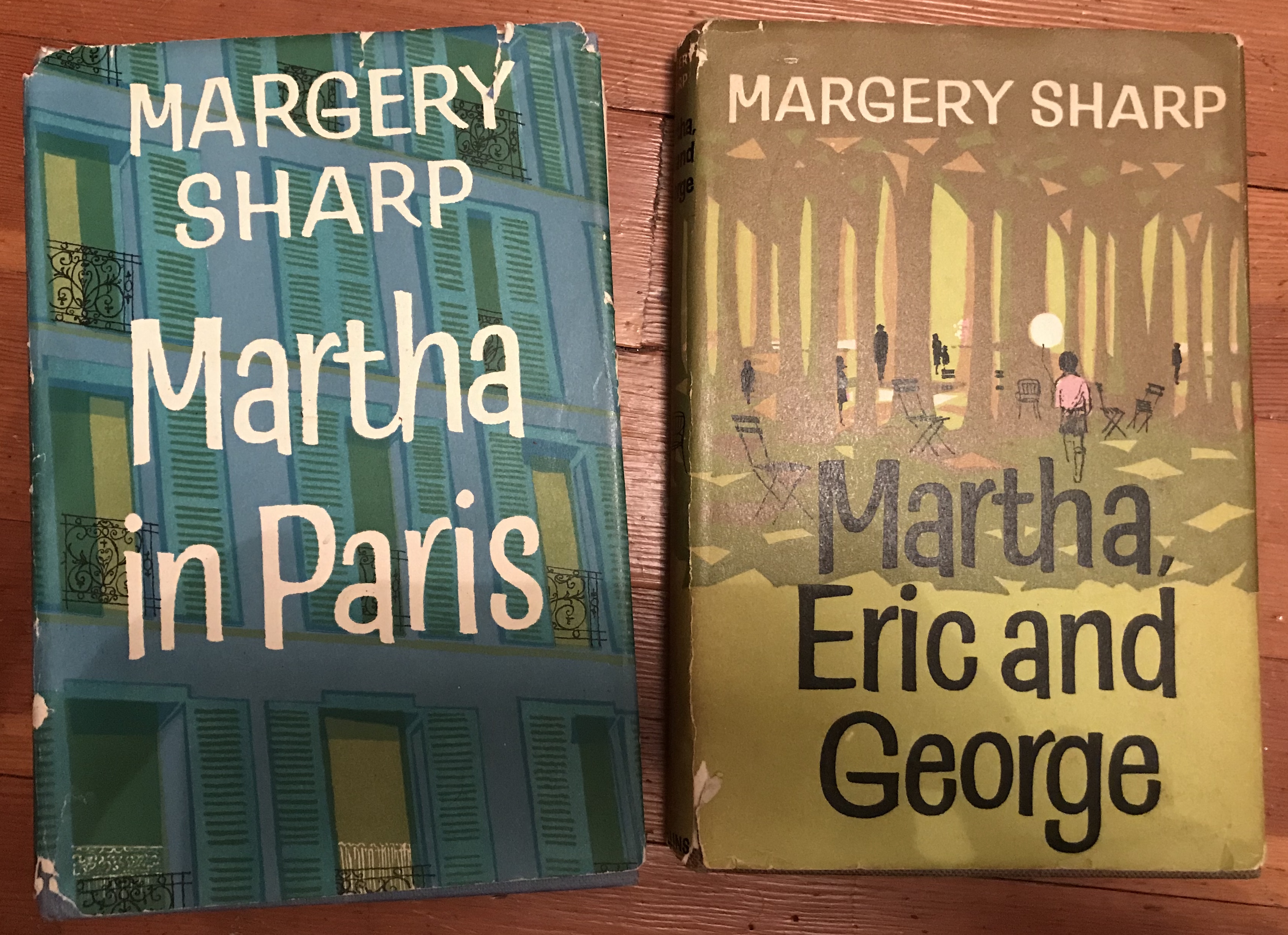
Firstly, Martha in Paris (1962) which sees Martha aged 18, pursuing her art under the patronage of her childhood friend Mr Joyce, who recognises her for the genius she is and the future star she will become. He feels that to develop as an artist, she must go to Paris. Martha isn’t keen on Paris, but the prospect of staying forever with her sweet-natured Aunt Dolores means she agrees to go:
“Contrary to Mr Joyce’s prophesy, she learned to speak practically no French at all. She learnt to understand it; but […]it wasn’t as though she had anything she particularly wanted to say. The power of expressing thoughts, or emotions, was unnecessary to her; and not to be able to answer questions a positive advantage.”
Martha is still very much the stolid child we met in The Eye of Love. She is single-minded and focussed entirely on her work. She has feelings for a few people but they are deeply buried, clear-sighted and unsentimental. She is inexpressive because in the main other people are of no real consequence to her; she is indifferent to them and so has no need to seek an understanding with them.
She seems an unlikely candidate for love, but fellow Brit, bank clerk Eric Taylor falls for Martha. Or rather, he falls for who he thinks Martha is: a shy, self-effacing virgin like himself. Martha doesn’t deliberately mislead him, because she doesn’t really bother with him at all.
“Eric Taylor, in love, still wasn’t ready to make love. He felt himself he hadn’t yet quite got the hang…a parting pressure of the hand was the most he attempted; which upon Martha, who had a grip like a navvy’s, left no impression at all.”
Despite these inauspicious circumstances, their relationship develops because Martha is drawn to visit Eric and his mother at their flat, due to the prospect of nice bath. Now onto huge SPOILERS – if you don’t want to know, you’ll need to skip to the end of the post.
Inevitably, these two naïve people end up in a predictable fix: Martha gets pregnant. She carries on going to art class and doing well; she is overweight and wears baggy smocks so her pregnancy is easy to hide. She also decides that although she enjoys sex, she loves her work more, and so she is done with that side of life.
“It was time for Martha to gather her forces. No prospect had ever appalled her more, not even that of painting Christmas cards at Richmond, than this loyally-offered prospect of honourable matrimony.”
Martha is not an easily likeable character, as she disregards almost everyone she encounters. However, she never does this out of cruelty and never intends to hurt anyone. If you like Saga Noren from The Bridge (which I do), you’ll like Martha.
Some things have dated in Martha in Paris: a rather flippant treatment of the prospect of rape and a horrible racist phrase used in passing by one character. But in its treatment of sexual politics and gender roles it is remarkably progressive for its time. Martha is shown to find joy in sex without love. She is also shown to prioritise her career over all else. Sharp suggests that Martha behaves as men have done for centuries, and asks if we judge her harshly, are we doing so because she is a woman who resolutely fails to fulfil traditional gender roles?
Sharp continues to expand on the theme of gender expectations in the sequel Martha, Eric and George (1964); as a comic writer she does this explicitly but with wit so it’s never didactic.
“Young men are not accustomed to being loved and left, abandoned to bear alone the consequences of their folly, just as if they were young women.”
But this is exactly what happens to Eric Taylor. Martha leaves the baby with him and his mother to be raised, while she returns to England to focus on her painting.
“No dashing hussar abandoning a village maiden could have behaved more cavalierly. Not that Martha was in any other sense dashing, far from it; her outstanding characteristic was rather a blunt stolidity which only Eric in his innocence could have seen as virginal shyness.”
His mother, as Martha foresaw, embraces this new challenge to become a doting grandmother. She also revels in her status as rescuer of a poor abandoned baby.
“There were no such compensations for Eric. For once, it was the man who paid.”
Martha meanwhile, has become a hugely successful artist. Events conspire to send her back to Paris ten years after she left her son on the Taylors doorstep. She has no plans to see Eric or her son ever again, but of course things work out otherwise. George has grown up very much like his mother in temperament: self-possessed and single-minded. Martha has no maternal feelings whatsoever.
“She desired neither husband nor lover, nor to be admired, nor to make other women envious. All she wanted was to be unencumbered.”
What will happen to this disparate trio? I think Sharp is brilliant at endings: things work out well, without diminishing the characters or retreating into sentimentality. Martha, Eric and George was no exception to this.
To end, a sentiment with which Martha would certainly not agree:
When I was searching for quotes about libraries I really liked this quote by Libba Bray but it was too long to use for a title:
“The library card is a passport to wonders and miracles, glimpses into other lives, religions, experiences, the hopes and dreams and strivings of ALL human beings, and it is this passport that opens our eyes and hearts to the world beyond our front doors, that is one of our best hopes against tyranny, xenophobia, hopelessness, despair, anarchy, and ignorance.”
This week’s theme is libraries, because one of the unforeseen benefits of my 2018 book buying ban is that I have rediscovered the joy of the library. You may well be wondering what kind of moron I am not to foresee this, but I really didn’t. The purpose of the book-buying ban is to get through the piles of unread books I own. It’s working, but not quite as well as I hoped because I’ve realised my library has novels. Up until this point I’d mainly used it for non-fiction books. It’s taken the ban for me to realise I can get in the library queue for new releases and get hold of rare books I’ll never be able to afford. Libraries are amazing!
Firstly, I finally reached the top of the queue for Reservoir 13 by Jon McGregor, which was published before my book buying ban last year, but I hadn’t got a copy. McGregor is one of my favourite authors and I didn’t want to wait another year before reading this, so I got on a long waiting list at the library.
Disclaimer: McGregor is never going to get anything but gushing reviews from me. I’ve loved his writing since his first novel If Nobody Speaks of Remarkable Things and as far as I’m concerned he can do no wrong. I understand this novel has divided people and I think its because the premise sets up certain expectations. A 13 year old girl, Becky Shaw, disappears from a village where she and her parents are holidaying for new year. However, this isn’t a thriller. It isn’t about the search for the girl, or what happened to her, or who may have taken her. What it is about is a community, the people in it, how their stories touch on one another. If like me, you’re a fan of McGregor, this won’t greatly surprise you. Although the rural setting is unusual for him, the themes are not. But if you come to it expecting a missing person puzzle to be solved, you’ll be sorely disappointed.
There are many recurring phrases and details in the book. Becky is 13, the village has 13 reservoirs, the story is set over 13 years and divided into 13 chapters. The chapters begin “At midnight when the year turned…” At intervals we are reminded “The missing girl’s name was Rebecca, or Becky, or Bex”. The effect is to show how things move on within the familiar; village lives continue but they also change. Meanwhile, Rebecca/Becky/Bex is held in a stasis, forever 13, the questions around what happened to her left hanging.
I associate McGregor with urban settings, but he writes beautifully of rural life. Old traditions are dying out: only one of the residents bothers collecting nettles for tea or elderflowers for cordial. The butchers – like so many local shops – closes due to lack of demand. Yet the seasons in their distinct beauty are there:
“On Bonfire Night there was a heavy fog, thick with woodsmoke, the fireworks seen briefly like camera flashes overhead. In the beech wood the foxes prepared their dens. The vixens dug down into old earths and reclaimed them, lining them out with grasses and leaves. In the eaves of the church the bats settled plumply into hibernation. By the river the willows shook off the last of their leaves. At night the freight trains came more often a single white leading and the wagons shadowing heavily behind. The widower asked Clive for advice over pruning his fruit trees and Clive was surprised to see the state things were in.”
McGregor does this throughout the novel, going straight from describing the natural world into a detail about the lives of one of the villagers without a paragraph break. In doing so he weaves the lives into the world that surrounds them and shows how one cannot be understood without the other.
I thought Reservoir 13 was absolutely stunning. It reminded me of Virginia Woolf in the use of repeated phrases and the focus small but significant details. In his usual unshowy style, McGregor captures the beauty and fragility of everyday life.
After I finished Reservoir 13 I went straight to the library to see if they had a copy of Reservoir Tapes, the sequel of sorts, and I didn’t even have to put my name in the queue for it. Reservoir Tapes is a series of short stories connected to Reservoir 13, originally broadcast on the radio. You can listen to them here.
Secondly, I found my library had a copy of Rhododendron Pie, Margery Sharp’s first novel from 1930, which is practically impossible to find and which you pay hundreds of pounds for online. There was a copy just sitting there – I couldn’t believe I hadn’t checked before.
Rhododendron Pie tells the story of Ann Laventie, whose natural leanings towards conservatism mark her out as different from the rest of her family. Her sister Elizabeth begins the birthday tradition of inedible floral birthday pies of the title, while little Ann would prefer an apple pie.
“It had once been said of Mr Laventie that he was a traditionalist in wine and a revolutionary in morals; and indeed, this capacity for making the best of both worlds was an outstanding characteristic of the family. They combined the extremes of old-world elegance and modern freedom, tempering a belief in free verse and free love with an equal feeling for societal decorum.”
As the children grow up, Elizabeth becomes an intellectual forever having essays published in journals while her brother Dick becomes a sculptor. Ann is at a bit of a loss. She is good at admiring what the others do and she is well-liked, but she flounders in working out what she wants and where she fits in. Sharp captures how society is changing for the interwar generation; one of Ann’s friends is perfectly open about the men she lives with on occasion. While there is discussion around this which seems remarkably forward-thinking and would sit well with readers today, Ann does not want a bohemian lifestyle.
“ ‘What I want,’ continued Ann recklessly, ‘is a nice wedding in the village church, with a white frock and orange blossom and lots of flowers and ‘The Voice that Breathed’ and two bridesmaids in cyclamen pink and rose petals afterwards and a reception in the drawing-room with a string quartet playing selections from Gilbert and Sullivan. In June. And a honeymoon in the Italian Lakes.
‘Where does Gilbert come in?’
‘He doesn’t. And I want to live in a house, not a flat, even if it’s only a little one in a suburb where there’s no-one amusing, with a back garden to dig in. And have bird pattern chintzes in the drawing-room and cold supper on Sundays because the maid’s out. I shall probably,’ finished Ann defiantly, ‘take a stall at the church bazaar.’”
Ann doesn’t come across as remotely priggish or boring though. She is authentic and truthful, and struggles with her knowing, arch, ironic family
“ ‘One of your family methods. Every now and then you do something deliberately ordinary, but in inverted commas so to speak, just to see what it feels like.”
What Rhododendron Pie is about is working out who you are and what you want from the world, and how tricky this can be when you seem to be at odds with your family and the section of society you live within. Without any didacticism, Sharp captures how this is especially hard for women. New freedoms are opening up, but women are still judged more harshly by society and have their actions further circumscribed by law.
“These were the things they understood, patient hope and quiet brave endurance: these were the woman’s part.”
Rhododendron Pie is remarkably accomplished for a first novel. Sharp would hone her skills further in future novels – particularly characterisation, which is a bit weak here – but her wit is here, her warmth, and her wisdom.
“‘That’s what you clever people never understand. You talk about life as though it were something rare and surprising that one had to be careful of. It’s nothing of the sort. It’s ordinary. And it’s only when you’ve accepted it as ordinary that you begin to see the wonder of it. That a swallow or a green field should be beautiful is nothing, but that they should be common as dirt is a miracle. I am continually amazed…at the casual beauty of things.’”
To end, a woman whose name helpfully rhymes with her profession, and an annoying man who won’t shut up and let people read in peace:
I thought the title quote rather apt, as I’m late to Margery Sharp Day this year, but I couldn’t let it pass after falling for the author since reading two of her novels for Margery Sharp day 2017. She’s so witty, she writes with such brio, and also with such humanity and warmth that I’m a confirmed fan.
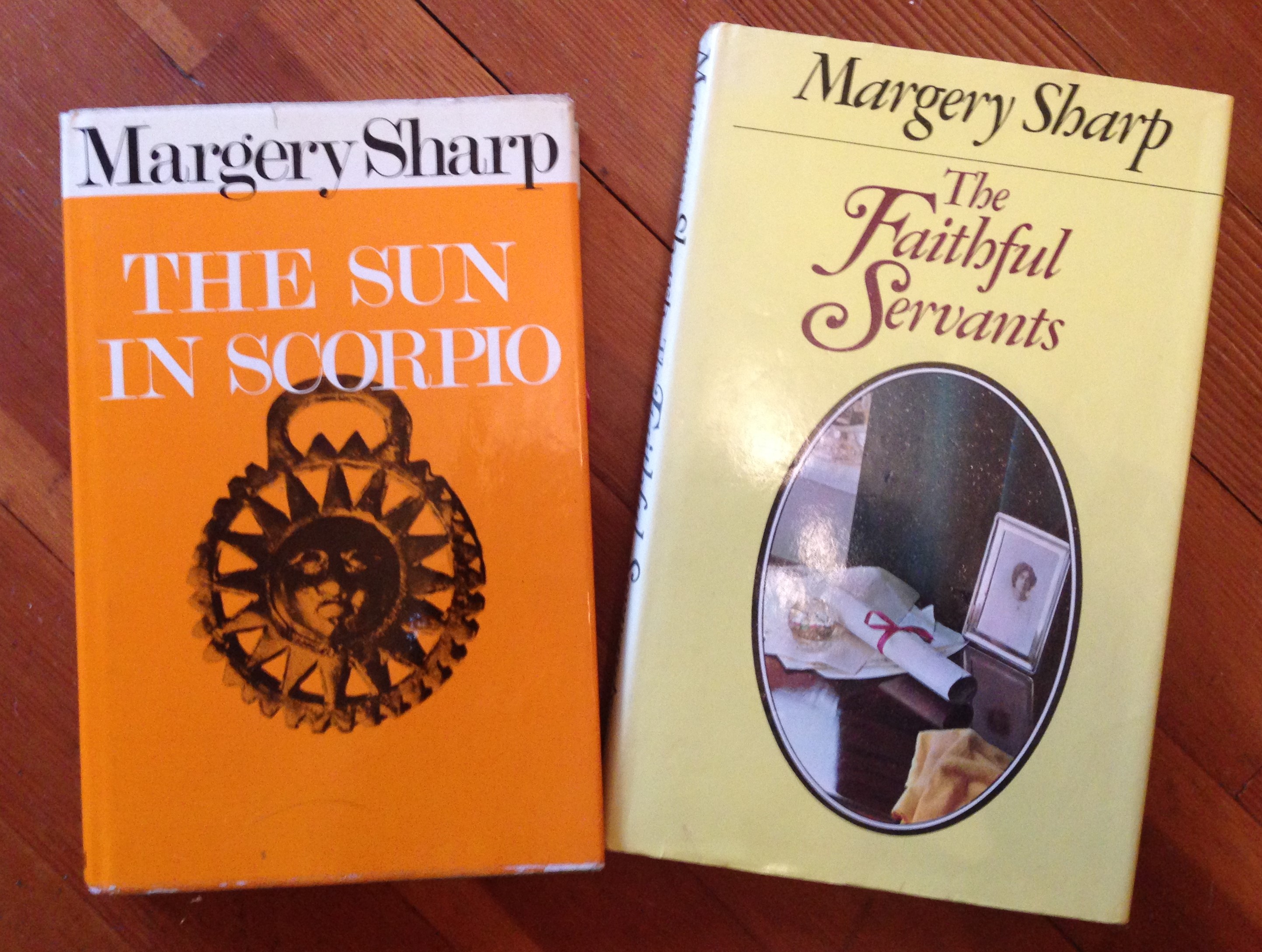
And yet, when reading The Faithful Servants (1975), these wonders of Sharp’s writing were not quite so evident. Jane from Beyond Eden Rock, who organises Margery Sharp Day and is a great champion of her writing, had said that her later novels were not quite as good, and how right she was. The Faithful Servants is absolutely still worth reading, but Sharp’s penultimate novel is not as sparkling as her earlier work.
It’s a great idea: a trust is established at the end of the nineteenth century by dissolute Jacob Arbuthnot for aged servants down on their luck. In portraying the requests to the trust, Sharp is able to track the huge societal changes that took place between the start of the trust and well into the twentieth century, by which time the welfare state has been established and the servant class almost entirely disappeared. The various visitors to the trust’s offices are colourful and the staff only slightly less so. But…. it doesn’t quite work. The characters are all well-observed as I would expect from Sharp, and there are are some lovely touches, such as the gentle relationship established between two beneficiaries, Miss Xavier and Miss Quartermaine, of whom “neither had the least idea that they were Lesbians.” Sharp’s wit is also in evidence:
“ ‘Lady P. simply meant that the children should drop whatever they were doing to make up the rosettes for a Tory party candidate, or sew bean bags for a Tory fete. As you know by now dear, I’ve always been a convinced Liberal; but I can assure you I didn’t object from party politics. What I objected to was the assumption that absolutely any activity took precedence over Moliere.’ ”
But it just doesn’t have the verve of her other novels. It reads more like a series of sketches, which in a sense is exactly what it is. Of course, this is a series of sketches by Margery Sharp, and so they are entertaining, sly and funny, with strong women in evidence:
“Mr Blackburn thought of her as a field flower plucked from its native heath; Mr McIntyre, as some shy little creature of the woods. Of course neither mentioned the fancy.
Then in 1874 she was arrested on a charge of murder, To be explicit, of having introduced arsenic into her employer’s night cap of tea.”
The Faithful Servants did not diminish my love for this author, but if Margery Sharp is new to you, this would not be the best place to start. A clever idea, not entirely fulfilled, but with moments of witty brilliance which act as a reminder that Sharp off her game is still better than many at their peak.
Secondly, back to 1965 and The Sun in Scorpio, which sees Sharp very much on form. The Pennon family live on a small outpost of the fading British empire, “The Next-Door Island” to Malta.
“They weren’t Army, and they weren’t Navy, they were irretrievably civilian; it was a measure of Mrs Pennon’s social insecurity that she always felt nervous before giving a dinner-party in case no-one came. At least they weren’t Trade however, and she always made a point of explaining her husband’s chest was weak.”
Sharp writes about the warm climate wonderfully and casts a similarly acute eye towards the familial relationships. The children Muriel, Cathy and Alan don’t particularly get on, and neither do their parents. Cathy especially loves the island and its warmth, and she has a formative moment with the governor, a bachelor the ex-pat ladies flutter around. However, the start of the Second World War sees Cathy wrenched away as the Pennons return to England, where their shortcomings are made even more apparent.
“Indeed, their new, heavier clothing swamped them all, diminishing individuality, and as it were underlining the fact that whereas on the Island (among some few hundred of the Ruling Race), they’d been at least petty someones, at Home (amongst some fifty millions) they were nobodies.”
Cathy in particular struggles under the grey skies of Britain. Muriel thrives as a hockey-playing school leader and Alan finds girls to fall in love with, but Cathy doesn’t excel at anything.
“In general they were a sulky lot, and Cathy was amongst the sulkiest. It was very hard on Mrs Pennon, but she had developed such a technique of losing herself in a novel, a daughter’s obvious misery disturbed her no more than a husband’s equally obvious lack of any will to live.”
Sharp follows them through the years, and while Alan is able to move away for work and Muriel turns into a unbearably smug married suburban mother, Cathy remains somewhat adrift. Once her parents are dead, she is financially bereft and has to live with Muriel. This situation depresses all involved, and when the opportunity arrives for Cathy to become a nanny to the daughter of landed gentry she gratefully escapes to Devon.
The mother of her charge is very beautiful, and very much younger than her husband.
“ ‘Alas!’ sighed Lady Jean (probably the only woman of her generation who could sigh alas and get away with it.)”
She is also manipulative and unfaithful, and her charm in referring to Cathy as her “attendant sprite” is not entirely successful. Cathy has no great affection for her small charge, but she also has no real choices in life. Sharp’s depiction of Cathy’s domestic situation is highly entertaining as she is wholly unsuited to being a nanny and has little in common with the media and image-obsessed small girl she is nannying:
“ ‘Poor gwandpa!’ lisped Elspet – out of flannel and into frills again. ‘Mummy says he’s tewwibly pwessed for money.’
‘Nonsense, he must be worth a million,’ said Cathy bracingly.
‘But all in land,’ pointed out Elspet. (It occurred to Cathy to wonder whether besides reading Vogue and Tatler her charge ever dipped into the Financial Times…..)
‘You don’t own entailed land, it owns you,’ explained Elspet. ‘Poor grandpa! I can’t go to sleep for worrying about him. You must read to me out of Peter Pan.’ “
The years pass and we see what happens to Muriel and Alan, and also Jacko, an islander who was friends with Cathy and taught her poker, who similarly finds himself in London. The main focus remains mainly on Cathy however, and Sharp doesn’t trouble to make her likable. Cathy has nothing particularly to recommend her and she isn’t very nice, but she is also unhappy, and as a woman in the early part of the twentieth-century she doesn’t have enough control over her life to try and remedy the situation. It doesn’t matter one bit that Cathy is so unlike a heroine though. It’s actually refreshing, and realistic, and told with Sharp’s wit, economy, and verve it’s a hugely enjoyable journey towards a perfectly realised ending. The Sun in Scorpio is an absolute joy.
To end, the wonderful Harry Belafonte singing a song Cathy would appreciate:











 madame bibi lophile recommends