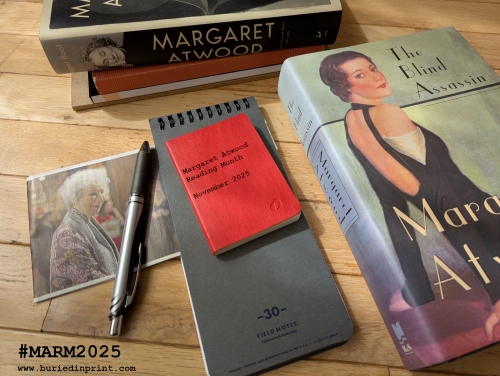
This is a contribution to Margaret Atwood Reading Month, hosted by Buried in Print. Happy Margaret Atwood’s birthday!
I really enjoy poetry, from ancient to contemporary, but I often neglect to pick it up. So MARM was a perfect opportunity to get back to reading it, as I had a copy of Atwood’s volume Dearly (2020), with its striking cover of iridescent feathers, in the TBR.
Dearly was written between 2008-2019 and includes a lot of Atwood’s enduring concerns: the natural world; the destruction of the planet; power structures that are imposed on others. There is also consideration of aging and death, and the volume is dedicated in absentia to her partner of many decades, Graeme Gibson, who died in 2019.
Atwood’s poetry is so accessible. She is an acute observer which suits poetry, and she conveys this without impenetrable allusion or obscure metaphor. In Salt she layers a series of images in evoking the past:
“Once in a while there was a pear or plum
or a cup with something in it,
or a white curtain rippling, or else a hand.
Also the mellow lamplight
in that antique tent,
falling on beauty, fullness,
bodies entwined and cherishing,
then flareup, and then gone.”
It was her consideration of aging and loss which appealed to me most in this volume, and there are some beautifully tender poems, full of love without sentimentality. In Blizzard:
“My mother, sleeping.
Curled up like a spring fern
although she’s almost a century.
I speak into her topmost ear,
the one thrust up like a wrinkled stone
above the hills of the pillows:”
And of course her titular poem, about shifts in language entwined with personal loss, which if you click the last link in this post you can hear her read. Her deep love for her life partner resonates throughout this volume, written before he died but filled with the anticipatory grief his dementia diagnosis gave rise to. Mr Lionheart in particular I found so moving, weighing what is being lost and what remains, for both the person with dementia and those who care for them:
“There’s birdsong, however,
from birds whose names have vanished.”
Before she concludes:
“Lions don’t know they are lions.
They don’t know how brave they are.”
What I haven’t captured here is Atwood’s characteristic wit and warmth, but rest assured it is here! There are poems that conclude with pithy lines, making me smile more than once. She is clever and funny and entertaining. Published just before she turned 81, in Dearly she is as engaged with the modern world and engaging as ever.
I found this essay about writing Dearly which includes Margaret Atwood reading the titular poem, so I highly recommend heading there for a read and listen.
To end, from Zombie:
“The hand on your shoulder. The almost-hand:
Poetry, coming to claim you.”
 madame bibi lophile recommends