Nightwood was not at all what I was expecting. Having never read Djuna Barnes before I had no preconceptions, and the blurb on the back described it as ‘the lives of Americans and Europeans in Paris in the decadent Roaring Twenties’. Yes please! But that was not the novel I got.
What I did get was very striking, and an intriguing piece of writing. I would describe it as a series of interconnected portraits and musings, very much in the modernist style. The characters are barely more than sketches, the plot is there but almost needn’t be. Instead we have glimpses, shattered shards that belong together but are as much about the gaps between them as trying to piece them all together.
Baron Felix has a background of secrets and lies. He falls in love with Robin and they have a child together, but she is constantly abstracted, given to disappearing for days on end:
“Felix found her presence painful, and yet a happiness. Thinking of her, visualizing her, was an extreme act of the will to recall her after she had gone, however, was as easy as the recollection of a sensation of beauty, without its details.”
Robin begins a long relationship with Nora Flood, an American who holds a salon, apparently based on the author:
“To ‘confess’ to her was an act even more secret than the communication provided by a priest. There was no ignominy in her; she recorded without reproach or accusation, being shorn of self reproach or self-accusation. This drew people to her and frightened them; they could neither insult nor hold anything against her, though it embittered them to have to take back injustice that in her found no foothold. In court she would have been impossible; no one would have been hanged, reproached or forgiven, because no one would have been ‘accused’. The world and its history were to Nora like a ship in a bottle; she herself was outside and unidentified, endlessly embroiled in a preoccupation without a problem.”
They are split up through Robin’s involvement with Jenny Petherbridge:
“She had a fancy for tiny ivory or jade elephants; she said they were luck; she left a trail of tiny elephants wherever she went; and she went hurriedly and gasping.”
Nora becomes the interlocutor for Dr Matthew-Mighty-grain-of-salt-Dante-O’Connor, who likes a drink and to lecture. There are long passages of discourse and the tone, voices and style reminded me at various points of Joyce, Eliot and Brecht. But Nightwood is definitely its own world too, and Barnes voice is strong and individual, and not trying to be anyone else.
I would definitely re-read Nightwood now I feel more prepared for it rather than expecting a more traditional prose novella. It’s one of those pieces with striking images or phrases that stay with you, independent of the story. I have a collection of Barnes short stories in the TBR somewhere and I’m definitely encouraged to dig them out, as I think her style will suit that form really well.
“None of us suffers as much as we should, or loves as much as we say. Love is the first lie; wisdom the last.”
This is my contribution to Jean Rhys Reading Week, hosted by Jacqui at JacquiWine’s Journal and Eric at Lonesome Reader. Do check out their blogs and join in!
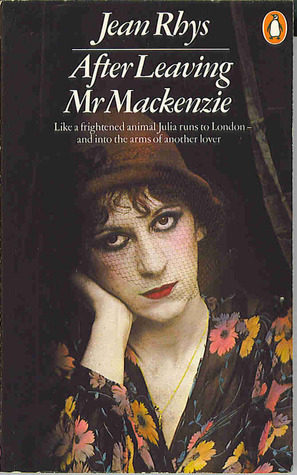
Firstly, After Leaving Mr Mackenzie (1930).
My edition is this 1970s Penguin – the subtitle manages to be both cheesy and misleading – bad Penguin!
I feel I should have found this novel much more depressing I did. Julia is a woman whose looks are fading, an impending disaster for her, as she has no money and lives off the handouts of lovers who will find her easier to discard the older she gets. At the moment she has an ambiguous quality:
“Her career of ups and downs had rubbed most of the hallmarks off her, so that it was not easy to guess at her age, her nationality, or the social background to which she properly belonged.”
People tend to judge her harshly rather than kindly, particularly because she is a woman and at a time of more rigid social rules, they can read her lifestyle in her clothes, hair and makeup. The men who use her escape more lightly, such as the titular lover with whom her relationship is breaking down:
“He was of the type which proprietors of restaurants and waiters respect. He had enough nose to look important, enough stomach to look benevolent. His tips were not always in proportion with the benevolence of his stomach, but this mattered less than one might think.”
After her cheques from Mr Mackenzie stop, Julia returns to England from France. Not quite estranged from her family but not on fond terms with them either, she lives in seedy Bloomsbury boarding houses:
“But really she hated the picture. It shared, with the colour of the plush sofa, a certain depressing quality. The picture and the sofa were linked in her mind. The picture was the more alarming in its perversion and the sofa the more dismal. The picture stood for the idea, the spirit, and the sofa stood for the act.”
I find that an astonishing piece of writing. To take a description of a dilapidated room and show how that reflects the mood of the person in it is one thing, but to extend it in such a way, so original and startling, really demonstrates why Rhys deserves to be lauded.
Julia ricochets around London, trying to find a man to take care of her. Rhys does not judge her protagonist which must have been quite shocking for 1930. Julia is sexually active, unmarried, childless, and is not punished by Rhys for such deviation from the feminine ideal. While she is a sad figure, even tragic, Rhys shows how we share a commonality with Julia rather than marking her out as Other.
“She was crying now because she remembered that her life had been a long succession of humiliations and mistakes and pains and ridiculous efforts. Everybody’s life was like that. At the same time, in a miraculous manner, some essence of her was shooting upwards like a flame. She was great. She was a defiant flame shooting upwards not to plead but to threaten. Then the flame sank down again, useless, having reached nothing.”
After Leaving Mr Mackenzie is a sad novel, but what keeps it from being depressing, for me, are the gentle touches of Rhys’ humour, such as in the description of Mr Mackenzie, and the fact that Julia holds on to her resilience. She is not a victim, despite being treated appallingly, but rather a realist, who knows that her options as a woman in her circumstances are limited. Rhys has a great deal to say but does so in a non-didactic way, leaving the reader to reach their own conclusions.
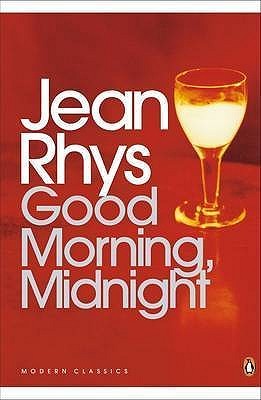
Secondly, Good Morning Midnight (1939). Superficially, this sounds very similar to After Leaving Mr Mackenzie: Sasha Jansen returns to Paris alone and broke. She is losing her looks and feels lonely and desperate… but it is quite different.
A more recent Penguin edition – blessedly free of a cheesy subtitle
Sasha does not flail around trying to extract money from everyone. Rather, Rhys writes this novel in the first person, using a degree of stream of consciousness to explore how a single woman at this point in history comes to terms with her life and the future that awaits her. Sasha is fragile:
“On the contrary, it’s when I am quite sane like this, when I have had a couple of extra drinks and am quite sane, that I realise how lucky I am. Saved, rescued, fished-up, half-drowned, out of the deep, dark river, dry clothes, hair shampooed and set. Nobody would know I had ever been in it. Except, of course, that there always remains something. Yes, there always remains something…”
She is self-destructive and lonely:
“I’ve had enough of these streets that sweat a cold, yellow slime, of hostile people, of crying myself to sleep every night. I’ve had enough of thinking, enough of remembering. Now whisky, rum, gin, sherry, vermouth, wine with the bottles labelled ‘Dum vivimus, vimamus….’ Drink, drink drink…As soon as I sober up I start again. I have to force it down sometimes…Nothing. I must be solid as an oak.”
And yet, amidst the sadness, there is resilience. We learn of Sasha’s past in Paris as she walks the streets, meets new people and is drawn back into her memories. The stream of consciousness and flitting between past and present is a highly effective. Rather than feeling like a contrived literary style, Rhys is able to create a real sense of being inside Sasha’s head and how someone would think: not in straight lines but (to steal an analogy from Jeanette Winterson) in spirals, back and forth.
Based on these two novels, I would say Rhys is brilliant at creating flawed, vulnerable women who are somehow survivors – they have a strength which is not immediately obvious, that perhaps they don’t even recognise themselves.
“I am trying so hard to be like you. I know I don’t succeed, but look how hard I try. Three hours to choose a hat; every morning an hour and a half trying to make myself look like everybody else. Every word I say has chains around its ankles”
A single woman with a sexual history who is no longer young does not have the most rosy prospects in interwar society and Rhys does not shy away from this. However, there is a sense that Sasha (and Julia) is not alone in her struggles. The search for meaning in a society that can degrade through disregard affects many and there is fellowship and sympathy to be found.
“I look thin – too thin – and dirty and haggard, with that expression that you get in your eyes when you are very tired and everything is like a dream and you are starting to know what things are like underneath what people say they are.”
Wiki tells me that when first published, (male?) critics found this novel well written but too depressing. I thought it was beautifully written and sad, but not depressing. I think for me depressing comes with a certain bleakness, and I didn’t find either novel bleak: neither Julia or Sasha ever quite lose hope.
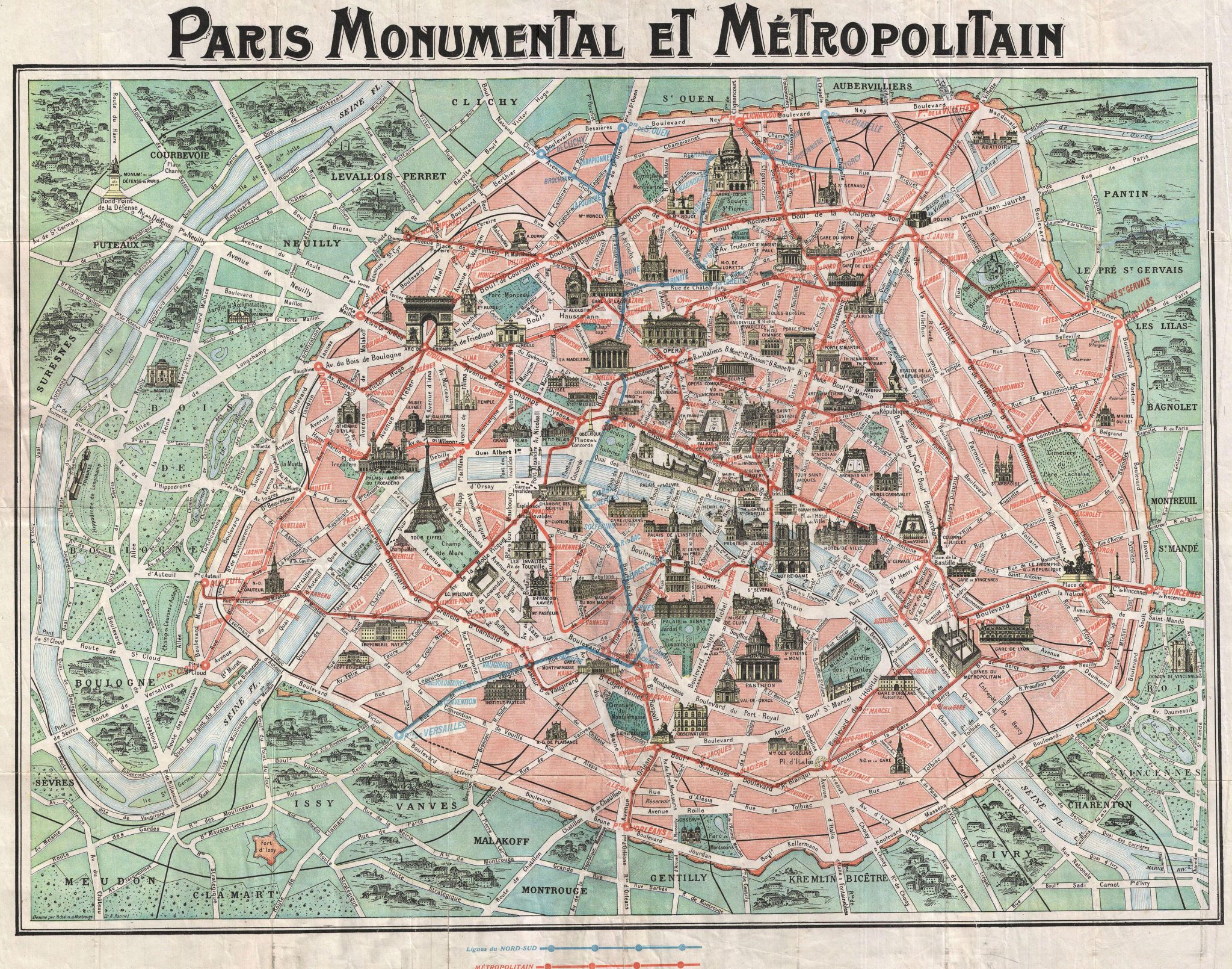
To end, if anyone can capture the vicissitudes of a life well-lived in Paris:
For a theme for this post I was thinking about Easter, about sacrifice and redemption, and also about Spring, the season of renewal and regeneration that it coincides with. I’ve opted for a novel with a self-sacrificing main character, and a poem that starts in April. They’re both quite odd texts: here’s to a weird Bank Holiday!
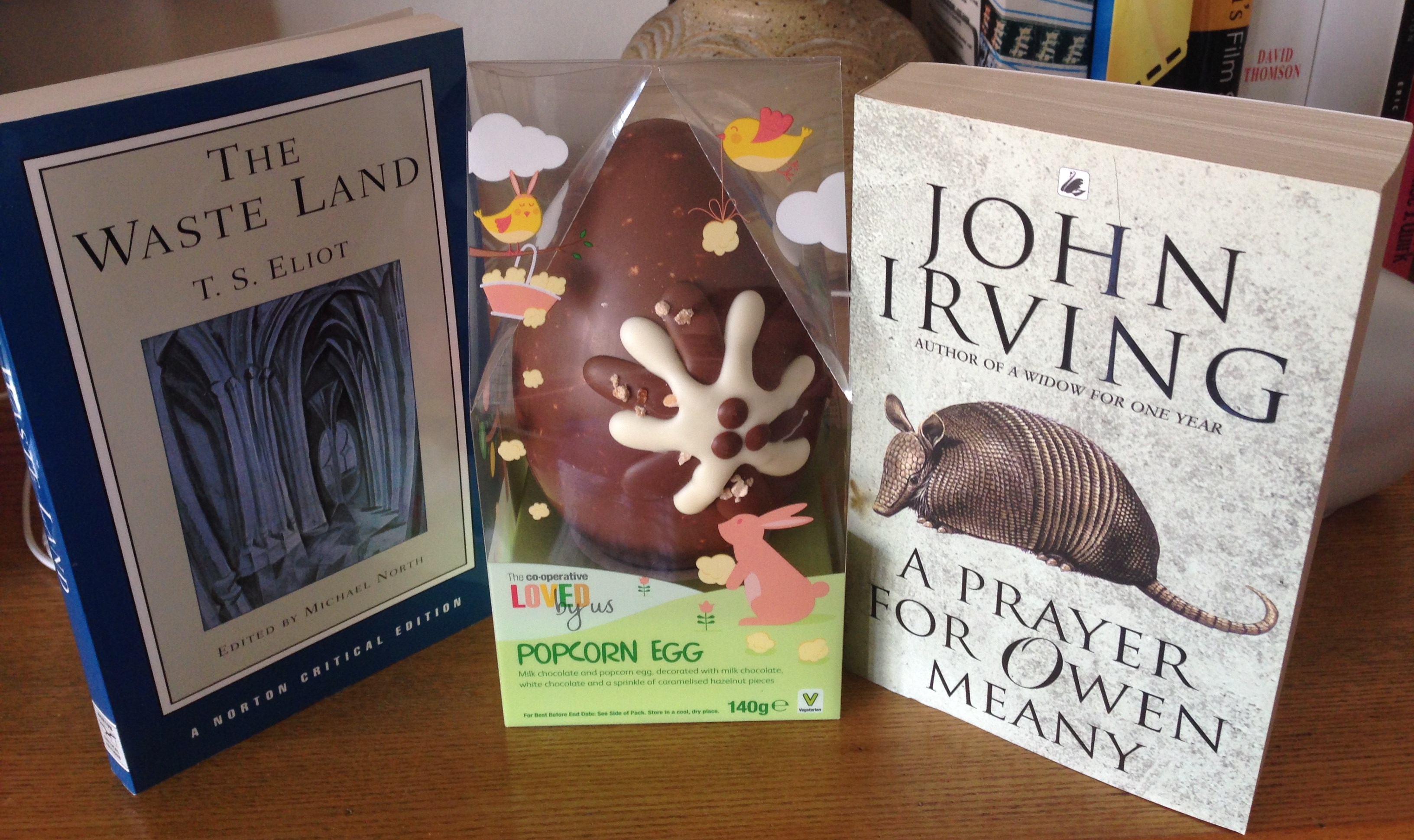
Firstly, A Prayer for Owen Meany by John Irving (1989, Black Swan). Irving is an enormously popular author and Owen Meany is one of his most-loved protagonists: a boy “with a wrecked voice” who is so tiny people can’t resist picking him up, his skin “the colour of a gravestone; the light was both absorbed and reflected by his skin, as with a pearl, so that he appeared translucent at times”. The story is narrated by his best friend Johnny Wheelwright, who is trying to come to terms with the role Owen has played in his life. When they are 11, Owen hits a foul ball that kills Johnny’s mother immediately. The boys reconcile by swopping their most treasured possessions: “He gave me his baseball cards, but he really wanted them back, and I gave him my stuffed armadillo, which I certainly hoped he’d give back to me – all because it was impossible for us to say to each other how we really felt.”
When he returns the armadillo, Owen has taken its claws, which Johnny comes to realise is Owen’s way of telling him: “GOD HAS TAKEN YOUR MOTHER. MY HANDS WERE THE INSTRUMENT. GOD HAS TAKEN MY HANDS. I AM GOD’S INSTRUMENT.” Owen’s speech is always in capitals to represent his bizarre voice, and as a device it really works, marking him out not only against the other characters but also in the book itself – you can flick through and find Owen immediately. So, Owen is already unusual, but is even more extraordinary than people realise. He thinks he is God’s instrument, and certainly Johnny agrees: “I now believe that Owen Meany always knew; he knew everything.” The events of their lives mean not only that “Owen Meany rescued me” and gave Johnny Christian faith, but that Owen’s absolute conviction in a greater scheme of things and his capacity for self-sacrifice are tested to the extreme. It’s so hard to say any more without giving away spoilers, but I urge you to read it. A Prayer for Owen Meany is a novel as truly original as its protagonist, funny and sad, elegiac and uplifting.
Secondly, The Waste Land by TS Eliot, a hugely famous and notoriously difficult poem. For what it’s worth, I would say don’t let the reputation it put you off. If you fancy giving it a go, read it and let the “heap of broken images” wash over you, see what it brings. You can always re-read using the footnotes (which will be copious – and Eliot’s own notes add more confusion rather than explication) to translate the Latin, Greek etc and find out about the plethora of allusions. The poem begins:
April is the cruellest month, breeding
Lilacs out of the dead land, mixing
Memory and desire, stirring
Dull roots with spring rain.
These lines are an allusion to the start of The Canterbury Tales:
Whan that Aprill, with his shoures soote
The droghte of March hath perced to the roote
And bathed every veyne in swich licour,
Of which vertu engendred is the flour;
Whan Zephirus eek with his sweete breeth
Inspired hath in every holt and heeth
The tendre croppes…
As you can see, Eliot takes the same premise but where Chaucer sees pastoral idyll (admittedly evoked a little ironically) Eliot sees something bleaker, death amongst the renewal, cruelty amongst the desire. The Waste Land is an odd, unsettling poem; its original title was going to be He Do the Police in Different Voices (a line from Our Mutual Friend) and The Waste Land is certainly a cacophony of voices, evoking different times, places and stories. As an embittered commuter who used to cross London Bridge every day, the following passage always sticks in my mind:
Unreal City,
Under the brown fog of a winter dawn,
A crowd flowed over London Bridge, so many,
I had not thought death had undone so many.
Sighs, short and infrequent, were exhaled,
And each man fixed his eyes before his feet.
Flowed up the hill and down King William Street,
To where Saint Mary Woolnoth kept the hours
With a dead sound on the final stroke of nine.
The Waste Land does this frequently, takes images that almost seem commonplace, like commuters walking over a bridge, and then undermines it, in this instance when you realise they are all ghosts, their movement seemingly without purpose. The Waste Land is a poem that defies easy explanation and raises far more questions than it answers. It can be a frustrating read, but also a hugely rewarding one that benefits from multiple readings.
Who is the third who walks always beside you?
When I count, there are only you and I together
But when I look ahead up the white road
There is always another one walking beside you
Gliding wrapt in a brown mantle, hooded
I do not know whether a man or a woman
—But who is that on the other side of you?
For a very interesting discussion on The Waste Land and how we read, head over to Necromancy Never Pays.
I feel like I should picture the books with an egg as odd and unsettling as the books themselves, a dinosaur egg or something. (Or an armadillo egg? But I’m feeling too lazy to make them, it is a Bank Holiday after all…) So here they are instead with a reassuringly chocolatey easter egg, a present from my brother:



 madame bibi lophile recommends