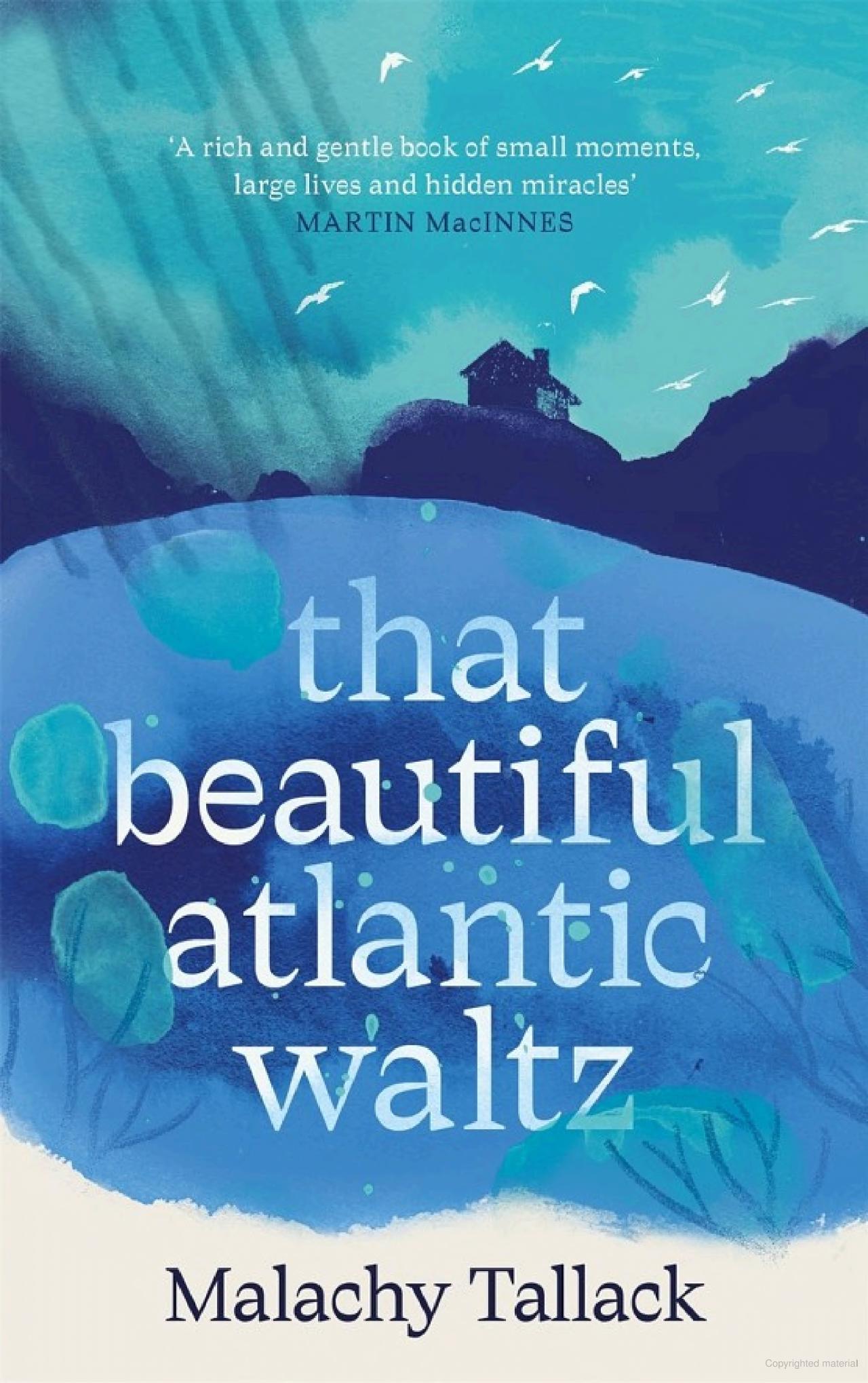
I wanted to read That Beautiful Atlantic Waltz by Malachy Tallack (2024) ever since I heard about it on Susan’s blog where it also made her Books of the Year. Everything about it appealed: the Shetland setting, the portrait of a life quietly lived, the theme of friendship and the concise but descriptive style. My hopes were ridiculously high; they were also fully met.
There are two timelines, one which begins in the late 1950s with Sonny on a whaling ship, following his marriage to Kathleen and family life with their son Jack and her uncle Tom, ending in the 1970s. The other follows solitary Jack in late middle-age, in the present day.
Apart from a brief few weeks in Glasgow, Jack has always lived in the same house on the croft in Shetland:
“He had so many memories of this room that it seemed not separate from him at all but a part of who he was and who he had always been. He had done so much of his living in this room.”
He is for the most part content with his life: taking walks, keeping his part time job ticking over, listening to his beloved country music and writing songs no-one will hear.
Tallack is a musician and he writes beautifully about music and all it can mean to people; how listening to it can be transcendental and how writing it can be a solitary act which simultaneously opens you up to the world. Jack’s handwritten songs punctuate the story and expand his portrayal beyond his immediate situation.
“To love was an act of imagination. It was to create possible futures, to build new and better selves. When love ended, those futures and those selves were what was lost. Jack knew something of loving from writing love songs. And he knew something of heartbreak, too.”
Jack is not especially damaged or traumatised, but he is a man whose solitary nature has found a space where it is never needed to be otherwise. He grew up in a house where feelings, worries and hopes were not discussed. His father Sonny is a man quick to anger who finds:
“So often feelings came to him like that: in a knot he was ill equipped to undo.”
While his more gregarious mother Kathleen doesn’t know how to broach her son’s silence:
“She listened, feeling the tears creep down her cheeks, not thinking of anything in particular, just hearing that cumbersome music, with a closed door between herself and her son.”
Life changes for Jack when someone leaves a kitten on his doorstep. He doesn’t want the cat but sometimes we share our lives with those we could never imagine choosing, and so Jack finds himself no longer living alone but with energetic, cheeky Loretta (named after Lynn). And his life begins to expand in ways he could not foresee.
In That Beautiful Atlantic Waltz, Tallack has crafted a story of such humane understanding and kindness. It isn’t remotely sentimental in its portrayal of the capacity of human beings to reach one another and to change.
It is a truth universally acknowledged, that the film version of a book is never as good as the original text. Except I don’t think that’s true. This week I’m going to look at two books where I think the film was better, but the novels are still worth reading. Slightly odd tack for a book blog to take, and I may end up regretting this, but let’s crash ever onwards!
Firstly, The Commitments by Roddy Doyle (1987). Here’s the trailer for the 1991 film, with a brilliant script by the author, in collaboration with the long-term writing partnership of Dick Clement and Ian La Frenais.
The Commitments is Roddy Doyle’s first novel, detailing how a group of white, working class Dubliners set up a soul band together. I think in this novel Doyle is really learning his craft, and his writing gets progressively stronger as he goes along. The Commitments is a far from terrible book, but it’s a bit slight, and filled with so much dialogue it reads more like a script than a novel for much of it. Still, if you’re going to have a novel filled with dialogue it may as well be written by Roddy Doyle, who has a great ear for how people speak and seems to take real joy in capturing it on the page:
“-Grow a pair o’ tits, pal, an’ then yeh can sing with them, said Billy.
– Are you startin’ somethin’?
-Don’t annoy me.
– Here! Said Jimmy. –None o’ tha’.
The time was right for a bit of laying down the law.
-No rows or scraps, righ’.
-Well said, Jim.
– An’ annyway, said Jimmy. –The girls are the best lookin’ part o’ the group.
– Dirty bastard, said Natalie.
-Thanks very much, Jimmy, said Imelda.
-No sweat ‘melda, said Jimmy.
-What’ll we sing? Bernie asked Joey The Lips.
-You know Walking in the Rain?
-Lovely.
– I WANT HIM, Imelda sang.
– It doesn’t exactly have a strong feminist lyric, does it? said James.
– Soul isn’t words, Brother, said Joey The Lips. – Soul is feeling. Soul is getting out of yourself.”
You can see that this is writing really stripped back: minimal punctuation, not always clear who is speaking. The style suits the tale of a bunch of people with very little creating music with only their voices and few instruments. It makes The Commitments a quick read, and the characters are evoked with warmth through minimal authorial intervention. By writing in such a sparse way, Doyle allows the characters to speak for themselves. At other times he uses scant detail, rarely embellished with imagery, to portray the lives of the band:
“’Joey The Lips got one of his dress suits dry-cleaned. Dean crawled in under his bed and found the one he’d flung under there. He soaked the jacket till the muck was nearly all gone. Then he brought it down to the cleaners.
Black shoes were polished or bought or borrowed.”
The Commitments is a well-observed story, evocative and humorous. However, a novel about music will always have much to gain from being filmed; hearing the talented cast of the film give their voice to soul classics brings the characters into being in a way that is nearly impossible in print.
Secondly, The Princess Bride by William Goldman (1973). Here’s the trailer for the 1987 film adaptation, screenplay by the author:
One of my favourite films from childhood that I still love to watch today – a definite winner on a rainy Sunday afternoon. Again, it’s not that the book is bad (the film is scripted by Goldman after all so you wouldn’t expect a great deal of difference) but the film is better. It takes all the best bits of the book and distils them into a fast-paced, funny narrative; the book can be a bit flabby at times by comparison. The film also offers some of the best cameos ever: Billy Crystal as Miracle Max, Mel Smith as the torturer, comic genius Peter Cook as the Impressive Clergyman, as well as a perfectly cast set of main characters. But if you like the film, you’ll like the book. The same dry, silly humour runs through it, and who wouldn’t love a tale of: “Fencing. Fighting. Torture. Poison. True love. Hate. Revenge. Giants. Hunters. Bad men. Good men. Beautifulest ladies. Snakes. Spiders. Beasts of all natures and descriptions. Pain. Death. Brave men. Coward men. Strongest men. Chases. Escapes. Lies. Truths. Passion. Miracles.”
The tale is one of Princess Buttercup, who falls in love with the stable boy Westley. He goes off to seek his fortune, and is captured by the Dread Pirate Roberts, who famously leaves no survivors. Believing her One True Love to be dead, Buttercup agrees to marry the hunting-obsessed Prince Humperdink. Before they can marry she is kidnapped by a gang comprising the cunning Vizzini (“never start a land war in Asia, [… and] never go against a Sicilian when death is on the line”), the giant Fezzik , and genius-swordsman-with-a-vendetta Montoya (“my name is Inigo Montoya, you killed my father, prepare to die!”) They are followed by the mysterious Man in Black, who seeks to foil their plans… Will goodness triumph? Will true love conquer all? Yes, of course, to both. This is a lovely escapist fantasy, but at the same time it is a satire on established rule and its abuses, which gives the story a more serious dimension. Prince Humperdink has arranged the kidnap of Buttercup in order to blame a neighbouring country and start a war. (Fill in your own contemporary analogy here.) He tells his henchmen to seek the “villains” in the thieves quarter:
““My men are not always too happy at the thought of entering the Thieves Quarter. Many of the thieves resist change.”
“Root them out. Form a brute squad. But get it done.”
“It takes at least a week to get a decent brute squad going,” Yellin said. “But that is time enough.
[…]
The conquest of the Thieves Quarter began immediately. Yellin worked long and hard each day […] Most of the criminals had been through illegal roundups before, so they offered little resistance.””
Goldman is also able to extend his humour in the novel towards the processes around writing, which he couldn’t do in the film; for example his editor querying his translation of the “original” story by S. Morgenstern:
“this chapter is totally intact. My intrusion here is because of the way Morgenstern uses parentheses. The copy editor at Harcourt kept filling the margins of the galley proofs with questions: […] “I am going crazy. What am I to make of these parentheses? When does this book take place? I don’t understand anything. Hellllppppp!!!” Denise, the copy editor, has done all my books since Boys and Girls and she had never been as emotional in the margins with me before.”
So there we go: two film recommendations as well as two book recommendations in the same post – call it a late Hogmany present from me to you, dear reader. Enjoy!
I was thinking about how this blog is supposed to be themes that relate books to life and how there are gaping holes in what I’ve covered so far. This week I attempt to redress the balance by picking something that is a huge part of most people’s lives: music. However, as the title quote shows, I may be digging myself the most enormous hole here, as trying to capture an aural experience through words is nigh on impossible. Let’s take a breath and have some music so if nothing else this post does make some sort of melodic offering. One of my favourite bands, and one of my mother’s favourite songs, Frogs Legs and Dragon’s Teeth by Bellowhead:
That was for you Maman! Right, back to books, and two brave writers who’ve made music a big part of their novels.
Firstly The Courage Consort by Michel Faber (Canongate, 2002). I’m fan of Michel Faber’s writing – I love his sparse style and unpredictability. Anything can happen his books, there’s no “typical Faber”. The Courage Consort is a novella (121 pages in my edition) told from the point of view of Catherine, one of five members of the titular a capella group headed by her husband, Roger. Catherine is emotionally fragile (we are introduced to her trying to decide whether to jump out of the window) and her husband seemingly oblivious to her pain. They join three others to rehearse an insanely complex piece called Partitum Mutante in an eighteenth-century chateau in Belgium. The composer arrives briefly to assist them, a madman who attacked his ex with a stiletto in an airport and tells them to make their singing “more extreme, but more soft also…quiet but loud”. Working on this seemingly doomed project, the disparate personalities that make up “the seventh most-renowned serious vocal ensemble in the world” start to come into conflict, but not in an entirely predictable way.
Faber creates a believably comic situation and the characters are generally well-observed, if bordering on national stereotypes at times. The character of Catherine is sympathetic and Faber shows how music carries over into her musings about life in general:
“Other people might think it was terribly exciting when two females singing in thirds made the airwaves buzz weirdly, but Catherine was finding that her nerves were no longer up to it. Even the way a sustained A flat tended to make an auditorium’s air-conditioning hum gave her the creeps lately. It was as if her face was being rubbed in the fact that music was all soundwaves and atoms when you stripped the Baroque wrapping-paper off it. But too much sonic nakedness wasn’t good for the spirit. At least that was what she was finding lately, since she’d started coming…adrift.”
But things are not necessarily what they seem: Catherine hears screaming in the night and is told a ghost story about the forest that surrounds them. No-one else hears it, and Catherine goes on to have an experience in the forest which is not told to the reader. This lack of explication stops The Courage Consort being a straightforwardly comic novel, as an eeriness creeps around the house and its inhabitants. Things do not go as planned, but ultimately the group comes to fully comprehend just how healing the experience of music can be.
Secondly, Grace Notes by Bernard MacLaverty (Vintage, 1997). Grace Notes tells the story of another Catherine, this one a composer struggling to manage her art alongside the demands of her life. These demands include a new baby and ensuing post-natal depression, her father’s death, and conflict with her mother. Musicality comes naturally to her, and she has an innate understanding form an early age:
“One day, when she was only three or four, she’d slipped away from the kitchen as her mother baked and listened to the radio. On this particular day the piano lid was open. Catherine had reached up above her head and pressed the keys as softly as she could. No sound came from them. She had to press harder to make the sound come. It frightened her when it did. Dar, deep , thundery. The booming faded away and the noise of the birds outside came back. She tried further up the piano where the notes were nicer, not so frightening. She pressed a single note, again and again. It wasn’t the note which made her feel funny – it was the sound it made as it faded away. The afterwards. It made her feel lonely. “
This idea, later defined as “the notes between the notes” – grace notes – is the novel’s theme and main image: what happens in the spaces between events, what is left unsaid, what is defined and what is undefinable. Catherine gradually comes to terms with her life throughout the course of the novel and moves onwards, creating a new symphony, but the grace notes continue: “it began with a wisp of music, barely there – a whispered five-note phrase on the violins and she was right back on that beach with her baby. […] Like the artist’s hand which moves to begin a drawing but makes no mark”. Having described Catherine’s life in an interwoven way – memories that come to her interspersed with descriptions of her life in the present – MacLaverty describes her music similiarly, the literal description of the action of instruments interwoven with the images that have inspired Catherine as she writes the symphony. It’s a highly effective method, and probably the nearest I’ve read to a representation of sound, and the feeling it evokes, written down.
As the novels are about two musical women, here they are pictured with two more musical women: Dusty Springfield and Lily Allen Cooper:


 madame bibi lophile recommends