“I am merely the canvas on which women paint their dreams.” (Rudolph Valentino)

I’m going through a bit of a reading slump at the moment, not a terrible one as I’m finding I can focus on my comfort reads, but I’m struggling with anything that needs more concentration. It’s very frustrating.

I wanted to take part in August’s Women in Translation Month, so I was hoping to recover my reading mojo in time. Having enjoyed All Our Yesterdays and The Dry Heart by Natalia Ginzburg previously, I thought her direct style would suit my addled brain well. Valentino (1957 transl. Avril Bardoni 1987)) is essentially a short story, just 62 pages in my edition (a Daunt Books reissue) and I whizzed through it on a short train journey to visit a friend in Sussex.
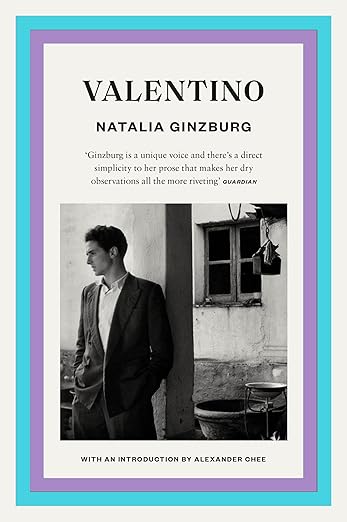
The story is narrated by Caterina, sister of the titular character:

“My father believed that [Valentino] was destined to become a man of consequence. There was little enough reason to believe this, but he believed it all the same and had done ever since Valentino was a small boy and perhaps found it difficult to break the habit.”

Valentino is vain and feckless, entirely undeserving of the faith his parents put in him and the sacrifices the whole family have made to finance his medical studies. He fritters away his time and routinely gets engaged to ‘teenagers wearing jaunty little berets’.

So when he announces his latest engagement, no-one takes it particularly seriously:

“It had happened so often already that when he announced he was getting married within the month nobody believed him, and my mother cleaned the dining room wearily and put on the grey silk reserved for her pupils’ examinations at the Conservatory and for meeting Valentino’s perspective brides.”

However, this engagement to Maddelena sticks. She is older, unattractive and incredibly rich. Valentino’s parents are heartbroken at his avariciousness being made so apparent. Caterina is more equanimous and she soon realises that Maddelena is caring and hard-working. Valentino is not worthy of his bride.

“It was not easy to explain to my sister Clara the turn that events had taken. That a woman had appeared with lashings of money and a moustache who was willing to pay for the privilege of marrying Valentino and that he had agreed.”

What follows is a carefully realised study of the family members and their dynamics, particularly around Valentino’s marriage. Caterina’s direct voice conveys the hurt Valentino inflicts, not through cruelty but through utter obliviousness and self-focus, without demonising him.

In such a short space, Ginzburg achieves a really moving portrait of familial relationships and how these exist under the pressures exerted by society.  There is sadness in the tale but also a deadpan humour. Caterina presents the situation without judgement, enabling a real depth to the characterisation.

Ginzburg is such an intelligent, insightful writer who never seeks to alienate readers with her cleverness. She presents knotty complexity with a deceptive simplicity of style. If you’ve never read her, Valentino is a good place to start.

“My emotions at that time were neither profound nor melancholic and I was confident that sooner or later things would improve for me.”

To end, Rudolph Valentino playing ‘a youthful libertine’ and dancing a tango, over 100 years ago:
“Everything that mattered had happened already” (Natalia Ginzburg)

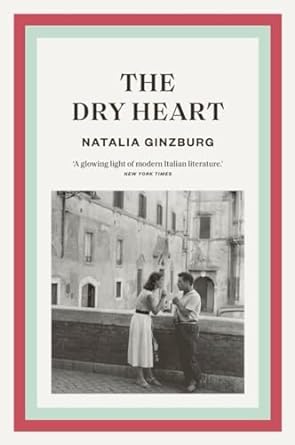
Last year I read All Our Yesterdays, which was my first experience of Natalia Ginzburg’s writing, and I absolutely loved her unfussy, direct style. The Dry Heart (1947 transl. Frances Frenaye 1952) is a much shorter work at just 108 pages but it packs a real punch.

On the first page, the unnamed narrator is with her husband in their home:

“I took the revolver out of his desk drawer and shot him between the eyes. But for a long time already I had known that sooner or later I should do something of the sort.”

And so this is a whydunit rather than a whodunit, as we are taken back to a time when a young, naïve girl marries a man who she knows does not love her:

“When a girl is very much alone and leads a tiresome and monotonous existence, with worn gloves and very little spending money, she may let her imagination run wild and find herself defenceless before all the errors and pitfalls which imagination has devised to deceive her.”

Initially her husband Alberto is interested in her, but not romantically. He reads Rilke to her and listens to all she has to say. But he is in love with Giovanna and he never pretends otherwise. They marry despite ambivalence on both sides.

She has friends, including Francesca who lives more independently and freely; and Augusto who is her husband’s friend but also kind and genuine towards her.  Yet the narrator still seems very isolated, and lonely within her marriage. Alberto obfuscates and disregards her feelings. Who she is and how his behaviour impacts on her is of no consequence to him.  

“I wanted to know a lot more about his feelings for me, but I couldn’t talk to him for long about anything important because it bored him to try and get to the bottom of things and turn them over and over the way I did.”

The simple, direct language lends itself to the length of the novella and also emphasises youth of narrator. The complexity of The Dry Heart lies in the characterisation and builds an intriguing portrait of a marriage.

Despite having undertaken such a violent act, the narrator doesn’t ask for sympathy, and doesn’t justify herself. She presents what happened without a trace of sentimentality or self-pity. Possibly she is detached and deeply traumatised, but as the reader comes to her at the point of the shooting, we don’t know if this voice is one of trauma or long-established.

By refusing to have the narrator engage in self-justification and avoiding any sense of authorial knowingness or psychological explanation, Ginzburg firmly places the why in the readers hands. It’s a masterstroke: she highlights patriarchal oppression, psychological warfare in marriage, the pitiable choices available for women and the danger of dismissing fellow human beings, without being remotely heavy-handed.    

The Dry Heart is hugely impressive and I’m looking forward to exploring Ginzburg further, thanks to the wonderful Daunt Books who are doing such a great job reissuing her work in translation.

It’s probably a mistake to follow every meandering of our feelings and waste time listening to every echo from within. That, in fact, is no way to live.”

To end, from a dry heart to a cold one:

“I think of a writer as a river: you reflect what passes before you.” (Natalia Ginzburg)

A desperate scrabbling attempt to get a final post written for Women in Translation Month!

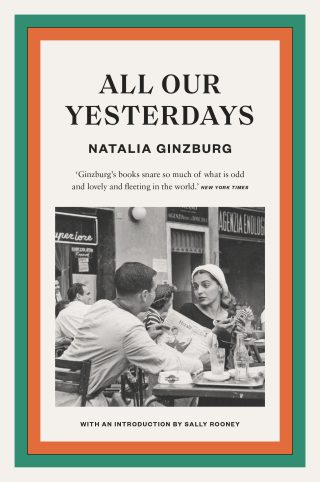
Daunt Books are such an interesting publisher and I was keen to read Natalia Ginzburg having heard wonderful things in the blogosphere, so I swooped on All Our Yesterdays (1952, transl. Angus Davidson 1956) when it turned up in my local charity bookshop. I think I’d read somewhere that this wasn’t the best place to start with this author, but I absolutely loved it.

The novel follows two families living in a northern Italian town from the 1930s, through the war years to peacetime. Although the blurb on the French flaps of my edition suggests Anna, the daughter of the poorer family, is the protagonist, really Ginzburg follows them all to a greater or lesser extent, with no overarching plot other than the sequence of years.

Although this approach sounds like a shortcoming, it works so well. It’s not a documentary novel but it gestures towards this with an omniscient neutral(ish) viewpoint and only reported speech. This felt unusual to read, but is so clever in capturing the everyday experiences of those living through extraordinary circumstances.

Anna’s siblings are Concettina, Ippolito, and Giustino. Concettina is popular with boys but struggles to find a purpose in life; Ippolito channels his energies into anti-Fascist activities with his friend from the richer family across the road:

“Emanuele and Ippolito did not even know Italy, they had never seen anything except their own little town, and they imagined the whole of Italy to be like their own little town, an Italy of teachers and accountants with a few workmen thrown in, but even the workmen and the accountants became rather like teachers in their imagination.”

Their lives are equally dictated by world events and by commonplace ones. Anna falls pregnant by her boyfriend and marries an eccentric older man, Cenzo Rena, moving with him to the southern village of Borgo San Costanzo. Her affair with her self-involved, callow boyfriend was no great passion, and while her marriage to Cenzo Rena attracts approbation, he is a warmer, more generous man than the one her own age.

“She was alone with Giuma’s face that gave her a stab of pain in her heart, and every day she would be going back with Giuma amongst the bushes on the river bank, every day she would see again that face with the rumpled forelock and the tightly closed eyelids, that face that had lost all trace both of words and of thoughts of her.”

These are people destined to be on the outskirts of war. Cenzo Rena holds a lot of sway in his local area and does help Jewish people fleeing the Nazi occupation, but on the whole the story of All Our Yesterdays is not one involving soldiers or revolutionaries. It is about ordinary people and for them the conflicts of war are reported facts not lived experience. The latter for them includes a lot of mundanity:

“And the bread in town was rationed and was a kind of soft, grey dough that you couldn’t ever digest, the bread was like the soap and the soap was like the bread, both washing and eating had become very difficult.”

Yet this doesn’t mean the story isn’t affecting, or that the characters avoid tragedy. There are some truly tragic events that are hugely affecting. Ginzburg manages to be even-handed in her treatment of her characters but not detached. Her writing is warm but unsentimental as she demonstrates that flawed people are as worthy of love and mourning as idealised ones.

In case I’ve made it sound unremittingly serious, I should mention that there humour in All Our Yesterdays too. There are romantic entanglements that are treated with a degree of levity, and eccentric housekeepers/family retainers with various foibles. All life is here.

I can’t think of another writer who approaches Ginzburg’s style, and looking back on it I can’t explain how she does what she does. This was a story that snuck up on me, the deceptively simple storytelling drawing me in more than I realised until I was totally immersed. An extraordinary novel.

“Fanfares of trumpets usually announced only small, futile things, it was away fate had of teasing people. You felt a great exultation and heard a loud fanfare of trumpets in the sky. But the serious things of life, on the contrary, took you by surprise, they spurted up all of a sudden like water.”

To end, of course there’s a very famous song I could post on the theme of Yesterday, but instead, to continue the mix of despair alongside levity: have you seen a parrot singing Creep by Radiohead?