“The house allows one to dream in peace.” (Gaston Bachelard)

November is full of wonderful reading events and I’ve been through the TBR pulling out possibilities for Novellas in November, German Lit Month, Margaret Atwood Reading Month and AusReading Month. Given my current reading and blogging pace it’s highly unlikely that I’ll manage them all, but I’m starting today with a post for Nonfiction November hosted by Doing Dewey.
In many ways this is the least likely of all the events for me to take part in, as I read practically no nonfiction. However, last year I read the first two in Deborah Levy’s ‘living autobiography’ trilogy and absolutely loved them.  The bibliophile’s crack-den that is the charity bookshop across the road from my flat never lets me down, and when saw the third instalment in there recently of course I swooped.
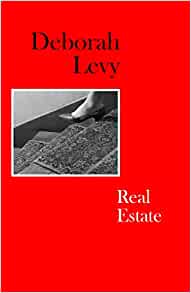
Real Estate (2021) sees Levy still living in the flat she moved to when her marriage ended, but as her children leave for university and beyond, she is trying to work out what makes a home, and whether she wants one.

“I was also searching for a house in which I could live and work and make a world at my own pace, but even in my imagination this home was blurred, undefined, not real, or not realistic, or lacked realism. I yearned for a grand old house (I had now added an oval fireplace to its architecture) and a pomegranate tree in the garden. It had fountains and wells, remarkable circular stairways, mosaic floors, traces of the rituals of all who had left there before me. That is to say the house was lively, it had enjoyed a life. It was a loving house.

[…] The odd thing was that every time I tried to see myself inside this grand old house, I felt sad.”

The themes from The Cost of Living and Things I Don’t Want to Know continue, as Levy considers how to live in a way that supports her work and enables her to authentically create her own space in middle-age, in a society that undervalues ageing and especially ageing women.

In Real Estate Levy is looking at the spaces she creates both internally and externally, and the challenge to have both reflecting and supporting the other.

“An extended family of friends and their children, an expanded family rather than a nuclear family, which in this phase of my life seemed a happier way to live. If I wanted a spare room for every friend, my flat could not support this idea. If I wanted a fireplace in every room, there were no fireplaces in my flat. So what was I going to do with all this wanting?”

She takes a fellowship in Paris for a while, living in an apartment she barely furnishes, knowing it will be transitory and focussing on her work. She visits Berlin and Mumbai and holidays in Greece. The various changes of scene don’t enable Levy to reach any conclusions about where to live, or how to reconcile her desires and needs with the practicalities entailed in bricks and mortar. But that’s not the point of these exploratory, reflective living autobiographies. Perhaps the point is that there is no answer – as we evolve and change, so do our needs, and perhaps so does the best place for us to be.

With this volume as with the previous two, Levy is a witty and challenging writer, so much fun while not shying away from serious issues and a strong feminist sensibility:

“Are women real estate owned by patriarchy?… Who owns the deeds to the land in that transaction?”

I particularly enjoyed this encounter at a literary party which she gatecrashes in London:

“A male writer of some note, but not in my own hierarchy of note, had knocked back a few too many gin cocktails. This liberated his desire to find a female writer in the room to undermine […] The truth was that he viewed every female writer as a sitting tenant on his land.”

Real Estate has been marketed as the final volume of Levy’s living autobiography and I really hope that’s not the case. She’s wonderful company.

To end, my own perennial real estate quandary is: do I leave my little London flat for somewhere cheaper so I can have a garden? I’ve been debating this for years and I will leave in the end, but here’s a warning about the perils of leaving London for a trip to the Home Counties (a bit sweary so do avoid if you’re not keen, but the lyric ‘Could you be my big spoon or are you just a bigot in Wetherspoons?’ meant I really wanted to share 😀 )

“A tree’s wood is also its memoir.” (Hope Jahren)

This week I’m joining in with Nonfiction November hosted by What’s Nonfiction. Despite not being a big non-fiction reader, I’ve been inspired by the month long event and also by Novellas in November, hosted by Cathy at 746 Books and BookishBeck. So I’m reading some short nonfiction to take part in both at once 😊

I’ve really enjoyed the novels by Deborah Levy that I’ve read: Swimming Home and Hot Milk. The first two volumes of her ‘living autobiography’ have been languishing in the TBR, so I’m grateful these two reading events prompted me to pick them up.

The first volume, Things I Don’t Want to Know (2013, 163 pages) is a response to George Orwell’s essay Why I Write, using the same headings (political purpose/historical impulse/sheer egoism/aesthetic enthusiasm). However, I think it’s also very much in conversation with Virginia Woolf’s A Room of One’s Own, as Levy considers what it means to be a professional writer for women in the twenty-first century.

“A female writer cannot afford to feel her life too clearly. If she does, she will write in a rage when she should write calmly.”

Yet the ‘living autobiography’ is written in the midst of events, without the distance of hindsight. This means the writing has an immediacy and is highly engaging, but there is also the discipline and consideration that comes from Levy being such a highly skilled writer.

The two sections that bookend the essay see Levy in Majorca at a time when she is deeply unhappy, finding herself crying on escalators. She escapes to Palma to think about her life, and also her art and the influence of other female artists. With Zofia Kalinska she observes:

“Content should be bigger than form – yes, but that was a subversive note to a writer like myself, who had always experimented with form, but it is the wrong note for a writer who has never experimented with form.”

While Things I Don’t Want to Know doesn’t follow a usual form for essay or memoir – it’s non-linear, never sets out a clearly-stated argument and hops between memories and broader observations – the content does remain bigger than form, because Levy’s observations are so sharp and her memories clear-sighted and unsentimental.

If I’m making this sound very heavy then I’m doing Levy a disservice, because she is humorous and has a wonderfully light touch. For example, she repeatedly returns to Duras in her artistic considerations, but wonders:

“Was Marguerite Duras suggesting that women are not so much a dark continent as a well-lit suburb?”

There is a strong feminist sensibility that runs throughout Things I Don’t Want to Know. In responding to Orwell, Levy highlights the very different experience of trying to work alongside the particular expectations and responsibilities faced by many women.

“We were to be Strong Modern Women while be subjected to all kinds of humiliations, both economic and domestic. If we felt guilty about everything most of the time, we were not sure what it was we had actually done wrong.”

In the Historical Impulse section, Levy reflects on her childhood in South Africa, where her father was imprisoned for being part of the African National Congress. As a child much of what is happening goes over her head though she also picks up on plenty; I found her portrait of her godmother’s daughter (who has to hide her relationship with her Indian boyfriend) very affecting:

“Melissa was the first person in my life who had encouraged me to speak up. With her blue painted-on eyes and blonde beehive that was nearly as tall as I was, she was spirited and brave and making the best of her lot. I couldn’t hear her but I knew her words were to do with saying things out loud, owning up to the things I wished for, being in the world and not being defeated by it.”

In the Sheer Egoism section, Levy moves to England with her family, and starts scribbling on paper napkins in cafes, not sure what she is doing but certain she has to write.

“Writing made me feel wiser than I actually was. Wise and sad. That was what I thought writers should be. I was sad anyway, much sadder than the sentences I wrote. I was a sad girl impersonating a sad girl.”

The Cost of Living sees Levy leaving her marriage and moving into a flat with her daughters. We learn very little about her husband or her marriage – which I was quite happy about – and instead Levy takes us with her as she considers what she wants from life and how she wants to live.

“Chaos is supposed to be what we most fear but I have come to believe it might be what we most want.”

The flat is not glamorous – visitors are creeped out by the communal areas Levy nicknames The Corridors of Love. She buys some plants, fixes her own plumbing, and works to her own hours.

“After all the heavy lifting, it was shock to be figuring out how to land the cadence of one single sentence”

Levy does not give the impression of being happy – she is grieving the breakdown of her marriage and she is very aware that she has not taken the easy choice – but she is living authentically. It is more sustainable and rewarding than fleeting happiness.

“To become the person someone else had imagined for us is not freedom – it is to mortgage our life to someone else’s fear.”

The strong themes of feminism, womanhood and the life of a writer established in Things I Don’t Want to Know continue through this volume. Levy has left behind the roles of Wife and Homemaker. She remains a mother but her children are older and don’t need her quite as they did.

“It was possible that femininity, as I had been taught it, had come to an end. Femininity, as a cultural personality, was no longer expressive for me. It was obvious that femininity, as written by men and performed by women, was the exhausted phantom that still haunted the early twenty-first century.”

Levy is a daughter and the section about her mother dying is very moving. She is also a friend and therefore not alone: her friend Celia helps her by providing the writing shed where her late husband (the poet Adrian Mitchell) used to work. Levy writes there trying to stay warm and listening to apples thud onto the roof.

At no point is The Cost of Living didactic. Levy doesn’t suggest for one moment that anyone should make the same choices she has. The title is literal and metaphorical: she has to work to earn money as this is a very real concern, but simultaneously to feel she is truly living there has been the cost of her marriage. All choices bring associated costs.

But with the right choices those costs are price worth paying. Levy is living her truth, has friends and fun, and she finds great meaning in her work:

“It is always the struggle to find language that tells me it is alive, vital, of great importance.”

I really loved both these volumes. Levy is so wise, funny and readable. She is never boring or pedestrian. The interesting choices she has made in life are reflected in the engaging choices she makes with her writing. I’m looking forward to reading the third volume of these memoirs, Real Estate, which was published this year.

To end, a song about a woman assessing her life choices: